 Write to the booksellers
-
Type
Art print (2)
Book (5971)
Magazine (20)
Manuscript (1)
Old papers (1)
Photographs (3)
-
Latest
Last 3 days (1)
Last month (5)
Last week (3)
-
Language
English (10)
French (5983)
German (1)
Greek (1)
Italian (1)
Latin (2)
-
Century
16th (2)
17th (9)
18th (245)
19th (890)
20th (3027)
21st (148)
-
Countries
Belgium (266)
Canada (3)
Côte d'Ivoire (13)
Denmark (1365)
France (4050)
Switzerland (301)
-
Syndicate
ALAC (3)
CLAM (3)
ILAB (4128)
NVVA (139)
SLACES (139)
SLAM (2601)
SNCAO (15)
PHYSIQUE - VOLUME 2.
EDITIONS SCIENTIFIQUES CLAUDE SERMANT. NON DATE. In-8. Broché. Etat d'usage, Couv. légèrement passée, Dos satisfaisant, Quelques rousseurs. environ 240 pages illustrées de nombreuses figures dans le texte.. . . . Classification Dewey : 530-Physique
Classification Dewey : 530-Physique
COMMENT SE SERVUR D'UN MICROSCOPE POUR FAIRE DES OBSERVATIONS EN LUMIERE POLARISEE
DE FRANCIA. NON DATE. In-12. Relié. Etat d'usage, Couv. défraîchie, Dos satisfaisant, Papier jauni. 17 pages. Relié par 1 agraffe rouillée. Quelques illustrations en noir et blanc, dans le texte. Nombreux soulignements à l'encre dans le texte.. . . . Classification Dewey : 530-Physique
Classification Dewey : 530-Physique
Le phénomène Zeeman.
Paris, Gauthier-Villars (Collection Scientia n°5), 1899, in 8°, cartonnage de l'éditeur, 100 pages.
...................... Photos sur demande ...................


Phone number : 04 77 32 63 69
"COULOMB, (CHARLES AUGUSTIN) - THE PRIZE-WINNING MÉMOIR CREATING THE SCIENCE OF FRICTION.
Reference : 44907
(1785)
Théorie des Machines Simples, en ayant égard au Frottement de leurs Parties, et a la Roideur des Cordages. piece qui a remporté le Prix double de l'Academie des Sciences pour l'année 1781.
Paris, Moutard, Panckoucke, 1785. 4to. Extract from ""Mémoires fe Mathematique et de Physique, Présentés à l'Academie des Sciences par divers Savans"", Tome X. Withtitlepage to vol. X. Pp. 131-332 and 5 folded engraved plates. The memoir has also its own titlepage. Fine and clean. Wide-margined.
First edition of this monumentalwork by which Coulomb CREATED THE SCIENCE OF FRICTION.""1781 saw him win the Academy prize for his mémoir ""Théorie des Machines Simples,"" in which the results of his experiments on the friction of different bodies slipping on one another (dry, or coated with greasy substances) were presented.""(Timoshenko p. 48).""Coulomb’s most celebrated study, one that brought him immediate acclaim, was ""Théorie des machines simples,"" his prize-winning friction study of 1781. He investigated both static and dynamic friction of sliding surfaces and friction in bending of cords and in rolling. From examination of many physical parameters, he developed a series of two-term equations, the first term a constant and the second term varying with time, normal force, velocity, or other parameters. In agreement with Amontons’s work of 1699, Coulomb showed that in general there is an approximately linear relationship between friction and normal force"" but he extended the investigation considerably to show complex effects due to difference in load, materials, time of repose, lubrication, velocity, and other considerations. Coulomb’s work in friction remained a standard of theory and experiment for a century and a half, until the advent of molecular studies of friction in the twentieth century. To quote Kragelsky and Schedrov’s recent monograph (p. 52) on the history of friction: ""Coulomb’s contributions to the science of friction were exceptionally great. Without exaggeration, one can say that he created this science.""(DSB).Poggendorff I:487.,
"COULOMB, (CHARLES AUGUSTIN) - THE PRIZE-WINNING PAPER ON MAGNETIC COMPASSES INTRODUCING THE TORSION BALANCE
Reference : 44921
(1780)
Recherches sur la meilleure Manière de fabriquer les Aiguilles Aimantées, de les suspendre, de s'assurer quelles sont dans le véritable Méridian magnétique: enfin de rendre raison de leurs Variations diurnes régulières: Pièce qui a partae le Prix p... - [THE PRIZE-WINNING PAPER ON MAGNETIC COMPASSES INTRODUCING THE TORSION BALANCE]
Paris, Moutard, Panckoucke, 1780. 4to. Extract from ""Mémoires fe Mathematique et de Physique, Présentés à l'Academie des Sciences par divers Savans"", Tome IX. With titlepage to vol. IX. Pp. (2), (167-) 264 and 4 folded engraved plates. The memoir has also its own titlepage. Fine and clean. Wide-margined.
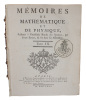
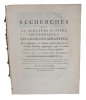
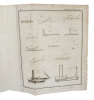
First printing of this monumental memoir (the invention of the TORSION BALANCE) dealing with the best way to construct a magnetic compass. The paper contains the design of a torsion suspension declination compass and the demonstration that the forces of torsion is proportional to the angle of twist. Coulomb received the prize awarded by the Academy for this paper drafted by the Academy in 1777 (he shared the prize with Van Swinden). - ""The importance of this memoir for Coulomb's career is that it CONTAINED ELEMENTS OF ALL HIS MAJOR PHYSICAL STUDIES: the quantitative study of magnetism, torsion and the torsion balance, friction and fluid resistance, and the germ of his theories of elasticity and magnetism.""(DSB).""Coulomb’s first writings on torsion were presented in his Academy prize-winning memoir of 1777, ""Recherches sur la meilleure maniere de fabriquer les aiguilles aimantées.""......... his simple, elegant solution to the problem of torsion in cylinders and his use of the torsion balance in physical applications were important to numerous physicists in succeeding years. In chapter 3, Coulomb developed the theory of torsion in thin silk and hair threads. Here he was the first to show how the torsion suspension could provide physicists with a method of accurately measuring extremely small forces. He showed that within certain angular limits, torsional oscillation consisted of simple harmonic motion. He examined the parameters relating the angle of twist to the length, diameter, and elastic properties of the torsion thread. In the range of simple harmonic oscillation Coulomb demonstrated that the force of torsion was proportional to the angle of twist. He used this principle in measuring small magnetic forces and also called attention to its use in measuring other forces, notably those of fluids in motion. Eventually he was able to measure forces of less than 9 x 10⁻⁴ dynes.""""Coulomb’s major memoirs in electricity and magnetism are his 1777 memoir on magnetic compasses, the famous series of seven electricity and magnetism memoirs read at the Academy from 1785 to 1791, and several magnetism memoirs prepared after the French Revolution. In his electrical studies Coulomb determined the quantitative force law, gave the notion of electrical mass, and studied charge leakage and the surface distribution of charge on conducting bodies. In magnetism he determined the quantitative force law, created a theory of magnetism based on molecular polarization, and introduced the idea of demagnetization (basically, that combinations of magnetic poles can ""cancel"" each other).""(DSB).Parkinson ""Breakthroughs"": 1777:P
La physique des nuages.
1940 P., Albin Michel, 1940, in 12 broché, 286 pages ; cent soixante-et-une illustrations, cachets.
...................... Photos sur demande ...................
Phone number : 04 77 32 63 69
COULOMB - OERSTED - AMPERE - ARAGO - BIOT - DAVY - FARADAY - G. & A. DE LA RIVE - FRESNEL - [Société française de physique]
Reference : 4805
Collection de mémoires relatifs à la physique publiés par la Société Française de physique : Tome I : MEMOIRES DE COULOMB - Tome II & III Mémoires sur L'ELECTRODYNAMIQUE --- 3 VOLUMES (complete set)
P., Gauthier-Villars, 1884/1887, 3 VOLUMES in 8 reliés en demi-toile grise à coins, étiquettes bordeaux, dos ornés d'un fleuron doré (reliures de l'époque), T.1 : 16pp., 414pp., T.2 : 7pp., 412pp., T.3 : (2), 403pp.,
---- EDITION ORIGINALE ---- Réunion en 3 volumes par la Société française de physique de mémoires relatifs à l'électricité et au magnétisme parus aux XVIIIe et XIXe siècles. Le premier volume contient tous les mémoires de COULOMB. Les deuxième et troisième volumes renferment les mémoires de OERSTED, AMPERE, ARAGO, DAVY, FRESNEL, BIOT et SAVART, FRESNEL, G. DE LA RIVE, FARADAY, BARLOW, A. DE LA RIVE, SAVARY, WEBER**4805/M1
Methoden der Mathematischen Physik -- BEL EXEMPLAIRE -- COMPLETE SET
Berlin, Springer, 1943, 2 volumes in 8 reliés en pleine toile éditeur, T.1 : 14pp., (1), 469pp., T.2 : 14pp., (3), 549pp.
---- BEL EXEMPLAIRE ---- Seconde édition**5679/M5DE
LA FAILLITE DU MATERIALISME, TOME II, LES PHENOMENES PHYSIQUES, L'ATOME, LES GAZ, LA CHALEUR ET L'ENERGIE (SCIENCE ET RELIGION, ETUDES POUR LE TEMPS PRESENT, N° 75)
Librairie Bloud & Cie, Paris. 1899. In-12. Broché. Etat d'usage, Couv. convenable, Dos abîmé, Intérieur acceptable. 62 pages. Tampons et annotations de bibliothèque sur le 1er plat et en page de titre.. . . . Classification Dewey : 530-Physique
'Science et religion', Etudes pour le temps présent, n° 75. Classification Dewey : 530-Physique
COURDILLE / SCHUNE / BENOIT / LEFEBURE
Reference : R320017393
(1984)
ISBN : 2040156240
EXERCICES DE PHYSIQUE AVEC RAPPELS DE COURS / SCIENCES DE LA NATURE ET DE LA VIE 1ere ANNEE.
DUNOD UNIVERSITE. 1984. In-4. Broché. Etat d'usage, Couv. convenable, Dos satisfaisant, Intérieur acceptable. 208 pages illustrées de nombreuses figures.. . . . Classification Dewey : 530-Physique
Classification Dewey : 530-Physique
"COURS ELEMENTAIRE DE PHYSIQUE + livret ""Notions sur les courants alternatifs"""
"ECOLE SPECIALE DES TRAVAUX PUBLICS. 1931. In-8. Broché. Bon état, Couv. convenable, Dos satisfaisant, Intérieur frais. 332 pages- nombreuses figures et formules de calculs dans le texte + en supplément, un livret de 51 pages ""Notions sur les courants alternatifs"". . . . Classification Dewey : 530-Physique"
Classification Dewey : 530-Physique
La lumière, principe du monde à propos de Jean Perrin, prix Nobel de physique 1926
P., L'artisan du livre, 1927, un volume in 8, broché, couverture imprimée, 61pp.
---- EDITION ORIGINALE**1389/M7DE
COURTINES Marcel, préparateur de physique au Collège de France, maître de conférences à l'Ecole centrale des Arts et Manufactures
Reference : 100217
(1927)
La lumière, principe du monde. A propos de Jean Perrin, prix Nobel de physique 1926. Quatrième cahier de la dix-huitième série
1927 Cahiers de la quinzaine - 1927 - petit In-8 broché - 61 pages - N° 347/1600
Bon état, tampon sur la première de garde et la page de grand titre, trace de stylo sur la page de titre
COURS ELEMENTAIRE DE PHYSIQUE / 17e EDITION.
ECOLE SPECIALE DE TRAVAUX PUBLICS. 1925. In-4. Broché. Etat d'usage, Livré sans Couverture, Dos abîmé, Intérieur acceptable. 315 pages augmentées de nombreuses figures en noir in texte - Couverture muette.. . . . Classification Dewey : 530-Physique
Classification Dewey : 530-Physique
Cours élémentaire de physique. Ecole spéciale des travaux publics, du bâtiment et de l'industrie.
Paris, Ecole Spéciale des Travaux Publics, 1925. 17 x 22, 315 pp., 269 figures, broché, non coupé, bon état (couverture défraîchie).
COUSIN (J.A.J.). Traité de CALCUL DIFFERENTIEL ET DE CALCUL INTEGRAL. P., Régent & Bernard, An IV (1796), première partie : 24pp., 319pp., 6 PLANCHES, deuxième partie : (2), 284pp. ; EDITION ORIGINALE ---- FRANCOEUR (L.B.). Traité élémentaire de MECANIQUE. P., Courcier, An XII (1804), 32pp., 459pp., 8 PLANCHES dépliantes. Troisième édition CONSIDERABLEMENT AUGMENTEE ---- SOIT DEUX OUVRAGES RELIES EN UN FORT VOLUME GRAND IN 4
P., Régent & Bernard, 1796 (pour l'ouvrage de COUSIN) ; P., Courcier, 1804 (pour l'ouvrage de COUSIN, 2 OUVRAGES reliés en fort volume in 4 demi-chagrin vert, (reliure de l'époque), (mouillures dans la marge supérieure des premiers feuillets, manque de papier d'origine dans la marge de la page de titre de l'ouvrage de COUSIN
---- L'ouvrage de COUSIN est en EDITION ORIGINALE ; Troisième édition CONSIDERABLEMENT AUGMENTEE pour l'ouvrage DE FRANCOEUR ---- "COUSIN's work is important in connexion with the theory of partial differential equations (Cantor's Vorlesungen vol. IV, pp. 951/6) and his Discours préliminaire (pp. 12) contains interesting information on the history of calculus". (Sotheran second suppl. vol. 1 n° 1302) ---- "FRANCOEUR publia un grand nombre d'excellents ouvrages destinés à l'enseignement des sciences, unissant à l'exactitude une grande clarté dans l'exposition. Il rendit aux sciences d'éminents services par son rare talent à expliquer les découvertes des autres savants et par son infatigable activité. Il entra à l'Académie des sciences en 1842". (Hoefer)**13950/1395/N1
L'électricité. Avec 107 gravures.
P., Hachette (Collection Bibliothèque des Merveilles), 1923, in 12 broché, 189 pages.
PHOTOS sur DEMANDE. ...................... Photos sur demande ...................
Phone number : 04 77 32 63 69
1911-1961. Cinquantenaire du premier Conseil de Physique Solvay.
1 En feuillets, portefolio en toile à rabats de l'éditeur. La toile est piquée, quelques mouillures claires et traces d'usure sans gravité, intérieur en très bonne condition. 30 x 40 cm, [16] p. + 11 planches avec reproductions photographiques contrecollées. Bruxelles, Institut International de Physique Solvay, 1961. Édition originale.
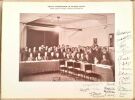
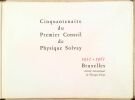
Album hommage reproduisant les photographies de groupe des 11 Conseils Solvay qui eurent lieu entre 1911 et 1958, légendées avec les noms des participants. La septième planche (7e Conseil, 22-29 octobre 1933) comporte leurs signatures en fac-similé. Pas de mention de tirage, exemplaire hors-série nominatif. Rare. Très bon état.
CRIBIER MICHEL, SPIRO MICHEL, VIGNAUD DANIEL
Reference : RO40235654
(1995)
ISBN : 2020143933
LA LUMIERE DES NEUTRINOS
Le Seuil. 1995. In-8. Broché. Bon état, Couv. convenable, Dos satisfaisant, Intérieur frais. 314 pages. Illustré de nombreux schémas et de nombreuses photos en noir et blanc dans le texte. Tranche légèrement passée.. . . . Classification Dewey : 530-Physique
'Science ouverte'. Classification Dewey : 530-Physique
The Limitation of the Gain of Two-Way Telephone Repeaters by Impendance Irregularities.
New York, American Telephone and Telegraph Company, 1925. 8vo. Volume IV, January, No. 1, 1925 of ""The Bell System Technical Journal"". Original printed blue front wrapper, back wrapper missing, spine worn. Tight and internally fine and clean. Pp. 15-25. [Entire issue: Pp. 529-185].
First publication of the paper in which Crisson proves that irregularities in telephone lines have a very important effect.
La lumière et la vision.
Tours, Mame, 1936, in 8° broché, 136 pages ; illustrations.
...................... Photos sur demande ...................
Phone number : 04 77 32 63 69
On Attraction and Repulsion resulting from Radiation. Received August 12, - Read December 11, 1873. This paper was read before the Royal Society, and the abstract was published in the ""Proceedings"" under the title ""On the Action of Heat on Gravitating...
(London, Taylor and Francis, 1874-76). 4to. No wrappers as extracted from ""Philosophical Transactions"" Year 1874, Vol. 164 - Part II. Pp. 501-527, textillustrations, showing his experimental equipment. And 1875 - II. Vol. 165. Pp. 519-547 and textillustr. showing experimental equipment.
First appearance of an importent historical paper in the investigations of radiation from cathode rays. This is Crookes first 2 papers on attraction and repulsion. In the same year he invented the ""light-mill"".""While working with his balance in a vacuum, Crookes noticed another ""anomaly"": the equilibrium of the balance was disturbed by slight differences in temperature of his samples. Inparticular he noticed that warmer bodies appeared to be lighter than colder ones:....At first Crookes believed this was a signpost pointing to a link between heat and gravitation....Since the attraction or repulsion was heighned by a decrease in pressure, Crookes was led s to suppose in 1873 that ""the movement is due to a repulsive action of radiation"" Repulsion was produced not only by heat radiation but also by light, and Crookes concluded - erraneously, as it turned out - that he had found a genuine case of ""the pressure of light"" postulated by the unfashionable corpuscular theory of light and Maxwell's as yet unaccepted electromagnetic theory.""(DSB III:477).Sir William Crookes (1832-1919) studied at the Royal College of Chemistry , London, and served there as an assistant to Hoffmann. In 1859 he founded the Chemical News and remained its proprietor and editor until his death. he early attracted attentuion by his discovery of the element thallium by spectroscopic methods. he was an active investigator in many fields of physics and contributed greatly to the advance of knowledge by his study of the radiometer and of the electric discharge in rarefied gases. -(PMM: 386 describing J.J. Thomson's Cathode Rays). - Magee, Source Book in Physics p. 564 ff.
On the Repulsion resulting from Radiation. - Part IV. Received June 27, - Read November 21, 1878
(London, Harrison and Sons, 1879). 4to. No wrappers as extracted from ""Philosophical Transactions"" 1879 - Vol. 170 - Part I. Pp. 87-134, textillustrations. Clean and fine.
This paper, recording a series of further experiments with ""The Crook Tube"" and ""the lines of pressure"" under radiation, is an importent paper in the history of vacuum physics.Sir William Crookes (1832-1919) studied at the Royal College of Chemistry , London, and served there as an assistant to Hoffmann. In 1859 he founded the Chemical News and remained its proprietor and editor until his death. He early attracted attention by his discovery of the element thallium by spectroscopic methods. He was an active investigator in many fields of physics and contributed greatly to the advance of knowledge by his study of the radiometer and of the electric discharge in rarefied gases.
On the Supposed ""New Force"" of M.J. Thore. Received May 5, - Read May 26, 1887.
(London, Harrison and Sons, 1888). 4to. No wrappers as extracted from ""Philosophical Transactions"" 1887 - Vol. 169 - Series A. Pp. 451-469, textillustrations. Clean and fine.
First appearance of a paper in which Crookes with his wide variety of apparatus tests Thores ""New Force"".""On february 15 last M.J. Thore communicated to a scientific society at Dax a short paper describing some results he had obtained on the rotation of a delicately suspended cylinder of ivory. So remarkable were these results that in a private letter to myself, accompanying a printed copy of his paper, Mr. Thore said ""they seem to demonstrate the existance of a new force inherent in the human organism."" (Crookes).Sir William Crookes (1832-1919) studied at the Royal College of Chemistry , London, and served there as an assistant to Hoffmann. In 1859 he founded the Chemical News and remained its proprietor and editor until his death. he early attracted attentuion by his discovery of the element thallium by spectroscopic methods. he was an active investigator in many fields of physics and contributed greatly to the advance of knowledge by his study of the radiometer and of the electric discharge in rarefied gases. -(PMM: 386 describing J.J. Thomson's Cathode Rays). - Magee, Source Book in Physics p. 564 ff.
On the Viscosity of Gases at High Temperatures. Received December 28, 1880, Read febiary 17, 1881.
(London, Harrison and Sons, 1881). 4to. No wrappers as extracted from ""Philosophical Transactions"" 1881 - Vol. 172 - Part II. Pp. 387-434, textillustr. and 4 plates (3 double-page folding). One plate showing apparatus.
First appearance of an importent paper which reports a series of experiments with the radiometer, invented 1875 by Crookes. In these experiments Crookes showed how the radiometer confirmed Maxwell's prediction that the viscosity of a gas was independent of its pressure except at the highest exhaustions.Sir William Crookes (1832-1919) studied at the Royal College of Chemistry , London, and served there as an assistant to Hoffmann. In 1859 he founded the Chemical News and remained its proprietor and editor until his death. he early attracted attentuion by his discovery of the element thallium by spectroscopic methods. He was an active investigator in many fields of physics and contributed greatly to the advance of knowledge by his study of the radiometer and of the electric discharge in rarefied gases. -(PMM: 386 describing J.J. Thomson's Cathode Rays). - Magee, Source Book in Physics p. 564 ff.

