Write to the booksellers
-
Type
Art print (2)
Book (5900)
Magazine (20)
Manuscript (1)
Old papers (1)
Photographs (3)
-
Latest
Last 24h (1)
Last 3 days (1)
Last month (34)
Last week (4)
-
Language
English (10)
French (5912)
German (1)
Greek (1)
Italian (1)
Latin (2)
-
Century
16th (2)
17th (9)
18th (247)
19th (890)
20th (2988)
21st (134)
-
Countries
Belgium (264)
Canada (3)
Côte d'Ivoire (13)
Denmark (1369)
France (3977)
Switzerland (301)
-
Syndicate
ALAC (3)
CLAM (3)
ILAB (4147)
NVVA (139)
SLACES (139)
SLAM (2616)
SNCAO (15)
Sur les traces d'Albert Einstein.
Couverture souple. Broché. 151 pages.
Livre. Préface d'Etienne Klein. Editions Hermann, 2005.
Cours méthodique de sciences physiques et naturelles et d'enseignement ménager à l'usage des écoles de filles.
BELIN Frères. 5ème édition. 1926. In-8. Relié toilé. Etat d'usage, Couv. défraîchie, Dos fané, Papier jauni. 155pp. Nbreuses illust n&b dans le texte, sur planches. Texte sur 2 colonnes.. . . . Classification Dewey : 530-Physique
Les corps inertes. L'Homme. Les animaux. Les plantes. Classification Dewey : 530-Physique
UN PEU DE SCIENCE POUR TOUT LE MONDE
Fayard. 2003. In-8. Broché. Très bon état, Couv. fraîche, Dos impeccable, Intérieur frais. 404 pages. Illustré de nombreux schémas en noir et blanc et en couleur dans et hors texte.. . . . Classification Dewey : 530-Physique
Atomes, clef du monde. La chute des graves. La lumière. Les triangles magiques... Classification Dewey : 530-Physique
UN PEU DE SCIENCE POUR TOUT LE MONDE - Ch1. Atomes, clefs du Monde, Ch2. La chutes des graves, Ch3. La lumière, Ch4. Les triangles magiques, Ch5. Le mystère de l'énergie, Ch6. La fée électricité...
FAYARD. 2003. In-8. Broché. Bon état, Couv. convenable, Dos satisfaisant, Intérieur frais. 404 pages - Quelques figures en noir et blanc dans le texte - Quelques annotations au crayon à papier sur l'ensemble de l'ouvrage n'altérant pas la lecture. . . . Classification Dewey : 530-Physique
Table : Ch1. Atomes, clefs du Monde, Ch2. La chutes des graves, Ch3. La lumière, Ch4. Les triangles magiques, Ch5. Le mystère de l'énergie, Ch6. La fée électricité... Classification Dewey : 530-Physique
Photo-electricity. The liberation of electrons by light with chapters on fluorescence and phosphorescence, and photo-chemical actions and photography
N.Y., Longmans, 1913; un volume in 8 relié en cartonnage éditeur, 7pp., (2), 221pp.
---- EDITION ORIGINALE ---- Early experimenters - The emission of negative electrons in a vacuum - The velocity of the electrons - The photo-electric current in gases at various pressures - Photo-electric substances : solids and liquids - Photo-electric substances : gases and vapours - The influence of temperature on the photo-electric discharge - The influence of the character of the light on the photo-electric discharge - Theories of photo-electric action - Fluorescence and phosphorescence - Photo-chemical actions and photography - etc ** 5999.M5DEP
La défaite de Platon ou la science du XXe Siècle
Fayard, coll. « le temps des sciences » 1995 In-8 broché. 501 pages. Bon état d’occasion.
Bon état d’occasion
La Science est le défi du XXIe Siècle
Plon 2009 In-8 broché 343 pages. Bon état d’occasion.
Bon état d’occasion
LES POURQUOI ET LES PARCE QUE OU LA PHYSIQUE POPULARISEE - 12ème EDITION.
A COMPTE D'AUTEUR. NON DATE. In-12. Cartonné. Etat du neuf, Couv. défraîchie, Mors fendus, Rousseurs. 211 pages - nombreux bandeaux et figures en noir et blanc dans et hors texte - petit tampon en debut d'ouvrage - petite etiquette collee au dos - tranche de la couverture frottée.. . . . Classification Dewey : 530-Physique
Classification Dewey : 530-Physique
Mémoires sur l'élasticité et la dilatibilité des fluides jusqu'aux très hautes pressions -- EDITION ORIGINALE -- TIRE-A-PART (OFFPRINT) des Annales de chimie et de physique tome 29 -- BEL EEMPLAIRE
P., Gauthier-Villars, 1893; un volume in 8 relié en demi-chagrin marron, dos orné de fers dorés (reliure de l'époque), 140pp., figures dans le texte
---- EDITION ORIGINALE ---- TIRE-A-PART (OFFPRINT) DES ANNALES DE CHIMIE ET DE PHYSIQUE ---- BEL EXEMPLAIRE ---- "AMAGAT's works dealt with fluide statics... They display the isotherms of a number of gases for temperatures between 0 and 100 and for pressures up to slightly more than 400 atmospheres... Without the experimental data contributed by Amagat, many important theoretical works would have been impossible : research on liquids, Tait's kinetic theory of gases, the works of Van Der Waals, the computation of coefficients in Sarrau's formula and Sarrau's application of his formula to oxygen...". (DSB I pp. 128/129)**71/L3
Mémoires sur l'Élasticité et la Dilatibilité des Fluides jusqu'aux trés hautes Pressions.
Pais, Masson, 1893. 8vo. Contemp. hcalf. Raised bands, gilt spine. A bit rubbed along edges. Bound with all 6 orig. printed wrappers to the parts. These bound at end. In: ""Annales de Chimie et de Physique"", 6ieme Serie, Tome 29. 576 pp. (Entire volume offered). Amagat's paper: pp. 68-136 a. pp. 505-574. Richly illustrated. (Stamps to verso of titlepage. Internally fine and clean.
First printing of these pioneering papers in high pressure technology, initiating the development of pressure measurement, and performing the first accurate measurements of the properties of high-pressure gases. A unit of number density, 'amagat', was named after him.
Recherches sur la Dilation et la Compressibilité des Gaz.
Paris, G. Masson, 1873. 8vo. Contemp. hcalf, raised bands, gilt spine. Light wear along edges. Small stamps on verso of titlepage. In: ""Annales de Chimie et de Physique"", 4e Series, Tome 29. - 575 pp. and 2 folded engraved plates. (Entire volume offered). Amagat's paper: pp. 246-285. With 9 textillustr. (showing apparatus).
First printing of a pioneer work on gases, their dilution and compressability in relation to pressures and temperatures - it is an expanded version of his doctoral thesis (1872).
Les électrons inobservables et les rayons. - [THE AMBARZUMIAN-IVANENKO HYPOTHESIS OF CREATION OF MASSIVE PARTICLES]
Paris, Gauthier-Villars, 1930. 4to. No wrappers. In: ""Comptes Rendus Hebdomadaires des Séances de L'Academie des Sciences"", Tome 190, No 9, Entire issues offered including the title page of tome 190. No backstrip. Pp. 582-84. [Entire issue: Pp. 539-900]
First printing of Ambarzumian and Iwanenko's landmark paper in which they first proposed the idea that in the course of interactions of elementary particles with nonzero rest masses, some of them might be created or annihilated. The idea proposed is regarded as being a cornerstone of contemporary quantum field theory. Higgs later applied some of Ambarzumian and Iwanenko's discoveries which eventually resulted in the discovery of the Higgs Boson, often referred to as the 'God Particle'. The idea of the creation of particles with nonzero rest masses was absolutely new and did not follow from classical notions and is now a part of the Standard Model.
Person, elements de Physique
"NON PRECISE. NON DATE. In-4. Relié demi-cuir. Etat d'usage, Couv. légèrement passée, Dos satisfaisant, Quelques rousseurs. XXVI planches illustrées de dessins en noir/blanc - Inscription ""Person.-Physique, Atlas"" + motifs floraux + filets dorés au dos - Coins frottés - Inclus 5 feuilles extraites d'un cahier d'ecole, manuscrites à l'encre, recto verso ""Composition, juillet 1922"", voir 3e photo. . . A l'italienne. Classification Dewey : 530-Physique"
Classification Dewey : 530-Physique
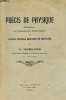
Précis de physique conforme au programme d'admission à l'école spéciale militaire de Saint-Cyr.
Imprimerie Barutel. non daté. In-8. Broché. Etat d'usage, Couv. convenable, Coiffe en pied abîmée, Intérieur frais. 219 pages - nombreuses figures en noir et blanc dans le texte - rousseurs sur les plats - coiffes légèrement abîmées.. . . . Classification Dewey : 530-Physique
Classification Dewey : 530-Physique
Amicale des anciens élèves de l'école normale supérieure d'éducation physique
Reference : 25302
(1961)
Premier degré d'éducation physique, exercices et jeux en progression 6 à 14 ans
1961, éditions Bourrelier, Ministère de l'éducation nationale, in-8 broché de 480 pages, nombreuses figures noir et blanc, préface de Maurice Herzog et de Michel Lebettre. Sous le patronage du haut-commissariat à la jeunesse et aux sports et de la direction des enseignements élémentaires et complémentaires. Au sommaire : gymnastique construite, éducation du sens du rythme, le terrain scolaire, formations, évolutions, gymnastique naturelle et de préparation sportive, les jeux, natation élémentaire. | Etat : Etat passable, couverture défraichie (Ref.: ref12523)
éditions Bourrelier, Ministère de l'éducation nationale
Experiences sur la Rarefaction de L'Air.
(Paris, Jean Boudot, 1706). 4to. Without wrappers. Extracted from ""Mémoires de l'Academie des Sciences. Année 1705"". Pp. 119-124.
First appearance of an important paper on the way to determinate absolute zero temperature. Amontons reports here on some phenomena he had observed while studying the proper way to calibrate his own air thermometer.
Que les Experiences sur lesquelles on se fonde pour prouver que les liquides se condensens & se refroidissent d'abord avant que se dilater à l'approche de la chaleur, ne le prouvent point, & que cette condensation apparante est purement l'effet de ...
(Paris, Jean Boudot, 1706). 4to. Without wrappers. Extracted from ""Mémoires de l'Academie des Sciences. Année 1705"". Pp. 75-80 a. 2 textillustrations.
First apperance of one of Amontons' last papers in which he further studies the effects and relations of air temperature to pressure, evaporation and freezing. Out of this he gained a vision of an absolute zero, reached when gases could contract no more.
De la Hauteur du Mercure dans les Barometres. (+) Suite des Remarques sur la hauteur du mercure....(+) Suite des remarques...(+) Suite des Remarques...(4 Parts).
(Paris, Jean Boudot, 1706). 4to. Without wrappers. Extracted from ""Mémoires de l'Academie des Sciences. Année 1705"". Pp. 229-232, 232-234, 234-236 a. 267-272.
First apperance of one of Amontons last papers on the barometer. He develops, after having noted that barometers are affected by heat as well as by the weight of the atmosphere, his mercury barometer.
Extraits du mémoire de l'action exercée sur un courant électrique par un autre courant, le globe terrestre ou un aimant présentés par Louis Poudensan.
P., Gauthier-Villars, 1964, in 8° broché, 64 pages.
PHOTOS SUR DEMANDE. ...................... Photos sur demande ...................


Phone number : 04 77 32 63 69
Mémoires sur l'électromagnétisme et l'électrodynamique
P., Gauthier-Villars, 1921; un volume in 12, broché, 14pp., 111pp.
---- Réimpression dans la collection des maîtres de la pensée scientifique de deux mémoires de A.M. Ampère. De l'action exercée sur un courant électrique, par un autre courant, le globe terrestre ou un aimant - Sur la détermination de la formule qui représente l'action mutuelle de deux portions infiniment petites de conducteurs voltaïques - Additions au mémoire précédent - Notice biographique ** 76.M7DE+CAV G2 (2ex)
Théorie mathématique des phénomènes électro-dynamiques uniquement déduite de l'expérience. Nouveau tirage augmenté d'un avant-propos de M. E. Bauer et d'un portrait de l'auteur
P., Blanchard, 1958; un volume in 8, broché, (4), 164pp., 2 planches dépliante
---- Réimpression de L'ouvrage le plus important d'AMPERE. Il y est fait la somme de tous ses travaux antérieurs. La première édition est quasiment introuvable ** 75.M5DE+CAV.F5
Corresponance et souvenirs (de 1793 à 1805). Recueillis par Madame H.C. Septième édition.
Paris, J. Hetzel et Cie, s.d. In-12 reliure 1/2 basane gold, dos à 5 nerfs orné de fleurons dorés, pièce d'auteur rouge, pièce de titre verte, tranches peignées, VI-368 pp. (rousseurs).
THEORIE MATHEMATIQUE des phénomènes ELECTRO-DYNAMIQUES uniquement déduite de l'expérience.
Editions Jacques Gabay Paris 1990 In-8 ( 240 X 160 mm ) de 387 pages, broché sous couverture imprimée. Très bel exemplaire bien complet des 2 planches dépliantes in-fine.