 Write to the booksellers
-
Type
Art print (2)
Book (5878)
Magazine (20)
Manuscript (1)
Old papers (1)
Photographs (3)
-
Latest
Last 24h (1)
Last 3 days (1)
Last month (35)
Last week (4)
-
Language
English (10)
French (5890)
German (1)
Greek (1)
Italian (1)
Latin (2)
-
Century
16th (2)
17th (9)
18th (246)
19th (886)
20th (2972)
21st (132)
-
Countries
Belgium (264)
Canada (3)
Côte d'Ivoire (13)
Denmark (1369)
France (3955)
Switzerland (301)
-
Syndicate
ALAC (3)
CLAM (3)
ILAB (4124)
NVVA (139)
SLACES (139)
SLAM (2593)
SNCAO (15)
Le grand Ampère d'après des documents inédits. Ouvrage orné de gravures. Troisième édition.
P., Perrin, 1925, in 8° broché, XV-277 pages ; petite déchirure sans manque à la couverture .
PHOTOS sur DEMANDE. ...................... Photos sur demande ...................


Phone number : 04 77 32 63 69
AMPERE - OERSTED - ARAGO - BIOT - DAVY - FARADAY - G. et A. DE LA RIVE - FRESNEL - BARLOW - SAVARY - WEBER - ETC -- Société Française de Physique
Reference : 4807
Mémoires sur l'ELECTRODYNAMIQUE
P., Gauthier-Villars, 1885/1887, 2 VOLUMES in 8 reliés en demi-chagrin rouge et en demi-chagrin vert (reliures de l'époque), 7pp., 412pp. ; (2), 403pp.
EDITION ORIGINALE ---- Réunion en deux volumes, par la Société Française de physique, des mémoires publiés sur l'électrodynamique par AMPERE, OERSTED, ARAGO, BIOT, DAVY, FARADAY, G. et A. DE LA RIVE, FRESNEL, BARLOW, SAVARY, WEBER, ETC ---- "Ces mémoires sont rangés par ordre de date. Le premier volume commence par le mémoire d'OERSTED, publié le 21 Juillet 1820, et va jusqu'à la fin de 1823. Il renferme également les mémoires d'AMPERE, d'ARAGO, de BIOT, de DAVY, de FARADAY, etc... Ceux d'AMPERE tiennent naturellement la plus grande place. Les mémoires d'AMPERE postérieures à 1823 occupent également une grande partie du volume. On trouvera, à très peu près, dans ces deux volumes tout ce qui a été publié sur l'électrodynamique par l'illustre physicien. On trouvera également quelques morceaux restés inédits ou publiés seulement par extraits ainsi que DEUX NOTES INEDITES DE FRESNEL relatives au magnétisme...". (Avertissement) ---- OERSTED : Expérience relative à l'effet du conflit électrique sur l'aiguille aimantée -- AMPERE : De l'action exercée sur un courant électrique par un autre courant, le globe terrestre ou un aimant ; Mémoire sur l'expression mathématique des attractions et des répulsions électriques ; Analyse des mémoires lus à l'Académie les 11 et 26 Décembre 1820 et les 8 et 15 Janvier 1821 ; Extrait d'une lettre d'Ampère à M. Le Professeur De La Rive sur des expériences électromagnétiques ; Expériences relatives aux nouveaux phénomènes électrodynamique obtenus au mois de Décembre 1821 ; Réponse à la lettre de M. Van Beck, sur une nouvelle expérience électromagnétique ; Exposé sommaire des nouvelles expériences électromagnétiques faites par différents physiciens, depuis le mois de Mars 1821 ; Second mémoire sur la détermination de la formule qui représente l'action mutuelle de deux portions infiniment petites de conducteurs voltaïques ; Mémoire sur la théorie mathématique des phénomènes électro-dynamiques, uniquement déduite de l'expérience, dans lequel se trouvent réunis les mémoires que M. Ampère a communiqués à l'Académie royale des Sciences, dans les séances des 4 et 26 Décembre 1820, 10 Juin 1822, 22 Décembre 1823, 12 Septembre et 28 Novembre 1825... -- ARAGO : Expériences relatives à l'aimantation du fer et de l'acier par l'action du courant voltaïque - Davy : Sur les phénomènes magnétiques produits par l'électricité ; Nouvelles recherches sur les phénomènes magnétiques produits par l'électricité . Sur un nouveau phénomène électromagnétique -- FRESNEL : Note sur des essais ayant pour but de décomposer l'eau avec un aimant ; Comparaison de la supposition des courants autour de l'axe avec celle des courants autour de chaque molécule ; Deuxième note sur l'hypothèse des courants particulaires -- BIOT & SAVARY : Sur l'aimantation imprimée aux métaux par l'électricité en mouvement -- G. DE LA RIVE : Notice sur quelques expériences électromagnétiques -- FARADAY : mémoire sur les mouvements électromagnétiques et la théorie du magnétisme ; notes d'Ampère sur le mémoire de Faraday -- BARLOW : Sur une expérience électromagnétique curieuse - G. DE LA RIVE : Lettre à M. Arago sur de nouvelles expériences relatives aux actions des courants galvaniques - A. De La Rive : Mémoire sur l'action qu'exerce le globe terrestre sur une portion de circuit voltaïque -- SAVARY, WEBER - ETC**4807/M2
André-Marie Ampère. 4e édition publiée à l'occasion du centenaire de sa mort.
Lyon, Vitte, 1936, in 8 broché, 270 pages, non coupé, gravures hors-texte ; couverture illustrée (manque angulaire en pied du plat supérieur).
...................... Photos sur demande ...................
Phone number : 04 77 32 63 69
Mémoire présenté á l'Académie royale des Sciences, le 2 octobre 1820, où se trouve compris le résumé de ce qui avait été lu á la même Académie les 18 et 25 septembre 1820, sur les effets des courans électriques. [AND] Suite du Mémoire sur l'Action m... - [FOUNDATION OF ELECTRODYNAMICS]
Paris, Crochard, 1820. 8vo. In 'Annales de Chimie et de Physique', Volume 15, pp.59-76170-218. The entire volme 15 offered here in contemporary fine half calf with gilt spine. Five engraved plates accompanying the memoires. A fine copy.
First edition of the first announcement of Ampère's discoveries on electromagnetism. Ampère first heard of Ørsted's discovery of electromagnetism on the 4th of September when Arago announced Ørsted's results to the Paris Academy of Sciences. In Ørsted's experiment a current-carrying wire is held over, and under, a compass needle - the result being that the needle is positioned at 45 degrees in respect to the wire. Ampére immediately saw that this result made no physical sense and realized that the true nature of the effect could not be observed until the force of terrestrial magnetism was somehow neutralized what Ørsted had observed and reported on was the resultant of the force from the wire and that from the earth's magnetic field. Ampère discovered that the compass needle sets at 90 degrees to the current-carrying wire when the effect of terrestial magnetism is eliminated. He also observed that current-carrying wires which are formed as spirals act as permanent magnets, and this lead him to his theory that electricity in motion produces magnetism and that permanent magnets must contain electrical currents. And thus Ampère laid the foundation of the new field of electrodynamics.Ampère announced his theory and experimental results, for the first time, in a series of memoires read before the Paris Academy of Sciences in September and October 1820. These memoires were first published in the September and October issues of Arago's 'Annales de Chimie et de Physique' (the offered items). In November Ampère had a seperate printing of his findings published under the title 'Mémoires sur I'action mutuelle de deux courans électriques, sur celle qui existe entre un courant électrique et un aimant ou le globe terrestre, et celle de deux aimans I'un sur I'autre.' (Dibner 62, Norman 43). On the title-page of this publication it is stated 'Extrait des Annales de Chimie et de Physique' and therefore this publication is often identified as an offprint of the two offered papers (see the Norman sales catalogue for an example). This is, however untrue, since it contains considerable changes and additions in comparison with text of the journal issues (see Williams: What were Ampère's Earliest Discoveries in Electrodynamics? ISIS, volume 74, p.492).Honeyman 82, Barchas 51, Wheeler 762.
Mémoire présenté á l'Académie royale des Sciences, le 2 octobre 1820, où se trouve compris le résumé de ce qui avait été lu á la même Académie les 18 et 25 septembre 1820, sur les effets des courans électriques. [AND] Suite du Mémoire sur l'Action m... - [FOUNDATION OF ELECTRODYNAMICS]
Paris, Crochard, 1820. 8vo. Without wrappers, as extracted from ""Annales de Chimie et de Physique"", Volume 15, pp. 59-76 and pp.170-218. Five engraved plates accompanying the memoires showing the experimental equipments. Half-title and title-page to volume 15 present.
First edition of the first announcement of Ampère's discoveries on electromagnetism. Ampère first heard of Ørsted's discovery of electromagnetism on the 4th of September when Arago announced Ørsted's results to the Paris Academy of Sciences. In Ørsted's experiment a current-carrying wire is held over, and under, a compass needle - the result being that the needle is positioned at 45 degrees in respect to the wire. Ampére immediately saw that this result made no physical sense and realized that the true nature of the effect could not be observed until the force of terrestrial magnetism was somehow neutralized"" what Ørsted had observed and reported on was the resultant of the force from the wire and that from the earth's magnetic field. Ampère discovered that the compass needle sets at 90 degrees to the current-carrying wire when the effect of terrestrial magnetism is eliminated. He also observed that current-carrying wires which are formed as spirals act as permanent magnets, and this lead him to his theory that electricity in motion produces magnetism and that permanent magnets must contain electrical currents. And thus, Ampère laid the foundation of the new field of electrodynamics.Ampère announced his theory and experimental results, for the first time, in a series of memoires read before the Paris Academy of Sciences in September and October 1820. These memoires were first published in the September and October issues of Arago's ""Annales de Chimie et de Physique"" (the offered items). In November, Ampère had a separate printing of his findings published under the title 'Mémoires sur I'action mutuelle de deux courans électriques, sur celle qui existe entre un courant électrique et un aimant ou le globe terrestre, et celle de deux aimans I'un sur I'autre.' (Dibner 62, Norman 43). On the title-page of this publication it is stated 'Extrait des Annales de Chimie et de Physique' and therefore this publication is often identified as an offprint of the two offered papers (see the Norman sales catalogue for an example). This is, however untrue, since it contains considerable changes and additions in comparison with text of the journal issues (see Williams: What were Ampère's Earliest Discoveries in Electrodynamics? ISIS, volume 74, p.492).Honeyman 82, Barchas 51, Wheeler 762. Sparrow, Milestones No 8.
Mémoire présenté á l'Académie royale des Sciences, le 2 octobre 1820, où se trouve compris le résumé de ce qui avait été lu á la même Académie les 18 et 25 septembre 1820, sur les effets des courans électriques. [AND] Suite du Mémoire sur l'Action m... - [THE FOUNDATION OF ELECTRODYNAMICS]
Paris, Crochard, 1820. 8vo. In 'Annales de Chimie et de Physique', Volume 15, pp. 59-76 170-218. The entire volme 15 offered in a nice contemporary half calf with gilt spine. A bit of wear to extremities. Five engraved plates accompanying the memoires. A very fine copy.
First edition of the first announcement of Ampère's discoveries on electromagnetism. Ampère first heard of Ørsted's discovery of electromagnetism on the 4th of September, when Arago announced Ørsted's results to the Paris Academy of Sciences. In Ørsted's experiment, a current-carrying wire is held over and under a compass needle - the result being that the needle is positioned at 45 degrees in respect to the wire. Ampére immediately saw that this result made no physical sense and realized that the true nature of the effect could not be observed until the force of terrestrial magnetism was somehow neutralized what Ørsted had observed and reported on was the resultant of the force from the wire and that from the earth's magnetic field. Ampère discovered that the compass needle sets at 90 degrees to the current-carrying wire, when the effect of terrestial magnetism is eliminated. He also observed that current-carrying wires which are formed as spirals act as permanent magnets, and this lead him to his theory that electricity in motion produces magnetism and that permanent magnets must contain electrical currents. And thus Ampère laid the foundation of the new field of electrodynamics.Ampère announced his theory and experimental results, for the first time, in a series of memoires read before the Paris Academy of Sciences in September and October 1820. These memoires were first published in the September and October issues of Arago's 'Annales de Chimie et de Physique' (i.e. the offered item). In November Ampère had a seperate printing of his findings published under the title 'Mémoires sur I'action mutuelle de deux courans électriques, sur celle qui existe entre un courant électrique et un aimant ou le globe terrestre, et celle de deux aimans I'un sur I'autre.' (Dibner 62, Norman 43). On the title-page of this publication it is stated 'Extrait des Annales de Chimie et de Physique' and therefore this publication is often identified as an offprint of the two offered papers (see the Norman sales catalogue for an example). This is, however untrue, since it contains considerable changes and additions in comparison with text of the journal issues (see Williams: What were Ampère's Earliest Discoveries in Electrodynamics? ISIS, volume 74, p.492).Honeyman 82, Barchas 51, Wheeler 762.
Mémoires sur l'action mutuelle de deux courans électriques, sur celle qui existe entre un courant électrique et un aimant ou le globe terrestre, et celle de deux aimans l'un sur l'autre. Lus à l'Académie royale des Sciences. (Extrait des ""Annales ... - [FOUNDING ELECTRO-DYNAMICS - OFFPRINT-ISSUE]
(Paris, 1820). Small 8vo. Contemporary (original?) blank blue paper wrappers. Annulated stamp to title-page, otherwise a nice, clean, and fresh copy. 68 pp. + 5 engraved plates.
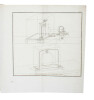
First edition, in the extremely scarce off-print, of the first announcement of Ampère's seminal discoveries on electromagnetism, which laid the foundation for electrodynamics. Ampère first heard of Ørsted's discovery of electromagnetism on the 4th of September, when Arago announced Ørsted's results to the Paris Academy of Sciences. In Ørsted's experiment, a current-carrying wire is held over and under a compass needle - the result being that the needle is positioned at 45 degrees in respect to the wire. Ampére immediately saw that this result made no physical sense and realized that the true nature of the effect could not be observed until the force of terrestrial magnetism was somehow neutralized"" what Ørsted had observed and reported on was the resultant of the force from the wire and that from the earth's magnetic field. Ampère discovered that the compass needle sets at 90 degrees to the current-carrying wire, when the effect of terrestial magnetism is eliminated. He also observed that current-carrying wires which are formed as spirals act as permanent magnets, and this lead him to his theory that electricity in motion produces magnetism and that permanent magnets must contain electrical currents. And thus Ampère laid the foundation of the new field of electrodynamics.""Ampère, professor of mathematics at the Polytechnique, heard of Oersted's discovery and immediately set up a series of experiments to determine the exact relationships of current-flow and magnetism. In a week Ampère presented the first of a series of papers establishing the laws of forces acting between conductors carrying current."" (Dibner). Ampère's seminal results were announced in a series of memoires read before the Paris Academy of Sciences in September and October 1820. These memoires were first published in the September and October issues of Arago's ""Annales de Chimie et de Physique"", and in November Ampère had the scarce seperate printing of his findings published under the title ""Mémoires sur I'action mutuelle de deux courans électriques, sur celle qui existe entre un courant électrique et un aimant ou le globe terrestre, et celle de deux aimans I'un sur I'autre"". It is this publication that is considered ""his first great memoir on electrodynamics"" (DSB).Sparrow: 8" Dibner: 62 Honeyman: 83 Barchas 51 (only the periodical-issue) Wheeler 762 (only the periodical-issue).
Mémoire sur une nouvelle Expérience électrodynamique, sur son application à la formule qui représente l'action mutuelle de deux élemend de conducteurs voltaïques, et sur de nouvelles conséquences déduites de cette formule. (Lu à l'Academie royale de... - [""THE NEWTON OF ELECTRICITY"" - THE CARDINAL FORMULAS OF ELECTRO-DYNAMICS]
Paris, Crochard, 1825. 8vo. 2 contemporary half calfs w. richly gilt spines. Light wear at top of spines. Minor scratches to upper compartments of spines. Small stamps on verso of title-pages and verso of plates. In: ""Annales de Chimie et de Physique, Par MM. Gay-Lussac et Arago."", tome 29 a. 30. - 448 pp. and 3 folded engraved plates + 448 pp. and 2 folded engraved plates. (The entire volumes offered). Ampère's papers: pp. 381-404 (tome 29) + Suite pp. 29-41 (tome 30) + ""Lettre à Gerhardi"": pp. 373-381 (tome 29). Clean and fine throughout.
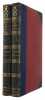
First appearance of this famous memoir, in which Ampère presented his collected results on electrodynamics to the French Academy, creating the foundation of 19th century developments in electricity and magnetism. In the words of James Clark Maxwell, ""We can scarcely believe that Ampère really discovered the law of action by means of the experiments which he describes. We are led to suspect, what, indeed, he tells us himself, that he discovered the law by some process which he has not shown us, and that when he had afterwards built up a pefect demonstration he removed all traces of the scaffolding by which he raised it.""The offered memoir was published BEFORE the famous ""Theorie mathématique des phénomènes électro-dynamiques uniquement déduite de L'expérience"", which did not appear until 1827. That 1827-Memoire incorporates, together with a new presentation of Ampère's results from 1820, 1822, 1823, the offered memoir (1825). (Horblit: 100 - Dibner: 62).""From 1814 until 1820 Ampére did not perform the kind of research that would have made it into the annals of the histrory of science, but on September 11, 1820 when he heard Francois Arago speak about Oersted's work, he got fresh inspiration and started the work that made him famous. Arago related how Oersted had found that a steady electric current influences the orientation of a compass needle. After a weak Ampère had determined experimentally that that two straight, parallel, and current-carrying, wires execute a force on each other. The magnitude of the force is inversely proportional to the distance between the wires and proportional to the strenghts of the current..... During the following years he continued his researches, both experimentally and theoretically. he built an instrument for measuring electricity that later was developed into the galvanometer. Finally in 1825 he presented his collected results to the Academy IN ONE OF THE MOST CELEBRATED MEMOIRS IN THE HISTORY OF NATURAL PHILOSOPHY (The paper offered)."" (Citizen's Compendium, p. 2). - Norman No 47.The volumes contain many other notable papers by: Wöhler, Fresnel, Marcet, Berzelius, Felix Savart, De la Rive, Braconnet, Boussingault, Magnus, Poncelet, Vaugelin, Poisson, Gay-Lussac, Faraday, Laplace etc.
Note sur l'Action mutuelle d'un Aimant et d'un Conducteur voltaïque.
(Paris, Crochard, 1828). No wrappers. In: ""Annales de Chimie et de Physique, Par MM. Gay-Lussac et Arago."", tome 37 (sec. cahier), Titlepage to vol. 37, pp. 113-223. (Entire issue offered). Ampere's paper: pp. 113-139 a. 1 large folded engraved plate.
First appearance of Ampere's last major paper on magnetism and electricity. As in his most importent paper from 1827, he shows the unification of the electric and the magnetic fields and treats the relations mathematically.
Note sur un appareil à l'aide auquel on peut vérifier toutes les propriétés des conducteurs de l'électricité voltaique, découvertes par M. Ampère. (+) Suite de la Note sur un Appareil à l'aide duquel on peut vérifier toutes les propriétés de condu...
Paris, Crochard, 1821. Without wrappers. In: Annales de Chimie et de Physique, Par MM. Gay-Lussac et Arago."", Tome 18., Cahier 1 a. 3. Titlepage a. htitle to vol. 18. Pp. (4), 1-112 a. pp. 225-336 a. 2 folded engraved plates. (Entire issues offered).. Ampère's papers: pp. 88-106 + pp. 313-333 The plates depicts experimental arrangements and Ampère's initial Rotation Apparatus.
Fisrt edition and first printings of the demonstrations of Ampere's new Equilibrium technique. When Faraday had completed his importent paper on Electro-magnetic motions he send it to Ampere.. Ampere invented the Rotation Apparatus in order to repeat Faraday's experiment on the electro-magnetic rotation. He produced an uninterrupted rotation, either of magnetic pole around a wire or of a wire around a magnetic pole. From these experiments originated a new theory of electricity and magnetism. .
Mémoire présenté á l'Académie Royale des Sciences, le 2 octobre 1820, où se trouve compris le résumé de ce qui avait été lu á la même Académie les 18 et 25 septembre 1820, sur les effets des courans électriques. [AND] Suite du Mémoire sur l'Action m...
Paris, Crochard, 1820. 8vo. In 'Annales de Chimie et de Physique', Volume 15, pp.59-76170-218. The entire volme 15 offered here. 448 pp., 5 engraved plates. Bound in contemporary half calf with gilt spine, Raised bands. Minor scratches to spine. Corners a bit bumped. Five engraved plates accompanying the memoires. Clean and fine.
First edition of the first announcement of Ampère's discoveries on electromagnetism. Ampère first heard of Ørsted's discovery of electromagnetism on the 4th of September when Arago announced Ørsted's results to the Paris Academy of Sciences. In Ørsted's experiment a current-carrying wire is held over, and under, a compass needle - the result being that the needle is positioned at 45 degrees in respect to the wire. Ampére immediately saw that this result made no physical sense and realized that the true nature of the effect could not be observed until the force of terrestrial magnetism was somehow neutralized what Ørsted had observed and reported on was the resultant of the force from the wire and that from the earth's magnetic field. Ampère discovered that the compass needle sets at 90 degrees to the current-carrying wire when the effect of terrestial magnetism is eliminated. He also observed that current-carrying wires which are formed as spirals act as permanent magnets, and this lead him to his theory that electricity in motion produces magnetism and that permanent magnets must contain electrical currents. And thus Ampère laid the foundation of the new field of electrodynamics. Ampère announced his theory and experimental results, for the first time, in a series of memoires read before the Paris Academy of Sciences in September and October 1820. These memoires were first published in the September and October issues of Arago's 'Annales de Chimie et de Physique' (the offered items). In November Ampère had a seperate printing of his findings published under the title 'Mémoires sur I'action mutuelle de deux courans électriques, sur celle qui existe entre un courant électrique et un aimant ou le globe terrestre, et celle de deux aimans I'un sur I'autre.' (Dibner 62, Norman 43). On the title-page of this publication it is stated 'Extrait des Annales de Chimie et de Physique' and therefore this publication is often identified as an offprint of the two offered papers (see the Norman sales catalogue for an example). This is, however untrue, since it contains considerable changes and additions in comparison with text of the journal issues (see Williams: What were Ampère's Earliest Discoveries in Electrodynamics? ISIS, volume 74, p.492). Honeyman 82, Barchas 51, Wheeler 762.
Ueber die gegenseitigen Wirkungen, welche auf einander ausüben zwei electrische Ströme, ein electrischer Ström und ein Magnet oder die Erdkugel, und zwei Magnete. Von Ampere... Frei bearbeitet von Gilbert. Erste Hälfte, (vorgelegt der Paris. Akad. den...
Leipzig, Johann Ambrosius Barth, 1821. 8vo. Contemp. hcalf. Gilt spine and with gilt lettering. Some scratches to spine. In: ""Annalen der Physik und der Physikalischen Chemie. Hrsg. Ludwig Wilhelm Gilbert"", Bd. 7 (= Bd. 67 der Reihe). (8),444 pp., 2 folded tables and 8 engraved plates. Small stamp to verso of titlepages. Ampére's paper: pp. 113-167 a. 225-258 with 4 engraved plates. Internally clean and fine.
First German versions of Ampére's famous papers, the first announcements of Ampère's discoveries on electromagnetism, being the German version of Ampére's ""Mémoires sur I'action mutuelle de deux courans électriques, sur celle qui existe entre un courant électrique et un aimant ou le globe terrestre, et celle de deux aimans I'un sur I'autre.""Ampère first heard of Ørsted's discovery of electromagnetism on the 4th of September when Arago announced Ørsted's results to the Paris Academy of Sciences. In Ørsted's experiment a current-carrying wire is held over, and under, a compass needle - the result being that the needle is positioned at 45 degrees in respect to the wire. Ampére immediately saw that this result made no physical sense and realized that the true nature of the effect could not be observed until the force of terrestrial magnetism was somehow neutralized" what Ørsted had observed and reported on was the resultant of the force from the wire and that from the earth's magnetic field. Ampère discovered that the compass needle sets at 90 degrees to the current-carrying wire when the effect of terrestial magnetism is eliminated. He also observed that current-carrying wires which are formed as spirals act as permanent magnets, and this lead him to his theory that electricity in motion produces magnetism and that permanent magnets must contain electrical currents. And thus Ampère laid the foundation of the new field of electrodynamics.Ampère announced his theory and experimental results, for the first time, in a series of memoires read before the Paris Academy of Sciences in September and October 1820. These memoires were first published in the September and October issues of Arago's 'Annales de Chimie et de Physique'. In November Ampère had a seperate printing of his findings published under the title 'Mémoires sur I'action mutuelle de deux courans électriques, sur celle qui existe entre un courant électrique et un aimant ou le globe terrestre, et celle de deux aimans I'un sur I'autre.' (Dibner 62, Norman 43). Honeyman 82, Barchas 51, Wheeler 762. (The French versions).The volume contains other importent papers of historical importence, relating to the discovery of electro-magnetism by Oersted in 1820. (Raschig, Bechstein, Georg von Buquoy, Prechtl, Boisgiraud).
"AMPÈRE, ANDRÉ-MARIE. - INCORPORATED IN THE ""PRINCIPIA"" OF ELECTRODYNAMICS.
Reference : 44786
(1824)
Extrait d'un Mémoire sur les Phénomènes électro-dynamiques. (Communique à l'Academie royale des Sciences le 22 dévcembre 1823). + Suite de l'Extrait, fait par M. Ampère, de son Mémoire sur les Phénomènes électro-dynamiques.
Paris, Crochard, 1824. 8vo. Without wrappers. In 'Annales de Chimie et de Physique', Series 2 - Volume 26, issue 2 and 3. With titlepage to vol. 26. Pp. 113-224 a. pp. 225-336, 1 folded engraved plate (entire issues offered). Ampere's papers: pp. 134-162 a. pp. 246-258.
First appearance of one of Ampere's importent contributions to electrodynamic. This memoir was later incorporated in his great memoir of 1827 ""Mémoire sur la théorie mathématique des phénomenes electro-dynamiques...."", published 1827, the ""Principia"" of electrodynamics.
"AMPÈRE, ANDRÉ-MARIE. - INCORPORATED IN THE ""PRINCIPIA"" OF ELECTRODYNAMICS AND THE INVENTION OF THE SOLENOID.
Reference : 48831
(1824)
Extrait d'un Mémoire sur les Phénomènes électro-dynamiques. (Communique à l'Academie royale des Sciences le 22 dévcembre 1823). + Suite de l'Extrait, fait par M. Ampère, de son Mémoire sur les Phénomènes électro-dynamiques. + Description d'un Appa...
Paris, Crochard, 1824. 8vo. Contemp. hcloth with gilt lettering to spine. In 'Annales de Chimie et de Physique', Series 2 - Volume 26. 448 pp. a. 5 large folded engraved plates. (Entire volume offered). Ampere's papers: pp. 134-162, 246-258 a. 390-411. A bit of browning to halftitle and verso of last plate. A few scattered brownspots.
The first paper is the first appearance of one of Ampere's importent contributions to electrodynamic. This memoir was later incorporated in his great memoir of 1827 ""Mémoire sur la théorie mathématique des phénomenes electro-dynamiques...."", published 1827, the ""Principia"" of electrodynamics.The second paper is the first appearence of the paper in which Ampere describes his invention of the SOLENOID, the electro-magnetic device he used in his early electrodynamical experiments.""A solenoid is a coil wound into a tightly packed helix. In physics, the term solenoid refers to a long, thin loop of wire, often wrapped around a metallic core, which produces a magnetic field when an electric current is passed through it. Solenoids are important because they can create controlled magnetic fields and can be used as electromagnets. The term solenoid refers specifically to a magnet designed to produce a uniform magnetic field in a volume of space (where some experiment might be carried out).""The volume contains further importent papers by Poisson ""Sur la Chaleur rayonnante"", pp. 225-246 + Note.. pp. 442-44, Gay-Lussac, Savart, Pelletier et Caventou, Becquerel etc.
"AMPÈRE, ANDRÉ-MARIE & MICHAEL FARADAY - DESCRIBING AMPERE'S ROTATION APPARATUS.
Reference : 41248
(1821)
Note sur unappareil à l'aide auquel on peut vérifier toutes les propriétés des conducteurs de l'électricité voltaique, découvertes par M. Ampère. (+) Suite de la Note sur un Appareil à l'aide duquel on peut vérifier toutes les propriétés de conduc... - [ELECTROMAGNETIC ROTATION ESTABLISHED]
Paris, Crochard, 1821. Contemp. full cloth. Light wear to spine ends. Gilt lettering to spine. In: Annales de Chimie et de Physique, Par MM. Gay-Lussac et Arago."", Tome 18. 448 pp. and 6 folded engraved plates (4 of these belonging to the described papers). Ampère: pp. 88-106 + pp. 313-333 and 4 plates. Faraday: pp. 337-379. Savary: pp. 370-379. The plates depicts experimental arrangements and Ampère's initial Rotation Apparatus. The whole volume present.
Fisrt edition and first printings of the demonstrations of Ampere's new Equilibrium technique. When Faraday had completed his importent paper on Electro-magnetic motions (the paper offered here in the first French edition) he send it to Ampere.. Ampere invented the Rotation Apparatus in order to repeat Faraday's experiment on the electro-magnetic rotation. He produced an uninterrupted rotation, either of magnetic pole around a wire or of a wire around a magnetic pole. From these experiments originated a new theory of electricity and magnetism. - The third memoir is the First French edition of Faraday's famous paper ""On some New Electro-Magnetical Motions, and on the Theory of Magnetism"" (Quaterly Journal of Science, October 1821), in which is recorded for the first time the conversion of electrical into mechanical energy. It also contains the first notion of the ""Line of Force"". He employed a magnet and a wire with a flowing current, which causd each separately to rotate round the other. He concluded that a current-carrying wire is sorraunded by a circular ""line of force"". Oersted had spoken of the ""electrical conflict"" surrounding the wire and had noted that ""this conflict performs circles"".
"AMPÈRE, ANDRÉ-MARIE. - THE CARDINAL FORMULAS OF ELECTRO-DYNAMICS.
Reference : 47420
(1825)
Mémoire sur une nouvelle Expérience électrodynamique, sur son application à la formule qui représente l'action mutuelle de deux élemend de conducteurs voltaïques, et sur de nouvelles conséquences déduites de cette formule. (Lu à l'Academie royale de...
(Paris, Crochard, 1825). Extracted from ""Annales de Chimie et de Physique, Par MM. Gay-Lussac et Arago."", tome 29 a. 30. Ampère's papers: pp. 381-404 a. 1 folded engraved plate (tome 29) + Suite pp. 29-41 (tome 30) + ""Lettre à Gerhardi"": pp. 373-381 (tome 29). With both halftitlepages to vol. 29 a. 30. Scattered brownspots.
First appearance of this famous memoir, in which Ampère presented his collected results on electrodynamics to the French Academy, creating the foundation of 19th century developments in electricity and magnetism. In the words of James Clark Maxwell, ""We can scarcely believe that Ampère really discovered the law of action by means of the experiments which he describes. We are led to suspect, what, indeed, he tells us himself, that he discovered the law by some process which he has not shown us, and that when he had afterwards built up a pefect demonstration he removed all traces of the scaffolding by which he raised it.""The offered memoir was published BEFORE the famous ""Theorie mathématique des phénomènes électro-dynamiques uniquement déduite de L'expérience"", which did not appear until 1827. That 1827-Memoire incorporates, together with a new presentation of Ampère's results from 1820, 1822, 1823, the offered memoir (1825). (Horblit: 100 - Dibner: 62).""From 1814 until 1820 Ampére did not perform the kind of research that would have made it into the annals of the histrory of science, but on September 11, 1820 when he heard Francois Arago speak about Oersted's work, he got fresh inspiration and started the work that made him famous. Arago related how Oersted had found that a steady electric current influences the orientation of a compass needle. After a weak Ampère had determined experimentally that that two straight, parallel, and current-carrying, wires execute a force on each other. The magnitude of the force is inversely proportional to the distance between the wires and proportional to the strenghts of the current..... During the following years he continued his researches, both experimentally and theoretically. he built an instrument for measuring electricity that later was developed into the galvanometer. Finally in 1825 he presented his collected results to the Academy IN ONE OF THE MOST CELEBRATED MEMOIRS IN THE HISTORY OF NATURAL PHILOSOPHY (The paper offered)."" (Citizen's Compendium, p. 2). - Norman No 47.
Description d'un Apparail électro-dynamique.
(Paris, Crochard, 1824). 8vo. Without wrappers. In 'Annales de Chimie et de Physique', Series 2 - Volume 26, Cahier 4. Pp. 337-448 (entire issue offered). With htitle to volume 26. Amperes' paper: pp. 390-411 and 2 folded engraved plates.
First appearence of the paper in which Ampere describes his invention of the SOLENOID, the electro-magnetic device he used in his early electrodynamical experiments.""A solenoid is a coil wound into a tightly packed helix. In physics, the term solenoid refers to a long, thin loop of wire, often wrapped around a metallic core, which produces a magnetic field when an electric current is passed through it. Solenoids are important because they can create controlled magnetic fields and can be used as electromagnets. The term solenoid refers specifically to a magnet designed to produce a uniform magnetic field in a volume of space (where some experiment might be carried out).""Poggendorff I, p. 29. - Ronalds, p. 10.
La diatomite (Kieselgur). Les diatomées et leurs emplois dans l'industrie. 2e édition.
P., Sté des silices fossiles de France, 1948, grand in 8° broché, 175pp., gravures.
PHOTOS sur DEMANDE. ...................... Photos sur demande ...................
Phone number : 04 77 32 63 69
Un corps Ferme et Harmonieux . C'est facile quelques minutes par jour suffisent
Bréal Bien être, 2010 - Grand In-8, br, couv glacée , CD AUDIO INCLUS, état neuf, 158 pages accompagnées de dessins de mouvements très bien explicités.
Très Bon Etat à neuf Mise à jour du Samedi 27 Juin 2026. Paiement PayPal immédiat, Mondial Relay pour : France, Allemagne, Autriche, Belgique, Espagne, Italie, Portugal, Luxembourg, Pays-Bas, Pologne (Communiquer votre point ou locker si connu). Une participation supplémentaire peut être demandée pour les colis lourds hors France où les envois compris entre 5 et 25 kg sont dégressifs : 2 à 4 kilogrammes - 7.99 / 5 à 10 kg - 15.99 / 15 -25 kg - 25.99. Certaines de nos collections ( Vian, Céline, Camus (...) peuvent être expédiées en Franco de port. Pour linternational hors Europe (Suisse, Canada, Japon, Etats-Unis, les frais dexpéditions peuvent varier selon le poids (mise à jour : 1 juin 2026).
Lettre Autographe Signée - Paris - sans date -
1 page in4 - trés bon état -
Il est heureux de savoir qu'il a aimé son livre - "Je me souviens avec plaisir des soirées passées aux Houches à bavarder et à chanter..." - Il l'embarrasse un peu en lui demandant un extrait de son "important ouvrage" mais comme le livre a failli s'appeler "la divine surprise", il pense à cet extrait: "...la divine surprise de voir le phénoméne prevu par le calcul apparaitre là ou on l'a prêvu, tel qu'on l'a prêvu" - Belle lettre -
The Positive Electron. - [DISCOVERY OF THE POSITRON]
(New York, For the American Physical Society by the American Inst. of Physics), 1933. 4to. No wrappers as issued in ""Physical Review, vol. 43, March 13, 1933"" pp. 491-494. and with 4 textillustr.
![The Positive Electron. - [DISCOVERY OF THE POSITRON]. "ANDERSON, CARL D.](https://static.livre-rare-book.com/pictures/LLX/38904_1_thumb.jpg)
First edition. The paper announces the discovery of the first antiparticle ever found. The existance of the positron was predicted by Dirac 3 years before. Anderson was awarded the Nobel Prize in 1936 ""For his Discovery of the Positron"".
Dielectriques. Traduit sous la direction de L. Godefroy et C. Baumberger.
P., Dunod (Collection "Monographies Dunod" N°63), 1966, in 12 relié pleine toile marron de l'éditeur, XI-207 pages.
PHOTOS sur DEMANDE. ...................... Photos sur demande ...................
Phone number : 04 77 32 63 69
Absence of Diffusion in Certain Random Lattices. - [THE ANDERSON LOCALIZATION]
Lancaster and New York, American Institute of Physics, 1958. Lex8vo. Volume 109, March 1, No. 5, 1958 of ""The Physical Review"", Second Series. In the original printed blue wrappers. Slight traces of wear to spine. Previous owner's stamp to front wrapper (C. Møller). Internally fine and clean. Pp. 1492-1505. [Entire issue: Pp. 1407-1862].
First edition of Anderson's seminal paper, in which he laid the foundation for a quantum-mechanical theory of transport in systems with a certain generic type of disorder involving onsite energy randomness. This is also known as the Anderson localization. On the basis of the discovery presented in the present article which led to investigations into the electronic structure of magnetic and disordered systems, Anderson was awarded the Nobel Prize in Physics in 1977. The discovery has allowed for the development of electronic switching and memory devices in computers.""Disorder-induced electron localization, i.e. Anderson localization, was first predicted by Andersonin 1958 [in the present paper]. In his pioneering paper, the continuity or discontinuity of the energy spectrum of electrons on a diagonally disordered system is related to their localization property."" (Nakayama, Fractal concepts in condensed matter physics, 2003, p. 117)""Anderson's model ushered in a new quantum mechanical view of metal-insulator transitions. And in the early 1960s, Nevill Mott introduced the notion of a mobility edge that separates extended and localized states. The idea of a mobility edge would develop into one of the most studied concepts of condensed-matter physics. For their work on disordered systems, Anderson, his thesis adviser John van Vleck, and Mott shared the 1977 Nobel Prize in Physics.Ironically, Anderson's 1958 paper hardly got noticed at first"" it was cited just 30 times in the first 10 years. Today, it's been cited over 4000 times, though too often as an ""unrecognizable monster"" as described by its creator in 1983. Indeed, theoreticians have found a variety of ways to look at localization - from scale-dependent diffusion and fractal wavefunctions to quantum chaos, dense-point spectra, and kicked rotors."" (Fifty years of Anderson localization Physics Today, August 2009).
Über die Existenzmöglichkeit von kosmischem Staube in der Sonnenkorona.
Berlin, Springer, 1924. 8vo. Bound in contemporary half cloth. In "" Zeitschrift für Physik"", vol. 28, 1924. Entire volume offered. Stamp to title page, otherwise fine and clean. Pp. 299-324. [Entire volume: IV, 392, (1) pp.].
First printing of Anderson's paper on the possibility of the existence of cosmic dust in the solar corona.
Le mécanisme de la nature. Exposé simple des idées modernes concernant la structure de la matière et les radiations. Traduit de l'anglais par G. Malgorn.
P., Dunod, 1932, in 8° broché, VIII-163 pages ; des rousseurs ; couverture un peu fanée.
...................... Photos sur demande ...................
Phone number : 04 77 32 63 69

