 Write to the booksellers
-
Type
Art print (2)
Book (5893)
Magazine (20)
Manuscript (1)
Old papers (1)
Photographs (3)
-
Latest
Last 3 days (4)
Last month (5)
-
Language
English (10)
French (5905)
German (1)
Greek (1)
Italian (1)
Latin (2)
-
Century
16th (2)
17th (9)
18th (246)
19th (891)
20th (2967)
21st (133)
-
Countries
Belgium (265)
Canada (3)
Côte d'Ivoire (13)
Denmark (1365)
France (3973)
Switzerland (301)
-
Syndicate
ALAC (3)
CLAM (2)
ILAB (4127)
NVVA (139)
SLACES (139)
SLAM (2601)
SNCAO (15)
On the Theory of Decrease of Velocity of Moving Electrified Particles on passing through Matter. In: Philosophical Magazine Vol. 25, No. 145, January 1913 pp. 10-31. - [BOHR'S FIRST WORK ON NUCLEAR PHYSICS]
London, Taylor & Francis, 1913. 8vo. Original printed wrappers" chipped, backstrip lacks. The whole issue. 200 pp., 2 plates.

First edition of Bohr's first work on nuclear physics, published just before his 'On the Constitution of Atoms and Molecules'. During his visit to Manchester Bohr had the chance to get a first hand account of Rutherford's investigations on the penetration of alpha-particles through matter. In order to explain the large-angle scattering of alpha rays, which Rutherford had observed, he proposed his ""nuclear"" model of the atom in contrast to J.J. Thomson's ""plum pudding"" model in 1910. Bohr eagerly took up the new model and soon recognized its far-reaching implications. In particular, he pointed out that the nuclear model of the atom implied a sharp separation between the chemical properties, ascribed to the peripherical electrons, and the radioactive properties, which affected the nucleas itself. In this paper the theory of the decrease of velocity of moving electrified particles in passing through matter is given in a form, such that the rate of the decrease in the velocity depends on the frequency of vibration of the electrons in the atoms of the absorbing material. In the conclusion Bohr could state 'that a hydrogen atom contains only 1 electron outside the positively charged nucleas, and that a helium atom only contains 2 electrons outside the nucleas'.Rosenfeld, Bohr Bibliography No. 5. Rosenfeld, Dictionary of Scientific Biography II, pp. 240-41.

On the Theory of Decrease of Velocity of Moving Electrified Particles on passing through Matter - [THE FOUNDATION OF BOHR'S ATOMIC THEORY]
London, Taylor & Francis, 1913. 8vo. Bound in one nice contemporary half calf binding with gilt leather title-label to spine. Published in ""The London, Edinburgh, and Dublin Philosophical Magazine and Journal of Science"", Vol. 25. No. 145-150 offered. Small repair to spine and blind stamped to lower part of title page. The Bohr papers: pp. 10-31. [Entire volume: VIII, 876 pp.+ 10 plates].
![On the Theory of Decrease of Velocity of Moving Electrified Particles on passing through Matter - [THE FOUNDATION OF BOHR'S ATOMIC THEORY]. "BOHR, ...](https://static.livre-rare-book.com/pictures/LLX/51729_1_thumb.jpg)
![On the Theory of Decrease of Velocity of Moving Electrified Particles on passing through Matter - [THE FOUNDATION OF BOHR'S ATOMIC THEORY]. "BOHR, ...](https://static.livre-rare-book.com/pictures/LLX/51729_2_thumb.jpg)
Bohr's seminal first work on nuclear physics, being the work that lays the foundation for his atomic theory (published before his ""On the Constitution of Atoms and Molecules""), in which he is able to conclude ""that a hydrogen atom contains only 1 electron outside the positively charged nucleus, and that a helium atom only contains 2 electrons outside the nucleus ."" ""Bohr's 1913 paper on alpha-particles [i.e. the present], which he had begun in Manchester, and which had led him to the question of atomic structure, marks the transition to his great work, also of 1913, on that same problem. While still in Manchester, he had already begun an early sketch of those entirely new ideas."" (Pais, p. 128). The present work must be considered one of the most important to the birth of modern atomic theory.After finishing his studies in Copenhagen, Bohr went to Cambridge in order to pursue his studies on electron theory under the guidance of J.J. Thompson. Thompson, who was beginning to lose interest in the subject by now, did, however, not recognize the genious of the young Bohr, and as soon as he could, Bohr went to Manchester, where Ernest Rutherford had established a laboratory. ""There, from March to July 1912, working with utmost concentration, he [i.e. Bohr] laid the foundation for his greatest achievements in physics, the theory of the atomic constitution."" (DSB). Bohr's survey of the implications of Rutherford's atomic model had led him to attack the much harder problem which lay at the core of it, namely determining the exact nature of the relation between the atomic number and the number of electrons in the atom. ""Bohr obtained a much deeper insight into the problem by a brilliant piece of work, which he - working, as he said, ""day and night"" - completed with astonishing speed"" (DSB), that paper being the present ""On the Theory of the Decrease of Velocity of Moving electrified Particles on passing through Matter"", which thus constitutes his very first publication on the subject, published immediately after this dense period of 1912, in the Philosophical Magazine of January 1913. ""The problem was one of immediate interest for Rutherford's laboratory: in their passage through a material medium, alpha particles continually lose energy by ionizing the atoms they encounter, at a rate depending on their velocity. Their energy loss limits the depth to which the particles can penetrate into the medium, and the relation between this depth, or range, and the velocity offers a way of determining this velocity. What Bohr did was to analyze the ionizing process on the basis of the Rutherford model of the atom and thus express the rate of energy loss in terms of the velocity by a much more accurate formula than had so far been achieved-a formula, in fact, to which modern quantum mechanics adds only nonessential refinements"" (DSB). In the present work, Bohr was thus able to conclude: ""In this paper the theory of the decrease of velocity of moving electrified particles in passing through matter is given in a form, such that the rate of the decrease in the velocity depends on the frequency of vibration of the electrons in the atoms of the absorbing material."" as well as the seminal words that have been formative for the birth of the modern atomic theory: ""Adopting Prof. Rutherford's theory of the constitution of atoms, it seems that it can be concluded with great certainty, from the absorption of alpha-rays, that a hydrogen atom contains only 1 electron outside the positively charged nucleus, and that a helium atom only contains 2 electrons outside the nucleus "". Bohr continues: ""These questions and some further information about the constitution of atoms which may be got from experiments on the absorption of alpha-rays, will be discussed in more detail in a later paper."" (pp. 30-31 of the original paper) - the last sentence referring directly to his three part ""On the Constitution of Atoms and Molecules"", in which he went on to present his postulates of the orbital structure of the electrons and their quantized radiation. Rosenfeld, Bohr Bibliography No. 5. Rosenfeld, Dictionary of Scientific Biography II, pp. 240-41. Pais, Niels Bohr's Times, pp. 117-31.
On the Theory of the Decrease of Velocity of Moving Electrified Particles on passing through Matter. [Off-print From the Philosophical Magazine (Vol. 25, No. 145) for January 1913 ]. - [THE FOUNDATION OF BOHR'S ATOMIC THEORY - PRESENTATION-COPY]
[London, Taylor & Francis], 1913. 8vo. Original printed wrappers. The fragile wrappers are detached, but fully intact. Merely tiny parts of the thin backstrip lacking. Three small tears to front wrapper, no loss, as well as a couple of creses. Back wrapper with a slight bend to the corner and minor fading to extremities. Pp. (9)-31.
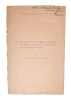


Scarce first edition, off-print issue with presentation-inscription, of Bohr's seminal first work on nuclear physics, being the work that lays the foundation for his atomic theory (published before his ""On the Constitution of Atoms and Molecules""), in which he is able to conclude ""that a hydrogen atom contains only 1 electron outside the positively charged nucleus, and that a helium atom only contains 2 electrons outside the nucleus ."" ""Bohr's 1913 paper on alpha-particles [i.e. the present], which he had begun in Manchester, and which had led him to the question of atomic structure, marks the transition to his great work, also of 1913, on that same problem. While still in Manchester, he had already begun an early sketch of those entirely new ideas."" (Pais, p. 128). The present work must be considered one of the most important to the birth of modern atomic theory.The work is inscribed to renowned Danish physicist and meteorologist Dan la Cour (1876-1942), son of the great Poul la Cour (1846-1908), who is considered the ""Danish Edison"". The inscription reads as thus: ""Hr. Docent Afdelingschef D. la Cour/ med venlig Hilsen/ fra/ Forfatteren."" [In Danish, i.e.: ""Mr. Assistant Professor Head of Department D. la Cour/ with kind regards/ from/ the author.""].Dan la Cour was the assistant of Niels Bohr's father, Christian Bohr, and a well known scientist. From 1903, he was head of the department of the Meteorological Institute, and from 1923 leader thereof. From 1908 he was Associate Professor at the Polytechnic College. His original scientific works are highly respected, as are his original apparati for measuring earth magnetism which are considered highly valuable. ""His original intelligence, which in many ways resemble that of his father, also bore fruit in his patenting of various inventions: the ""Pyknoprobe"", developed to quickly determine the different layers of the sea"" a use of termite in quickly heating food and drinks out in the open under unfavourable weather conditions."" (From the Danish Encyclopaedia - own translation). He wrote a number of important and esteemed works and was member of the Danish Scientific Academy as well as many prominent international scientific commissions of meteorology and geophysics (i.e. president of the International Geodetical and Geophysical Union). He was also honorary Doctor at the George Washington University. After finishing his studies in Copenhagen, Bohr went to Cambridge in order to pursue his studies on electron theory under the guidance of J.J. Thompson. Thompson, who was beginning to lose interest in the subject by now, did, however, not recognize the genious of the young Bohr, and as soon as he could, Bohr went to Manchester, where Ernest Rutherford had established a laboratory. ""There, from March to July 1912, working with utmost concentration, he [i.e. Bohr] laid the foundation for his greatest achievements in physics, the theory of the atomic constitution."" (DSB). Bohr's survey of the implications of Rutherford's atomic model had led him to attack the much harder problem which lay at the core of it, namely determining the exact nature of the relation between the atomic number and the number of electrons in the atom. ""Bohr obtained a much deeper insight into the problem by a brilliant piece of work, which he - working, as he said, ""day and night"" - completed with astonishing speed"" (DSB), that paper being the present ""On the Theory of the Decrease of Velocity of Moving electrified Particles on passing through Matter"", which thus constitutes his very first publication on the subject, published immediately after this dense period of 1912, in the Philosophical Magazine of January 1913. ""The problem was one of immediate interest for Rutherford's laboratory: in their passage through a material medium, alpha particles continually lose energy by ionizing the atoms they encounter, at a rate depending on their velocity. Their energy loss limits the depth to which the particles can penetrate into the medium, and the relation between this depth, or range, and the velocity offers a way of determining this velocity. What Bohr did was to analyze the ionizing process on the basis of the Rutherford model of the atom and thus express the rate of energy loss in terms of the velocity by a much more accurate formula than had so far been achieved-a formula, in fact, to which modern quantum mechanics adds only nonessential refinements"" (DSB). In the present work, Bohr was thus able to conclude: ""In this paper the theory of the decrease of velocity of moving electrified particles in passing through matter is given in a form, such that the rate of the decrease in the velocity depends on the frequency of vibration of the electrons in the atoms of the absorbing material."" as well as the seminal words that have been formative for the birth of the modern atomic theory: ""Adopting Prof. Rutherford's theory of the constitution of atoms, it seems that it can be concluded with great certainty, from the absorption of alpha-rays, that a hydrogen atom contains only 1 electron outside the positively charged nucleus, and that a helium atom only contains 2 electrons outside the nucleus "". Bohr continues: ""These questions and some further information about the constitution of atoms which may be got from experiments on the absorption of alpha-rays, will be discussed in more detail in a later paper."" (pp. 30-31 of the original paper) - the last sentence referring directly to his three part ""On the Constitution of Atoms and Molecules"", in which he went on to present his postulates of the orbital structure of the electrons and their quantized radiation. Rosenfeld, Bohr Bibliography No. 5. Rosenfeld, Dictionary of Scientific Biography II, pp. 240-41. Pais, Niels Bohr's Times, pp. 117-31.
Original photography.
""Geneva / 12-15. Februar 1952"". 17 x 11,7 cm. A stamp on the back stating: ""Copyright / URS G. ARNI / REPORTER-PHOTOGRAPHIE / 15, R. CHARLES-GIRON TÉL 2.37.55 / GENÈVE"". In pencil: ""Nils Bohr / atomphysikkonferens / Geneva / 12-15. Februari 1952"". The photo depicts an elderly Bohr with a briefcase under his arm in white shirt, tie and three piece suit.
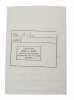
The picture shows Bohr participating in what would become one of the most important physic conferences in the second half of the 20th century. Here CERN, the European Organization for Nuclear Research, was established. Niels Bohr had been one of the central figures in the development of atomic theory in the early 20th century and was the father to the exceedingly important Copenhagen Interpretation. These merits made him the head of the theoretical division of CERN which was located in Copenhagen. ""In Geneva the representatives of 12 European governments signed the convention setting up the interim organization, which came into being on 15 February 1952 with the title of ""European Council for Nuclear Research"", called ""CERN"" for short after the initials of the French title. Belgium, Denmark, France, the German Federal Republic, Greece, Italy, the Netherlands, Norway, Sweden, Switzerland and Yugoslavia were then provisionally united to carry out nuclear research. During the whole lifetime of the interim CERN, the United Kingdom remained simply an observer, although the interest shown in the project by that country soon took the shape of new ideas, the provision of consultants and gifts."" (CERN COURIER).
Physical Science and the Study of religions.
(Copenhagen), Munksgaard, 1953. Royal8vo. In orig. printed wrappers. Offprint from ""Studia Orientalia Ioanni Pedersen septuagenario""., pp. 385-390.
First edition. - Rosenfeld: 95.
PHYSIQUE ATOMIQUE ET CONNAISSANCE HUMAINE
DENOEL GONTHIER. 1964. In-12. Broché. Bon état, Couv. convenable, Dos satisfaisant, Intérieur frais. 181 pages- nombreuses annotations à l'encre sur la page de faux titre. . . . Classification Dewey : 530-Physique
COLLECTION BIBLIOTHEQUE MEDIATIONS N°18 Classification Dewey : 530-Physique

"Physique atomique et connaissance humaine - collection ""Bibliothèque médiations"""
Denoël/Gonthier. 1964. In-12. Broché. Etat d'usage, Couv. légèrement passée, Dos satisfaisant, Papier jauni. 181 pages.. . . . Classification Dewey : 530-Physique

Classification Dewey : 530-Physique
Physique atomique et connaissance humaine. Traduit par Edmond Bauer et Roland Omnes
Gauthier-Villars 1961 In-8 broché 24,2 cm sur 15,8. 98 pages. Dos muet. Bon état d’occasion.
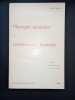
Bon état d’occasion
The Penetration of Atomic Particles through Matter.
Copenhagen., 1948. Orig. printed wrappers. 144 pp.
First edition
The quantum postulate and the recent development of atomic theory. - [COINING THE TERM 'COMPLEMENTARITY']
London, Macmillan and Co., 1928. Royal8vo. In recent full blue cloth with gilt lettering to spine. Extracted from ""Nature"", January - June, 1928, Vol. 121. Entire April 14-issue offered. Fine and clean. [Bohr:] Pp. 580-90. [Entire issue:] Pp. 561-608.
First edition of Bohr's exceedingly influential statement of his 'complementarity' principle, the basis of what became known as the 'Copenhagen interpretation' of quantum mechanics. In the paper he coined the term 'complementarity' and thereby created an entire new fundamental principle of quantum mechanics.""Immediately after Heisenberg's work on uncertainty relations, Bohr presented his concept of complementarity at a conference a Lake Como in Italy. Bohr's lecture marked the first attempt to provide a genuine philosophical underpinning to the new advances in physics. The uncertainty relations had provided Bohr a concrete measure of the consequences of the wave-particle duality and thereby a physics-based justification for the ideas he was working on. Bohr had already embraced the wave-particle duality underlying quantum theory and he presented the concept of complementarity as the fundamental feature of a new conceptual framework broad enough to include it"" (Paul McEvoy, Niels Bohr). ""For Bohr, complementarity was an almost religious belief that the paradoxes of the quantum world must be accepted as fundamental, not to be 'solved' or trivialized by attempts to find out 'what's really going on down there.' Bohr used the word in an unusual way: the 'complementarity' of waves and particles, for example (or of position and momentum), meant that when one existed fully, its complement did not exist at all"" (Louisa Gilder, The Age of Entanglement). ""The lecture was published in Nature in 1928 in a revised form It sparked significant debate in the years that followed and solidified the boundaries between those who accepted Bohr's view of the consequences of quantum theory and those who were seeking a more 'realistic' microscopic theory or a more realistic interpretation of quantum theory itself"" (McEvoy, P. 70).The paper was published almost simultaneously in English, Danish, English, French and German, the present English publication being the first.
Zur Frage der Polarisation der Strahlung in der Quantentheorie. - [TOWARDS QUANTUM THEORY]
Braunschweig und Berlin, Vieweg & Sohn, Julius Springer, 1921. Contemp. hcloth. Stamp on titlepage. In ""Zeitschrift für Physik. Hrasg. von Karl Scheel"", vol. 6., IV,416 pp. Bohr's paper: pp. 1-9. A faint dampstain in right margin.
First edition. ""...in the hands of Bohr and his school the correspondence principle was like ""a magic wand that allowed the results of the classical wave theory to be of use for the quantum theory...but a costly price had to be paid. For taking resort to classical physics in order to establish quantum-theoretic predictions, or in other words, constructing a theory whose corroboration depends on premises which conflict with the substance of the theory, is of course a serious inconsistency from the logical point of view. Being fully aware of this difficulty, Bohr attempted repeatedly to show ""the correspondence principle must be regarded purely as a law of quantum theory, which can in no way diminish the contrast between the postulates and electrodynamic theory."" The earliest allusion to such a conception may perhaps be found as early as 1921 in a paper (the paper offered) in which Bohr briefly discussed the function of the principle...""(Max Jammer).
Zur Frage der Polarisation der Strahlung in der Quantentheorie. - [TOWARDS QUANTUM THEORY - THE CORRESPONDENCE PRINCIPLE]
Braunschweig und Berlin, Vieweg & Sohn, Julius Springer, 1921. 8vo. Bound in Contemporary half cloth. Stamp on title-page. In ""Zeitschrift für Physik. Hrasg. von Karl Scheel"", vol. 6. [Bohr's paper:] pp. 1-9. [Entire volume: IV, 416 pp].
First edition of this seminal contribution to the correspondence principle. ""...in the hands of Bohr and his school the correspondence principle was like ""a magic wand that allowed the results of the classical wave theory to be of use for the quantum theory...but a costly price had to be paid. For taking resort to classical physics in order to establish quantum-theoretic predictions, or in other words, constructing a theory whose corroboration depends on premises which conflict with the substance of the theory, is of course a serious inconsistency from the logical point of view. Being fully aware of this difficulty, Bohr attempted repeatedly to show ""the correspondence principle must be regarded purely as a law of quantum theory, which can in no way diminish the contrast between the postulates and electrodynamic theory."" The earliest allusion to such a conception may perhaps be found as early as 1921 in a paper (the paper offered) in which Bohr briefly discussed the function of the principle...""(Max Jammer).The volume contains paper by famous phycisists such as E. Brody, H. Pauli, M. Born, W. Pauli Jr. and many others.
Zur Frage der Polarisation der Strahlung in der Quantentheorie. - [TOWARDS QUANTUM THEORY - THE CORRESPONDENCE PRINCIPLE]
Braunschweig und Berlin, Vieweg & Sohn, Julius Springer, 1921. 8vo. Bound in contemporary half cloth. Crossed out stamp on title-page. In ""Zeitschrift für Physik. Hrasg. von Karl Scheel"", vol. 6. Entire volume offered. [Bohr's paper:] pp. 1-9. [Entire volume: IV, 416 pp].
First edition of this seminal contribution to the correspondence principle. ""...in the hands of Bohr and his school the correspondence principle was like ""a magic wand that allowed the results of the classical wave theory to be of use for the quantum theory...but a costly price had to be paid. For taking resort to classical physics in order to establish quantum-theoretic predictions, or in other words, constructing a theory whose corroboration depends on premises which conflict with the substance of the theory, is of course a serious inconsistency from the logical point of view. Being fully aware of this difficulty, Bohr attempted repeatedly to show ""the correspondence principle must be regarded purely as a law of quantum theory, which can in no way diminish the contrast between the postulates and electrodynamic theory."" The earliest allusion to such a conception may perhaps be found as early as 1921 in a paper (the paper offered) in which Bohr briefly discussed the function of the principle...""(Jammer).The volume contains paper by famous phycisists such as E. Brody, H. Pauli, M. Born, W. Pauli Jr. and many others.
Über den Bau der Atome. Mit 9 Abbildungen.
Berlin, Julius Springer, 1924. Uncut in orig. printed wrappers. 60 pp.
First German edition of Bohr's Nobel Prize Lecture. It is translated by W. Pauli Jr. after the Danish original ""Om Atomernes Bygning, Nobelforedrag."" - Rosenfeld No 26.
Über die Anwendung der Quantentheorie auf den Atombau. I. Die Grundpostulate der Quantentheorie. - [TOWARDS QUANTUM THEORY]
Braunschweig u. Berlin, Vieweg & Sohn, Julius Springer, 1923. Contemp. hcloth. A nick in middle of spine, otherwise fine. Stamp on titlepage. In ""Zeitschrift für Physik. Hrsg. von Karl Scheel"", BD. 13. IV,406 pp. Bohr's paper: pp. 117-165.
First edition. As Bohr in his 1918 paper (The quantum theory of line spectra) had discussed the expectation that there was a necessary connection between the classical and the future theory in the limit of large quantum numbers, and in a later paper (1920) named it ""Korrespondenzprincip"" (Principle of Correspondance), Bohr now in the paper offered discussed again the fundamental principles of Quantum Theory in connection with the Principle of Correspondence.Rosenfeld No 29.
Über die Anwendung der Quantentheorie auf den Atombau. I. Die Grundpostulate der Quantentheorie. - [TOWARDS QUANTUM THEORY]
Berlin, Springer, 1923. 8vo. In contemporary half cloth with gilt lettering. In ""Zeitschrift für Physik"" Bd. 13 & 14, 1923. Entire volumes offered, bound in one. Stamp to front free end paper, otherwise a fine and clean copy. Pp. 237-255. [Entire volume: V, (1) 426 pp.].
First edition. As Bohr in his 1918 paper (The quantum theory of line spectra) had discussed the expectation that there was a necessary connection between the classical and the future theory in the limit of large quantum numbers, and in a later paper (1920) named it ""Korrespondenzprincip"" (Principle of Correspondance), Bohr now in the paper offered discussed again the fundamental principles of Quantum Theory in connection with the Principle of Correspondence.Rosenfeld No 29.Also in the volume is Born & Heisenberg's paper, ""Über Phasenbeziehungen bei den Bohrschen Modellen von Atomen und Molekeln"", on Bohr's atomic model, being a part of Heisenberg's Habilitation, which he completed under Born in 1924 in Göttingen.Cassidy 1923a.
Logarithmisch-Trigonometrische Tafeln mit fünf Decimalstellen. Sechste Stereotyp-auflage. - [FROM THE LIBRARY OF NIELS BOHR]
Berlin, P. Stankiewicz, (forword dated 1884). 8vo. Publishers blind stamped cloth. With RUBBER STAMP of NIELS BOHR and HANDWRITTEN SIGNATURE of CHRISTIAN. XVI,173,(1),(2) pp.
From the library of physicist Niels Bohr and his father Christian Bohr.
"BOHR, NIELS AND F. KALCKAR. - THE LIQUID DROP MODEL OF BOHR INTRODUCED.
Reference : 48816
(1937)
On the Transmutation of Atomic Nuclei by Impact of Material Particles. I. General theoretical Remarks. (all published)
Copenhagen, Levin & Munksgaard,1937. 8vo. Uncut in orig. printed wrappers. In: ""Det KGL. Danske Videnskabernes Selskab. Mathematisk-fysiske Meddelelser. XIV,10"". 40 pp. Fine and clean.
First edition of the work in which Bohr introduced his famous Liquid Drop Model of the atom in order to interprete the nuclear structure. (The paper was not continued as Kalckar died the following year).""It had, of course, been clear to Bohr that analogies with atomic spectra could not be of help in interpreting his (earlier) picture of nuclear structure. Peripheral electrons, thinly spread within the atomic volume, can be compared to a dilute gas of particles interacting in pairs only. By contrast Bohr's picture of intranuclear motions of tightly bound nucleons should show 'essential collective aspects', he said. Now, together with Kalckar, he suggested that for nuclei a much more proper comparison would be with a drop of liquid. That analogy should not be taken too literally, the dynamics of a true liquid drop is vastly different from thta of nucleai. Yet the comparison, treated cautiously, was tempting and in the event proved fruitful in many respects, particularly in regard to collective motions.""(Pais ""Niels Bohr's Times"", pp. 339-40).""In the liquid drop model, formulated by Niels Bohr, the nucleons are imagined to interact strongly with each other, like the molecules in a drop of liquid. A given nucleon collides frequently with other nucleons in the nuclear interior, its mean free path as it moves about being substantially less than the nuclear radius. This constant ""jiggling around"" reminds us of the thermal agitation of the molecules in a drop of liquid. The liquid drop model permits us to correlate many facts about nuclear masses and binding energies"" it is useful in explaining nuclear fission. It also provides a useful model for understanding a large class of nuclear reactions."" (FAQ).Rosenfeld No 56.
Réunion Internationale de Physique-Chimie-Biologie. Congrès du Palais de la Découverte Paris - Octobre 1937.
Paris, Hermann et Cie, 1938. Orig. printed wrappers. VIII,527 pp.
With original contributions by Bohr (Mechanique nucleaire), I.P. Debye, Raman, Polanyi, Bothe, Perrin, Blackett and others.
Über die Quantentheorie der Strahlung. (The quantum theory of radiation). - [TOWARDS QUANTUM MECHANICS]
Braunschweig, Berlin, Vieweg & Sohn u. Julius Springer, 1924. 8vo. Bound in contemporary halfcloth. In ""Zeitschrift für Physik"", Bd. 24. (Entire volume offered). A stamp on titlepage otherwise fine and clean. Pp.69-87. [Entire volume: IV,412 pp].
First apperance (simultaneously printed in Philosophical Magazine) of a fundamental paper in the development of the Quantum Theory, as it here was set forth three fundamental ideas: 1. Slater's idea of 'a Virtual radiation field', 2. statistical conservation of energy and momentum, and 3. statistical independence of the processes of emission and absorption in distant atoms. (See Van der Waerden ""Sources of Quantum Mechanics"" No. 5).""In an effort to reconcile the particulate and wavelike properties of radiation, Bohr, Kramers, and Slater in 1924 formulated a new quantum theory of radiation. According to their hypothesis, momentum and energy-are conserved only statistically in interactions between radiation and matter."" (DSB).The present paper became a great influence to Bothe and his Compton collisions and the Coincidence method which eventually resulted in him being awarded the Nobel Prize in Physics.
Über die Quantentheorie der Strahlung. (The quantum theory of radiation). - [TOWARDS QUANTUM MECHANICS]
Braunschweig, Berlin, Vieweg & Sohn u. Julius Springer, 1924. 8vo. Bound in contemporary halfcloth. In ""Zeitschrift für Physik"", Bd. 23 & 24. (Entire volume offered). No stamps, not an ex library copy. Fine and clean. Pp.69-87. [Entire volume: IV,412 pp].
First apperance (simultaneously printed in Philosophical Magazine) of a fundamental paper in the development of the Quantum Theory. Three fundamental ideas were set forth here: 1. Slater's idea of 'a Virtual radiation field', 2. statistical conservation of energy and momentum, and 3. statistical independence of the processes of emission and absorption in distant atoms. (See Van der Waerden ""Sources of Quantum Mechanics"" No. 5).""In an effort to reconcile the particulate and wavelike properties of radiation, Bohr, Kramers, and Slater in 1924 formulated a new quantum theory of radiation. According to their hypothesis, momentum and energy-are conserved only statistically in interactions between radiation and matter."".The present paper became a great influence to Bothe and his Compton collisions and the Coincidence method which eventually resulted in him being awarded the Nobel Prize in Physics.
"[BOHR, NIELS (+) H. B. G. CASIMIR (+) L. ROSENFELD (+) A. PAIS (+) W. HEISENBERG (+) D. H. PERKINS (+) H. ALFVÉN et al].
Reference : 51307
(1952)
Report of the International Physics Conference Sponsored by The Council of Representatives of European States for Planning and International Laboratory and Organizing other form of Co-operation in Nuclear Research. Institute for Theoretical Physics Co...
Copenhagen, Institute for Theoretical Physics, 1952. 4to. In the original grey stapled printed wrappers. Stenciled. ""52.15"" wirtten in top right corner of front wrapper. Very fine and clean. 65 pp.
Rare stenciled report on the major international physics conference held in Copenhagen, 1952, sponsored by the Council of Representatives of European States ""for planning an international laboratory and organizing other forms of co-operation in nuclear research"" (From the introduction in the present report by Niels Bohr). This laid much of the technical foundation for the CERN-acceleration built two years later. ""[…] an international nuclear physics conference was held in Copenhagen"" on that occasion the type of accelerator to be built as the main goal of the new European organization was amply discussed. A report on the conclusions reached by the participants was presented by Heisenberg to the Council which held its Second Meeting in Copenhagen immediately after the Conference. Thus the decision was taken that the Proton-Synchrotron Group should explore the possibility of constructing a 10 GeV proton-synchrotron which, at that time, represented the biggest machine in the world."" (Amaldi, 20th Century Physics, Essays and Recollections).
On the Constitution of Atoms and Molecules. 3 Parts (all). (+) The High-Frequency Spectra of the Elements. - [THE BIRTH OF MODERN ATOMIC THEORY (PMM 411)]
London, Taylor & Francis, 1913. 8vo. Bound in one nice contemporary half calf binding with gilt leather title-label to spine. Published in ""The London, Edinburgh, and Dublin Philosophical Magazine and Journal of Science"", Vol. 26. No. 151-156 offered. Small repair to spine and blind stamped to lower part of title page. Front hindge a bit loose. A fine copy. The Bohr papers: pp. 1-25" pp. 476-502 pp. 857-875. [Moseley:] Pp. 1024-1034. [Entire volume: VIII, 1064 pp.+ 24 plates].
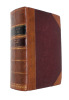
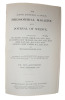
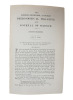
First edition of Bohr's seminal main work, which constitutes the departure from classical theories to the birth of modern atomic physics" by incorporating Planck's quantum postulate it became possible to calculate the wavelength of the hydrogen emission and thus to explain the regularity of the Balmer-lines. In 1922 Bohr was awarded the Nobel Prize ""for his services in the investigation of the structure of atoms and of the radiation emanating from them"".""Bohr's three-part paper postulated the existence of stationary states of an atomic system whose behavior could be described using classical mechanics, while the transition of the system from one stationary state to another would represent a non-classical process accompanied by emission or absorption of one quantum of homogeneous radiation, the frequency of which was related to its energy by Planck's equation"" (Norman).In his previous paper (""On the Theory of Decrease of Velocity of Moving Electrified Particles on passing through Matter"") Bohr had adopted Rutherford's nuclear model of the atom, and had become convinced that it was the peripherical electrons that determined the chemical properties of an element, whereas the nucleus determine the radioactive properties. However, Rutherford's model had an apparent explanatory problem: Why were the negatively charged electrons held away from the positive nucleus? In his doctorial dissertation on the electron theory of metals, Bohr had clarified the limitations of this theory, in particular its ability to explain magnetic properties, and he had shown how this arose from the classical nature of some of its foundations. Bohr strongly expected that the key to solving this problem was to be found in some way of introducing Planck's law of quantum action.In the beginning of 1913 Bohr heard about Rydberg's remarkable discovery in spectroscopy. Rydberg's formula could represent the frequencies of the lines of the hydrogen spectrum in the simplest form in terms of two integers. As soon as Bohr saw this formula, he immediately recognized that it gave him the missing clue to the correct way to introduce Planck's law of quantum of action into the description of the atomic systems. The rest of the academic year was spent reconstructing the whole theory upon the new foundation and expounding it in a large treatise, which was immediately published as these three papers in the 'Philosophical Magazine'. It was in these papers that Bohr first gave his postulates of the orbital structure of the electrons and their quantized radiation.Bohr's atomic theory inaugurated two of the most adventurous decades in the history of science. Bohr introduced the following postulates: 1. An electron can revolve about its nucleus only in certain special circular orbits. 2. The ordinary electron revolves about its nucleus in an invariable orbit, without radiating or absorbing energy. 3. Radiation takes place when and only when the electron falls from an orbit with greater energy to one of less energy.""In his great papers of 1913, Bohr presented his theory as being founded upon two postulates, whose formulation he refined in later papers. The first postulate enunciates the existence of stationary states of an atomic system, the behavior of which may be described in terms of classical mechanics" the second postulate states that the transition of the system from one stationary state to another is a nonclassical process, accompanied by the emission or absorption of one quantum of homogeneous radiation, whose frequency is connected with its energy by Planck's equation. As for the principle by which the possible stationary states are selected, Bohr was still very far from a general formulation" indeed, he was keenly aware of the necessity of extending the investigation to configurations other than the simple ones to which he had restricted himself. The search for sufficiently general quantum conditions defining the stationary states of atomic systems was going to be a major problem in the following period of development of the theory."" (DSB).Also contained in the volume is Henry Moseley's famous paper ""The High-Frequency Spectra of the Elements"" in which he ""used the method of X-ray spectroscopy devised by Braggs to calculate variations in the wave length of the rays emitted by each element. These he was able to arrange in a series according to the nuclear charge of each element. [...] It was now possible to base the periodic table on a firm foundation, and to state with confidence that the number of elements up to uranium is limited to 92."" (PMM 407).PMM 411Rosenfeld, Bohr Bibliography No. 6.
Electron Capture and Loss by Heavy Ions Penetrating Through Matter.
Copenhagen, 1954. Matematisk-fysisk Meddelelser, volume 28, no. 7. Completely fresh and unopend copy. 31 pp.
Rosenfeld no. 96.
"BOHR, NIELS. & LÉON ROSENFELD. + LEV LANDAU & RUDOLF PEIERLS.
Reference : 35750
(1933)
[Three papers] 1. Zur Frage der Messbarkeit der elektomagnetischen Feldgrössen. + 2. Erweiterung des Unbestimmtheitsprinzips für die relativistische Quantentheorie. + 3. Field and Charge Measurements in Quantum Electrodynamics. - [QUANTUM FIELD THEORY]
Copenhagen, Levin & Munksgaard, 1933. + Berlin, Springer 1931. + Lancaster, American Physical Society, 1950. First paper: Published as no. 8 of vol. 12 in 'Kgl. Dankse Vid. Selsk. Math.-Fys. Medd.'. 8vo. Original printed wrappers. With the ownership signature of Danish physicist Mogens Pihl (Prof. of physics at Copenhagen University 1957-77). 65,(1) pp. Second paper: Published in 'Zeitschrift für Physik', vol. 69, pp.56-69. The entire volume in contemporary half cloth offered here.Third paper: Published in 'The Physical Review', vol. 78, no. 6, pp.794-798. The entire issue in original printed wrappers offered here. With rubber stamp of Danish physicist Christian Møller (Author of ""The Theory of Relativity, 1952"").
First editions of these fundamental papers in the development of quantum field theory. The process of measuring electromagnetic fields involves the observation of charged test bodies in those fields. Therefore the theory of electrodynamics is an inseparable extension of mechanics. A quantum theory of fields thus inherits, in some form, the limitations of measurement which lie at the foundation of quantum mechanics. In 1931 Landau and Peierls published a critical analysis of the consequences of such limitations in a relativistic quantum theory of fields (second paper offered). Landau and Peierls came to the negative conclusion that in several cases, the concept of momentum was without physical meaning and quantities such as the strength of a field was un-measurable. In their famous paper from 1933 Bohr and Rosenfeld (first paper offered) carefully reviewed the arguments of Landau and Peierls and showed, through the use of particular measuring arrangements, that a consistent quantum theory of fields is possible without further limitations than the ones which secure the consistency of quantum mechanics. The BR-paper is often credited with having laid the foundation for quantum electrodynamics. Bohr continued his work in this field, and in 1937 he completed a manuscript entitled ""Field and Charge Measurement in Quantum Theory"", but this was never published. When, in the late 1940s the important work on QED by Tomonaga, Schwinger, Dyson, and Feynman appeared in The Physical Review, Bohr and Rosenfeld again joined and published the essentials of the 1937 manuscript in the same journal (third paper offered).See Abraham Pais: Bohr's Times, pp.358-364. Mehra & Rechenberg: The Historical Development of Quantum Theory, vol. 6, pp.697-703. Collected Works of Niels Bohr, vol. 7, pp.3-33.

