 Write to the booksellers
-
Type
Art print (2)
Book (5889)
Magazine (20)
Manuscript (1)
Old papers (1)
Photographs (3)
-
Latest
Last 24h (2)
Last month (33)
Last week (5)
-
Language
English (10)
French (5901)
German (1)
Greek (1)
Italian (1)
Latin (2)
-
Century
16th (2)
17th (9)
18th (246)
19th (886)
20th (2973)
21st (132)
-
Countries
Belgium (264)
Canada (3)
Côte d'Ivoire (13)
Denmark (1369)
France (3966)
Switzerland (301)
-
Syndicate
ALAC (3)
CLAM (3)
ILAB (4124)
NVVA (139)
SLACES (139)
SLAM (2593)
SNCAO (15)
Nouvelles récréations physique et mathématiques, contenant ce qui a été imaginé de plus curieux dans ce genre, et ce qui se découvre journellement; auxquelles on a joint les causes, leurs effets, la manière de les construire, et l’amusement qu’on en peut tirer pour étonner et surprendre agréablement. Troisième édition, considérablement augmentée. 3 Volumes.
Paris, chez Gueffier 1786, 208x125mm, XV-VII- 375 + 410 + 408pages, demi-veau à coins, pièces de titre en cuir rouge, manquantes aux tome 2 et 3. Bon état.
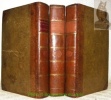
illustré de 102 planches gravées, dont 21 en parties coloriées (32/48/22), Pour un paiement via PayPal, veuillez nous en faire la demande et nous vous enverrons une facture PayPal
Mass loss and evolution in close binaries proceedings of the IAU colloquium N°6
Copenhagen university publications fund. 1970. In-8. Broché. Bon état, Couv. convenable, Dos satisfaisant, Intérieur frais. 238 pages.. . . . Classification Dewey : 530-Physique
Etiquette sur coiffe en pied. Tampon bibliothèque. texte écrit en anglais. Classification Dewey : 530-Physique

Physik als Erlebnis. Experimente aus dem HEUREKA Volkslabor, mit einem Begriffsverzeichnis.
Zürich, Schweizerische Akademie der technischen Wissenschaften, 1991, gr. in-8vo, 48 S. ill., Original-Pappband.

(SLACES, NVVA)
Phone number : 41 (0)26 3223808
Physik für alle. Eine volkstümliche Darstellung der Physik und ihrer technischen Anwendungen. Unter Mitarbeit von Helmut Kröncke und unter autorisierter Benutzung der «Wunderwelt der Physik» von Th. Rulemann. In 2 Bänden.
Stuttgart, Dieck, 1926-1927, in-4°, 393 S. / 327 S., mit 777 Illustrationen und 41 Porträts, Original-Leinenbände, mit OU. (O. Umschlag: Ludwig Hollwein).
Band 1 «Das Reich der Mechanik» in zweiter Auflage, Band 2 «Schall / Wärme / Licht» in erster Auflage. “Zweck des vorliegenden Werkes ist, die Grundlagen der Physik in leichtverständlicher Form und ohne Anwendung mathematischer Formeln Lesern ohne fachliche Vorkenntnisse zu vermitteln ...(aus dem Vorwort). Image disp.
(SLACES, NVVA)
Phone number : 41 (0)26 3223808
Das Verhalten von Atomen im magnetischen Drehfeld. - [FIRST DERIVATION OF THE HELLMANN-FEYNMAN FORMULAS]
Berlin, Springer, 1932. 8vo. In contemporary halv cloth with gilt lettering to spine. In ""Zeitschrift für Physik"", Bd. 73, 1932. Entire issue offered. Stamp to front free end-paper and titlepage, Extremities with light wear. Pp. 169-84. [Entire volume: VII, (1), 846 pp.].
First appearance of Paul Güttinger's important paper which constitute the first derivation of the Hellmann-Feynman formulas.In quantum mechanics, the Hellmann-Feynman theorem relates the derivative of the total energy with respect to a parameter, to the expectation value of the derivative of the Hamiltonian with respect to that same parameter. According to the theorem, once the spatial distribution of the electrons has been determined by solving the Schrödinger equation, all the forces in the system can be calculated using classical electrostatics.
Das Verhalten von Atomen im magnetischen Drehfeld. - [FIRST DERIVATION OF THE HELLMANN-FEYNMAN FORMULAS]
Berlin, Springer, 1932. 8vo. In contemporary halv cloth with gilt lettering to spine. In ""Zeitschrift für Physik"", Bd. 73, 1932. Entire issue offered. Stamp to front free end-paper and titlepage, Extremities with light wear. Pp. 169-84. [Entire volume: VII, (1), 846 pp.].
First appearance of Paul Güttinger's important paper which constitute the first derivation of the Hellmann-Feynman formulas.In quantum mechanics, the Hellmann-Feynman theorem relates the derivative of the total energy with respect to a parameter, to the expectation value of the derivative of the Hamiltonian with respect to that same parameter. According to the theorem, once the spatial distribution of the electrons has been determined by solving the Schrödinger equation, all the forces in the system can be calculated using classical electrostatics.
Einfuhrung in die theoretische Physik mit besonderer Berucksichtigung ihrer modernen probleme -- EDITION ORIGINALE -- 2 VOLUMES (COMPLETE SET)
Berlin und Liepzig, Walter de Gruyter, 1921, 2 volumes in 8 reliés en pleine toile éditeur, (dos passé), T.1 : 7pp., 384pp., T.2 : 6pp., 286pp.
---- EDITION ORIGINALE ---- BON EXEMPLAIRE ---- "Haas became the first to apply a quantum formula to the clarification of atomic structure. In the process he substituted real atoms for the more formula than physical Planck oscillators in the radiation cavity... He was a remarkable forerunner of Bohr's atomic theory...". (DSB V p. 609)**5604/M2
Physik fur jedermann mit besonderer Berucksichtigung der modernen technischen Anwendunger -- EDITION ORIGINALE
Berlin, Springer, 1933, un volume in 8 relié en pleine toile éditeur, 10pp., 273pp.
---- EDITION OIRIGINALE ---- BON EXEMPLAIRE ---- "Haas'w work in the history of physics was inspired by his interest in older as well as modern theories (He was invluenced by Mach's and Ostwald's interest in the history of science). Haas possessed the conviction that no other method is as suited as the historical for facilitating the understanding of physical principles and for clarifying and deepening the knowledge of their significance . His numerous books written from this point of view, often based on his lectures and addresses, are masterpieces of clear exposition". (DSB V pp. 60/610) ---- Das Licht - Die Elektrizität - Die Wärme - Die Materie**2528/K2
Die Welt der Atome. Zehn gemeinverständliche Vorträge.
Berlin, Leipzig, W. de Gruyter, 1926. Cont. hcloth. VIII,130 pp., textillustr. and 3 plates.
First edition.
Materiewellen und Quantenmechanik. Eine elementare Einführung auf Grund der Theorien De Broglies, Schrödingers und Heisenbergs.
Leipzig, Akademische Verlagsgesellschaft, 1928. Orig. full cloth. VI,(2),160 pp. Fine and clean, near mint condition.
First edition.
Einführung in die theoretische Physik. Mit besonderer Berücksichtigung ihrer modernen Probleme. 3. und 4., völlig umgearbeitete und vermehrte Auflage. In 2 Bänden.
Berlin und Leipzig, 1923-24, gr. in-8°, X + 307 S. (S. 46-47 leichte Durchstreichungen mit Tintenfeder) / VIII + 379 S., mit insgesamt 130 Abbildungen im Text und auf 2 Tafeln, Original-Leinenbände.
Der österreichische Physiker Arthur Haas war Professor in Leipzig und Wien.“Haas work in the history of physics was inspired by his interest in older as well as modern theories. He possed the ‘conviction that no other method is as suited as the historical for facilitating the understanding of physical principals and for clarifying and deepening the knowledge of their significance’. His numerous books written from this point of view, often based on his lectures and addresses, are masterpieces of clear exposition which were widely diseminated and translated into many languages.”Dictionary of Scientific Biography V/609-610; Brockhaus V/168.
(SLACES, NVVA)
Phone number : 41 (0)26 3223808
Sur la métallographie électronique. Techniques opératoires. Etude des structures d’aciers au Carbone et d’aciers faiblement alliés. Etude du comportement à chaud d’un acier au Cr-Mo.Université de Liège. Faculté des sciences appliquées.
Liège, 1953, 300x210mm, 163pages, broché. Très bel exemplaire.
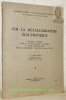
46 planches en n/b, Pour un paiement via PayPal, veuillez nous en faire la demande et nous vous enverrons une facture PayPal
LA CORROSION DES METAUX.
PRESSES UNIVERSITAIRES DE FRANCE. 1959. In-12. Broché. Etat d'usage, Couv. défraîchie, Coiffe en tête abîmée, Intérieur acceptable. 124 pages - quelques figures en noir et blanc dans et hors texte - tampon + annotation sur la page de titre et de faux titre - étiquette collée en regard de la page de titre - coins frottés - étiquette collée sur la coiffe en pied - coiffe en pied abîmée.. . . . Classification Dewey : 530-Physique
Collection que sais je ? le point des connaissances actuelles N°843. Classification Dewey : 530-Physique
La libération de l’énergie nucléaire. Extrait de Actes de la Soc. Helvétique des Sciences Naturelles.
Lausanne, F. Rouge 1945, 230x155mm, 17pages, broché.
Pour un paiement via PayPal, veuillez nous en faire la demande et nous vous enverrons une facture PayPal
Comment on fait quelques expériences Magnétiques et Hypnotiques à l'état de veille.
Paris, Librairie Mesmérienne, sans date (circa 1920) ; in-8, broché ; 63, (1) pp., couverture verte.
Edition originale rare. L'expérimentation consiste à faire faire toute sorte d'opérations physiques ainsi que d'imposer des interdictions (de fumer, etc.), et d'animer une sorte de spectacle privé ! Petites traces d'insolation sans importance, bon état général.
Die Aggregatzustände des Wassers.
Berlin, 1888. Contemp. clothbacked boards. Stamp on title. 11 pp. Scattered brownspots. Inscribed copy.
L’expérience de la rotation électro-magnétique et l’induction unipolaire.“Bibliothèque Universelle. Archives des Sciences Physiques et Naturelles.”
Genève, Bureau des Archives 1901, 230x145mm, 61pages, broché. Bon état.
Pour un paiement via PayPal, veuillez nous en faire la demande et nous vous enverrons une facture PayPal
Uber das Zerplatzen des Urankernes durch langsame Neutronen in Abhandlungen der Preussischen Akademie der Wissenschaften, Jahrgang 1939, Mathematisch-Naturwissenschaftliche Klasse, N° 12 -- EDITION ORIGINALE -- TIRE-A-PART (OFF-PRINT) -- BEL EXEMPLAIRE
Berlin, Akademie der Wissenschaften, 1939, un volume in 4 broché, couverture imprimée, 20pp., figures dans le texte
---- EDITION ORIGINALE ---- TIRE-A-PART (OFF-PRINT) ---- TRES BEL EXEMPLAIRE ---- "NUCLEAR FISSION" ---- DIBNER N° 168 : "HAHN and STRASSMANN, bombarding uranium with neutrons (as indicated by Fermi in the mid-1930s), found that treating the bombarded uranium with barium resulted in some strongly radioactive material. By late 1938 they suspected that uranium fission had occured, and their colleague Lise MEITNER, now under Nazi exile, announced the results from Stockholm. Aided by STRASSMANN, the report, above, was prepared and was published on 6 January 1939. It indicated fission of the uranium nucleus into two parts of about equat size with the release of much energy. Thru BOHR and FERMI this nuclear energy was to become a reality in the atomic pile and the bomb blasts of 1945 as well as in the nuclear power stations of the following decades. HAHN received the Nobel prize in 1944 ; he, MEITNER and STRASSMANN shared the U.S.A" ---- DSB VI pp. 14/17 - Partington IV p. 966 - Norman N° 963**2549/ARM4
Über den Nachweis und das Verhalten der bei der Bestrahlung des Urans mittels Neutronen entstehenden Erdalkalimetalle (+) Nachweis der Entstehung aktiver Bariumisotope aus Uran und Thorium durch Neutronenbestrahlung (+) Nachweis weiterer aktiver Bruch... - [DISCOVERY OF NUCLEAR FISSION]
Berlin, Springer, 1939. Royal8vo. Bound in later gray half cloth with marbled boards and gilt lettering to spine. In ""Naturwissenschaften"", Vol. 27, 1939. A very fine and clean copy.
First printing of these seminal papers which constitutes the first announcement of nuclear fission. The formulations in these papers are rather cautious and obviously the authors were not in possession of an explanation for the phenomena which they had observed.At this point Lise Meitner was no longer at the University of Berlin. Due to here jewish background she was forced to give up here position and she fled to Denmark. However" Hahn continued to communicate with here and reported his and Strassmann's results. Together with here nephew Otto Frisch she was able to give a physical explanation for the phenomena using the 'liquid drop model' of the atomic nuclear which had recently been developed by Niels Bohr. Meitner and Frisch submitted their paper to 'Nature' on the 16th January [3rd paper offered, the issue was published the 11th February 1939]. Hahn and Strassmann most probably came into possession of Meitner and Frisch's theory before its publication since they submitted another paper the 28th January [the 2nd paper offered, the issue was published the 10th February 1939] in which they restated there results in more detail and stated the phenomena of fission with clear certainty.
Über das Zerplatzen des Urankernes durch langsame Neutronen (Offprint from ""Abhandlungen der Preussischen Akadamie der Wissenschaften""). - [THE FIRST OF THE FOUNDING PAPERS ON THE DISCOVERY OF NUCLEAR FISSION]
Berlin, Walter de Gruyter und Co., 1939. 4to (295 x 210 mm). In the original printed green wrappers. A little faded at edges, but otherwise a near perfect copy. Completely clean and fresh, also the title on the thin spine. Illustrated. 20 pp.
First edition, offprint issue, of the first of Hahn and Strassmann's seminal papers on nuclear fission which eventually lead to the creation of the atomic bomb. As a chemist, Hahn was initially reluctant to propose a revolutionary discovery in physics. Lise Meitner and her nephew, Otto Frisch, in Sweden, came to the same conclusion and were able to work out the basic mathematics of nuclear fission – a term that was coined by Frisch. ""The discovery of nuclear fission by Otto Hahn and Fritz Strassmann opened up a new era in human history. It seems to me that what makes the science behind this discovery so remarkable is that it was achieved by purely chemical means."" (Lise Meitner, 1963). At the end of the war Hahn was astonished to hear that he had won the Nobel Prize in Chemistry in 1944 and that nuclear bombs had been developed from his basic discovery. “In 1934 Fermi roused the world of radioactivity with his method of neutron bombardment and that same year reported on the possible production of transuranic elements by irradiating uranium with neutrons. The irradiation had led to radioactive substances with different half-lives such as 10s, 40s, 13min, and 90min. Fermi’s group had separated the 13-min and 90-min ‘bodies’ chemically from uranium and had shown that they were not isotopes of elements, which are located only a few places below uranium in the Periodic Table … they assumed that the uranium nucleus with the extra neutron transformed, via beta decay, into a nucleus of an element with the number 93 in the Periodic Table. That could still be unstable and transit, by another beta decay, into a nucleus of element 94.The idea of more than 92 elements was, of course, contested. Ida Noddack, a renowned chemist and co-discoverer of the element rhenium, pointed out that all known elements had to be excluded before new ones were proposed. This very sound advice was not taken. Nuclear physicists saw no possibility for a nucleus to fragment into large pieces. Nothing more drastic than alpha decay had ever been observed. Another way out was also proposed: in spite of Fermi’s interpretation, his 13-min body might be an isotope of protactinium, element number 91. Here Hahn and [Lisa] Meitner came in. After all, they were discoverers of protactinium and knew the properties of this element. They were able to show that the activity in question was not due to protactinium and became convinced that transuranic elements had been produced. They began intensive work in this new field, from 1935 onwards together with Strassmann … Quite a number of substances with different half-lives and different chemical properties were found in uranium irradiated with neutrons. A detailed scheme for their production was proposed, which implied the creation and subsequent decay of four, possibly five, transuranic elements. It was not seriously challenged by other groups working in the field. When Austria was annexed in 1938, Lise Meitner became a German citizen and, because of her Jewish descent, was in acute danger. Helped by Hahn and other colleagues, she fled via Holland and Denmark to Sweden, where she could work in the Physical Institute of the Academy of Sciences in Stockholm. Hahn and Strassmann continued alone. The decay products of the apparent transuranic elements seemed to contain three substances, which underwent beta decays of different half-lives and were chemically very similar to barium. They were taken to be isomeric nuclei of the isotope Ra231 of radium. Radium is an alkaline-earth metal as is barium and is located below barium in the second column of the Periodic Table, hence the similarity. Hahn and Strassmann tried to isolate the radium. Since only minute quantities could have been produced, a precipitation with barium as carrier from a solution was performed" the barium was to carry along the chemically similar radium. The precipitate then only contained barium and radium, which were to be separated in the next step. As mentioned above, Hahn was well versed in the method of separation, fractional crystallization, originally introduced by Marie Curie. But although they tried hard and checked and rechecked their method, Hahn and Strassmann were unable to separate any radium by chemical means. In their first paper they still conclude rather cautiously: ‘We come to the conclusion: Our ‘radium isotopes’ have the properties of barium as chemists we should rather say the new bodies are not radium but barium. [. . . ] As ‘nuclear chemists’, in a certain sense close to nuclear physics, we cannot yet decide ourselves to perform this step contradicting all previous experience of nuclear physics. A series of strange coincidences might still have faked our results.’ “Hahn had kept Meitner informed by letter about the work and he mailed her a copy of the manuscript of the paper on 21 December 1938, the same day it was submitted to Die Naturwissenschaften. The manuscript reached her in a small town near Gothenburg, where she had gone to visit Swedish friends over Christmas and where she had also invited her nephew Otto Frisch. We have already met him as collaborator of Stern in Hamburg. He, too, had been forced to leave Germany and at that time was working in Bohr’s institute in Copenhagen. Meitner showed him Hahn’s letter and the manuscript and dismissed the possibility of mistake: ‘Hahn was too good a chemist for that.’ The two began to look for an explanation. The nucleus could not just been cracked like a nut. In fact there was evidence that it behaved rather like a droplet. Now, a droplet might divide into two smaller ones by contracting in one direction, then elongating, and so on, until it finally would split up. The uranium nucleus might need little extra energy to do so, because its many protons provided a repulsive electrical force counteracting the attractive nuclear force between all nucleons, protons as well as neutrons. This extra energy could be provided by a single neutron. Meitner calculated that the energy of 200 MeV would be released in a single process, an energy equivalent to one-fifth of the rest mass of a proton. After a few days, Frisch returned to Copenhagen and told Bohr, who was enthusiastic: ‘Oh what idiots we have all been! Oh but this is wonderful! Have you and Lise Meitner written a paper about it?’ Frisch told him that there would soon be a paper and asked Bohr, who was about to travel to the United States to participate in a conference, not to discuss the matter before it would appear in print … this promise could not be kept and Bohr’s reports triggered intense activities which led to the first nuclear reactor in less than four years … “For the next few years, Hahn and Strassmann continued to identify radioactive isotopes produced in uranium fission. By spring of 1945, they had found a total of about 100 isotopes from 25 different elements … In 1945 Hahn was awarded the Nobel Prize in Chemistry for the year 1944 … In 1966 Meitner, Hahn, and Strassmann were the first non-US citizens to be given the Enrico-Fermi Award by the American president” (Harvest of a Century, pp. 264-7). Hahn, Meitner, and Strassmann were not engaged in nuclear-weapons research during World War II. Hahn later, as director of the Max-Planck-Gesellschaft (the postwar successor to the Kaiser Wilhelm Gesellschaft), he spoke vigorously against the misuse of atomic energy. Meitner—who many thought should have received the Nobel Prize with Hahn—continued to do nuclear research in Sweden and then England. Strassmann nurtured the study of nuclear chemistry in Mainz, Germany.Dibner 168 Norman 963 (PMM 422)
Les radiocolloïdes
P., Hermann, 1934, un volume in 8, broché, couverture imprimée, 25pp.
---- EDITION ORIGINALE**07ar
The Coming Age of Solar Energy
Harper & Row publishers, 1973 15 x 21, 231 pp., 86 figures, cartonnage, éditeur + jaquette, Très bon état - 2e édition revue
Smoke and ashes: heritage of power. A look at the sun. The solar pioneers. - We discover the sun-again. Solar power for the space age. - Putting the sun to work. The white magic of photochemistry. - Electric power from the sun. The orbiting solar power pl
Vivre avec le rayonnement
EYROLLES. 1979. In-8. Broché. Bon état, Couv. convenable, Dos satisfaisant, Intérieur frais. 121 pages. Nombreuses illustrations et photos en noir et blanc dans le texte.. . . . Classification Dewey : 530-Physique
Préface de Pr M. Tubiana. Traduit de l'américian par Marc Odier. Classification Dewey : 530-Physique
Description du VENTILATEUR, par le moyen duquel on peut renouveller facilement & en grande quantité, l'air des mines, des prisons, des hôpitaux, des maisons de forces, & des vaisseaux […traduit de l'anglois, par M. P. Demours.
Charles-Nicolas Poirion Paris 1744 1 vol. In-12 de 1 f.n.ch. (faux titre) LII 277 pp. 1 f.n.ch., veau de l'époque, dos à nerfs orné, pièce de titre, tranches jaspées.

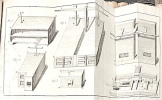
Edition originale de la traduction française. Ouvrage orné de deux planches gravées repliées. L'auteur, véritable inventeur de l'aération artificielle, y démontre l'importance du renouvellement de l'air dans les lieux clos ou confinés dans un souci sanitaire et hygiénique mais aussi son utilité dans la conservation et le séchage de diverses denrées dont la poudre à canon. Il semble que son invention fut immédiatement utilisée, surtout en France, par les soins et sous la direction de Duhamel et son utillité dans l'assainissement de l'air fut souvent soulignée (Garrison & Morton n° 1596 - DSB VI-47, pas dans Bibl. Walleriana). "Ingénieur et « physiologiste », esprit universel comme nombre de ses contemporains, le savant anglais Stephen (Etienne) Hales (1677-1761) a réalisé et expérimenté de nombreuses machines dans tous les domaines industriels. Constatant que la santé des équipages contribue largement à leur bonne tenue au combat, il conçoit un modèle de machine destiné, entre autres usages, à la ventilation des navires. Dans le XVIIIe siècle humaniste, la rapidité de la diffusion des idées se constate à la brièveté du délai de traduction et de publication en France, cinq ans après l’édition originale en Angleterre. Cependant la marine royale française, après de nombreux et très sérieux essais, renoncera à ce type de machine. Mais, placée sous la même influence hygiéniste alors synonyme de progrès, les concepteurs des vaisseaux de guerre français perfectionneront les systèmes d’aération par manche et cheminée. La maquette de la frégate « Renommée », conservée au musée national de la Marine, montre cet équipement". Bon exemplaire.
Magie, oder die Zauberkräfte der Natur, so auf den Nutzen und die Belustigung angewandt worden. Vierter und letzter Theil. (nur Bd. 4 von 4).
Wien, Trattner, 1787, in-8vo, 3 Bl. (Titelbl. mit gest. Vign.) +650 S. + 6 gef. Kupfertafeln, ex-Libris ‘Friedrich Alfred Bekker’, Orig. Pergament, Titelschildchen aus Leder.
Elektrische Versuche / Chemische Versuche / Magnetische Versuche / Optische Versuche / Oekonomische - Specifische - Vermischte Versuche
(SLACES, NVVA)
Phone number : 41 (0)26 3223808

