 Write to the booksellers
-
Type
Autograph (1)
Book (1629)
Magazine (2)
-
Latest
Last month (27)
Last week (5)
-
Century
17th (1)
18th (4)
19th (48)
20th (484)
21st (49)
-
Countries
Belgium (1171)
Canada (4)
Côte d'Ivoire (3)
France (180)
Switzerland (274)
-
Syndicate
ALAC (4)
CNE (2)
ILAB (52)
NVVA (2)
SLACES (2)
SLAM (26)
L’ami du chant. Partie pratique. Seconde section. Chants à trois ou à quatre voix. Dans un ordre méthodique, sur des textes religieux, moraux et patriotiques. Exactement messurés.
Berne, Impr. Haller 1849, 185x145mm, 78pages, broché. Taches sur le bord des premières pages
Pour un paiement via PayPal, veuillez nous en faire la demande et nous vous enverrons une facture PayPal
Debussy.
Paris, Editions de La Différence, 1987, in-4, broché, 400 pages. Bon état.
NB. Les questions et commandes sont traitées dans les 48h, les expéditions reprendront le 9 octobre. Merci !
Beethoven, biographie critique. Collection : Les musiciens célèbres.
Paris, Henri Laurens, 1952. 14 x 20, 151 pp., 14 illusrations hors texte, reliure rexine rouge, très bon état.
Richard Wagner et son influence sur l'art musical français. Collection : Les grands musiciens par les Maîtres d'aujourd'hui.
Paris, Librairie Delgrave, 1930. 14 x 19, 93 pp., quelques illustrations, broché, très bon état.
En frontispice, portrait de Richard Wagner.
Le chef d'orchestre et son équipe.
Paris, René Julliard, 1949. 14 x 19, 239 pp., reliure pleine rexine rouge, bon état (dos insolé).
Envoi de l'auteur à la page de faux-titre, mais le nom du dédicataire a été découpé.
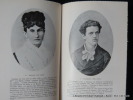
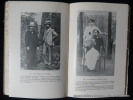
Debussy. Documents iconographiques.
Genève, Pierre Cailler, 1952, Broché, 205 documents. Bon état.
NB. Les questions et commandes sont traitées dans les 48h, les expéditions reprendront le 9 octobre. Merci !
Music and Colonialism in Fascist Italy. Identity, Propaganda, and Ethnographic Representation
, Brepols, 2026 Hardback, Pages: 292, Size:210 x 270 mm, Illustrations:39 b/w, 8 tables b/w., Language: English. ISBN 9782503624686.
Summary This book offers the first comprehensive investigation of the role of music within the context of Italian imperial expansion in Africa, with a particular focus on the Fascist period. While Italy's colonial project spanned approximately sixty years, it was during the final decades - under Mussolini's regime - that music emerged as a subtle yet potent instrument of propaganda. Despite its importance, the intersection of Italian music and colonial politics has remained critically underexplored, often eclipsed by postwar narratives that sought to deny or obscure cultural complicity. Drawing on archival sources, colonial newspapers, Italian and international press, published and unpublished scores, and personal accounts, the book examines four domains of entanglement between music and imperial ideology: the projection of Italian cultural identity in Libya through opera houses and concert programming; the colonial staging of Arab musical and dance traditions to satisfy orientalist appetites; the overlooked field of Italian musical ethnography in colonial settings, marked by flawed methodology and rare sonic documentation; and the creation of propagandistic works endorsing imperial ambitions. Special attention is given to Libya under Governor Italo Balbo, including Radio Tripoli's role in circulating local music, and to compositions by Adriano Lualdi and Alfredo Casella that engaged with imperial themes. These case studies show how music was mobilized to affirm nationalism, legitimize domination, and shape perceptions of the Other. By reintegrating music into the historiography of Italian colonialism, this study reclaims a neglected dimension of twentieth-century culture, challenging enduring silences in both musicological and postcolonial scholarship. TABLE OF CONTENTS Foreword by Gianpaolo Chiriacò Preface Chapter One. Introduction Chapter Two. Music and Cultural Hegemony in Libya: Theatres as Instruments of Empire Introduction Italian Colonialism in Libya in Context The Politics of Cultural Life in Colonial Libya Cultural Institutions in Tripolitania and Cyrenaica Modernity and Local Traditions: The Music Programming of Radio Tripoli Chapter Three. Musical Ethnography and Colonial Discourse Introduction Early Colonial Musical Ethnography and its Later Dissemination Colonial Knowledge and Musical Ethnography during the Fascist Period Case Studies: Key Figures and Contributions Sonic Representations of the Other: Sound Collection and the Display of Musical Traditions from the Overseas Territories Chapter Four. Italian Composers and Imperial Propaganda: Between Artistic Autonomy and Political Control Introduction Awards and Competitions The 'Spontaneous' Response of Composers Colonial Narratives on Stage Aural Traces of Italian Colonialism in Postcolonial Italy Epilogue Bibliography Index of Names
Madrigalkompositionen im Umfeld der Habsburger Höfe um 1600
Köln, 1992 iii + 192 + 222pp. (of which 222pp. with music scores), 21cm., softcover, text in German, Doctoral dissertation (Inaugural-Dissertation zur Erlangung des Doktorgrades der Philosophischen Fakultät der Universität zu Köln), stamp at verso of title page, text is clean and bright, good condition, M108938
über die Klangerzeugung in Orgelpfeifen
Berlin, 1969 82pp., with illustrations in text, 21cm., softcover, text in German, Doctoral dissertation (Dissertation zur Verleihung der akademische Würde Doktor-Ingenieur, Fakultät für Elektrotechnik der Terchnische Universität Berlin), text and interior are clean and bright, good condition, M108971
Le conservatoire de musique de Lausanne, 1861 - 1986. Bibliothèque historique vaudoise n.° 83.
Lausanne, BHV 1986, 230x160mm, 163pages, broché. Exemplaire à l'état de neuf.
Pour un paiement via PayPal, veuillez nous en faire la demande et nous vous enverrons une facture PayPal
Joseph Haydn, son art, son époque, sa gloire.
Paris, Editions Corrêa, 1950. 14 x 19, 289 pp., reliure rexine rouge, très bon état.
"Préface de Thomas Mann; traduit par M. Buchet."
La symphonie. Collection : Que sais-je ?, N° 1633.
Paris, Presses Universitaires de France (PUF), 1976. 12 x 18, 128 pp., broché, très bon état.
La symphonie. Que sais-je ?, N° 1633.
Paris, Presses Universitaires de France, PUF,1976. 11 x 18, 126 pp., broché, bon état (1 cachet de librairie).
Histoire musicale du Moyen-Age
Paris, PUF, 1950, in-8, Broché, 355 pages. Index. Bon état.
NB. Les questions et commandes sont traitées dans les 48h, les expéditions reprendront le 9 octobre. Merci !
Précis de musicologie
Presses Universitaires de France 1958 431 pages in8. 1958. broché. 431 pages. Le 'Précis de musicologie' dirigé par Jacques Chailley est un ouvrage collectif publié aux Presses Universitaires de France offrant un guide et un panorama de la science musicologique. Il vise à donner l'essentiel de la matière pour orienter les étudiants et chercheurs avec des références utiles
Très bon état certaines pages non coupées
Melodik und Harmonik bei Richard Wagner.
Berlin, Harmonie, 1899. 8°. 28 S. Orig.-Broschur.
Mit Gebrauchsspuren mit Klebstreifen. Papier gebräunt und stockfleckig.

La percussion. Collection : Instruments de musique.
Lausanne, Payot, 1977. 19 x 21, 108 pp., 86 illustrations en couleurs et en N/B, reliure d'édition carton imprimé, très bon état.
"L'orgue. Collection : ""Instruments de musique""."
Lausanne, Editions Payot, 1970. 19 x 21, 96 pp., nombreuses illustrations en N/B et en couleurs, quelques dessins, reliure d'édition carton illustré, très bon état.
Music and the Politics of Censorship From the Fascist Era to the Digital Age
, Brepols - Harvey Miller, 2025 Hardback, Pages: xvi + 464 pages, Size:210 x 270 mm, Illustrations:15 b/w, 1 tables b/w., Language:English, *new. ISBN 9782503618463.
In relation to music, the word censorship immediately calls to mind the totalitarian regimes of the twentieth century, in particular those of Nazi Germany and the USSR. But music censorship is arguably even more prominent and pervasive in our own age, not only in authoritarian states but also in Western liberal democracies. This book aims to enhance our understanding of censorship practices, the social and political values they serve, and the governmental and legal frameworks that have enabled them to flourish. Its twenty chapters ? written by a team of international scholars ? explore both historical case studies and the new forms of censorship that have emerged in the digital age. It evaluates different theories and models for understanding censorship, applying the concept not only to top-down government controls but also to the measures that cultural institutions, the media, and global corporations have put in place to police music and musicians. Crucial too is the exploration of how music censorship relates to other forms of political action, including cancelling, critique, and performative activism. The book also reveals the diverse strategies that musicians and listeners have employed to circumvent censorial control and to march to a different beat. TABLE OF CONTENTS James Garratt, Music and the Politics of Censorship: An Introduction Theories and Models Beate Kutschke, Five Strictures on Music Censorship James Garratt, Rethinking Music Censorship under Neoliberalism Naomi Waltham-Smith, Silenced Music, Civil Liberties, and Human Rights Law Classical Music under Censorship in the Fascist Era and Cold War Alison Minkus, Censorship at the New York Philharmonic during World War Two Thomas Radecke, Subversive Institutional Censorship: The Reluctant Dispersal of the Allgemeine Deutsche Musikverein by the National Socialist Regime, 1933-1937 Isabella Abbonizio, Theatre Censorship in Italo-Turkish Diplomatic Relations: Lodovico Rocca?s Monte Ivnòr (1938-1939) R?ta Stanevi?i?t?, (Self-)Censorship in Soviet Lithuanian Music during the Stalinist Period Michal ??epán, Censorship Practices in Music during the Totalitarian Regime in Slovakia Belén Pérez Castillo, The Said and the Unsaid: Luis de Pablo, Xenakis, and Hispanic-French Relations Arising from Two Uncomfortable Concerts at the Beginning of the 1970s Policing Subversive and Transgressive Music and Musicians Iván Iglesias, Rethinking Popular Music Censorship: Jazz in European Dictatorships (1925-1948) Robert Gyorgyi, Whose Cziffra? Cultural Diplomacy in the Cold War and the Political Value of a Dissident Artist Marie Josephine Bennett, «Frankly, the Hypocrisy over the Censorship of This Single Horrifies Me»: Scott Walker?s ?Jackie? (1967) Mara Favoretto, Censorship in Rock Music in Argentina, 1976?1983: The Case of Luis Alberto Spinetta Raffaella Bianchi, Is Morality the New Nationalism? Shifting Paradigms for Music Censorship in Türkiye Music Censorship in Contemporary Neoliberal and Authoritarian Regimes Andrew Holden, Censorship of Opera in the Twenty-First Century: The Discontents of a Transnational Art Form Edwin K. C. Li, Hermeneutic Mischief and the Affect of Sonic Remainders Thiago Cazarim, Brazilian Rap Music, Censorship, and the Economy of Performativity: The Fiction/Reality Relation on Trial Audrey Amsellem, Listening as Silencing: Sonic Data, Extraction, and Surveillance Rachel Griffin, The Politics of Algorithmic Censorship: Automated Moderation and its Regulation Abstracts and Biographies Index of Names
Office of the Holy Trinity at Saint Martial de Limoges during the Eleventh Century
, Brepols, 2020 Paperback, lxxiv + 131 pages, Size:210 x 297 mm, Illustrations:16 tables b/w., 68 musical examples, Languages: English, Latin. ISBN 9782503574561.
Summary The Holy Trinity forms a cornerstone of Christian belief, and references to it abound in the liturgy. Every Psalm ends with the invocation of the Father, the Son and the Holy Ghost in the Doxology supplied as the final verse. But around the turn of the tenth century, clerics decided to devote the first Sunday after Pentecost to the veneration of the Trinity. They created a new liturgy for the day, and evidence suggests that Stephen, Bishop of Liège (? 920) revised an earlier form of the Office into the version that saw wide dissemination in the Latin West from the end of the tenth century. The abbey of Saint Martial in Limoges exhibited considerable enthusiasm for the feast and its Office beginning in the early eleventh century. Its scriptorium prepared no fewer than five copies of the Office, including four fully neumed versions between ca. 1010 and 1050, including the earliest extant transcribable copy with music in the hand of Adémar de Chabannes, musician, scribe, homilist and historian. This edition presents a critical text of the Office as it was practised at Saint Martial during the first half of the eleventh century, beginning with Adémar's version, but also considering the other witnesses from the abbey. It includes full critical and explanatory commentary with an Introduction that discusses the role of Stephen of Liège in the authorship of the Office, the witnesses from Saint Martial and their relationship to other early witnesses of the Office, and its musical and literary style. TABLE OF CONTENTS Introduction with discussion of the contribution of Bishop Stephen of Liège to the authorship of the Office, the witnesses, liturgical considerations, editorial principles and the musical styles of the melodies as transmitted at Saint Martial. The edition itself, with comprehensive commentary. Appendix with liturgical lections from Matins. Indices.
Percussion
HATIER 1980 287 pages in8. 1980. broché. 287 pages. Cet ouvrage de James Holland publié chez Hatier en 1980 offre un vaste panorama des instruments de percussion avec descriptions diagrammes et informations historiques. Il est conçu comme un guide de référence pour un public large incluant musiciens et musicologues
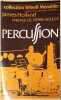
Bon état
Percussion
HATIER Sans date. Cet ouvrage de James Holland publié par Hatier en 1980 offre un vaste panorama des instruments de percussion avec descriptions et diagrammes. Il inclut un répertoire une bibliographie une discographie et des adresses destiné à un public large mais aussi aux musicologues
Très bon état
Les Géorgiques Chrétiennes. Chants I et II. Chants III et IV. Chants V, VI et VII.
Paris, Mercure de France 1912, 205x160mm, 60 + 60 + 89pages, reliure demi-toile à coins. Plats papier amrbré. Pièce de titre doré au dos. Belle reliure. Exemplaire sur papier vergé. Bel exemplaire.
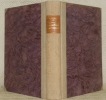
Pour un paiement via PayPal, veuillez nous en faire la demande et nous vous enverrons une facture PayPal
"Le cor; aperçu de son histoire et de son usage. Collection : ""Instruments de musique""."
Lausanne, Editions Payot, 1977. 19 x 21, 112 pp., nombreuses illustrations en N/B et en couleurs, quelques notations musicales, reliure d'édition carton illustré, très bon état.
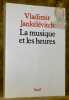
La musique et les heures.
Paris, Editions du Seuil 1988, 205x140mm, 292pages, broché. Exemplaire à l'état de neuf.
Pour un paiement via PayPal, veuillez nous en faire la demande et nous vous enverrons une facture PayPal

