 Write to the booksellers
-
Type
Any type (2)
Artists book (1)
Autograph (2)
Book (3629)
Drawings (1)
Engraving (1)
Magazine (50)
Manuscript (1)
Music sheets (42)
-
Latest
Last 3 days (2)
Last month (238)
Last week (4)
-
Language
Dutch (8)
English (7)
French (3684)
German (2)
Greek (1)
Italian (1)
Latin (3)
Russian (23)
-
Century
16th (2)
17th (53)
18th (103)
19th (406)
20th (1282)
21st (154)
-
Countries
Belgium (266)
Canada (28)
China (2)
Côte d'Ivoire (18)
Denmark (126)
France (2787)
Germany (10)
Netherlands (5)
Switzerland (457)
United Kingdom (6)
United States of America (24)
-
Syndicate
ALAC (21)
CLAM (28)
CLAQ (8)
CNE (5)
ILAB (1512)
NVVA (125)
SLACES (125)
SLAM (1141)
SNCAO (5)
Théorie des proportions chimiques, et table synoptique des poids atomiques des corps simples, et de leurs Combinaisons les plus importantes
Paris, Firmin Didot frères et J.-B. Baillière, 1835, in-8, [4]-477 pp, Demi-veau cerise postérieur, dos à faux nerfs et orné, Seconde édition française, la première étant parue en 1819 sous le titre d'Essai sur la théorie des proportions chimiques et sur l'influence chimique de l'électricité (Paris, Méquignon-Marvis). L'auteur expose ici sa théorie des combinaisons chimiques fondée sur le rôle de l'électricité. Les tables alphabétiques des poids atomiques de cette édition ont été considérablement augmentées. Ex-libris manuscrits en tête et en fin d'ouvrage. Étiquette de la bibliothèque de J[oseph] Laissus (1900-1969), directeur-fondateur de l'École technique supérieure du Laboratoire. Coins un peu usés. Bon état intérieur. Couverture rigide
Bon [4]-477 pp.


"BERZELIUS, JÖNS JACOB. - ONE OF THE MOST IMPORTENT WORKS IN THE HISTORY OF CHEMISTRY - THE FRENCH VERSION.
Reference : 46030
(1811)
Essais sur les proportions déterminées dans lesquelles se trouvent réunis les élémens de la nature inorganiques. (+) Suite des experiences sur les proportions déterminées, d'après lesquelles les élémens de la nature inorganique s'unissent... (In all...
Paris, Chez J. Klostermann fils, 1811-12. Bound in 6 contemp. hcalf. Gilt spines, slightly rubbed. Wear to top of spines. In: ""Annales de Chimie, ou Recueil de Mémoires concernant la Chemie"" Tome 78, 79, 80, 81, 82 and 83. (Entire volumes offered). The 14 parts: (Tome 78:) pp. 5-37, 105-132, 217-242. - (Tome 79:) pp. 113-142, 233-264. - (Tome 80:) pp. 5-37, 225-258. - (Tome 81:) pp. 5-36, 278-303. - (Tome 82:) pp. 5-33, 113-125, 225-72. (Tome 83:) pp. 5-35 a. pp. 117-127. With in all 3 engraved plates. Some scattered brownspots.
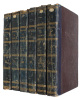
The papers represents one of the first announcements of Berzelius' discovery of the fixed chemical proportions, determining the weights and valencies of the various constituent elements in inorganic compounds. The papers were published at the same time in Swedish, German (both here in Annalen and in Schweiger's Journal), and in French. By running many hundreds of analysis of chemical compounds he gave so many examples of the law of definite proportions that the world of chemistry could no longer doubt its validity, and in so doing he gave experimental evidence to the atomic theory. He hereby laid a solid fundation for the further development of chemistry. A reprint is found in Ostwald's Klassiker der exakten Wissenschaften, No. 35.According to Söderbaum (Jac. Berzelius, 2, p.12) ""It was a giant work, one of the most importent in the history of chemistry, which was here presented. One is even more impressed when one remembers that it was a pioneer undertaking in every sense of the term. Analytic and synthetic methods existed before Berzelius' time, to be sure, but there were no precise methods of the sort which he required. They all had to be elaborated at the cost of time and labour.""(J. Erik Jorpes ""Jac. Berzelius"", p.45).""In general Berzelius's efforts were directed toward the consolidation and extension of the atomic theory. He improved chemical analysis and determined the composition of a large number of compounds, thus verifying the laws of constant and multiple proportions and furnishing the most accurate equivalent weights then available. By ingenious methods he arrived at the correct atomic composition of most common substances, and thus was enabled to draw up (in 1826) a table of atomic weights very nearly identical with the modern one.""(Leicester & Klicktein ""A Source Book in Chemistry"", p. 258).Parkinson ""Breakthroughs"", 1810-20 C.
"BERZELIUS, JÖNS JACOB. - ONE OF THE MOST IMPORTENT WORKS IN THE HISTORY OF CHEMISTRY- GERMAN VERSION.
Reference : 43628
(1811)
Versuch, die bestimmten und einfachen Verhältnisse anzufinden, nach welchen die Bestandtheile der unorganischen Natur mit einander verbunden sind. Erste Hälfte. (+) Zweite Hälfte. (+) Erste Fortsetzung des Versuchs, die bestimmten...(+) Zweite Fortse...
Halle, Rengerschen Buchhandlung, 1811, 1811, 1812. Without wrappers as published in ""Annalen der Physik. Herausgegeben von Ludwig Wilhelm Gilbert"", Bd. 37, Drittes u. Viertes Stück + Bd. 38, Sechtes Stück + Bd. 40, Zweites u. Drittes Stück. The entire issues offered (5 issues). With titlepage to vol. 37, 38 a. 40. Pp. 233-480 a. 3 engraved plates., pp. 121-236 a. 2 engraved plates., pp. 117-348 a. 1 engraved plate. Berzelius's papers: pp. 249-337 a. 415-472.- Pp. 161-226. - Pp. 162-208 a. 235-330..
The papers represents one of the first announcements of Berzelius' discovery of the fixed chemical proportions, determining the weights and valencies of the various constituent elements in inorganic compounds. The papers were published at the same time in German (both here in Annalen and in Schweiger's Journal), and in French. By running many hundreds of analysis of chemical compounds he gave so many examples of the law of definite proportions that the world of chemistry could no longer doubt its validity, and in so doing he gave experimental evidence to the atomic theory. He hereby laid a solid fundation for the further development of chemistry.According to Söderbaum (Jac. Berzelius, 2, p.12) ""It was a giant work, one of the most importent in the history of chemistry, which was here presented. One is even more impressed when one remembers that it was a pioneer undertaking in every sense of the term. Analytic and synthetic methods existed before Berzelius' time, to be sure, but there were no precise methods of the sort which he required. They all had to be elaborated at the cost of time and labour.""(J. Erik Jorpes ""Jac. Berzelius"", p.45).""In general Berzelius's efforts were directed toward the consolidation and extension of the atomic theory. He improved chemical analysis and determined the composition of a large number of compounds, thus verifying the laws of constant and multiple proportions and furnishing the most accurate equivalent weights then available. By ingenious methods he arrived at the correct atomic composition of most common substances, and thus was enabled to draw up (in 1826) a table of atomic weights very nearly identical with the modern one.""(Leicester & Klicktein ""A Source Book in Chemistry"", p. 258).Parkinson ""Breakthroughs"", 1810-20 C.
"BERZELIUS, JÖNS JACOB. - THE INTERNATIONAL LANGUAGE OF CHEMISTRY INTRODUCED.
Reference : 46988
(1813)
Experiments on the Nature of Azote, of Hydrogen, and of Ammonia, and upon the Degrees of Oxidation of which Azote is susceptible. (+) Essay on the Cause of Chemical Proportions, and on some Circumstances relating to them: together with a short and eas...
London, Robert Baldwin, 1813 a. 1814. 8vo. 2 contemp. hcalf. Marbled boards. Spines lacks and boards detached. In: ""Annals of Philosophy"" or Magazine of Chemistry, Mineralogy, Mechanics... By Thomas Thomson"". Vol. II and Vol. III. Entire volumes offered. Berzelius' papers: pp. 276-284, 357-368 (the first paper in vol. II), pp. 443-454 (vol. II) a. pp. 51-62, 93-106, 244-257 a. 353-364. (vol. III). Internally fine and clean.
First printing of these milestone papers in the history of chemistry, where Berzelius introduced his famous chemical symbolism whereby an element is generally represented by the first letter of its Latin name, or, in the event of elements having the same first letter, by the first two letters. Even though his atomic symbols were introduced in 1813 (see the note on p. 359 in the first paper), it was quite a few years before Berzelius's symbols were adopted by the chemistry community. But once accepted, they became the new international language of chemistry.Berzelius ""contributed more to the development of the atomic theory and to the setting up of accurate values of the atomic weights than did any other worker of the time. Of his contributions, moreover, to the development of the atomic theory and the advancement of chemical science, not the least valuable was the introduction of a chemical symbolism which, with slight modification, is in use at the present day. By giving his symbols a quantitative meaning - the symbol of an element representing one atomic proportion by weight - it was possible ""to show briefly and clearly the number of elementary atoms in each compound and, after the determination of their relative weights, present the results of each analysis in a simple and easely retained manner"". This symbolism was speedily adopted on the Continent but, in England, only after some considerable time.""(Findlay ""A Hundred Years of Chemistry"", p. 14.).Parkinson ""Breakthroughs"", 1813 C. - Leicester & Klickstein ""A Source Book in Chemistry"", p. 258 ff. - Holmberg 1813:28 a. The volume contains other notable papers THOMAS THOMSON ""On the Discovery of the Atomic Theory"", pp. 329-338. and JOHN DALTON ""Remarks on the Essay of Dr. Berzelius on the Cause of Chemical Proportions"", pp. 174-180 (Vol. III).
"BERZELIUS, JÖNS JACOB. - THE INTERNATIONAL LANGUAGE OF CHEMISTRY INTRODUCED.
Reference : 49243
(1813)
Experiments on the Nature of Azote, of Hydrogen, and of Ammonia, and upon the Degrees of Oxidation of which Azote is susceptible.
London, Robert Baldwin, 1813. 8vo. Contemp. hcalf. Marbled boards. Spine lacks and boards loose. In: ""Annals of Philosophy"" or Magazine of Chemistry, Mineralogy, Mechanics... By Thomas Thomson"". Vol. II. - VIII,480 pp. a. 7 plates. (Entire volume offered). Berzelius' paper: pp. 276-284, 357-368. Some browning and brownspots to plates.
First printing of this milestone papers in the history of chemistry, where Berzelius introduced his famous chemical symbolism (the offered paper is the first on the subject - Leicester & Klickstein calls it the ""Preliminary note) whereby an element is generally represented by the first letter of its Latin name, or, in the event of elements having the same first letter, by the first two letters. Even though his atomic symbols were introduced in 1813 (see the note on p. 359), it was quite a few years before Berzelius's symbols were adopted by the chemistry community. But once accepted, they became the new international language of chemistry. Berzelius ""contributed more to the development of the atomic theory and to the setting up of accurate values of the atomic weights than did any other worker of the time. Of his contributions, moreover, to the development of the atomic theory and the advancement of chemical science, not the least valuable was the introduction of a chemical symbolism which, with slight modification, is in use at the present day. By giving his symbols a quantitative meaning - the symbol of an element representing one atomic proportion by weight - it was possible ""to show briefly and clearly the number of elementary atoms in each compound and, after the determination of their relative weights, present the results of each analysis in a simple and easely retained manner"". This symbolism was speedily adopted on the Continent but, in England, only after some considerable time.""(Findlay ""A Hundred Years of Chemistry"", p. 14.).Parkinson ""Breakthroughs"", 1813 C. - Leicester & Klickstein ""A Source Book in Chemistry"", p. 258 ff. - Holmberg 1813:28 a.
DE L'EMPLOI DU CHALUMEAU DANS LES ANALYSES CHIMIQUES ET LES DÉTERMINATIONS MINÉRALOGIQUES
Paris Chez Méquignon-Marvis, Libraire 1821 in 8 (20x12,5) 1 volume broché, couverture muette de papier marbré ancien, tranches teintées rouge, VI et 396 pages et un feuillet d'errata non chiffré in fine, ave 4 planches gravées dépliantes, petite pastille de restauration ancienne dans le bas de la marge de la page de titre. Traduit du suédois par F. Fresnel. Bon exemplaire ( Photographies sur demande / We can send pictures of this book on simple request )
Bon Broché
Conversations avec Dieu.
Saint-Maurice d'Ételan, s. e. [Pierre Bettencourt], 1948. In-8° broché, couverture imprimée. ÉDITION ORIGINALE. De la collection "ni peur, ni espoir". Illustrée en frontispice d'un dessin de Max Jacob. Tirage unique de 110 exemplaires sur grand vélin d'Arches, celui-ci non numéroté.
Parfait état.
De saint-Petersbourg à Saint-Germain des Près, Souvenirs
Paris Gallimard 1980 in-12° lègère petite tache en couverture sans gravité sinon aspect de neuf
Bon Couverture souple
MÉLANGES BIBLIOGRAPHIQUES.
Librairie des Bibliophiles. 1871. In-8°, reliure demi-toile. 280 pp. E.O. 1/300 sur papier vergé. [10 chine / 300 vergé].
Bon état. Exemplaire de Jean-Jacques Pauvert comportant son cachet d'ex-libris.
Bibliographie Moliéresque.
Paris, Auguste Fontaine, 1875. In-8, rel. de l'ép. demi-chagrin marron, dos à nerfs, titre doré, tête mouchetée, couv. cons., XIX-412 pp. et 20 pp. (extrait cat. de l'éditeur), portrait au frontispice de Molière (gravure de Lalauze), table générale des auteurs et des ouvrages cités. Tirage limité à 500 ex. sur papier de Hollande, n° 72.
![Bibliographie Moliéresque. . [BIBLIO] LACROIX (Paul) [bibliophile Jacob]](https://static.livre-rare-book.com/pictures/TRA/603057_1_thumb.jpg)
1732 entrées remarquablement documentées. Dos lég. insolé et frotté, intérieur très frais, bel ex. - Frais de port : -France 8,4 € -U.E. 10 € -Monde (z B : 15 €) (z C : 33 €)
Aventures d'un orphelin
Delagrave Bibliothèque de récréation du Bibliophile Jacob Cartonnage d'éditeur 1882 Cartonnage toile de l'éditeur in-8, toile rouge, décor noir et doré sur le premier plat et le dos, tranches dorées, 441 pp, illustré de 8 aquarelles hors texte en couleur et de 50 dessins, infimes rousseurs, très bel exemplaire Livraison a domicile (La Poste) ou en Mondial Relay sur simple demande.
Contes à ses petits enfants sur l'Histoire de France.-
Avec 11 grandes gravures d'après les dessins de H. Philippoteaux et une chromolithographie d'après Emile Wattier. 2°édition. Firmin-Didot. 1875. In-8 dos chagrin rouge orné à 4 nerfs, tranches dorées, 501pp., charmantes gravures h.-t. Exemplaire assez affecté par des rousseurs.
Histoire naturelle des insectes. (Petit Buffon illustré, IV). Extraite des grands ouvrages de Buffon, Lacépède et Cuvier.
Paris Didier 1854 1 vol. relié in-24, demi-chagrin vert, dos lisse, décor doré avec petit fer "abeille", tranches dorées, 268 pp. (cartonnage éditeur en bon état). Exemplaire bien complet des 16 belles planches gravées hors-texte.
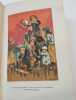
Aventures d'un petit orphelin racontées aux petits-enfants du bibliophile Jacob et publiées par lui - Illustrés de 8 aquarelles hors texte et de 50 dessins par Ferdinandus , avec une carte itinéraire du voyage dans l'Orléanais
Paris Delagrave 1882 Paris - Delagrave - 1882 - Petit In4 pleine percaline illustrée de l'éditeur - 441 pages - trés belles aquarelles gommées aux couleurs éclatantes - absence de rousseurs .
Bon
Catalogue de la bibliothèque dramatique de M. de Soleinne
Alliance des arts | Paris 1843-1845 | 13 x 22 cm | 5 volumes reliés en 4
Edition originale. Reliures en demi veau gris, dos à quatre nerfs sertis de filets dorés, pièces de titre et de tomaison de maroquin bordeaux, plats de papier marbré, gardes et contreplats de papier caillouté, tranches marbrées, reliures de l'époque. Bel exemplaire agréablement établi. - Photographies et détails sur www.Edition-Originale.com -
Catalogue de la bibliothèque dramatique de Pont de Vesle. - Catalogue de la bibliothèque théâtrale de M. Joseph de Filippi
Alliance des arts A. Aubry Tresse | Paris 1846-1861 | 13 x 22 cm | 3 volumes reliés en 1
Edition originale pour chacun des catalogues. Le second catalogue est en deux parties. Reliure en demi veau gris, dos à quatre nerfs sertis de filets dorés et d'un fleuron, pièce de titre et de un caisson de maroquin bordeaux, plats de papier marbré, gardes et contreplats de papier caillouté, tranches marbrées, reliure de l'époque. Bel exemplaire agréablement établi. - Photographies et détails sur www.Edition-Originale.com -
Curiosités infernales : Diables, bons anges, fées, elfes, follets et lutins, esprits familiers, possédés et ensorcelés, revenants, lamies, lémures, larves, vampires, prodiges et sortilèges, animaux parlants, présages de guerre, de naissance, de mort etc.
Garnier frères Paris, sd (1905), in-12 broché, couverture illustrée, II-396pp.-36pp. De catalogue : Diables, bons anges, fées, elfes, follets et lutins, esprits familiers, possédés et ensorcelés, revenants, lamies, lémures, larves, vampires, prodiges et sortilèges, animaux parlants, présages de guerre, de naissance, de mort etc. Quelques rares rousseurs sinon bon exemplaire imprimé sur un papier de qualité. Belle couverture illustrée.
Iconographie moliéresque contenant la liste générale et complète des portraits de Molière, et celle des suites de vignettes publiées jusqu'aujourd h'ui pour les oeuvres de cet auteur.
1872 Nice, chez J. Gay et Fils Editeurs, 1872, 37 p., demi-toile, environ 22x14cm, édition originale numérotée 32/100, 2 frontispices, un ex-libris sur le premier contreplat, dos sali et insolé, des frottements sur la reliure, quelques annotations au crayon à papier dans les marges, bon état pour le reste.

Merci de nous contacter à l'avance si vous souhaitez consulter une référence au sein de notre librairie.
Le commerce des livres anciens.
P., Editions des Cendres, 1994 ; in-8, broché. 29 pp.-1f. Grandes marges. Vignette ex-libris. Très bon état.
Edition tirée à 510 exemplaires, un des 10 sur vergé d'Ecosse écru, celui-ci porte le N°XI avec un mot manuscrit de l'éditeur.Ce texte reproduit un article paru en 1880 dans "Miscellanées bibliographiques" publiées par Edouard Rouveyre.
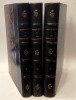
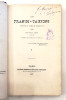
Les francs-taupins. Histoire du temps de Charles VII. 1440. Par Paul L. Jacob, bibliophile membre de toutes les Académies
Eugène Renduel Editeur-libraire / Imprimerie de Cosson "Paris, 1834, 3 vol. in-8 demi-basane bleu, dos à quatre faux-nerfs, fleurons dorés. Reliure signée E. Stern rel. Paris. (reliure vers 1870) T.I LII (titre / faux-titre ./ dédicace--312pp. T.II 2ff.-350pp. T.III 2ff.-418pp.-1f. D'errata. Vicaire IV-820 donne un feuillet blanc à la fin du troisième volume mais ne signale pas l'important errata (un feuillet imprimé recto verso). La préface intitulée : ""L'Histoire et le roman historique"" est constituée d'une nouvelle faisant l'éloge de la bibliophilie. Premier et dernier feuillet de chaque volume légèrement brunis sinon volumes quasi exempts de rousseur. Trace d'eau claire en marge inférieure des 20 derniers feuillets du premier volume. Edition originale rare."
Les Turquoises. Poésies, contes et nouvelles.
Paris, Librairie Veuve Jules Renouard sans date, vers 1860, 355x260mm, 124pages, reliure d'éditeur. Percaline brune, dos et plat supérieurs richement ornés d’ormentations dorés, encadrement à froid, tranches dorées. Haut du dos abimé, bas du dos charnière fendue sur 7 cm.
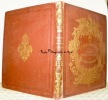
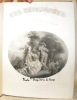
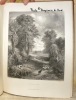
frontispice et titre gravés, 18 planches hors texte, vignettes in texte, Pour un paiement via PayPal, veuillez nous en faire la demande et nous vous enverrons une facture PayPal
L'Hospice du Mont Saint-Bernard : La convalescence du vieux conteur / La demoiselle du château / Le goûter de Pentecôte / Une bonne action de Rabelais / Les suites de la passion du jeu
"Librairie Ch. Delagrave. Non daté. In-8. Relié demi-cuir. Etat d'usage, Coins frottés, Dos à nerfs, Papier jauni. 235 pages. Nombreuses illustrations monochromes dans le texte. Gardes marbrées. Titre et fleurons dorés au dos. Premier plat décoré d'une couronne de lauriers avec la mention ""Petit lycée Janson de Sailly"".. . . . Classification Dewey : 840-Littératures des langues romanes. Littérature française"
6e édition. Illustrations de P. Kauffmann et A. Ferdinandus. Classification Dewey : 840-Littératures des langues romanes. Littérature française
Bulletin des arts. Guide des amateurs de tableaux, dessins, estampes, livres, manuscrits, autographes, médailles et antiquités. Ve année, Tome V, 1846-1847
Paris, Administration de l'Alliance des arts 1846-1847 Tome 5 complet: 448pp., 25cm., reliure cart. du 19e s., quelques rousseurs, avec une page ex-libris reliée : "Bibliotheek van Rotterdam. Geschenk van den Heer A.J. Lamme, directeur van het Museum Boymans alhier a.1867", avec qqs. petits cachets, bon état, peu commun, S91123
CONTES ET POÉSIES DE LA CHAUSSÉE.
Paris, Librairie des Bibliophiles, 1880. In-12, demi-chagrin rouge, dos à nerfs, titré, ornés d'un filet perlé, caissons à double encadrement doré, plats granités, gardes marbrées, tranches mouchetées, rel. de l'époque, eau-forte par Lalauze en frontispice, VII-115pp, table, tirage à petit nombre. (Collection des chefs-d'oeuvre inconnus)
![CONTES ET POÉSIES DE LA CHAUSSÉE.. BIBLIOPHILE JACOB [publiés par]](https://static.livre-rare-book.com/pictures/TRA/567189_1_thumb.jpg)
Claude Nivelle de la Chaussée 1692-1754, est le créateur d'un genre théâtral, la comédie larmoyante. "Délicieux petit livre", finement ornementé, bel ex. - Frais de port : -France 5,7 € -U.E. 8 € -Monde (z B : 12 €) (z C : 22 €)
La Pervenche. Livre des Salons, par Messieurs Marie Aycard, Emile Deschamps, Alfred des Essarts, Alexandre Dumas, Paul Féval, Léon Gozlan, Jules Janin, Jules Lacroix, Alfred de Martonne, Paul de Musset, Félix Pyat, Emile Souvestre, E. de Varennes, et Mesdames Fanny Richomme, Anaïs Ségalas, sous la direction du Bibliophile Jacob, enrichi de douze magnifiques gravures anglaises.
Paris, Mme Ve Louis Janet, sans date, volume grand in-8 relié pleine percaline romantique bleu-nuit illustré, 252 pages, dos lisse orné de longs fers dorés, plats décoré d'une grande plaque dorée, trois tranches dorées, exemplaire sans rousseur mais papier des gravures jauni, très bon état

