 Write to the booksellers
-
Type
Any type (2)
Artists book (1)
Autograph (2)
Book (3623)
Drawings (1)
Engraving (1)
Magazine (50)
Manuscript (1)
Music sheets (42)
-
Latest
Last 3 days (2)
Last month (239)
Last week (4)
-
Language
Dutch (8)
English (7)
French (3678)
German (2)
Greek (1)
Italian (1)
Latin (3)
Russian (23)
-
Century
16th (2)
17th (53)
18th (104)
19th (407)
20th (1275)
21st (153)
-
Countries
Belgium (266)
Canada (28)
China (2)
Côte d'Ivoire (18)
Denmark (126)
France (2781)
Germany (10)
Netherlands (5)
Switzerland (457)
United Kingdom (6)
United States of America (24)
-
Syndicate
ALAC (21)
CLAM (28)
CLAQ (8)
CNE (5)
ILAB (1512)
NVVA (125)
SLACES (125)
SLAM (1141)
SNCAO (5)
Espoirs et sagesse de la médecine [ Livre signé par l'auteur - Envoi à Maurice Druon ]
Envoi ms. de l'auteur, 1 vol. in-8 br., éditions Odile Jacob, Paris, 1993, 239 pp.
![Espoirs et sagesse de la médecine [ Livre signé par l'auteur - Envoi à Maurice Druon ]. BERNARD, Jean (1907-2006)](https://static.livre-rare-book.com/pictures/CDL/69996_thumb.jpg)
![Espoirs et sagesse de la médecine [ Livre signé par l'auteur - Envoi à Maurice Druon ]. BERNARD, Jean (1907-2006)](https://static.livre-rare-book.com/pictures/CDL/69996_2_thumb.jpg)
![Espoirs et sagesse de la médecine [ Livre signé par l'auteur - Envoi à Maurice Druon ]. BERNARD, Jean (1907-2006)](https://static.livre-rare-book.com/pictures/CDL/69996_3_thumb.jpg)
Envoi de l'auteur à Maurice Druon et à son épouse: "Pour Madeleine et Maurice Druon, vers la médecine du XXIe siècle, avec l'amitié fidèle de Jean Bernard". L'auteur et le dédicataire étaient tous deux académiciens. Maurice Druon (1918-2009), auteur notamment de la célèbre saga historique des Rois maudits, fut élu à l'Académie Française en 1968. Il en devint le Secrétaire Perpétuel, de 1985 à 1999. L'auteur, quant à lui, fut élu à l'Académie Française en 1975, au fauteuil de Marcel Pagnol. Le professeur Jean Bernard, éminent hématologue et oncologue, présida le Comité National d'Ethique de 1983 à 1993. Etat très satisfaisant (couv. lég. frottées, bon état par ailleurs) pour cet exemplaire d'une origine prestigieuse.
Die Dialoge des Aristoteles in ihrem Verhältnis su seinem übrigen Werken
Darmstadt, Wissenschaftliche Buchgesellschaft 1968 175pp., Reprint of the original 1863-edition, publisher's hardcover in green cloth with gilt title on spine, 23cm., text and interior clean and bright, good condition, F105366
Zwei Abhandlungen über die aristotelische Theorie des Drama
Darmstadt, Wissenschaftliche Buchgesellschaft 1968 [8] + 187pp., reprographic reprint of the original 1880-edition, 21cm., publisher's hardcover in cloth with gilt lettering on spine, spine sunfaded, text and interior clean and bright, good condition, F105516
Art et objets du Maroc. Meubles, zellidjs, tapis.
Paris: ABC Décor, 1974 in-4, 90 pages, illustrations en couleurs, carte. Rel. toile, bon état.
Art et objets du Maroc. Meubles, zellidjs, tapis. (Paris: ABC Décor, 1974). [M.C.: Afrique du Nord, beaux arts, Maroc]
Ars conjectandi, opus posthumum. Accedit tractatus de seriebus infinitis, Et Epistola Gallicè scripta de ludo pilae reticularis.
Basilea, Impensis Thurnisiorum Fratum, 1713. Petit in-4 de [4]-306-35-[1] pages, plein veau moucheté brun, dos à nerfs, pièce de titre en maroquin beige, filet doré sur les coupes, tranches rouges.
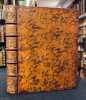
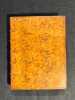
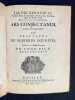
Édition originale de «l'ouvrage de référence sur la théorie des probabilités» qui « a énoncé les principes fondamentaux du calcul des probabilités et a été le premier à suggérer que cette théorie pouvait s'étendre au-delà des frontières des mathématiques pour s'appliquer aux affaires civiques, morales et économiques » (Norman). Cet ouvrage « a constitué la première tentative systématique visant à établir la théorie des probabilités sur des bases solides, et il reste encore aujourd'hui le fondement de nombreuses applications pratiques reposant sur les probabilités : les assurances, les statistiques et les tables mathématiques de fécondité » (PMM). L’Appendice, rédigée en français, explique les différentes stratégies du jeu de paume et les probabilités de victoire dans différentes situations. Bernoulli aborde les joueurs de force inégale, les parties à deux contre un et d’autres permutations du jeu. Bien complet des tableaux dépliants aux pages 172, 306 et 24 de la seconde partie. Très bel exemplaire. Norman 216; PMM 179.
"BERNOULLI, (JACOB). - A NEW ERA IN THE MECHANICS OF ELASTICAL BODIES.
Reference : 44383
(1706)
Veritable Hypothêse de la Résistance des Solides, Avec la Démonstration de la Coubure des corps qui sont Ressort. Lettre du 12. Mars 1705.
Paris, Jean Boudot, 1706. 4to. Without wrappers. Extracted from ""Mémoires de l'Academie des Sciences. Année 1705"". Pp. 176-186 and 1 folded engraved plate.
First appearance of a founding paper in the theory of elastic curves. ""Importent also is his last work, on the resistance of elastic bodies (1705)."" (DSB II, p.49 s).""During the last quarter of the seventeenth century and the beginning of the eighteenth centuries a rapid development of the infinitesimal calculus took place. Started on the Continent by Leibnitz...it progresssed principally by the work of Jacob and John Bernoulli. In trying to expand the field of application of this new mathematical tool, they discussed several examples from mechanics and physics. One such example treated by Jacob Bernouilli..concerned the shape of the deflection curve of an elastic bar and in this way he began an importent chapter inthe mechanics of elastic bodies.""(Timoshenko ""History of Strenght of Materials"" p. 25-26).

Analysis magni problematis Isoperimetrici. - [BERNOULLI'S SOLUTION TO THE ISOPERIMETRIC PROBLEM]
Leipzig, Gross & Fritsch, 1701. 4to. Contemporary full vellum. Handwritten title on spine. A small stamp to title page and page . Pasted library label to pasted down front free end-paper. In: ""Nova Actorum Eruditorum Anno MDCCI"". Pp 213-228 + 1 engraved plate. [Entire volume: (2), 581 pp. + 8 engraved plates].
First publication of Jacob Bernoulli influential dissertation in which he published the first correct solution to the isoperimetric problem both Johann Bernoulli and Leibniz had been seeking without success. The paper influenced both Leonhard Euler in writing his first research paper and British mathematician Brook Taylor to begin a dispute which has later been referred to as Taylor versus Continental mathematicians. ""It [the dissertation] was considered as a prodigy of sagacity and invention: and indeed, if the time be considered, it will not be too much to assert, that a more difficult problem never was solved."" (Bossut. A general history of mathematics. 341 p.).The isoperimetric problem is an ancient problem which dates back to antiquity and can be described as which curve, if any, maximizes or minimizes the area of its enclosed region?Euler, who had been taught by Johann Bernoulli, published his first paper in 1726 which was a note on the construction of isochronous curves in a resistant medium.DSB II, 48b.The following papers by Johann Bernoulli are also contained in the present volume:1. Disquisitio Catoptrico-Dioptrica exhibens Reflexionis et Refractionis naturam ex aequilibrii fundamento deductam. Pp 19-26.2. Novaratio construendi radios osculi seu curvanturae in Curvis quibusvis etc. Pp. 136-40.3. Multisectio Anguli vel Arcus, duplici aequatione universali exhibita. Pp. 170-75.
Le moyen de parvenir
œuvre contenant la raison de ce qui a été,est et sera, avec démonstration certaine selon la rencontre des effets de la vertu,revu,corrigé et mis en meilleur ordre,publié pour la première fois avec un commentaire historique et philologique,accompagné de notices littéraires par Paul.L. JACOB,bibliophile.In 12 demi cuir fauve,dos lisse,titre, filet,roulette dorés,filets à froid. Faux-titre, titre, XXIX,506 pages,déchirure page 423 en marge extérieure, réparation ancienne.Librairie Charles Gosselin 1841.Coiffe réparée,mors renforcés,fragiles.
Jacob et Abel Grimmer. Catalogue raisonné
La Renaissance du Livre 1991 In-4 24,5 x 32,5 cm. Reliure de l’éditeur pleine toile cachou sous jaquette rempliée et illustrée en couleurs, 400 pp., plus de 500 reproductions en noir et blanc et en couleurs. Exemplaire en très bon état. Deux maîtres de la peinture flamande entre Bruegel et Rubens.
Très bon état d’occasion
Jacob et Abel Grimmer - catalogue raisonné
La Renaissance du Livre, Tournai, 1991. Fort in-4, reliure pleine toile éditeur sous jaquette illustrée en couleurs, 398 pp. Préface - Chapitre Premier : Jacob Grimmer : Biographie. -Œuvre. - Composition. - Coloris. - Thèmes. - Dessins. - Influences subies. - Collaborateurs. - Réputation et cote. - Evolution picturale. - Rayonnement artistique. - Originalité. - Apport. - Conclusion - ...

Avec 156 illustrations en noir et 102 planches couleurs. --- Plus d'informations sur le site archivesdunord.com
L’illustration de la poésie à l’époque du Cubisme 1909-1914. Derain. Dufy. Picasso
Éditions Klincksieck, coll. « Le Signe de L’Art », n° 8 1971 In-8 broché 21,6 cm sur 17. 238 pages. 1 Cahier central + illustrations en noir et blanc in-texte. Bon état d’occasion.
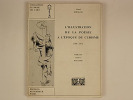
Bon état d’occasion
Om Blåsrörets Användande i Kemien och Mineralogien.
Stockholm, Henr. A. Nordström, 1820. Recent hcloth. (10),302,(2) pp. and 4 folded engraved plates. Very few brownspots.
First edition of Berzelius' important work on the Blowpipe, through which it became the most importent instrument of the chemist. The following years it was translated into German, English, French and Russian.
Des Recherches sur la Composition des prussiates ou des hydro-cyanates ferrugineux. III-VII.
(Paris, Crochard, 1820). Without wrappers as issued in ""Annales de Chimie et de Physique"", tome XV, pp. 225-264. A small tear to one leaf.
First edition.
Lehrbuch der Chemie. Nach des Verfassers schwedischer Bearbeitung der Blöde-Palmstedt'schen Auflage übersetzt von F. Wöhler. 4 Bde. (8 Abtheilungen).
Dresden, Arnoldischen Buchhandlung, 1825-31. Uncut in 8 orig. blue boards. Printed on good paper. A wormtrack on cover of volume IV:2, only effecting cover and halftitle. With all 13 folded engraved plates, showing chemical apparatus. Titles with rubber-stamps.
This German translation of Berzelius main work contains many additions by the author not found in the swedish original. ""Berzelius's work on the science of Chemistry in general is universally known. He mastered the whole of Chemistry as no one else has ever done since his time, and he created something new in all the spheres in which he worked.""
Lehrbuch der Chemie. Nach des Verfassers Schwedischer Bearbeitung der Blöde-Palmstedt'schen Auflage übersetzt von F. Wöhler. 1. Band, Erste Abth.
Dresden, Arnoldischen Buchhandlung, 1825. Cont. hcalf. Gilt back. Back slightly rubbed. Stamp on title. XVIII,442 pp. and 3 folded engraved plates. Internally fine and clean, printed on goos paper.
First German edition. The first part of Berzelius' famous ""Lehrbuch"".
Lehrbuch der Chemie. Nach des Verfassers schwedischer Bearbeitung der Blöde-Palmstedt'schen Auflage übersetzt. 2. Bd., erste-zweite Abth. (in 2 Bde).
Dresden, Arnoldischen Buchhandlung, 1826. 2 cont. hcalf. Gilt backs. Backs slightly rubbed. Stamp on titles. VI,XIII,995,(4) pp. Internally fine and clean, printed on good paper.
First German edition of the second volume (in 2 parts) of Berzelius' famous ""Lehrbuch"".
(Von der Anwendung des Löthrohrs in der Chemie und Mineralogie. 2. Auflage.).
(Nürnberg, Schrag, 1828). Cont. marbled boards. Gilt back. Gilt titlelabel. Lightly rubbed. XVI,282 pp. and 4 folded engraved plates. Titlepage lacks and with a hole in pp. 1-2 loosing some words on p.2. A few leaves with marginal browning, otherwise clean and printed on good paper.
Second German edition, the first published 1821 translated from the Swedish original from 1820. The classic work on the blowpipe and its history.
Rapport Annuel sur les Progrès des Sciences Physiques et Chimiques. Présenté... a l'Academie Royale des Sciences de Stockholm. Traduit du Suédois, sous les Yeux de l'Autheur. Par (Philippe) Plantamour. 1.-7. Année.
Paris, Fortin, Masson et Cie, 1841-47. Bound in 5 uniform contemp. hcalf. Richly gilt spines and with gilt lettering. printed on good paper. Clean and fine.
First French edition (all published) of Berzelius's ""Arsberättelser...."" - Partington IV, p. 146.
"BERZELIUS, J. (JÖNS JACOB). - INTRODUCING CATALYSIS AND CATALYTIC FORCE, A NEW CHEMICAL POWER.
Reference : 44894
(1836)
Quelques Idées sur une nouvelle Force agissant dans les Combinaisons des Corps Organiques.
Paris, Crochard, 1836. No wrappers. In: ""Annales de Chimie et de Physique, Par MM. Gay-Lussac et Arago."", 2e Series, tome 61, Cahier 2. Pp. 113-224. (entire issue offered). Berzelius's paper: pp. 146-151. With titlepage to Tome 61.
First French edition of this importent paper in the history of chemistry in which Berzelius advanced the concept of 'Catalysis', and described inorganic reactions by way of metals and the biological reactions by enzymes. The paper on Catalysis was first published in his ""Årsberättelse"" (Annual Survey) in 1835. - Axel Holmberg 1836:14. - Partington IV, pp. 263-64""This is a new force in inorganic and organic nature, bringing into being chemical activity, and more widely distributed than has hitherto been thought, the naure of which is completely concealed. If I all it a new force it is not my meaning that it is independent of the electrochemical relations of matter, but on the contrary I can only assume that it is a special kind of manifestation of these. So long as its nature and relations are unknown it will be convenient to considerit a new force, and to give it a name.""(Berzelius).Parkinson ""Breakthroughs"", 1836 C.The issue contains furthermore two importent papers by the founder of modern organic cemeistry, Auguste Laurent ""Sur l'Acide Naphtalique et ses Combinaisons"", pp. 113-125 and ""Théorie des Combinaisons Organiques"", pp. 125-151.Laurent: A founder of modern organic chemistry, Laurent was one of the most important chemists of the nineteenth century.
"BERZELIUS, J. (JÖNS JACOB). - INTRODUCING CATALYSIS AND CATALYTIC FORCE, A NEW CHEMICAL POWER.
Reference : 49288
(1836)
Quelques Idées sur une nouvelle Force agissant dans les Combinaisons des Corps Organiques.
Paris, Crochard, 1836. Berzelius's paper: pp. 146-151. Some browning to the first and last leaves. Some scattered brownspots.
First French edition of this importent paper in the history of chemistry in which Berzelius advanced the concept of 'Catalysis', and described inorganic reactions by way of metals and the biological reactions by enzymes. The paper on Catalysis was first published in his ""Årsberättelse"" (Annual Survey) in 1835. - Axel Holmberg 1836:14. - Partington IV, pp. 263-64""This is a new force in inorganic and organic nature, bringing into being chemical activity, and more widely distributed than has hitherto been thought, the naure of which is completely concealed. If I all it a new force it is not my meaning that it is independent of the electrochemical relations of matter, but on the contrary I can only assume that it is a special kind of manifestation of these. So long as its nature and relations are unknown it will be convenient to considerit a new force, and to give it a name.""(Berzelius).Parkinson ""Breakthroughs"", 1836 C.The issue contains furthermore two importent papers by the founder of modern organic cemeistry, Auguste Laurent ""Sur l'Acide Naphtalique et ses Combinaisons"", pp. 113-125 and ""Théorie des Combinaisons Organiques"", pp. 125-151. And Avogadr: ""Nouvelles recherches sur le Pouvoir Neutralisant de quelques Corps Simples. (Extrait). Pp. 419-432.Laurent: A founder of modern organic chemistry, Laurent was one of the most important chemists of the nineteenth century.
Des Changemens dans la système de Minéralogie chimique, qui doivent nécessairement résulter de la proprieté qur possèdent les corps isomorphes, de se remplacer mutuellement en proportions indéfinies.
(Paris, Crochard, 1826). No wrappers. In: ""Annales de Chimie et de Physique, Par MM. Gay-Lussac et Arago."", tome 31, Cahier 1. Halftitle to vol. 31.Pp.5-112 a. 1 folded engraved plate. (The entire issue offered). Berzeliu's paper: pp. 5-36.
First appearance of a milestone paper in chemistry. In this paper Berzelius drew up the table of atomic weights of the elements, which, with only a few exceptions are similar to those used today. He symbolizes the elements by the first or two letters of the Latin name of the element, and he symbolizes compounds by stting the element symbols together together with the number of atoms involved when grater that one. This is the importent revison of his system announced in 1818.""In 1819 Mitscherlich showed that similarity in chemical structure is accompanied by identity of crystalline form (Mitscherlich's law of isomorphism). berzelius realized at once that Mitscherlich's findins called for importent changes in his own system. he accordingly published a new table of atomic weights in 1826 (the paper offered).""(Taton ""Science in the 19th Century"", p. 279). - Holmberg, Bibliografi öfver Berzelius, nr. 29.
Des Changemens dans la système de Minéralogie chimique, qui doivent nécessairement résulter de la proprieté qur possèdent les corps isomorphes, de se remplacer mutuellement en proportions indéfinies. - [ATOMIC WEIGHT OF ELEMENTS]
Paris, Crochard, 1826. 8vo. In later full buckram with gilt lettering to spine. In: ""Annales de Chimie et de Physique, Par MM. Gay-Lussac et Arago."", tome 31. Entire volume offered. Stamp to verso of half title. Light occassional brownspotting. [Berzelius' paper:] Pp.5-37. [The entire issue:] 448 pp. + 3 plates.
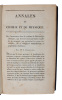

First appearance of a milestone paper in chemistry. In this paper Berzelius drew up the table of atomic weights of the elements, which, with only a few exceptions are similar to those used today. He symbolizes the elements by the first or two letters of the Latin name of the element, and he symbolizes compounds by stting the element symbols together together with the number of atoms involved when grater that one. This is the importent revison of his system announced in 1818. ""In 1819 Mitscherlich showed that similarity in chemical structure is accompanied by identity of crystalline form (Mitscherlich's law of isomorphism). berzelius realized at once that Mitscherlich's findings called for importent changes in his own system. he accordingly published a new table of atomic weights in 1826 (the paper offered).""(Taton ""Science in the 19th Century"", p. 279). - Holmberg, Bibliografi öfver Berzelius, nr. 29. The present volume also contain the following important papers: Sur les Minéraux cristallisés qui se trouvent dans les aerolithes (Gustave Rose) Mémoire sur les Combinaisons du Phosphore, et particulièrement sur celles de ce corps avec l'hydrogène (Dumas) Seconde Lettre sur les Cavernes à ossemens de Lunel-Vieil, de Saint-Antoine et de Saint-Julien, près de Montpellier (Hérault) adressés à M. Gay-Lussac par M. Marcel de Serres " Nouveau Catalogue des cgutes de pierres ou de fer de poussières ou de substances molles, sèches ou humides, suivant l'ordre chronologique (E. F. F. Chladni) Note sur la Communication des mouvements vibratoires (Félix Savart) Recherches sur les Effets électriques de contact produits dans les changemens de temp
Des Changemens dans la système de Minéralogie chimique, qui doivent nécessairement résulter de la proprieté qur possèdent les corps isomorphes, de se remplacer mutuellement en proportions indéfinies. - [ATOMIC WEIGHT OF ELEMENTS]
Paris, Crochard, 1826. 8vo. In a bit later half cloth with gilt lettering to spine. In: ""Annales de Chimie et de Physique, Par MM. Gay-Lussac et Arago."", tome 31. Entire volume offered. No institutional stamps. [Berzelius' paper:] Pp.5-37. [The entire issue:] 448 pp. + 3 plates.
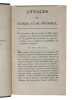
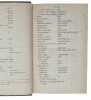
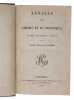
First appearance of a milestone paper in chemistry. In this paper Berzelius drew up the table of atomic weights of the elements, which, with only a few exceptions are similar to those used today. He symbolizes the elements by the first or two letters of the Latin name of the element, and he symbolizes compounds by stting the element symbols together together with the number of atoms involved when grater that one. This is the importent revison of his system announced in 1818. ""In 1819 Mitscherlich showed that similarity in chemical structure is accompanied by identity of crystalline form (Mitscherlich's law of isomorphism). berzelius realized at once that Mitscherlich's findings called for importent changes in his own system. he accordingly published a new table of atomic weights in 1826 (the paper offered).""(Taton ""Science in the 19th Century"", p. 279). - Holmberg, Bibliografi öfver Berzelius, nr. 29. The present volume also contain the following important papers: Sur les Minéraux cristallisés qui se trouvent dans les aerolithes (Gustave Rose)Mémoire sur les Combinaisons du Phosphore, et particulièrement sur celles de ce corps avec l'hydrogène (Dumas)Seconde Lettre sur les Cavernes à ossemens de Lunel-Vieil, de Saint-Antoine et de Saint-Julien, près de Montpellier (Hérault)adressés à M. Gay-Lussac par M. Marcel de Serres " Nouveau Catalogue des cgutes de pierres ou de fer de poussières ou de substances molles, sèches ou humides, suivant l'ordre chronologique (E. F. F. Chladni) Note sur la Communication des mouvements vibratoires (Félix Savart)Recherches sur les Effets électriques de contact produits dans les changemens de temp
Versuch einer lateinischen Nomenclatur für die Chemie, nach electrisch-chemischen Ansichten. (Im Auszuge, frei bearbeitet, und mit Vorschlägen für die deutsche Nomenclatur begleitet, von Gilbert).
Leipzig, Johann Ambrosius Barth, 1812. Without wrappers. In: ""Annalen der Physik und der Physikalischen Chemie. Hrsg. Ludwig Wilhelm Gilbert"", Bd. 12 (= Bd. 42 der Reihe), Neuntes Stück. Titlepage to vol. 12. Pp. 1-116 a. 1 engraved plate. (The entire issue offered). Berzelius' paper: pp. 37-89.
First German edition of this classic paper in chemistry in which Berzelius presented his system of nomenclature to the scientific world. The paper was first preseted in French ""Essay sur la nomenclature chimique"" in Journal de Physique the year before (1811).""Of his contributions, moreover, to the development of the atomic theory and the advancement of chemical science, not the least valuable was the introduction of a chemical symbolism which, with slight modifivcations, is in use at the present day. By giving his symbols a quantitative meaning - the symbol of an element representing one atomic proportion by weight - it was possible ""to show briefly and clearly the number of elementary atoms in each compound and, after the determination of their relative weights, present the results of each analysis in a si8mple and easely retained manner."". This symbolism was speedily adopted on the Continent but, en England, only after some considerable time.""(Findley ""A Hundred Year of Chemistry"", p. 14). - Holmberg, Bibliografi öfver Berzelius, 1812:7).
Lehrbuch der Chemie. Aus der schwedischen Handschrift des Verfassers übersetzt von F. Woehler.
4. verbesserte Orig.-Aufl. (Band 3 in 3. Aufl. von 1834). 10 Bände. Dresden u. Leipzig, Arnold, 1835–1841. 8°. Mit 12 gef. Kupfertafeln und einigen Textillustr. Pappbände aus der Zeit mit roten Rückenschildchen (3. Band Halbleinenband nicht uniform).
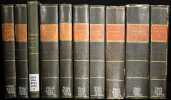
Vgl. Duveen S. 75 u. Hirsch-H. I, 510 (für die Originalausgabe u. die erste deutsche Ausgabe von 1833–1841). Selten so komplett. Jöns Jakob Berzelius (1779–1848), schwedischer Chemiker, leistete einen bahnbrechenden Beitrag für die moderne Chemie. Er bezeichnete die chemischen Elemente erstmals mit Buchstaben und entdeckte Selen, Cer und Thorium. – Ausgeschiedenes Bibliotheksexemplar mit entsprechenden Stempeln und handschr. Rückennummerierungen. Alte handschr. Besitzereinträge auf den Vorsätzen. Papier durchgehend unterschiedlich stark stockfleckig und gebräunt. Einbände berieben.

