 Write to the booksellers
-
Type
Book (132)
Magazine (3)
-
Language
French (133)
Italian (1)
Russian (1)
-
Century
16th (2)
17th (2)
18th (3)
19th (5)
20th (68)
-
Countries
Belgium (15)
Canada (1)
Denmark (7)
France (98)
Netherlands (6)
Switzerland (7)
United States of America (1)
-
Syndicate
ALAC (1)
CLAM (1)
ILAB (30)
NVVA (2)
SLACES (2)
SLAM (16)
Reference : 1488
janus
numéro 1 avril mai 1964 in 8 broché 156 pages
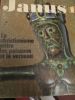
le christianisme entre les poissons et le verseau
Janus. Esquisse d'un système.
Paris, Calmann-lévy 1979. Bon in-8 broché, couverture ornée d'éd., 348 pages avec annexes dont index.
Theodori Bezae Vezelii Poemata. (Bound with:) Marci Antonii Mureti Juvenilia. (And:) Johannis Secundi Hagiensis Juvenilia.
Leiden (Lugduni Batavorum), 1757.
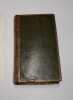
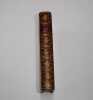
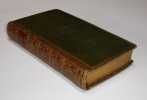
12mo in 8 & 4 sheets. 3 volumes in 1: (IV),IV,124 p., a portrait of Beza; X,106 p., a portrait of Muretus; IV,3-156 p. Green morocco 16 cm (Ref: Brunet 1,239; Graesse cf 1,359, where we find the imprint Paris 1757) (Details: Green morocco; red morocco shield on the back; gilt floral decoration on the back; boards with gilt triple fillet borders; inside dentelles gilt; marbled endpapers; edges of the bookblock gilt; woodcut printers' mark of Joseph Gérard Barbou on all three titles, depicting an old man who stands in the shade of a vine-entwined elmtree. The motto is 'Non solus'. The 2 portraits have been etched by Fiquet) (Condition: Some wear to the extremes. A small bump in the bottom edge of the front board. Two tiny and almost invisible wormholes in the front joint) (Note: All three titles in this book have a false imprint, 'Lugduni Batavorum', i.e. Leiden, in the Dutch Republic. It was according to Brunet actually published in Paris by Barbou. He does not explain, but the printer's mark, paper, printing and layout looks indeed very Barbou. The Short Title Catalogue Netherlands (STCN) is not sure either about Leiden, it adds 'printed in France?' In Latin elegiac and epigrammatic poetry, from Roman times to the Renaissance, there is constant reference to the 'poetry of youth', as 'standing in contrast to a kind of poetry suitable to be written in old age. The poets characterize the latter poetry as serious, moral, and austere, touching on wars and politics and patriotism. The former is filled with passion and exuberance, concerned not with weighty national issues, but with jokes and laughter and erotic affaires'. (K.M. Summers, 'The Iuvenilia of Marc-Antoine Muret', Columbus, 2006, p. XXV-XXVI) The first edition of 'poemata juvenilia' of the young Calvinist theologian Theodore de Bèze, or Theodorus Beza, 1519-1605, was published in Paris in 1548. 'It had certain rather free pieces printed, which were afterwards made a matter of bitter reproach against him. He therefore suppresed them in the following editions'. (Ebert) This first edition, including the erotic love poems which Beza later regretted having ever published, was clandestinely reprinted. Beza was considered to be among the best Neo-Latin poets of his time. He is however best known for his Latin translation of the New Testament, his critical Greek edition of the New Testament, and for being the founder of the University of Geneva. The Frenchman Marc Antoine Muret, latinized as Marcus Antonius Muretus, 1526-1585, 'exemplifies the essence of French Renaissance humanism. A master of Latin and student of Classical Antiquity, he not only engaged in the recovery and exposition of ancient texts, he also actively employed the old genres and skills in the contemporary ecclesiastical and public spheres. He wrote Latin poetry, both sacred and profane, delivered public orations in Latin and lectured in various schools throughout France and Italy on authors as diverse as Catullus and Tacitus and on topics as varied as Greek philosophy and Roman law'. (K.M. Summers, 'The Iuvenilia of Marc-Antoine Muret', Columbus, 2006, p. XIII) His 'Iuveninlia' were first published in 1552. The Dutch neolatin poet Janus Secundus Nicolai Hagiensis, was born on the 15th of november 1511, the day of the martyr Secundus, in The Hague. He died very young in 1536. In 1528 he moved to Mechelen, the residence of the Austrian vicequeen Margaretha of Parma. The southern part of the Netherlands was in this time the center of a florishing urban civilization. In May 1530 Secundus met a young prostitute from Mechelen, called Julia, and fell in love with her. Julia became the subject of his first book of elegies, his 'Julia Monobiblos', in which he tells how he won and lost his love. During his studies in Bourges under the famous jurist Alciati he wrote his first 'Basia'. Alciati introduced Secundus there also to the newest Italian poetry. A humanist poet often started his career with erotic poetry, like Piccolomini and Beza. Secundus' 'kiss-poems' are a variation on two 'kiss-poems' of the Latin poet Catullus (ca. 84-54 B.C), who became during the Renaissance a model for love-poetry. Secundus wrote in his short life 6835 lines of poetry, of which only 425 lines were printed during his lifetime. He wrote 'with equal fluency all kinds of lyrical, heroic, and elegiac verse. Down to the present day Secundus lives in literary history as the kissing poet' (...) 'Until far in the 18th century Secundus is mentioned as one of the classics of love poetry' (IJsewijn, Companion to Neo-Latin studies I, Leuven, 1990, p. 152) The first edition of his collected works was posthumely published in 1541 in Utrecht, and was edited by Secundus brother Marius. After the poems of Janus Secundus we find 46 pages with the 'Pancharis Joan. Bonefonii Averni ad Jacobum Guellium (p. 111-156)) (Provenance: On the verso of the front flyleaf: 'John Wordsworth, Edinburgh, 1827'. This is the English classical scholar John Wordsworth, 1805-1839, nephew of the Romantic poet William Wordsworth. 'In October 1824 he entered Trinity College, Cambridge. His university career was distinguished. In 1825 he obtained the Bell scholarship, in 1826 a scholarship at his own college, and was second for the Porson prize; in 1827 he obtained it. In 1828 he proceeded to the B.A. degree, but was disqualified for classical honours through distaste for mathematics. In 1830 he was elected fellow of his college. (...) In 1834 he was appointed a classical lecturer in Trinity College, and undertook to edit Richard Bentley's Correspondence (afterwards completed by his brother Christopher Wordsworth'. (Source Wikipedia)) (Collation: pi4 (plus portrait); A8, B4, C8, D4 etc., K4, L2; Portrait, A8 B4, etc. X8, Y4) (Photographs on request)
Revue universitaire de l'adolescence N°3
Au bureau du journal. 1980. In-8. Broché. Bon état, Couv. convenable, Coiffe en tête abîmée, Intérieur frais. 208 pages.. . . . Classification Dewey : 400-LANGUES
Texte écrit en allemand, en anglais et en français. Classification Dewey : 400-LANGUES

Quinti septimi Florentis Tertulliani Ad Nationes Libri Duo
Leiden Brill 1929. In Leiden Brill 1929. In-8 broché de XIX + 155 pages. Très bon état.
Toutes les expéditions sont faites en suivi au-dessus de 25 euros. Expédition quotidienne pour les envois simples, suivis, recommandés ou Colissimo.
La Culture Italienne, Dix Siècles De Civilisation
Paris Editions André Bonne Petit In-8 dédié à Pierre Brandon - 390 pp
Bon Broché à raba
JANI BROUKHUSII POEMATUM LIBRI SEDECIM.
1711 Amstelaedami [Amsterdam], Excudit Franciscus Halma, 1711. In-quarto (208 X 258) maroquin vert, triple encadrement de filet doré sur les plats, filets dorés en place des nerfs, urnes dorées dans les compartiments, coupes filetées, tranches jaunes (reliure de lépoque) ; (1) f. blanc, frontispice gravé, titre avec vignette gravée, 10 ff. (dédicace, préface et élégie), 502 pages, (14) pp. (index), (2) ff. blancs.
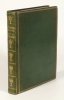
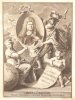
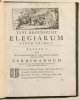
ELEGANTE EDITION de ce recueil de poésie en hollandais. Elle est illustrée de 59 GRAVURES du dessinateur et graveur hollandais Jan GOEREE (1670-1781), dont un frontispice hors-texte, une vignette dans le titre, trois bandeaux, 54 vignettes dans le texte et des lettrines. Jean Van BROEKHUIZEN (Amsterdam, 1640-1707) est un poète et érudit hollandais dont les oeuvres sont rares. Après avoir reçu une bonne éducation littéraire, il resta quelque temps chez un apothicaire, puis il prit du service, devint lieutenant, fut envoyé en Amérique sur la flotte de Ruyter en 1674, et revint en Hollande l'année suivante. Se trouvant à Utrecht, il prit part à un duel et encourut pour ce fait la peine de mort ; mais, grâce à l'intervention du savant Groevius, il fut sauvé. Après avoir été quelque temps capitaine dans la milice à Amsterdam, Broekhuizen se retira à Amstelveen où il passa les dernières années de sa vie, se livrant entièrement alors à son goût pour la littérature. Outre ses "Poésies latines", publiées à Utrecht (1684), on a de lui des "Poésies hollandaises" très élégantes, mais peu nombreuses, ainsi que des éditions de Properce, de Catulle, de Sannazar, etc. BEL EXEMPLAIRE, grand de marges, dans un beau maroquin du temps. (Brunet, Manuel de l'amateur, VI, 13029). FINE COPY. PICTURES AND MORE DETAILS ON REQUEST.
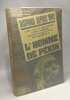
DISPARU DEPUIS 1941 - L'HOMME DE PEKIN
SEGHERS DOCUMENT 1975 260 pages in8. 1975. Broché. 260 pages. Traduit de Sénès Florence - Illustrations de Jankovics györgy
Quelques marques d'usures de lecture et/ou de stockage mais du reste en assez bon état. - encore sous blister- envoi rapide et soigné dans une enveloppe à bulle depuis France
L'homme de Pékin - disparu depuis 1941
Seghers 1975 in8. 1975. Broché.
Bon Etat couverture un peu défraîchie intérieur propre tranche ternie
L'homme de Pékin
Seghers 1975 in8. 1975. Broché.
Bon état sous papier de soie tranche ternie intérieur propre
ESPRIT DE SUITE
aux Editions Janus, Paris 1954 - EDITION ORIGINALE (un des 26exemplaires sur pur fil du marais marqués de AàZ, celui ci porte la lettre S) - Portrait de l'auteur par Daniel SARREAU et dessins originaux de Julien OUTIN et Pierre OMCIKOUS.TRES BELLE DEDICACE DE L'AUTEUR A FJ ARMORIIN
Ray A3*
JANUS n° 3 : L'HISTOIRE ET LA SEXUALITE : DEMAIN, ADAM ET EVE ?
imprimerie moderne de l'est 1964 périodique revue 20*17,5 172 pages
assez bon broché, bas du dos recollé ----------> Pour bénéficier du tarif de livraison le plus avantageux, pour la France et certains pays d'Europe, les livres seront expédiés par Mondial Relay. Merci de m'indiquer un point relais Mondial Relay lors de votre commande
Revue des Hautes Pyrnes (Bigorre, Quatre-Valles, Nbouzan, etc.) Juillet 1909 Madame Cottin Bigorre
Au bureau du journal. 1909. In-8. Broch. Etat d'usage, Livr sans Couverture, Agraffes rouilles, Intrieur frais. Pagin de 227 288 pages.. . . . Classification Dewey : 70.491-Plante, janus, plexus
L’homme et ses idoles
Robert Laffont / Nouvelle Librairie de France février-mars 1965, in-8 broché, 160pp; illustré - très bon état
JANUS,
Z.p., onbekend, 1962 Softcover inder geillustreerde kartonomslag met flappen, oblongformaat : 240 x 175mm., 52pp.
Genummerd exemplaar binnen een oplage van 75. In goede staat.
Carmina.
Torshavn, H.N. Jacobsens Bókahandil, 1941. Ubeskåret i originale bogtrykte omslag. 72 pp.
Originaludgaven.
Moriendo.
Torshavn, Norrøna Forlagid, 1944. Ubeskåret i originale bogtrykte omslag. 64 pp.
Originaludgaven.
Introduction à la psychologie périnataleLes effets à long terme de la vie avant, pendant et après la naissance
Florence Ludi, collection Naitre et grandir , le Souffle d'Or , broché 302 pages , absolument neuf Ray F1*
Gedenkschriften van Janus Droogstoppel uit den Duitschen Bezettingstijd 1914-1918 [3 volumes] I: Geschiedenis der "Droogstoppels" en der "Vrije Stem", II: Mijn proces voor het "Kriegsgericht" in de gevangenissen te Antwerpen, aken, Werden en Cassel-Wehlheiden, III: Mijne verdere lotgevallen te Antwerpen, Cassel en Straatsburg
, Antwerpen, Buerbaum-Van der Goten, s.d., Volledig in drie delen: 296 + 302 + 318pp., 20cm., originele omslagen, goede staat, B20807
Pinacotheca Imaginum illustrium Doctrinae vel Ingenii laude Virorum qui auctore superstite diem suum obierunt. 2 parties reliées ensemble (sur 3).
Coloniae, Agrippinae, 1645, pt. in-8vo, page de titre gravée, 8 ff., frontispice gravé (portrait ERYTHRAEUS) 300 p. + 2 ff. + 233 p. + 1 f., sans reliure, dos fendu à plusieurs endroits. (Ex. à relier).
Brunet III, 1052; Graesse VIII, 284; Bibl. Walleriana 16133.

(SLACES, NVVA)
Phone number : 41 (0)26 3223808
Pinacotheca Imaginum illustrium Doctrinae vel Ingenii laude Virorum qui auctore superstite diem suum obierunt. Editio nova. 3 Tle in 1 Bd.
Guelferbyti (Wolfenbüttel, Meisner), apud Jo. Christoph. Meisnerum, M DCCXXIX, (1729), kl. in-8°, 7 n.n. Bl., mit Frontispiz-Porträtkupfer, Titel mit Vignette (springendes Pferd ) + 845 S. + 2 n.n. Bl. (Index), Pergament d. Zeit.
Der Autor war ein hochbegabter Jurist, er hatte jedoch einen 'schlechten Stern', da er ständig auf der Suche nach Protektoren war, die aber immer starben, bevor sie ihm nützlich werden konnten. (Hoefer XLII/654 f). 2 Bl. : Frontispiz, Titel und letztes Bl. gelöst. Brunet II, 1952. Erstmals 1643-48 erschienene Sammlung von ca. 240 Biographien.
(SLACES, NVVA)
Phone number : 41 (0)26 3223808
L'HOMME DE PEKIN.
SEGHERS. 1975. In-8. Broché. Bon état, Couv. convenable, Dos satisfaisant, Intérieur frais. 260 pages - quelques planches d'illustrations en noir et blanc.. . . . Classification Dewey : 930.1-Archéologie
Traduction de Jocelyn de Pass - Disparu depuis 1941 le FBI, la CIA, des savants américains et chinois, un milliardaire recherchent les restes d'un homme mort depuis 650 000 ans. Classification Dewey : 930.1-Archéologie
Lampas, sive Fax artium liberalium, hoc est Thesaurus criticus (…). Tomus primus.
Frankfurt, J. Rhodius, 1602. 8vo. In contemporary full vellum with yapp edges. With Luxdorph’s super ex-libris to front board and his name to upper outer margin of front free end-paper. A few stains and miscolouring to title-page, otherwise a good copy. (126), 1464, (46) pp.
First edition, first volume, of this monumental collection of treatises on classical antiquity. Goldschmidt 75
HIPPOCRATIS COI MEDICORUM Omnium Longe Principis, Opera Quae apud nos extant omnia. Per Ianu Cornarium Medicum Physicum Latina Lingua conscripta. Accssit index rerum copiosissimus.
Lugduni (Lyon), Apud Ant. Vincentium, M.D.LIII (1553), 1 volume in-12 de 175x105x55 mm environ, 1f.blanc, 40 ff. (titre en rouge et noir avec vignette à la marque de l'imprimeur Antoine Vincent)-1f.blanc-539 feuillets, 2ff.blancs, (un numéro pour 2 pages), plein veau brun de l'époque, dos à nerfs, titres à peine visible sur pièce de titre grenat, orné de fleurons aux entrenerfs et un motifs en losange au centre des plats (dorure en effacée). Exemplaire entièrement réglé, avec colophon en dernière page : Lugduni Excudebat Petrus Fradin, M.D.LV. Avec la Marque de l'imprimeur Antoine Vincent gravée sur bois et des Lettrines gravées sur bois. Sig. |-|||||8, a-z, A-O8, P4, Q-Y8, Aa-Yy8, (Yy8 le dernier feuillet réglé est un feuillet blanc). Reliure abimée avec manque de cuir sur le dos les coupes et les coins, des annotations manuscrites par endroits dans les marges et sur la page de titre, rares manques de papier, petites taches et cernes dans les marges, galeries de ver marginales en début et fin de volume (sans atteinte au texte). Rare impression lyonnaise réalisée par FRADIN pour Antoine VINCENT; Janus Cornarius (Johann Hainpol ou Hagenbut), ami d'Erasme, professeur de Médecine qui donna plusieurs traductions d'Hippocrate.
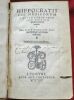
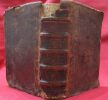
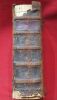
Marque dAntoine Vincent : avant-bras et main sortant dun nuage, entourés dun serpent se mordant la queue. La main tient un sceptre fleuri et deux rameaux en rinceaux, mention à gauche du sceptre « Vin / cin / ti. » Merci de nous contacter à l'avance si vous souhaitez consulter une référence au sein de notre librairie.

