 Write to the booksellers
-
Type
Book (132)
Magazine (3)
-
Language
French (133)
Italian (1)
Russian (1)
-
Century
16th (2)
17th (2)
18th (3)
19th (5)
20th (68)
-
Countries
Belgium (15)
Canada (1)
Denmark (7)
France (98)
Netherlands (6)
Switzerland (7)
United States of America (1)
-
Syndicate
ALAC (1)
CLAM (1)
ILAB (30)
NVVA (2)
SLACES (2)
SLAM (16)
Les fêtes solaires
1951 Janus - 1951 - petit In-8 broché - 30 pages - N° 124/150 - envoi (dédicace) de l'auteur
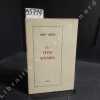
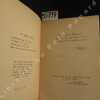
Bon état bon
De kunst van het zoenen. De 'Kussen' en andere liefdesgedichten, vertaald en toegelicht door J.P. GUÉPIN.
Utrecht, Bijleveld, 1997.
136 p. Hardb. 21 cm (Text, transl. & 'Nawoord'; incl. dustjacket)
Het boek der kusjes van Janus Secundus, in het Nederlandsch vertolkt door J.H. Scheltema.
Leiden, E.J. Brill, 1902.
LIX,76 p. Wrappers 21 cm (Text, translation, and a 76 page study on the work of Secundus) (Cover scuffed and chipped; back weak and almost broken; paper yellowing)
Iohannis Secundi Opera. Accurate recognita, ex museo P. Scriverii.
Leiden (Lugduni Batavorum), Apud Franciscum Hegerum, 1631. (Colophon at the end: 'Impressa Lugduni Batavorum, in nova officina typographica Wilhelmi Christiani, 1631')
12mo. XXVIII,384 (recte 382),(1 colophon),(1 blank) p. Vellum. 13.5 cm 'The kissing poet' (Ref: STCN ppn 833698613; Brunet 5,257; Willems 1669; Graesse 6,339; Ebert 20786) (Details: 5 thongs laced through the joints. Short title in ink on the back. Engraved title with the portrait of the first love of the neolatin poet Janus Secundus, Julia, locked within a kind of medallion and surrounded by 2 cornucopiae; the text reads: 'Vatis amatoris Iulia sculpta manu', i.e. 'a portrait sculped by the hand of the author'. On p. *10 verso an almost full-page engraved portrait of Janus Secundus himself, holding in his hand the medal or medallion he made with the portrait of Julia; underneath the portrait a 4 line poem by his brother Hadrianus Marius) (Condition: Vellum age-tanned. Front pastedown detached. Some irregular pagination) (Note: The Dutch neolatin poet Janus Secundus Nicolai Hagiensis, was born on the 15th of november 1511, the day of the martyr Secundus, in The Hague. He died very young in 1536. In 1528 he moved to Mechelen where his father was appointed president of the 'High Council'. This town was the residence of the Austrian vicequeen Margaretha of Parma. The southern part of the Netherlands was in this time the center of a florishing urban civilization. In May 1530 Secundus met a young prostitute from Mechelen, called Julia, and fell in love with her. Julia became the subject of his first book of elegies, his 'Julia Monobiblos', in which he tells how he won and lost his love. During his studies in Bourges under the famous jurist Alciati he wrote his first 'Basia'. Alciati introduced Secundus there also to the newest Italian poetry. A humanist poet often started his career with erotic poetry, like Piccolomini and Beza. Secundus' 'kiss-poems' are a variation on two 'kiss-poems' of the Latin poet Catullus (ca. 84-54 B.C), who became during the Renaissance a model for love-poetry. Secundus wrote in his short live 6835 lines of poetry, of which only 425 lines were printed during his lifetime. He wrote 'with equal fluency all kinds of lyrical, heroic, and elegiac verse. Down to the present day Secundus lives in literary history as the kissing poet' (...) 'Until far in the 18th century Secundus is mentioned as one of the classics of love poetry' (IJsewijn, Companion to Neo-Latin studies I, Leuven, 1990, p. 152) The first edition of his collected works was posthumously published in 1541 in Utrecht, and was edited by Secundus brother Marius. All later editions are based on this edition. The manuscript with the collected works used for this edition came later in the possession of the Dutch classicist Petrus Scriverius, 1576-1660. He produced a new edition in 1612, in which he also incorporated poems of Secundus which had been omitted in the 1541 edition because they were thought to be disagreeable to the French and English king. In this second edition of 1631 Scriverius incorporated more material from other sources and manuscripts. (Best source for Secundus is J.P. Guépin, 'De kunst van Janus Secundus', Amst., 1991.) It opens with 18 page with 'testimoni'a and 'iudicia' on Secundus. After the poems of Secundus, Scriverius added some poems of his brother Marius: 'Cymba amoris et alia poemata'. (p. 249/266) This is followed by Secundus' prose letters, though with some poetry, that he wrote during his 3 voyages through France, and his trip to Spain. (p. 269/345) At the end have been added some letters and a treatise on the family of Secundus 'De Nicolao Patre, & gente Nicolaia') (Collation: *8,(between leaf *4 and *5 have been inserted the leaves pi*5 and pi*6), **4; A-Q12 (Between the gatherings C and D the pagination of 72/79 is skipped.Leaf H11, p. 195/96, misnumbered 159/196, is a cancel. Leaves K11 & K12 have also irregular pagination, the numbers of the pages 244/45 are doubly used. Leaf L8 is a blank leaf. Leaf Q12 verso blank)) (Photographs on request)
Joannis Secundi opera.
Paris (Parisiis), Sumtibus Societatis, 1748.
12mo. (II),382,(1 corrigenda) p., portrait. Vellum 14.5 cm (Ref: cf. Willems 1669) (Details: 5 thongs laced through the joints. An engraved portrait on the title of the first love of Janus Secundus, Julia, locked within a kind of medallion and surrounded by 2 cornucopiae; the text reads: Vatis amatoris Iulia sculpta manu, i.e. a portrait sculped by the hand of the author; opposite the title is a full-page engraved portrait of Janus Secundus himself, holding in his hand the medal or medallion he made with the portrait of Julia; underneath the portrait a 4 line poem by his brother Hadrianus Marius) (Condition: Binding soiled. Old ownership entry on the first flyleaf. Outer margin of the portrait & the title thumbed. Paper yellowing) (Note: The Dutch neolatin poet Janus Secundus Nicolai Hagiensis, was born on the 15th of november 1511, the day of the martyr Secundus, in The Hague. He died very young in 1536. In 1528 he moved to Mechelen where his father was appointed president of the High Council. This town was the residence of the Austrian vicequeen Margaretha of Parma. The southern part of the Netherlands was in this time the center of a florishing urban civilization. In May 1530 Secundus met a young prostitute from Mechelen, called Julia, and fell in love with her. Julia became the subject of his first book of elegies, his Julia Monobiblos, in which he tells how he won and lost his love. During his studies in Bourges under the famous jurist Alciati he wrote his first Basia. Alciati introduced Secundus there also to the newest Italian poetry. A humanist poet often started his career with erotic poetry, like Piccolomini and Beza. Secundus' kiss-poems are a variation on two kiss-poems of the Latin poet Catullus (ca. 84-54 B.C), who became during the Renaissance a model for love-poetry. Secundus wrote in his short live 6835 lines of poetry, of which only 425 lines were printed during his lifetime. He wrote 'with equal fluency all kinds of lyrical, heroic, and elegiac verse. Down to the present day Secundus lives in literary history als the kissing poet' (...) 'Until far in the 18th century Secundus is mentioned as one of the classics of love poetry' (IJsewijn, Companion to Neo-Latin studies I, Leuven, 1990, p. 152) The first edition of his collected works was posthumely published in 1541 in Utrecht, and was edited by Secundus' brother Marius. All later editions are based on this edition. The manuscript with the collected works used for this edition came later in the possession of the Dutch classicist Petrus Scriverius, 1576-1660. He produced a new edition in 1619, in which he also incorporated poems of Secundus which had been omitted in the 1541 edition because they were thought to be disagreeable to the French and English king. In his second edition of 1631 Scriverius incorporated more material from other sources and manuscripts. (Best source for Secundus is J.P. Guépin, De kunst van Janus Secundus, Amst., 1991) The book on offer here is a reissue of the third edition of 1651. Willems says about the edition of 1651: 'L'édition de 1651 reproduit textuellement la précédente', id est that of 1631. The book opens with 18 pages testimonia and iudicia on Secundus. After these preliminary pages and before Secundus' text we find on page 27 a kind of half title: Joannis Secundi poemata quae reperiri potuerunt omnia. Ex tertia editione Petri Scriverii anno 1650. The year 1650 seems to be a printing error of the French printer. At the end are added some letters and a treatise on the family of Secundus De gente Nicolaia) (Provenance: on front flyleaf the old ownership entry of 'Frid. Guil. von Knebel'. We found on the internet a Friedrich Wilhelm von Knebel, 1735-1799, who seems to have been a rigid and at the same time sloppy Prusian state official. On the front pastedown is written in a different hand 'Ostheide'. Ostheide might refer to the Samtgemeinde (collective municipality) in the district of Lüneburg, south of Hamburg, in Lower Saxony, Germany. Ostheide is also a German family name) (Collation: pi1 (= A12), A12 (minus leaf A12), B-Q12 (R1, corrigenda)) (Photographs on request)
Janus Secundus (1511-1536). De tekstoverlevering van het tijdens zijn leven gepubliceerde werk.
Nieuwkoop, de Graaf, 1986.
323 p. Wrs. 24 cm (Diss.)
Tibulle, Albius ? Mirabeau, Honoré'Gabriel Riqueti ? Second, Jean (Janus Secundus)
Reference : LRB589
(1798)
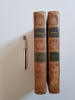
Élégies de Tibulle, suivies des Baisers de Jean Second? Tome second ? Tibulle, suivi de Contes et Nouvelles? Tome troisième
s.n., Rue S. André'des'Arts, n° 46 Paris 1798 Nombre de volumes : 2 volumes (tomes 2 et 3 seuls) — Reliure : Pleine basane marbrée de l'époque, encadrement de filets dorés sur les plats, dos lisses richement ornés de fleurons et roulettes, pièces de titre et de tomaison vert sombre dorées — Illustrations : Nombreuses figures gravées hors texte, dont frontispice 'Sophie' signé Borel del. et Delignon sculp. ; titre du t. II annonçant « avec quatorze figures », t. III « avec figures » — Langue : Texte latin et traduction française en regardContenu :? Tome II : Élégies de Tibulle, suivies des Baisers de Jean Second (traduction par Mirabeau), avec planches gravées.? Tome III : Tibulle, suivi de Contes et Nouvelles (par Mirabeau), notamment 'Le Filet de Vulcain, ou les Amours de Mars et Vénus', avec figures.Particularités d'exemplaire : Avis de tirage imprimé indiquant qu'il « a été tiré quelques exemplaires de cet Ouvrage sur papier vélin, et un très'petit nombre sur grand papier vélin superfin » — État : Bel ensemble d'époque, frottements d'usage aux plats et aux coiffes, petites épidermures et coins émoussés ; mors localement fendillés sans gravité ; papier vélin frais dans l'ensemble avec rousseurs et brunissures éparses, pâles mouillures marginales à quelques feuillets ; belles impressions des tailles'douces


JANUS LERNUTIUS ( 1545-1619 ),
, Brussel, Paleis der Academien, 1955, softcover originele uitgeversomslag, 18x26cm, 209pp.
Verhandelingen van de Koninklijke Vlaamse Academie voor Wetenschappen, Letteren en Schone kunsten van Belgie, Klasse der Letteren/ Menswetenschappen, 1955, verhandeling nr 23. In goede staat.
JANUS MET HET DUBBELE VOORHOOFD,
Bussum, Van Dishoeck, 1908 Gebonden, beige linnen, 311pp., 15.5x21cm.,
Samlingsbind med skrifter og disputatser af medlemmer af slægten Worm. ialt 12 skrifter.
Kbhvn., 1619-1739. 4to. Et hldrbd. fra omkring 1750, ryg slidt. Ialt ca. 500 pp.
Af Ole Worm kan fremhæves: Laurea I Philosophica. Summa. Waldkirch, 1619 og ""Jubileum Evangelium...Salomon Sartor, 1619"".


