 Write to the booksellers
-
Type
Book (7255)
Disk (44)
Drawings (1)
Engraving (9)
Magazine (89)
Maps (4)
Music sheets (135)
New book (2)
Old papers (1)
Photographs (19)
Posters (1)
-
Latest
Last 24h (2)
Last 3 days (10)
Last month (948)
Last week (6)
-
Language
Czech (1)
Dutch (11)
English (156)
French (7379)
German (4)
Italian (2)
Latin (3)
Russian (4)
-
Century
16th (17)
17th (43)
18th (199)
19th (882)
20th (2482)
21st (1567)
-
Countries
Belgium (1158)
Canada (34)
China (56)
Côte d'Ivoire (6)
Denmark (1063)
France (4893)
Germany (1)
Netherlands (181)
Switzerland (155)
United Kingdom (9)
United States of America (4)
-
Syndicate
ALAC (27)
CLAM (27)
CLAQ (2)
ILAB (2238)
NVVA (15)
SLACES (15)
SLAM (1026)
SNCAO (4)
"BOLTZMANN, LUDWIG. - THE STEFAN-BOLTZMANN LAW - BLACKBODY RADIATION
Reference : 43536
(1884)
Ableitung des Stefan'schen Gesetzes, betreffend die Abhängigkeit der Warmestrahlung von der Temperatur aus der electromagnetischen Lichttheorie.
Leipzig, Johann Ambrosius Barth, 1884. Without wrappers as issued in ""Annalen der Physik und Chemie. Hrsg. von G. Wiedemann."", Neue Folge Bd. 22, 6. Heft (= No 6). Titlepage to vol. 22. Pp. 145-304 (entire issue offered ""Heft"" 6). Boltzmann's paper: pp. 291-294. Small stamp to titlepage and verso of.
First appearance of this importent paper in which Boltzmann uses the second law of thermodynamics and Maxwell's electromagnetic theory to derive theoretically, based on Stefan's experimental observations, the proportionality of the radiation emitted from a body and the fourth power of the temperature of the body in Kelvin units. ""The law show a possible connection between thermodynamics and electromagnetism that was exploited in the later quantum theory. In the 1920s it was applied by Edington and others in explaining the equilibrium of stellar atmospheres.""(DSB II, p. 266).""The law states that the total energy radiated per unit surface area of a black body per unit time (known variously as the black-body irradiance, energy flux density, radiant flux, or the emissive power), is directly proportional to the fourth power of the black body's thermodynamic temperature T (also called absolute temperature).The Stefan Boltzmann law was experimentally discovered in the year 1879 by Josef Stefan and deduced 1884 by Ludwig Boltzmann theoretically by thermodynamic considerations from the classical electromagnetic theory of the radiation. In the year 1900, thus 21 years after the Stefan Boltzmann law, discovered Max Planck the Planck radiation law designated after it, from which the Stefan Boltzmann law follows simply by integration over all directions and wavelengths. The Planck radiation law could attribute the Stefan Boltzmann constant also for the first time with the introduction of the quantum of action h to fundamental natural constants.""Parkinson ""Breakthroughs"" 1883 P.
NOUVELLE METHODE POUR LA RECHERCHE DES FALSIFICATIONS DU THE -
BULLETIN ECONOMIQUE DE L'INDOCHINE-HANOI- 1941-INSTITUT DES RECHERCHES AGRONOMIQUES ET FORESTIERES -GOUVERNEMENT GENERAL DE L'INDOCHINE - plaquette gd.IN8 br.,19p. 7 ht - 2 cartes couleur dépliantes - un graphique - envoi autographe auteur à Saurin
Remise de 20% pour toutes commandes supérieures à 200 €
Le Saint curé d'Ars: Le chemin du ciel
Editions du Rocher 1998 265 pages 14x2 2x22 4cm. 1998. Broché. 265 pages.
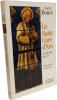
Très bon état
Things Dying Things Newborn: Selected Poems
The Menard Press 1985 106 pages in8. 1985. broché. 106 pages. Things Dying Things Newborn est un recueil de poèmes d'Yves Bonnefoy traduit en anglais par Anthony Rudolf publié par The Menard Press en 1985. L'ouvrage explore les thèmes de la mort et de la renaissance à travers une réflexion poétique sur l'existence et le sentiment d'exil
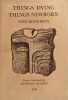
Bon état
Betrachtung über die Natur, mit Anmerkungen und Zusätzen herausgegeben von Johann Daniel Titius. Fünfte Auflage. 2 Bde.
Wien, B.Ph. Bauer, 1804. 2 contemp. boards. Tome-and titlelabels gilt. Engraved portrait as frontispiece. Portrait shaved in outer margin. XXXVI,438"(1),XVI,534,(24) pp.
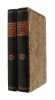
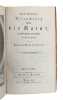
The translator and editor of this work, Johann Daniel Titius, whose commentary and additions to Bonnet's work, takes up nearly as much space Bonnet's text, is known for his formulation of the socalled ""Titius-Bode-Law"" and for using this rule to predict the existence of a celestial object at 2.8 AU from the sun. This Law and observation of his, was published in the above work.
"BONNET, (CHARLES). - FIRST SCIENTIFIC DESCRIPTION OF THE TAPEWORM.
Reference : 45045
(1750)
Dissertation sur le Ver nommé en Latin Tænia, & en francois Solitaire, où après avoir parlé d'un nouveau secret pour l'expulser des intestins dans lesquels il est logé, qui a eu d'heureux succès, l'on donne quelques observations sur cet Insecte. P...
Paris, L'Imprimerie Royale, 1750. 4to. Extract from ""Mémoires de Mathematique et de Physique, Présentés à l'Academie des Sciences par divers Savans"", Tome I. Pp. 478-529 pp. and 2 engraved plats. With titlepage to Volume I. A small wormhole to inner margin.
First appearance of this classic study of the tapeworm (Taenia), being the first accurate description of the Proglottids.""In 1741 he began to study reproduction by fusion and the regeneration of lost parts in the freshwater hydra and other animals. The following year he discovered that the respiration of caterpillars and butterflies is performed by pores, to which the name of stigmata has since been given. He also studied tapeworms. These investigations earned him a membership of the Royal Society of London in 1743, the same year he became a doctor of laws.""""Bonnet is considered one of the fathers of modern biology. He is distinguished for both his experimental research and his philosophy, which exerted a profound influence upon the naturalists of the eighteenth and nineteenth centuries. "" (D.S.B. II: 286).With: M. Geer ""Observation sur la propriété singulière qu'ont les grandes Chenilles á quatorze jambes & à double queue, du Saule, de seringuer de la liqueur"". Pp. 530-638 a. 1 engraved plate.
L'histoire du monde en 500 marches
Arthaud 2017 400 pages 17x22 5x2 8cm. 2017. broché. 400 pages.

Très bon état

La struttura logica del linguaggio (Studi Bompiani)
Bompiani 2001 537 pages in8. 2001. Broché. 537 pages.

Bon étatdos un peu creusé sans rides intérieur propre
Booker T.,Curtis King,Mancini Henry,The Mustangs,Count Basie,The Ventures - Cropper Jones,Steinberg Jackson -
Reference : 29815
(1962)
The Ancient Egyptian Book of the Dead. Translated by Raymond O. Faulkner. Edited by Carol Andrews.
(London, British Museum, 1985). 4to. Orig. full cloth with dustjacket. 192 pp. Richly illustrated partly in colour.
The Book of The Dead or going Forth by Day. Ideas of the Ancient Egyptians concerning the hereafter as expressed in their own Terms. Translated by Thomas George Allen. Prepared for Publication by Elizabeth Blaisdell Hauser.
Chicago, Univ. of Chicago Press, (1974). 4to. Orig. printed wrappers. X,306 pp.
(Studies in Ancient Oriental Civilization No. 37).
The Book of The Dead or going Forth by Day. Ideas of the ancient Egyptians concerning the Hereafter as expressed in their own terms. Translated for publication by Elizabeth Blaisdell Hauser.
Chicago, University og Chicago Press, (1974). 4to. Nice solid private full cloth. X,306 pp.
(Studies in Ancient Oriental Civilization No. 37).
The Egyptian Book of The Dead. The Book of going forth by Day. Being the Papyrus Ani (Royal Scribe of the divine Offerings)...Translated by Raymond O. Faulkner. With additional Translations and a Commentary by Ogden Goelet, Jr.
San Francisco, Chronicle Books, (1994). Folio. Orig. boards with dustjacket. 176 pp., 37 colourplates and illustr. in black/white.
FROM JANUARY TO DECEMBER
REVIEW OF REVIEWS OFFICE. Non daté. In-12. Broché. Etat d'usage, Couv. légèrement passée, Dos satisfaisant, Intérieur acceptable. 58 pages. Nombreuses illustrations en noir et blanc dans et hors texte.. . . . Classification Dewey : 420-Langue anglaise. Anglo-saxon
Classification Dewey : 420-Langue anglaise. Anglo-saxon

TONEEL EN THEATERLEVEN TE BRUSSEL NA 1830,
, Archief en Museum van het Vlaams Leven te Brussel, 1993, Gebrocheerd onder geillustreerde kartonomslag, 150 x 240mm., 256pp., z/w illustratie.
Zo volledig mogelijke inventaris van verdwenen en nog bestaande toneelgezelschappen te Brussel. Boek is in zeer goede staat.
Voyage pitoresque aux glacières de Savoye. fait en 1772.
A Genève, chez L. A. Caille, imprimeur-libraire, 1773. 8°. 303 S. Mit Anfangs- und Schlussvignette. Etwas späterer Halblederband.
e-Hls. – Erste Ausgabe. – André César Bordier (1746–1802), studierte Theologie in Genf, war kurze Zeit als Pfarrer tätig, ab 1775 im Genfer Rat der Zweihundert und ab 1790 Ratsherr. «In seinem Werk "Voyage pittoresque aux glacières de Savoie" (1773) feierte er als Erster die Erhabenheit der Gletscher» (HLS). Eine frühe Beschreibung der Gletschergebiete Savoyens (Mont-Blanc-Gruppe). – Mit erneuerten Vorsätzen. Mit Exlibris. Das Halbtitelblatt und das letzte Blatt unschön restauriert. Das Papier vereinzelt stockfleckig.

Phone number : 41 (0)44 261 57 50
Cahier Studybac - Enseignement scientifique - première - tronc commun: Préparer son bac et apprendre en s'amusant
Studyrama 2021 96 pages 17x21 9x1 1cm. 2021. Broché. 96 pages.
Très bon état - L'ouvrage qui n'a jamais été lu peut présenter de légères traces de stockage mais est du reste en très bon état. envoi rapide et soigné dans un emballage adapté depuis France
La grande aventure des indiens d'Amérique du Nord
Selection du reader's digest 1978 21 8x2 4x30cm. 1978. Relié.
très frais
China as a tea producer: areas of cultivation, methods of planting and manufacture, export trade, production and consumption, both in China and abroad
Shanghai 1926 The Commercial Press Hardcover 1st Edition
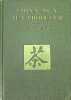
Coins de couverture endommagés et usure normale, 19,5 x 13,5 cm, 252 pp., Anglais, 1ère édition, Illustrations, état du livre : Très Bon Aperçu du livre Le travail de Torgasheff fournit une analyse détaillée du secteur du thé chinois à l'époque : Zones de culture : Il a identifié et décrit les régions chinoises spécifiques où le thé était cultivé, comme la province de Chekiang (Zhejiang). Méthodologie : Le livre couvre à la fois les méthodes de plantation et la fabrication industrielle de divers types de thé. Analyse économique : Torgasheff a inclus 59 tableaux statistiques détaillant le commerce d'exportation, la production intérieure et la consommation tant en Chine qu'à l'étranger. Classification : Il a fourni une classification systématique précoce des thés chinois en fonction de leur source et de leurs méthodes de transformation. [Cette description peut avoir été traduite par une IA.]
ALOES OF THE SOUTHAFRICAN VELD,
Johannesburg, Voortrekkerspers, 1971 Bound, cloth, illustrated paperjacket in colour, 210 x 270mm., 299pp., colour illustration troughout. .
Will enable the amateur to recognise the most important differences between the various species and to identify them in the veld or garden with difficulty. In satisfying condition.
Créez vous-même votre régime
Flammarion 2018 224 pages 14 5x21 9x1 9cm. 2018. Broché. 224 pages.
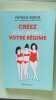
Bon état
The Sovietization of Ukraine 1917-1923: The Communist Doctrine and Practice of National Self-Determination (The Canadian Library in Ukrainian Studies)
Canadian Institute of Ukrainian Studies 1980 488 pages 4x23x15cm. 1980. Broché. 488 pages. Cet ouvrage analyse la théorie et la pratique bolcheviques de l'autodétermination nationale en Ukraine de la révolution de 1917 à la création de l'Union soviétique en 1923. Il présente un compte rendu détaillé des événements ayant conduit à la soviétisation de l'Ukraine et examine la théorie marxiste sur la question nationale ainsi que la situation socio-économique et politique du pays à la veille et pendant la révolution
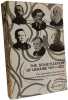
Bon état intérieur propre bonne tenue
"BOSCOVICH (BOSCOVIC), ROGER JOSEPH (RUDJER J.). - GEOMETRICAL OPTICS AND THE RAINBOW.
Reference : 45083
(1760)
Extrait d'une Lettre du P. Boscovich, Jésuite, Correspondant de l'Academie, écrite à M. de Mairan.
(Paris, Imprimerie Royale, 1760). 4to. Extract from ""Mémoires de Mathematique et de Physique, Présentés à l'Academie des Sciences par divers Savans"", Tome III. Pp. 321-325. A faint dampstain to inner margins.
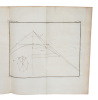
First apperance of Boskovic's paper in which he explains how light is refracted and reflected in droplets of water, creating the coloured rainbow - he discusses the sphericity in connection with both refraction and reflexion of light and he comments on Newton's optics.

