 Write to the booksellers
-
Type
Book (7249)
Disk (44)
Drawings (1)
Engraving (9)
Magazine (89)
Maps (4)
Music sheets (135)
New book (2)
Old papers (1)
Photographs (19)
Posters (1)
-
Latest
Last 24h (2)
Last 3 days (1)
Last month (862)
Last week (110)
-
Language
Czech (1)
Dutch (9)
English (156)
French (7375)
German (4)
Italian (2)
Latin (3)
Russian (4)
-
Century
16th (16)
17th (43)
18th (197)
19th (878)
20th (2479)
21st (1561)
-
Countries
Belgium (1156)
Canada (32)
China (56)
Côte d'Ivoire (7)
Denmark (1063)
France (4889)
Germany (1)
Netherlands (181)
Switzerland (156)
United Kingdom (9)
United States of America (4)
-
Syndicate
ALAC (25)
CLAM (25)
CLAQ (2)
ILAB (2237)
NVVA (15)
SLACES (15)
SLAM (1028)
SNCAO (4)
VICTOIRE SUR L'EVEREST. (The ascent of everest)
Traduit de l'Anglais par Bernard Pierre. Dessins de Charles Evans. Avant-propos de S.A.R. le duc d'Edimbourg. Préface de Maurice Erzog. Editions Amiot-Dumont 1953. Broché In8 carré sous jaquette illustrée couleurs. 350 pages. Dessins dans le texte de Charles Evans, Planches photos nb (héliogravure) hors-texte, carte. Bon état.La toile de fond - Le plan - L'Approche - Le dispositif - L'Assaut - Après la victoire - APPENDICES : Journal de l'expédition (septembre 1952 - juin 1953), par Wilfrid Noyce - Schéma de l'organisation de l'expédition - Remarques sur certaines pièces d'équipement, par C. G. Wylie - Le matériel à oxygène, par Tom Bourdillon - Le régime alimentaire, par L. G. C. Pugh et G. C. Band - Physiologie et médecine, par L. G. C. Pugh et M. P. Ward - Tableau des charges d'assaut - Fournisseurs - Glossaire - Le plan de base.avec sa jaquette en bon etat
Catalogue of the Loan Exhibition of Flemish and Belgium Art Burlington House London 1927 Memorial Volume
London / UK, Country life - The Anglo - Belgian union, 1927 Bound in gr-infolio, in slipcase, in fine condition !!!! 261pp. with 96 plates, one in color. .
Numbered edition no. 442. section of tapestry by A. Kendrick, section of drawings and engravings by Campbell Dodgson
The Black Dwarf and A Legend of Montrose
Adam and Charles Black 1913 in8. 1913. Cartonné. Le livre 'The Black Dwarf and A Legend of Montrose' de Sir Walter Scott rassemble deux romans historiques se déroulant en Écosse. 'The Black Dwarf' met en scène un personnage solitaire et mystérieux tandis que 'A Legend of Montrose' explore les conflits du XVIIe siècle. L'œuvre reflète le style caractéristique de Scott mêlant histoire et fiction


couverture défraîchie rousseurs sur la tranche intérieur propre
Van Gogh and the colors of the night
Brussel, Mercatorfonds / Fonds Mercator, 2008 Hardcover, Bound with dusjacket, Pagina's: 160,Afmetingen: 27 x 23 cm,80 illustraties in kleur. . ISBN 9789061538295.
his very first letter sketch in 1876 until his last paintings in 1890. In many paintings, most of which are now considered to be key works in his oeuvre, he addressed the paradoxical task of representing night through color. Van Gogh and the Colors of the Night presents new insight on Van Goghs depictions of the twilight and dark hours, and is the first volume to focus on this aspect of the artists career. This book explores the different layers of content of these works: tradition and modernity, rest at the end of the day, the cycles of nature and rural labour, the poetry of the night, and artistic and literary influences. It also discusses in depth the stylistic and technical methods Van Gogh used to realize his effects of dark and light. This publication accompanies the exhibition of the same name at the MOMA in New York (from the 21st of September 2008 until the 5th of January 2009) and the Van Gogh Museum in Amsterdam (from the 13rd February until the 7th of June 2009). English (ISBN 978 90 61538 29 5)
Van Gogh et les couleurs de la nuit
Brussel, Mercatorfonds / Fonds Mercator, 2008 Hardcover, Bound with dusjacket, Pagina's: 160,Afmetingen: 27 x 23 cm,80 illustraties in kleur. . ISBN 9789061538288.
Les representations du crepuscule et de la nuit sont comme un fil rouge dans la carriere de Van Gogh et comptent pour la plupart parmi ses plus grands chefs d'oeuvre. 'Les mangeurs de pommes de terre' et la serie 'des semeurs au soleil' couchant en sont de celebres exemples. Avant meme de devenir artiste, Vincent van Gogh eprouvait deja une predilection pour l'ambiance du soir et de la nuit. Il l'associait a la poesie et a une impression de securite. Dans ce livre, le lecteur decouvre comment Vincent etudie les differents aspects des heures nocturnes et les combine avec d'autres themes, comme le combat mene par l'etre humain face a la durete de l'epoque moderne et l'emotion qui l'accompagne, ou encore le contraste entre la nature, grotesque et eternelle, et la vie insignifiante et ephemere de l'homme. Les sources litteraires qui ont influence l'artiste sont egalement abordees, ainsi que les procedes techniques et stylistiques qu'il a utilises pour rendre la lumiere et l'obscurite
Hær begynnes then Zelands low paa ræt dansk och er skifft i sijw bøgher och hwer bogh haffuer sith register oc ær wel offuer seeth och rætthelige corrigeret. (Kolofon: Oc nu gien Prentet udi Kiøbenhaffn Anno 1576 lige effter den Gamle Lowbog...).
(Colophon:) Kiøbenhaffn (Copenhagen), Matz Wingaardt, 1576. 4to. Pragtfuldt samtidigt hellæderbind af kalveskind over træ med skråtskårne kanter og 2 lukkestroppe med messingbeslag (det ene hængsel løst), antageligt udført af en dansk bogbinder. 3 ophøjede ægte bind på ryggen og med blindtrykte stregbordurer. Permer med dobbelte stregrammer og 2 brede rammer udført med ruller og stempler. Midtfelterne med stort pladetrykt billede af Justitia, på bagpermen et billede af Justinian ?. Kapitæler med mindre reparationer. Titelbladet med en træsnit illustration af den danske konge med rigsvåbnet. Kolofon med Gotfred af Ghemens trykkermærke i træsnit. 111 unummerede blade. Indersiden af forpermen har notater i gl. hænder vedrørende bogens indhold. Fra Oscar Wandels bogsamling med hans exlibris. Da bogen ikke er ombundet foreligger den her i dens opsrindelige størrelse med pænt brede marginer. Få spredte brunpletter. Nogle blade med en svag skjold nederst på siderne. De første 6 blade (incl. titelbladet) er noget restaurerede med senere omkantning. Titelbladet har en smule tab af stregrammen omkring kongen, blad 2 recto har tab af et ord i nederste linie (tagher). Trykt på svært papir.
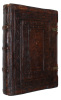
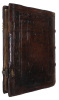
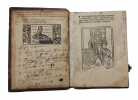
Extremely rare first printing of what is arguably the world's first facsimile, namely Mads Vingaard's 1576 reproduction of the first printing of the Law of Sealand, originally printed by Ghemen in 1505 and here re-issued in exact reproduction. This wonderful print is not merely a ""line to line, word to word""-reproduction, but a facsimile making use of the same types and exact reproductions of the woodcuts. It is generally believed that ""the first facsimile in the history of the book was a manuscript of Austrian provenance - the Goldene Bulle - reproduced in 1697 by the Frankfurt law historian Heinrich Günther Thülemeyer and Johann Friedrich Fleischer"" (from ""Imagination, Almanach"" 1986-1993, Sammelheft. 1993"" 2006). The present reproduction predates that work otherwise hailed as the first ""facsimile"" in the history of the book by more than a century!Some credit Plantin in the 17th century with being the first to produce a facsimile. This is also about a century after Mats Vingaard's facsimile of the Law of Sealand. Like the laws of Sealand and The Law of Scania, The Law of Jutland"" constitutes a law book (""Rechtsbuch"" in German) in the sense of a private collection of those common laws pertaining to inheritance, ownership, marriage, measurement of land, murder, theft, vandalism, etc. that were commonly applicable in the region.The medieval Danish regional laws possess an immense importance both linguistically and legally, and the influence is evident even today, both in the development of our legal system and of our written language. At the time of their foundation, the Danish kingdom was divided into jurisdictional areas, lands, that in turn were divided into townships. Each land had a county council, which also served as a judicial court. It quite quickly became standard for the township court to be able to refer verdicts and rulings to the county/land council. In the 13th century, there were three main lands, namely Jutland, Sealand and Skåne. With time, these three lands came to rule over all townships, and thus, we find three ruling legal books from the 13th century, namely the three earliest Danish law books - Jyske Lov, the Sealandic Laws, and Skånske Lov. They were all printed for the first time in 1505 and 1505 respectively. It is not until 1683 (with ""Danske Lov"") that Denmark gets a law that covers the entire kingdom. The 1576 facsimile is scarce and Thesaurus estimates that only ab. 10 copies still exist on private hands.

SKJÖLDEBRAND, A.F. (ANDERS FREDERIK) - THE WAR AGAINST POLAND AND DENMARK 1655-58.
Reference : 45461
(1806)
Batailles de Charles X Gustave Roi de Suede. Gravées d'apres les dessins du Comte de Dahlberg et les tableaux de Lembke et publiées par ordre de Sa Majesté le Roi Regnant.
Stockholm, 1806. Large folio oblong. (44 x 61 cm.). Contemp. hcalf, covers with marbled paper. Titlelabel in red and gilt pasted on frontcover. Wear to foot of spine, otherwise fine. Engraved titlepage (battle view), engraved plate depicting the Carl Gustav on horseback in front of a battle scene and 11 engraved plates showing battlescenes after Dahlberg's drawings. All engravings in beautiful toned sepia aquatint. A few marginal brownspots. A very fine copy.
Very scarce first printing of this series of plates, aiming at glorifying the Swedish victories, showing battlescenes - Warsaw, Carnova, Columbi, Guesne and the crossing of the Belt in Denmark - from the wars against Poland and Denmark (1655-58), in fine engravings by Skjöldebrand.
Botanische Ergebnisse der Schwedischen Expedtion nach Patagonien und dem Feuerlande 1907-1909. III.: A Botanical Survey of the Falkland Islands.
Uppsala & Stockholm, 1913. 4to. No wrappers. Uncut. 129 pp., 1 map and 14 plates.
(Kungl. Svenska Vetenskapsakademiens Handlingar. Bd. 50:3).
SKÅNE - THERSNER, ULRIC. - THE GRAND TOPOGRAPHY OF SWEDISH ROMANTICISM.
Reference : 45334
(1816)
Skånska Utsigter. Vue de Scanie. (Smudstitelbladet: Fordna och Närvarande Sverige. La Suède Ancienne et Moderne).
(Stockholm, 1816-23). Tvær-folio. (39 x 51 cm.). Samtidigt hldrbd. med rygforgyldning. Lidt slidt ved kapitæler. Ryg med lettere brugsspor. (6, Smudstitel, Dedikation til Kongen,Företal) pp. Graveret titelblad, Innehåll (2 blade) samt 60 plancher i kobberstik eller aquatintetryk, tegnet af Thersner og graverede af S.H. Petersen eller C.F. Akrell. Med 60 blade beskrivende tekst (fra 1-4 pp. pr. planche). Med svensk/fransk parallelltekst. Plancherne forestiller vuer og herregårde. Enkelte blade med kantforstærkninger, 1 blad med repareret revne. Som altid med lidt brunpletter, dog mest marginale.
Et ganske udmærket eksemplar af det første bind (omhandlende Skåne) af Thersners stort anlagte topografiske mesterværk, som udkom i 12 dele i årene 1816-67. Inspirationen til værket, som blev fortsat af hans datter Thora Thersner, fik han fra Dahlbergs Suecia Antiqua et Hodierna og fra Skjöldebrands Voyage Pittoresque au Cap Nord.Swedish Books 1280-1967, no.57.
Slappey Sterling G. Dowgierd Antoine Chamber of commerce of the United States
Reference : 33440VPSL
ISBN : 9782760400771
The Good Daughter: The gripping No. 1 Sunday Times bestselling psychological crime suspense thriller you won't be able to put down! (Charlie Quinn 2)
HarperCollins 2018 512 pages 12 8x19 6x3 2cm. 2018. Broché. 512 pages.
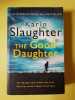
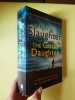
Bon état
The Good Daughter: The gripping No. 1 Sunday Times bestselling psychological crime suspense thriller you won't be able to put down! (Charlie Quinn 2)
HarperCollins 2018 512 pages 12 8x19 6x3 2cm. 2018. Broché. 512 pages.
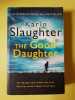
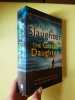
Bon état
THE PAINTED FURNITURE SOURCEBOOK. Motifs from medieval times to the present day.
Londen, Collins & Brown Limited, 1998 hardback, original color illustrated cover, 21x27,5 cm, 160 pp., illustrated in b/w and color. Good condition. ISBN 1855854686.
Annie Sloan brings her artist's eye to the immense popular subject of painted furniture. In this unique sourcebook she has gathered together an inspirational world and arranged them in themed chapters - fruits and flowers, figures and animals, classical, abstract and geometric and finishes. Close-ups and cut-outs allow the reader to duplicate images and a motif libraby provides a selection of original images to decorate your furniture. A glossary and a section on paint finishes complete this perfect inspiration for fans of painted furniture everywhere.
Crossing Boundaries. Issues of Cultural and Individual Identities in the Middle Ages and the Renaissance,
Turnhout, Brepols, 1999 Hardback, XII+283 p., 15 b/w ill., 2 b/w tables, + 2 music scores, 160 x 240 mm. ISBN 9782503508184.
The essays collected here cover a range of topics and periods, and have in common the concept of boundaries, which is defined according to discipline, and movement through boundaries. The essays collected here have in common the concept of boundaries, which is defined according to discipline, and movement through boundaries. The essays cover a range of topics and periods. The first section consists of literary approaches to boundaries, ranging widely in subject matter from Norman drama to sixteenth-century goodnight ballads. The second section includes mainly historical studies of such topics as social mobility in Geoffrey of Monmouth's twelfth-century History of the Kings of Britain, post-1453 Byzantine identity, and Milanese Renaissance musical genres. Individually and as a group, the essays contribute fresh insights into well-known and some less familiar works of the Middle Ages and the Renaissance. Contributions include: Linda Georgianna, 'Geoffrey of Monmouth's Historia regum Britanniae: lessons in self-fashioning for the bastards of Britain'; Robert L.A. Clark, 'Eve and her audience in the Anglo-Norman Adam'; John Damon, 'Seinte Cecile and Cristes owene knyghtes: violence, resignation, and resistance in the Second Nun's Tale'; Elaine R. Miller, 'Linguistic identity in the Middle Ages: the case of the Spanish Jews'; Emily Steiner, 'Medieval documentary poetics and Langland's authorial identity'; Patricia Marby Harrison, 'Religious rhetoric as resistance in Early Modern goodnight ballads'; Jami Ake, 'Mary Wroth's willow poetics: revising female desire in Pamphilia to Amphilanthus'; Annabel Patterson, '"The human face divine": identity and the portrait from Locke to Chaucer'; Jonathan Harris, 'Common language and the common good: aspects of identity among Byzantine emigres in Renaissance Italy'; Nolan Gasser, 'Beata et venerabilis Virgo: music and devotion in Renaissance Milan'; Elspeth Whitney, 'Sex, lies, and depositions: Pierre de Lancre's vision of the witches' sabbath'; Laura Hunt Yungblut, '"Straungers and aliaunts": the "un-English" among the English in Elizabethan England'. New.
La longue marche
Editions Richelieu, 1969. Deux volumes petit In-4 joliment reliés par l'éditeur plein Reluskin , gardes en papier jaspé , signet , état remarquable tant sur le plan de la reliure que du texte , nombreux documents noir et couleurs , qq hors texte , 396 + 329 pages . Ensemble à l'état de neuf .
Un document remarquablement servi par les exigences de l'Imprimerie Nationale et son concours exceptionnel. Préface et notes de Lucien Bianco ( directeur d'étude à l'école Pratique des hautes études ) , propos recueillis par Agnes Smedley traduits par Claude Payen .BON ET BEL OUVRAGE . Très Bon Etat Mise à jour du Samedi 27 Juin 2026. Paiement PayPal immédiat, Mondial Relay pour : France, Allemagne, Autriche, Belgique, Espagne, Italie, Portugal, Luxembourg, Pays-Bas, Pologne (Communiquer votre point ou locker si connu). Une participation supplémentaire peut être demandée pour les colis lourds hors France où les envois compris entre 5 et 25 kg sont dégressifs : 2 à 4 kilogrammes - 7.99 / 5 à 10 kg - 15.99 / 15 -25 kg - 25.99. Certaines de nos collections ( Vian, Céline, Camus (...) peuvent être expédiées en Franco de port. Pour linternational hors Europe (Suisse, Canada, Japon, Etats-Unis, les frais dexpéditions peuvent varier selon le poids (mise à jour : 1 juin 2026).
Vroedkunde - Verhandeling over het bespiegelend en bewerkend deel der Vroedkunde / In 't Engels geschreven door William Smellie ...; na de derde druk in 't Hollandsch gebragt, en met eenige weinige aanmerkingen en zaaken vermeerderd door Matthys van der Haage.
, Te Amsterdam, By Jan Morterre, 1765 + 1766, Gebonden, volleder, goudopdruk op front, 5 nerven en titelvignet op rug, originele titelpagina's, 210 x 280mm., 266 + 262 + 304 + 78pp + 41 gegraveerde platen met hun verklaring.
Verhandeling over het bespiegelend en bewerkend deel der Vroedkunde / In 't Engels geschreven door William Smellie; na de derde druk in 't Hollandsch gebragt, en met eenige weinige aanmerkingen en zaaken vermeerderd door Matthys van der Haage. Het geheel is in perfecte staat!
Flemish Miniatures from the 8th to the mid-16th Century. The Medieval World on Parchment.
1 Relié, pleine toile et jaquette illustrée de l'éditeur. 32 x 25 cm, 528 p., très nombreuses illustrations. Leuven, Davidsfonds, 1999. Edition originale
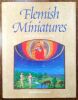
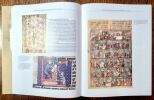
Étude abondamment illustrée, bibliographie, index des manuscrits, index des enlumineurs. Textes en anglais. Très bon état
Books to Bytes: Knowledge and Information in the Postmodern Era
BFI publishing 1994 216 pages 15 8x1 8x23 6cm. 1994. Cartonné jaquette. 216 pages.

Très bon état
Money and Financial Intermediation: The Theory and Structure of Financial Systems
Prentice hall 1978 370 pages 22 86x2 286x15 748cm. 1978. Cartonné. 370 pages.

Bon état sans jaquette intérieur propre bonne tenue petit accroc sur le bords supérieur du premier plat
"SMITH, ROBERT. - THE MAIN TEXTBOOK ON OPTICS IN THE 18TH CENTURY.
Reference : 50315
(1755)
Vollständiger Lehrbegriff der Optik nach Herrn Robert Smiths Englischen mit Aenderungen und Zusätzen ausgearbeitet von Abraham Gotthelf Kästner.
Altenburg, Richterischen Buchhandlung, 1755. 4to. Contemp. boards. Handwritten titlelabel on spine. Engraved titlevignette. (20),531,(5) pp. and 22 folded engraved plates. A few scattered brownspots, but in general clean.
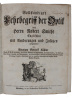
Scarce first German edition of this hugely influential textbook in optics.""Smith wrote on optics and harmonics. In 1738 he published A Compleat System of Optics in Four Books, viz. A Popular, at Mathematical, a Mechanical, and a Philosophical Treatise. Both comprehensive and reliable, the work became probably the most influential optical textbook of the eighteenth century. It was also published in Dutch in 1753, in German in 1755, and in two different French translations in 1767, In 1778 an abridged version was published in English. In turn, its popularity helped to establish the eighteenth-century conviction that light is particulate."" (DSB).
Smith Will Lawrence Martin Leoni Tea Karyo Tchéky Randle Theresa Bay Michael
Reference : 300003033
(2001)
Molekular-kinetische Theorie der Opaleszenz von Gasen im kritischer Zustande. sowie einiger verwandter Erscheinungen. (Kinetic Theory of Gas Opalescence at the Critical State). (Bearbeitet nach einer am 2. December 1907 der Krakauer Akademie vorgelegt...
(Leipzig, Johann Ambrosius Barth), 1908 No wrappers. In: ""Annalen der Physik. Vierte Folge. Hrsg. von W. Wien und M. Planck."", Vierte Folge. Band 25, No 2. Pp. 185-376. The entire issue offered. Smoluchowski's paper: pp. 206-226The block is punched in inner margins after cords.
First German edition. ""His paper ""Teoria kinetyczna opalescencji gazów w stanie krytycznym"" (""kinetic Theory of Gas Opalescence at the Critical Stale"" 1907) - the paper offered in the German version - shows why the critical point plays such an important role and states that the opalescence of pure gas also should be observable under normal conditions: ""Each of us has observed it innumerable times when admiring the blue of the sky or the glow of the rising sun."" Smoluchowski combined the theory of fluctuations with the results of Lord Rayleigh’s researches on the blue of the sky" his finding (Einstein also took part in the discussion) was that the blueness of the sky was caused by fluctuations in the density of the air. Smoiuchowski’s laboratory production of sky blue closed the investigation to a certain extent.that pure air can opalesce in the laboratory under normal conditions.
Women in Educational Policy-making. A Qualitative and Quantitative Analysis of the Situation in the E.U.
Leuven, Universitaire Pers, 1999 Paperback, English, original editor's jacket, 16x24 cm., 148 pp. ISBN 9789061869528.
Studia Paedagogica : 24. Enhancing the participation of women in high-level decision-making in several sectors of society has been on the agenda of national and international institutions for several years. These endeavours, however, are not always equally successful. In this book, the authors evaluate the participation of women in the field of educational policy-making in western Europe, both from a quantitative and a qualitative perspective. Over the last decennia, many countries have taken legal steps in order to eliminate structural obstacles to women's access to high level positions; nevertheless, women still take up only a small minority of these functions, which suggests that cultural factors are obstructing women's empowerment as much as juridical factors. Increasing the numbers of women as a purely quantitative approach to the problem is inadequate, because it leaves these cultural elements unchallenged. Therefore, in the first, theoretical part of this book, the authors address the question of the relationship between women's participation in politics and the question of social emancipation. Through a deconstruction of the different arguments for increasing women's participation in policy-making, the authors try to indicate in what sense or under what conditions women's participation in politics can address not only the problem of women's equal rights, but also that of engendering a less discriminative, more democratic and emancipatory politics. In the second part, they analyse on an empirical level the participation of women in educational policy-making in the member countries of the E.U. The aim thereby is to explore some general tendencies and to formulate hypotheses concerning interrelationships between some of the data. This part gives rise to a number of interesting questions for further research.
Norges Konge-Sagaer fra de ældste Tider indtil anden Halvdeel af det 13de Aarhundrede efter Christi Fødsel. 2 bd.
Christiania, Feilberg & Landmark, 1859 - 1871. 8vo. Uniformly bound in two contemporary half calf binding. Wear and scratches to extremities. Vol. 1 missing leather on upper compartment. Internally leaves evenly browned. XL, 560 pp: XV, 500 pp.
art of Soviet Palekh
Moskau, , 1958 55pp 39 coloured plates all in an original red box. + slipcase..
Highlights from the Moscow exhibition of artists of Palekh invluding paintings of miniatures.Text in 3 languages:English,French and Russian. A very good and clean copy.Palekh, the village from which the art originated, traditionally decorated icons in this manner.

