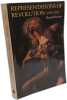
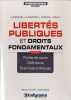
, Brepols, 2010 352 p., 240 x 310 mm,Languages: English, Hardback with dusjacket. ISBN 9782503535784.
This is the first published summary of the entire complex of the great necropoles of Rome, which were situated on Vatican Hill. The work concerns one of the most extensive, richest, and least-known Roman archaeological phenomena and bears witness to the work of creating an underground museum that has been followed internationally as a model of conservation practice. From the submerged world of the necropoles emerges the funeral ?normality? of the Roman world, from poorer cremations in wooden urns, to sumptuous sarcophagi, to sepulchres adorned with frescoes and mosaics. One can also observe Egyptian cults influencing the practice of epicurean philosophy. In addition, we can catch a glimpse of the first traces of Christianity, which include the presence of St. Peter the Apostle?s tomb. "Il s'agit d'un tres bel ouvrage qu'on ne se lasse pas de feuilleter, et dont on retiendra plus particulierement la richesse du propos et la qualite des photographies en pleine page, ainsi que le souci de donner un apercu aussi bien de la diversite du decor ornemental que du mobilier mis au jour. P. Liverani et G. Spinola nous offrent la une synthese eclairante et passionnante sur cet exceptionnel ensemble funeraire."
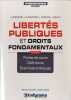
, , 2011 272 p., 220 x 280 mm, Languages: English,Paperback. ISBN 9782503540733.
From the late sixteenth century until around 1800, new ideas and practices of urban planning and the implementation of public buildings, water works and fortifications from the Low Countries were disseminated across Europe and America. Engineers, mathematicians and other scientists in the Low Countries applied methods of design and land surveying that were gradually assimilated and often modified following exchanges within local practice. In some cases, models were projected onto the existing situation. This phenomenon of disseminating and exchanging theoretical models and practical methods between the Low Countries, Europe and its colonies during this period developed into a new Early Modern Urbanism movement within the Western World. Grid-like plans figured prominently in these processes of dissemination and exchange. In the Low Countries, grid-like structures allowed a comprehensive approach to a multitude of complex problems in urban planning (for example, the connection of canals, streets and fortifications) in parts of existing towns, as well as in city extensions and ex novo cities. Moreover, the experimental approaches in Antwerp and other urban laboratories resulted in new theories on town planning and fortification as well. Given the distinct cultures of the Catholic Spanish Southern Netherlands and the Republican, Dutch Calvinist Northern Netherlands, the Low Countries provide an excellent case for studying the identity of urban forms. Both engaged in enormous expansion overseas, and the simultaneous exchange of practices between the southern and northern parts of the Low Countries lead to the combination of identities. In this new volume in the Architectura Moderna series, various scholars examine the dissemination of practical methods and theoretical models of urban planning from the Northern and Southern Low Countries, in addition to exchanges with local practices in Northern and Central Europe and in the New World.
Turnhout, Brepols, 2011 Paperback, XIV+408 p., 300 b/w ill., 220 x 280 mm. ISBN 9782503540733.
From the late sixteenth century until around 1800, new ideas and practices of urban planning and the implementation of public buildings, water works and fortifications from the Low Countries were disseminated across Europe and America. Engineers, mathematicians and other scientists in the Low Countries applied methods of design and land surveying that were gradually assimilated and often modified following exchanges within local practice. In some cases, models were projected onto the existing situation. This phenomenon of disseminating and exchanging theoretical models and practical methods between the Low Countries, Europe and its colonies during this period developed into a new Early Modern Urbanism movement within the Western World. Grid-like plans figured prominently in these processes of dissemination and exchange. In the Low Countries, grid-like structures allowed a comprehensive approach to a multitude of complex problems in urban planning (for example, the connection of canals, streets and fortifications) in parts of existing towns, as well as in city extensions and ex novo cities. Moreover, the experimental approaches in Antwerp and other urban laboratories resulted in new theories on town planning and fortification as well. Given the distinct cultures of the Catholic Spanish Southern Netherlands and the Republican, Dutch Calvinist Northern Netherlands, the Low Countries provide an excellent case for studying the identity of urban forms. Both engaged in enormous expansion overseas, and the simultaneous exchange of practices between the southern and northern parts of the Low Countries lead to the combination of identities. In this new volume in the Architectura Moderna series, various scholars examine the dissemination of practical methods and theoretical models of urban planning from the Northern and Southern Low Countries, in addition to exchanges with local practices in Northern and Central Europe and in the New World. New.
Turnhout, Brepols, 2005 Paperback, XII+261 pages ., 157 b/w ill., 220 x 280 mm.*NEW ISBN 9782503518138.
In this publication, attention is devoted to the technical aspects in the work of Hans Vredeman de Vries. Throughout his long career, he has perfected his skills as a painter, architect, fortification engineer and hydraulic engineer. Those technical aspects are considered not so much as discrete characteristics, but rather as a particular way in which this late sixteenth- century artist from the Low Countries typically dealt with a number of disciplines of the technical and applied arts. Indeed, from a predominantly traditional approach to his work, too much emphasis has until now been placed on his highly personal contribution to the dissemination of ornamental elements, whereby typical Renaissance characteristics, such as technical innovation and engineering, are relegated to the background. During Hans Vredeman de Vries's lifetime, attempts began to be made to define the arts and the sciences. Defining the demarcation criteria of the sciences would continue to gain in importance especially at the beginning of the seventeenth century. With his work, Vredeman de Vries raised Architectura together with all its technical acquisitions to the level of both the Artes and the Scienciae. Attempts were even made to establish some kind of hierarchy. Yet the artist never strictly separated fine and applied arts, nor did he explicitly distinguish between theory and practice. It was the intention of Vredeman de Vries to aim towards an equilibrium between the sciences and the arts. A team of thirteen distinguished art and architectural historians from North America, Germany, the Netherlands and Belgium focus upon Vredeman de Vries's diverse manifestations of knowledge: urbanism, fortification works, hydraulics, interior decoration, architecture (its practical and technical aspects), inlay work and furniture, tapestry and the use of scientific instruments. One author points out that the similarity between such 'technical' practices and the structure of, for example, sixteenth-century rhetorical practices, forces us to consider Vredeman de Vries not simply as an architect, an engineer, or a designer, but above all as an experimenter in multiple disciplines and various fields. New.
Turnhout, Brepols, 2008 Paperback, original editor's jacket, english, 22x28 cm., 266 pp., 186 b/w + 16 colour illustrations.*NEW ISBN 9782503523880.
Architectura Moderna ARCHMOD 6. It is the aim of this publication to bring together researchers to confront the results of their studies about the interpretation of the facade of this Counter-Reformation church, the phenomenon of diffuse light created by reflection and refraction on marble statues, pillars and multiple ornaments, the combination of linear and parallel perspective applications, the sacral and social use of space, the signification of the facade and towers as parts of a perspective scene in the city landscape and the relationship of Rubens's paintings with the Baroque interior. Special attention is also devoted to the School of Mathematics, installed in Antwerp by the Jesuits at that time.
Turnhout, Brepols, 2008 Paperback, 266 p., 186 b/w ill. + 16 colour ill., 220 x 280 mm. *NEW ISBN 9782503523880.
During the sixteenth century Antwerp was at the forefront of the Renaissance north of the Alps. Not only a new architectural style flourished in the Antwerp metropolis, but at the end of the sixteenth century sciences such as mathematics, optics, geometry and perspective became more and more important. They helped to redefine architecture and the other fine arts on a more scientific base. Their introduction in the arts at the beginning of the seventeenth century lead to new experiences, applications and even innovations in architecture. The Jesuit Order played a very crucial rule in this process. The realization of their new church in the centre of the city of Antwerp became one of the first attempts to bring together the applications of all those new ideas in one total project. Paintings by Peter Paul Rubens and sculptures by Hieronymus Duquenoy, Artus Quellinus etc. were participating in one of the first Early Baroque architectural realizations in the Low Countries. The Jesuit Church of Antwerp, actually the St Carolus Borromeus Church, was designed by Francois d'Aguilon, a scientist and architect of the Jesuit Order. His publication Opticorum Libri sex on optics and on the reflection of light was edited by the Officina Plantiniana in 1613, the same year he started his project for the church. This scientific and theoretical work helps us to understand the new experiences with light and space he experimented with. It is the aim of this publication to bring together researchers to confront the results of their studies about the interpretation of the facade of this Counter-Reformation church, the phenomenon of diffuse light created by reflection and refraction on marble statues, pillars and multiple ornaments, the combination of linear and parallel perspective applications, the sacral and social use of space, the signification of the facade and towers as parts of a perspective scene in the city landscape and the relationship of Rubens's paintings with the Baroque interior. Special attention is also devoted to the School of Mathematics, installed in Antwerp by the Jesuits at that time. The central question will be whether we can conclude that at the beginning of the seventeenth century the innovative sense of creating a new architecture, so typical for the sixteenth century in Antwerp, still persisted in this city during the early seventeenth century, and even lead to a new interpretation of architectural space in European context. New.
Turnhout, Brepols, 2012 Paperback, 262 p., 200 b/w ill., 220 x 280 mm. ISBN 9782503513010.
Rubens book Palazzi di Genova' was well diffused in European countries as England, the Netherlands, France, Germany and Italy thanks to the numerous contacts the famous painter and diplomat maintained in humanistic, artistic and political circles. From 1622 on this book, containing two volumes, was edited at several times during the 17th and 18th Century. But the direct influences of the numerous facades, plans, cross-sections, staircases and building details on modern architecture look rather limited, especially in his own country. In this study, several scholars in architectural history analyse how the examples of Genoese palazzi and churches as presented by Rubens were accepted in different European countries. Much attention is given to the question if these examples inspired a new architectural typology, in which the inner court of the houses was substituted by a 'salone in mezzo'. An attempt is made to situate Rubens' book among the late 16th and early 17th Century treatises and model books. The way in which Rubens presented the new Genoese architecture of villa's, palaces and churches and the introduction he wrote as a 'painter-architect' to this book were so modern at that time, that the reception of this prestigious edition in folio had more to do with changes in considering architectural theory and practice as with the propagation of a late renaissance style influenced by Antique examples. Languages: English, French, German. New.condition !!
La Fabrica 2016 La Fabrica, 2016, cartonnage éditeur sous le bandeau éditeur dépliant, environ 29x 24 cm. Cartonnage un peu sali. Bon état néanmoins et intérieur très propre.
A project on Mediterranean metaphysics by Bernard Plossu, with textes by Ricardo Wazquez and Juan Manuel Bonet. Texte en ANGLAIS et en ESPAGNOL. Merci de nous contacter à l'avance si vous souhaitez consulter une référence au sein de notre librairie.
Antwerp, Pandora, 1995 Bound, grey linen with dustjacket in orig. slipcase, 231pp., 25x31cm., num. ills. in col. and b/w., as new. ISBN 9053250352.
Leipzig, Johann Ambrosius Barth, 1859. Without wrappers as issued in ""Annalen der Physik und Chemie. Hrsg.von Poggendorff"", Bd. 107, Viertes Stück.(= Heft No. 8 of 1859). (The entire issue offered (Heft 4 of vol. 107 with titlepage to vol. 107). Pp. 497-660. - Plücker's papers: pp. 497-539 a. 638-643. Clean and fine.
First printing of this milestone paper describing Plückers first observations on Cathode Rays, which he called ""the beautiful and mysterious green glow"", and produced by discharges in tubes exhausted by means of the Geissler pump. These importent observations lead directly to Röntgens discovery of the Röntgen Rays.""Cathode rays were first observed by Julius Plücker in 1859 (the paper offered). They are rays which are found in the neighbourhood of the point of exit of an electrical current passing through a Geissler tube. These rays stimulated intense interest and experiment. William Crookes greatly improved these discharge tubes and intensified the degree of rarification of gases within them. The tubes in this form is known as Crookes tube. Crookes declared his conciction that the cathode rays represented matter in a fourth, hitherto unobserved form....It was reserved for J.J. Thomson (in 1908) to discover the true nature of the cathode rays.""(PMM no 386).
(Berlin, G. Reimer, 1834) 4to. No wrappers. Extracted from ""Journal für die reine und angewandte Mathematik. Hrsg. von A.L. Crelle"", Bd.12. - Plücker's paper pp. 105-108.
First printing of the paper containing the famous ""Plücker Equations"". ""...one of Plücker's great achievements, published in Crelle's Journal for 1834, was the discovery of four equations, bearing his name (the paper offered), that relate the class and order of a curve with the singularities of the curve."" (Boyer. History of Mathematics).
Turnhout, Brepols, 1993 Paperback, XXVII+187 p., 165 x 240 mm. ISBN 9789070419356.
Languages: Latin, English.
"POCKELS, F. - THE POCKELS EFFECT OR PHOTOELASTIC EFFECT DISCOVERED.
Reference : 49414
(1889)
Leipzig, Johann Ambrosius Barth, 1889. 8VO. Contemp. hcalf. Raised bands, gilt spine. Top of spine worn and some wear to upper compartment. In ""Annalen der Physik und Chemie. Hrsg. von G. Wiedemann."", Neue Folge Bd. 37. VIII,680 pp. a. 7 folded plates. Pockels' paper: pp. 144-172, 269-305, 372-394. Small stamp to htitle, title-page and verso of. Internally fine.
First printing of Pockels' paper in which he announced the discovery of the effect which bears his name. He shows that the optical property is changed by a change in the dieelectric function induced by electric deformation of a solid. The discovery became to have a wide use in semiconductor technology.The volume contains further notable papers ELSTER & GEITEL ""Ueber die Electricitätserregung beim Contact verdünnter Gase mit galvanisch glühende Drähten"", pp. 315-329. - HEINRICH HERTZ ""Ueber die Fortleitung electrischer Wellen durch Drähte"", pp. 395-407. - W. HALLWACHS ""Ueber den Zusammenhang des Elektricitätsverlustes durch beleuchtigung mit der Lichtsabsorption"" (The photo-electric effect !), pp. 666-674, papers by Lenard, Ferdinand Braun (2 papers) etc.
Editions Hatier 2011 96 pages 12 6x0 6x17cm. 2011. pocket_book. 96 pages.
Très bon état - livre issu de destockage - pouvant présenter d'infimes traces de stockage - Expédié soigneusement dans emballage adapté
VASSEUR 2013 10 4x1x14 8cm. 2013. Broché.
Très bon état
[G. P. Putnam's Sons, New York and London, The Knickerbocker Press] - POE, Edgar Allan ; (COBURN, Frederick Simpson)
Reference : 67538
(1902)
With 23 Illustrations from Original Designs, by Frederick Simpson Coburn, 8vo, blue hardcover, G. P. Putnam's Sons, New York and London, The Knickerbocker Press, s.d. (copyright 1902), 491 pp.
Good condition (slight spot on first cover).
Poem by Juan Pablo Plazas, an interview with Tania Nasielski and the artist
Reference : 64030
, Posture Editions Nr 42, 2021 PB, 297 x 210 mm, 96 pages, ENG edition. ISBN 9789491262432.
Colombian anthropologist and artist Juan Pablo Plazas is fascinated by the ability of people and communities to interpret the world in different ways. In his practice, he starts from everyday objects and raw materials that have special material or formal properties. With wonder and a sense of humour, he takes them out of their ordinary context, turns them into sculptures or gives them a role in a performance. Through this action, Plazas breaks through the 'dead normal' and invites us to understand objects as animated, living matter. 'Even if You' is a book in which all the lines set out by the artist in recent years come together as if they were a crossroads. 'When I think of the art I create and the discourse that surrounds my art, this image comes to mind: a ship adrift between icebergs. The icebergs being the found things, stories, encounters, situations that surface in an unpredictable way. The fact that I'm able to see only the tip of the iceberg, that maybe there are other parts of things that I can't understand or even put into words. It makes me think of the sublime being portrayed on the top of the mountain, without being able to what's underneath. Only in this case, the mountain is submerged in water and constantly on the move. What we can't see in the case of trees, is that they are all connected through a net of roots.' Fragment of By Any Other Name, a conversation between Tania Nasielski and Juan Pablo Plazas
, Munster, Edition Octopus, 2005. ( dub), Gebunden, original kartoniert illustriert koloriert, 20x27,5cm,144pp, illustriert koloriert und s/w.
Deutsce Reimfassung der Dichtung Van den vos Reynaerde( = Reinaert I) aus dem 13. Jahrhundert von Willem, der den Madock machte
"POINCARE, H. (HENRI). - THE DISCOVERY OF AUTOMORPHIC FORMS.
Reference : 49173
(1882)
(Paris: Gauthier-Villars), 1882. 4to. No wrappers. In: ""Comptes Rendus Hebdomadaires des Seances de l'Academie des Sciences"", Vol 94, No 4 + 15 + 17. Pp. (149-) 184, pp. (997--) 1068 a. pp. (1139-) 1214. (3 entire issues offered). Poincare's papers: pp. 163-168, 1038-1042 a. 1166-67.
First appearance in print of the discovery of the automorphic forms, which Poincaré named Fuchsian functions.""One of Poincaré's first discoveries in mathematics, dating to the 1880s, was automorphic forms. He named them Fuchsian functions, after the mathematician Lazarus Fuchs, because Fuchs was known for being a good teacher and had researched on differential equations and the theory of functions. Poincaré actually developed the concept of these functions as part of his doctoral thesis. Under Poincaré's definition, an automorphic function is one which is analytic in its domain and is invariant under a discrete infinite group of linear fractional transformations. Automorphic functions then generalize both trigonometric and elliptic functions."" (Wikipedia).
Berlin, Stockholm, Paris, F. & G. Beijer, 1882-84. Large4to (272 x 230 mm). Three volumes uniformly bound in contemporary half calf with gilt lettering to spine. In ""Acta Mathematica"", volume 1-5. Light wear to extremities, boards and spines with scratches. Stamp to verso of front board in all volumes. First three leaves in first volume detached, otherwise internally fine and clean. Vol. I, pp. 1-62" Pp. 193-294 Vol. II, pp. 97-113 Vol. III. pp. 49-92 Vol. IV pp. 201-312" Vol. V pp. 209-278.
First publication of these groundbreaking papers which together constitute the discovery of Automorphic Functions. ""Before he was thirty years of age, Poincaré became world famous with his epoch-making discovery of the ""automorphic functions"" of one complex variable (or, as he called them, the ""fuchsian"" and ""kleinean"" functions)."" (DSB).These manuscripts, written between 28 June and 20 December 1880, show in detail how Poincaré exploited a series of insights to arrive at his first major contribution to mathematics: the discovery of the automorphic functions. In particular, the manuscripts corroborate Poincaré's introspective account of this discovery (1908), in which the real key to his discovery is given to be the recognition that the transformations he had used to define Fuchsian functions are identical with those of non-Euclidean geometry. (See Walter, Poincaré, Jules Henri French mathematician and scientist).The idea was to come in an indirect way from the work of his doctoral thesis on differential equations. His results applied only to restricted classes of functions and Poincaré wanted to generalize these results but, as a route towards this, he looked for a class functions where solutions did not exist. This led him to functions he named Fuchsian functions after Lazarus Fuchs but were later named automorphic functions. First editions and first publications of these epochmaking papers representing the discovery of ""automorphic functions"", or as Poincaré himself called them, the ""Fuchsian"" and ""Kleinian"" functions.""By 1884 Poincaré published five major papers on automorphic functions in the first five volumes of the new Acta Mathematica. When the first of these was published in the first volume of the new Acta Mathematica, Kronecker warned the editor, Mittag-Leffler, that this immature and obscure article would kill the journal. Guided by the theory of elliptic functions, Poincarë invented a new class of automorphic functions. This class was obtained by considering the inverse function of the ratio of two linear independent solutions of an equation. Thus this entire class of linear diffrential equations is solved by the use of these new transcendental functions of Poincaré."" (Morris Kline).Poincaré explains how he discovered the Automorphic Functions: ""For fifteen days I strove to prove that there could not be any functions like those I have since called Fuchsian functions, I was then very ignorant" every day I seated myself at my work table, stayed an hour or two, tried a great number of combinations and reached no results. One evening, contrary to my custom, I drank black coffee and could not sleep. Ideas rose in crowds I felt them collide until pairs interlocked, so to speak, making a stable combination. By the next morning I had established the existence of a Class of Fuchsian functions, those which come from hypergeometric series" i had only to write out the results, which took but a few hours...the transformations that I had used to define the Fuchsian functions were identical with those of Non-Euclidean geometry...""
Paris, Gauthier-Villars, 1905. 4to. No wrappers. In: ""Comptes Rendus Hebdomadaires des Séances de L'Academie des Sciences"", Tome 140, No 23. Titlepage to vol. 140. Pp. (1497-) 1572. (Entire issue offered). Poincaré's paper: pp. 1504-1508. Titlepage with a stamp on verso. A bit of upper right corner gone. Leaves a bit fragile, caused by the poor paperquality. Clean.
First printing of this famous paper delivered to the Academy of Paris on its session of June 1905, as the first Poincaré relativistic text ""On the dynamic of electron"", where Poincaré set forth the essential element of relativity and the ""Lorentz Transformation"". Poincaré concludes ""It seems that this impossibility of demonstrating absolute motion is a general law of nature"" !! and that Newton's law need modification and that there should exist gravitational waves which propagate with the velocity of light !! - This famous paper gave rice to the controversy about priority around the discovery of special relativity as Poincaré's paper is from June 5 and Einstein's first paper on relativity was received by the ""Annalen"" on June 30, both 1905.""The official history tells us that Einstein, without having read the works of Lorentz and Poincaré past 1895 and without any prior publication on the subject, had written alone in Bern the ""founder paper"" of the Relativity in the last days of June 1905. For that reason, and a few other of less importance, the biographers of Einstein have called that year 1905 ""Annus mirabilis"" and its centenial is celebrated in 2005. However on June 5, 1905, after many other papers on this subject, Poincaré had presenteda note at the French Academy of Science, a text that contains the essential elements of Einstein paper: the relativity principle and the ""Lorentz transformation"". This coincidence involves the suspicion of a possible plagiarism of Poincaré by Einstein."" (C. Marchal ""Poincaré, Einstein and the Relativity: the Surprising Secret.""
"POISEUILLE, (JEAN LÉONARD MARIE). - THE ""POISEUILLE-LAW"" GENERALIZED.
Reference : 45036
(1847)
Paris, Victor Masson, 1847. Contemp. hcalf, raised bands, gilt spine. Light wear along edges.Three small stamps on verso of titlepage. In ""Annales de Chimie et de Physique"", 3ieme Series, tome 21. 512 pp. a. 6 plates. (Entire volume offered). Poiseuille's paper: pp. 76-110. 3 small stamps on verso of titlepage. A small stamp on verso of plates.
First printing of the paper in which - after being persuated by a committee lead by Arago to make further experiments - Poiseuille generalized the law named after him, first announced in 1840. He studied experimentally the flow of different liquids through capillary tubes, and found the law named after him, that relates the flow to the pressure, the diameter and the lenght of the tube and to the viscosity of the liquid. Poiseuille's investigations are fundamental in blood viscosimetry. ""Poiseuille's work represents a major advance in blood pressure measurements""(Gedeon p. 189).""Poiseuille’s paper (the 1840-paper) was reviewed by a committee consisting of Arago, Piobert, and Regnault. They persuaded him to make further experiments with ether and mercury, and these investigations were published in 1847 (the paper offered). He found that ether yielded the same law as distilled water, whereas mercury obeyed a different law. In 1870 Emil Gabriel Warburg found that mercury obeys the Poiseuille law, except for certain anomalies caused by amalgamation in metal tubes.""(DSB). The paper was also printed at the same time in ""Comptes Rendues"".The volume contains other notable papers by August Laurent, Matteucci, Bravais, Senarmont ""Mémoire sur la Conductibilité des Substances cristallisées pour la Chaleur"", pp. 457-470.
"POISSON, (SIMÉON-DENIS). - CO-FOUNDING THE ""MATHEMATICAL THEORY OF ELASTICITY"".
Reference : 44897
(1828)
(Paris, Crochard, 1828). 8vo. Without wrappers. In 'Annales de Chimie et de Physique', Series 2 - Volume 37, Cahier 4. Pp. 337-444 (entire issue offered). Poisson's paper:pp. 337-355.
First appearance of one of the founding papers in ""The mathematical Theory of Elasticity"" and Poisson's first on the subject. ""The theory of elasticity based on the idea of a molecular structure attracted Poisson's interest, and he did much to lay the foundations of that science.""(Timoshenko p. 111 ff.).""In the preface to the long ""Mémoire sur I’équilibre et le movement des corps élastiques"" (14 April 1828), the hints yield to explicit declaration. In applying mathematics to physics, Poisson stated, it was necessary at first to employ abstraction and ""in this regard, Lagrange has gone as far as possible in replacing physical ties by equations between coordinates."" Now, however, ""along with this admirable conception,"" it is necessary to ""construct physical mechanics, the principle of which is to reduce everything to molecular actions."" In other words, the death of Laplace the previous year enabled Poisson to move boldly ahead with his long range plans and to present himself as Laplace’s successor.""(DSB)The issue offered contains notable papers by Berzelius, Gay-Lussac and others.
"POISSON, (SIMÉON-DENIS). - COINING THE PHRASE ""LAW OF LARGE NUMBERS""
Reference : 49883
(1835)
(Paris, Bachelier), 1835-36. 4to. No wrappers. In: ""Comptes Rendus Hebdomadaires des Séances de L'Academie des Sciences"", Tome 1, Séance du Lundi 14 Décembre 1835 and tome 2, Séance Lundi 11 Avril 1836 + Séance Lundi 27 Juin 1836 + Séance du Lundi 18 Avril 1836. + Pp. (467-) 498, (355-) 386, (387-) 402 a. pp. (601-) 630. (4 entire issues offered. Poisson's papers: pp. 473-495 (1835), pp. 377-380, pp. 395-400 and pp. 603-13. (1836). Clean and fine.
First appearance of 3 importent paper in probability theory, serving as a preamble to Poissons's famous work published two years later, and with nearly the same title ""Recherches sur la probabilité des jugements en matiere criminelle et en matiere civile"" (1837). The paper offered introduces THE LAW OF LARGE NUMBERS (Loi universelle des Grandes nombres, pp. 478-79), a key concept in probability theory. Poisson states that all events of a moral as well as of a physical nature are subject to this universal law. His definition (in English translation) on p. 478 reads ""Things of every kind obey a universal law that we may call the law of large numbers. Its essence is that if we observe a very large number of events of the same nature, which depend on constant causes and on causes that vary irregularly, sometimes in another, 1.e., not progressively in any determined sense, then almost constant proportions will be found among numbers"" (p. 478 in the first memoir).
"POISSON, (SIMÉON-DENIS). - INTRODUCING ""THE LAW OF LARGE NUMBERS""
Reference : 47235
(1835)
(Paris, Bachelier), 1835-36. 4to. No wrappers. In: ""Comptes Rendus Hebdomadaires des Séances de L'Academie des Sciences"", Tome 1, Séance du Lundi 14 Décembre 1835 and tome 2, Séance Lundi 11 Avril 1836. Pp. (467-) 498 and (355-) 386. (2 entire issues offered. Poisson's papers: pp. 473-495 (1835) a. pp. 377-380 (1836).
First appearance of 2 importent paper in probability theory, serving as a preamble to Poissons's famous work published two years later, and with nearly the same title ""Recherches sur la probabilité des jugements en matiere criminelle et en matiere civile"" (1837). The paper offered introduces THE LAW OF LARGE NUMBERS (Loi universelle des Grandes nombres, pp. 478-79), a key concept in probability theory. Poisson states that all events of a moral as well as of a physical nature are subject to this universal law. His definition (in English translation) on p. 478 reads ""Things of every kind obey a universal lw that we may call the law of large numbers. Its essence is that if we observe a very large number of events of the same nature, which depend on constant causes and on causes that vary irregularly, sometimes in another, 1.e., not progressively in any determined sense, then almost constant proportions will be found among numbers"" (p. 478 in the first memoir).""Prior to the publication of the ""Rechearces"", Poisson presented his principal results and philosophical views to the Academie des Sciences in papers read at the sessions of 14 december 1835 and 11 April 1836. The first memoir became the ""Préambule"" of the ""Rechearches"" and outlined Poisson's criticism of Laplace's approach to the probability judgements, the universal applicability of the law of large numbers, and some of the results based on the Ministry of Justice's statistics.... Poisson's second memoir discussed his ""Law of Large Numbers"", with special attentuion to how it differed from bernoulli's theorem and how it was particularly well suited for applications to the moral sciences..."" (Lorraine Daston ""Classical Possibility in the Emlightment"", pp. 364-65).""In Recherches sur la probabilité des jugements en matière criminelle et en matière civile (1837"" (Research on the Probability of Criminal and Civil Verdicts), an important investigation of probability, the Poisson distribution appears for the first and only time in his work. Poisson’s contributions to the law of large numbers (for independent random variables with a common distribution, the average value for a sample tends to the mean as sample size increases) also appeared therein."" Encl. Britannica). - In fact the law appears here, two years before, in the offered paper."" (Encl. Britannica).