 Write to the booksellers
-
Type
Book (7245)
Disk (44)
Drawings (1)
Engraving (9)
Magazine (89)
Maps (4)
Music sheets (135)
New book (2)
Old papers (1)
Photographs (19)
Posters (1)
-
Latest
Last 3 days (1)
Last month (862)
Last week (110)
-
Language
Czech (1)
Dutch (9)
English (156)
French (7371)
German (4)
Italian (2)
Latin (3)
Russian (4)
-
Century
16th (16)
17th (43)
18th (196)
19th (878)
20th (2477)
21st (1561)
-
Countries
Belgium (1156)
Canada (32)
China (56)
Côte d'Ivoire (7)
Denmark (1063)
France (4886)
Germany (1)
Netherlands (181)
Switzerland (155)
United Kingdom (9)
United States of America (4)
-
Syndicate
ALAC (25)
CLAM (25)
CLAQ (2)
ILAB (2236)
NVVA (15)
SLACES (15)
SLAM (1028)
SNCAO (4)
Forsøg til en Islandsk Naturhistorie, med adskillige oekonomiske samt andre Anmærkninger.
Kiøbenhavn (Copenhagen), C.F. Holm, 1786. 8vo. In contemporary full calf with five raised bands and gilt lettering to spine. Double line gilt boarders of boards. Light wear to extremities, scratches to boards and light miscolouring to spine. Light occassional marginal brownspotting. Deaccession-stamp to title page. Overall a nice copy. XVI, 414 pp. + 7 folded engraved plates.
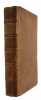
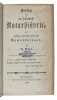
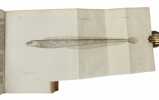
First edition of Mohr’s important work on the economy and natural history of Iceland. “In 1780, the Faeroese naturalist, Nicolai Mohr (1742-90) was sent to Iceland specifically to investigate some of Olavius’ discoveries, such as graphite in Siglufjördur in the North which, it was believed, might be of economic significance. Mohr spent two summers in Iceland and travelled around the northern and eastern parts. He later wrote a book (the present) about his travels. MPhr concentrates on the economy and natural history of Iceland, but his book is written in the form of a travelogue, and his observations on all that he saw helped to build up a picture of conditions in Iceland at the time” (Caseldine, Iceland – Modern Processes and past Environments).

"MOISSAN, HENRI - ONE OF THE MAJOR PROBLEMS IN CHEMISTRY SOLVED - THE ISOLATION OF FLUORINE
Reference : 44236
(1887)
Recherches sur L'Isolement du Flour.
Paris, G. Masson, 1887. 8vo. Contemp. hcalf, raised bands, gilt spine. Light wear along edges. Small stamps on verso of titlepage. In: ""Annales de Chimie et de Physique"", 6e Series - Tome 12. 576 pp. (Entire volume offered). Moissan's paper: pp. 472-537. Many textillustrations of apparatus in woodcut.
First appearance of the paper in which Moissan describes his isolation and observation of the properties of fluorine gas and his succes in producing diamond with his pectacular arc method. Fo these achievements he was the first French to be awarded the Nobel Price in chemistry (1906).The existence of the element fluorine had been well known for many years, but all attempts to isolate it had failed and some experimenters had died in the attempt.""Moissan eventually succeeded in preparing fluorine in 1886 by the electrolysis of a solution of potassium hydrogen difluoride (KHF2) in liquid hydrogen fluoride (HF). The mixture was needed because hydrogen fluoride is a non-conductor. The device was built with platinum/iridium electrodes in a platinum holder and the apparatus was cooled to -50 °C. The result was to completely isolate the hydrogen produced from the negative electrode from the fluorine produced at the positive one.This is essentially still the way fluorine is produced today."" (Wikipedia).Partington IV, p. 912. - Weeks ""Discovery of teh Elements"", p. 272 ff. - Parkinson ""Breakthroughs"" 1885 C.
Description d'un nouveau four électrique.
(Paris, Gauthier-Villars), 1892. 4to. No wrappers. In: ""Comptes Rendus Hebdomadaires des Séances de L'Academie des Sciences"", Tome 115, No 24. Pp. (1029-) 1112. (Entiere issue offered). Moissan's paper: pp. 1031-1033.nA few small tears to frontpage.
First printing of the paper in which Moissan described his famous invention of the Electric Furnace and hereby laying the foundations for high-temperature chemistry. For this invention and his isolation of flourine Moissan received the Nobel Prize in 1906.""Moissan had turned his attention to the production of artificial diamonds and in the process constructed his famous electric furnace, which, although simple in design, proved to be a technological tool of the first order. The original model, which he subsequently improved, was demonstrated to the Academy of Sciences in December 1892 (the paper offered). It consisted of two blocks of lime, one laid on the other, with a hollow space in the center for a crucible, and a longitudinal groove for two carbon electrodes which produced a high-temperature electric arc. In one experiment Moissan heated iron and carbonized sugar in his electric furnace, causing the carbon to dissolve in the molten iron..... Moissan’s electric furnace provided great impetus to the development of high-temperature chemistry. With this apparatus he prepared and studied refractory oxides, silicides, borides, and carbides" he succeeded in volatilizing many metals" and, by reducing metallic oxides with carbon, he obtained such metals as manganese, chromium, uranium, tungsten, vanadium, molybdenum, titanium, and zirconium. The electrochemical and metallurgical applications to industry of Moissan’s work became immediately apparent, for example in the large-scale production of acetylene from calcium carbide.""(DSB).Moissan received the Nobel prize in Chemistry in 1906 ""in recognition of the great services rendered by him in his investigation nd isolation of the element fluorine, and for the adoption in the service of science of the electric furnace called after him"".Parkinson ""Breakthroughs"" 1892 C.This issue also contains another notable paper by PIERRE CURIE in which he describes his invention of a quadrant electrometer that improved upon the one devised by Kelvin by adding an ingenious magnetic damper.
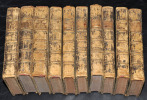
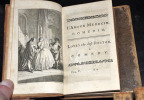
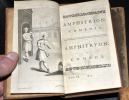
The works of Moliere
1755 French and English London for D. Browne and A. Millar , 1755, 10 volumes in 16, relié cuir , bien complets,
ray armo L4
Amphitryon (Petits Classiques)
Editions Larousse 2009 192 pages 12 4x1x17 8cm. 2009. Broché. 192 pages.

Très bon état - L'ouvrage qui n'a jamais été lu peut présenter de légères traces de stockage mais est du reste en très bon état. envoi rapide et soigné dans un emballage adapté depuis France
Amphitryon (Petits Classiques)
Editions Larousse 2009 192 pages 12 4x1x17 8cm. 2009. Broché. 192 pages.
Bon état
Dom Juan Ou Le Festin De Pierre
Editions Hatier 2015 208 pages 12 6x17 4x1 2cm. 2015. Broché. 208 pages.
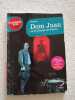
Etat correct

Le Bourgeois Gentilhomme
Hachette 2008 223 pages 11x1 2x17 2cm. 2008. Broché. 223 pages.
Bon état
Le malade imaginaire: Parcours associé : Spectacle et comédie
Nathan 2020 220 pages 12 5x17 5x1 3cm. 2020. Broché. 220 pages.
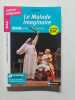
Bon état
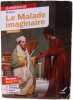
Le Malade imaginaire: suivi du parcours « Spectacle et comédie »
Hatier Litterature generale 2020 260 pages 12 4x17 3x1 4cm. 2020. Broché. 260 pages.
Etat correct
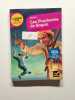
Les Fourberies de Scapin: nouveau programme
Editions Hatier 2014 164 pages 12 6x1x17 4cm. 2014. pocket_book. 164 pages.
Bon état
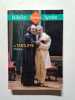
Le Tartuffe: Nouvelle édition avec cahier photos
Editions Belin 2016 224 pages 17x24 2x1 1cm. 2016. Broché. 224 pages.
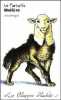
Etat correct
Petits Classiques Larousse / Dom Juan: Lektüre - Neubearbeitung. Ungekürzter Text
Editions Larousse 2011 192 pages 12 3x17 6x1 2cm. 2011. Broché. 192 pages.


Bon état
Petits Classiques Larousse / Dom Juan: Lektüre - Neubearbeitung. Ungekürzter Text
Editions Larousse 2011 192 pages 12 3x17 6x1 2cm. 2011. Broché. 192 pages.
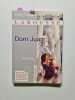
Bon état
Souvenirs de jeunesse: 1793-1803 (Le Temps retrouvé) (French Edition).
Mercure de France, 1991 14 x 20 cm., 517 pp, Broché
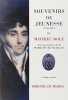
- - VENTE PAR CORRESPONDANCE UNIQUEMENT - LIEN DE PAIEMENT, NOUS CONSULTER.

Josse de Momper der Jüngere / Josse de Momper the Younger.Catalogue raisonné,
1986 Luca Verlag,Freren 1986, in 4 toile ed.sous étui illustré,699 pp., 385 ills., (85 colour), cloth with slipcase. Catalogue raisonné, listing 578 genuine works and 223 false attributions, arranged by subject matter. With critical chronological study of his life, work and influences, locational index, bibliograhy, list of exhibitions. German text with summary in English.
First Edition 703 S. mit zahlr. teils farb., teils ganzseit. Textabb. Erste deutsche Ausgabe des klassischen Werkverzeichnis der Gemälde von Josse de Momper dem Jüngeren. - Titel mit hs. namen. Papierbedingt kaum gebräunt. Sprache: Deutsch Gewicht in Gramm: 4000.ISBN10: 3923641052 ISBN13:9783923641055 Remise de 20% pour toutes commandes supérieures à 200 €
Redefining History on Pre-Islamic Accounts: The Arabic Recension of the Martyrs of Najrân (Gorgias Eastern Christian Studies Band 26)
Gorgias Press 2010 132 pages 15 748x1 524x23 114cm. 2010. Cartonné. 132 pages.
Très bon état intérieur propre bonne tenue
"MONGE, (GASPARD). - THE GENERAL REPRESENTATION OF DEVELOPABLE SURFACES.
Reference : 44972
(1780)
Mémoire sur les Fonctions Arbitraires continues ou discontinues, qui entrent dans les Intégrales des Équations aux Différences finies. (1774) (+) Mémoire sur les Propriétés de plusieur Genres de Surfaces Courbes, particulièrement sur celles des Surfac...
(Paris, Moutard, Panckoucke, 1780). 4to. Extract from ""Mémoires fe Mathematique et de Physique, Présentés à l'Academie des Sciences par divers Savans"", Tome IX. Pp. 345-381 a. 2 folded engraved plates. And pp. 382-440 a. 3 folded engraved plates. Clean and fine.
First printing of two importent papers by Monge in differential functions and infinitesimal geometry, - in the first he discussed the nature of the arbitrary functions involved in the integrals of, finite difference equations. He also considered the, equation of vibrating strings, a topic he later investigated more fully. In the second memoir Monge returned to infinitesimal geometry. Working on the theory of developable surfaces outlined by Euler in 1772, he applied it to the problem, of shadows and penumbrae and treated several, problems concerning ruled surfaces. ""It is in this paper that he gives a general representation of developable surfaces...""(Morris Kline ""Mathematical Thoughts from Ancient to Modern Times"", p. 567).
"MONGE, (GASPARD). - THE NATURE OF THE ARBITRARY FUNCTION OF PARTIAL DIFFERENTIAL EQUATIONS.
Reference : 44968
(1776)
Mémoire sur la Détermination des Fonctions Arbitraires qui entrent dans les intégrales des Équations aux differences partielles-
(Paris, Imprimerie Royale, 1776). 4to. Extracts from ""Mémoires de Mathematique et de Physique, Présentés à l'Academie des Sciences par divers Savans"", Année 1773. Pp. 305-327. Clean and fine.
First printing of Monge's second paper on the theory of partial differential equations.In this memoir Monge continued his investigations in ""a field of study that was to hold his interest for many years: the theory of partial differential equations. In particular he, undertook the parallel examination of certain equations of this type and of the families of corresponding surfaces. The geometric construction of a particular, solution of the equations under consideration allowed, him to determine the general nature of the arbitrary, function involved in the solutions of a partial differential equation. Moreover, this finding enabled him to take a position on a question then being disputed by d Alembert Euler and Daniel Bernoulli.""(DSB).
Monica Maroni ; Marcello Francone ; translation : Manuela Dominguez
Reference : 24175
Compostela and Europe : The Story of Diego Gelmirez
UK, Skira , 2010 Hardback, 430 pages, ENG. edition, 285 x 245 x 35 mm, mint condition , illustrated in color / b/w. . ISBN 978885720493213.
The international nature of Santiago de Compostela in the 12th century cannot be understood without the exceptional figure of Diego Gelmirez (1070?-1140). Immediately after Diego Gelmirez became bishop, he undertook the struggle to achieve metropolitan dignity
L'impressionnisme et son époque en 2 volumes: tome 1- nom propres A à T / tome 2-noms propres de U à Z noms ccommuns de A à Z
Bouquins 1987 13 4x3 8x19 2cm. 1987. Broché.
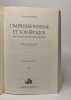
emboitage en excellent état tranches très légèrement fânées intérieur propre
Monographs of the Institute of Archaeology Michael Avi-Yonah
Reference : 100153340
(1976)
Gazetteer of Roman Palestine --- Qedem 5
The Hebrew University of Jerusalem 1976 in8. 1976. Cartonné. Ce gazetteer publié en 1976 dans la collection Qedem de l'Institut d'archéologie de l'Université hébraïque de Jérusalem répertorie plus de 900 sites de la Palestine romaine. Chaque entrée propose une reconstruction du nom ancien (hébreu ou grec) ainsi que ses équivalents anciens et modernes. L'ouvrage est le fruit d'un travail de recherche original considérable
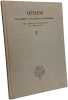
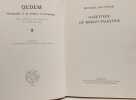
Bon état intérieur propre bonne tenue
Montaigne Michel de Huguet Alexandra
Reference : 500047872
(2020)
ISBN : 9782091864969
Essais: Avec le parcours "Notre monde vient d'en trouver un autre"
Nathan 2020 112 pages 13 97x18 8x0 76cm. 2020. Broché. 112 pages.
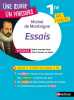
Très bon état

