 Write to the booksellers
-
Type
Book (7793)
Disk (45)
Drawings (1)
Engraving (9)
Magazine (89)
Maps (4)
Music sheets (134)
New book (4)
Old papers (1)
Photographs (19)
Posters (1)
-
Latest
Last 24h (1)
Last 3 days (2)
Last month (132)
Last week (938)
-
Language
Czech (1)
Dutch (9)
English (156)
French (7920)
German (4)
Italian (2)
Japanese (1)
Latin (3)
Russian (4)
-
Century
16th (17)
17th (43)
18th (199)
19th (885)
20th (2806)
21st (1770)
-
Countries
Belgium (1156)
Canada (32)
China (56)
Côte d'Ivoire (7)
Denmark (1063)
France (5433)
Germany (1)
Netherlands (181)
Switzerland (155)
United Kingdom (12)
United States of America (4)
-
Syndicate
ALAC (25)
CLAM (25)
CLAQ (2)
ILAB (2248)
NVVA (15)
SLACES (15)
SLAM (1037)
SNCAO (4)


CURZON LORD, By The Marquess CURZON OF KEDLSTON
Reference : RO60138494
(1984)
ISBN : 0283991666
A VICEROY'S INDIA, Leaves from Lord Curzon's Note-Book
Sidgwick & Jackson. 1984. In-8. Relié. Bon état, Couv. convenable, Dos satisfaisant, Intérieur acceptable. 192 pages. Photo en couleur en frontispice (portrait). Illustré de nombreuses photos en noir et blanc et en couleur, dans et hors texte.. Avec Jaquette. . . Classification Dewey : 420-Langue anglaise. Anglo-saxon
By the Marquess Curzon of Kedleston. Edited by Peter KING. Intro. by Elizabeth LONGFORD. Classification Dewey : 420-Langue anglaise. Anglo-saxon
CURZON OF KEDLESTON Marquess (President (1911-1914) of the Royal Geographical Society)
Reference : 13978625
Tales of Travel.
London: Hodder and Stoughton, 1923 in-8, viii-344 pages, portrait frontispice (détaché), 26 illustrations hors texte dont une carte dépliante (Map of Afghanistan prepared and circulated by Amir Abdur Rhaman Khan). Index. Reliure percaline d'éd., plat décoré, rousseurs infimes, bel exemplaire. Edition originale. Notes de voyage en Tunisie, Afghanistan, Egypte, Zambèze, Sainte-Hélène Japon, Koweit, ...
Tales of Travel. (London: Hodder and Stoughton, 1923). [M.C.: voyages, Tunisie, Afghanistan, Egypte, Zambeze, Japon, Koweit, Sainte-Hélène, Napoléon]
SOUVENIRS DU CHEVALIER DE CUSSY Garde du Corps, diplomate et Consul Général 1795-1866. Publiés par le Comte Marc de Germiny.
1909 2 volumes, reliure demi-chagrin vert olive (binding half shagreen) in-octavo (22,8 x 14,5 cm), reliure d'époque, dos 5 nerfs (spine with raised bands) insolé (le vert olive a viré au soleil en marron-clair)- entre-nerfs à fleuron au fer plein or (floweret with full blocking stamp) - titre frappé or (gilt title) et tomaison (volume numbering), papier marbré vert aux plats (cover with marbled paper), toutes tranches lisses (all edges smooth), orné d'un portrait en frontispice en héliogravure en noir,[4]-IV-417 et [4]-426 pages, 1909 Paris E. PLON, Nourrit et Cie Imprimeurs-Editeurs,
Tulard, 380, Bertier de Sauvigny, 294. Seuls les chapitres I à III concernent l'Empire : Entrée des alliés à Paris, Première Restauration et Cent-Jours. "Garde du corps en 1815, Ferdinand de Cussy ne suivit pas le roi à Gand mais revint dans l'armée après Waterloo pour s'engager dès l'année suivante dans la carrière diplomatique. D'abord en poste à Berlin où il connut Chateaubriand, et à Dresde, il devint directeur des consulats au ministère en 1825, consul à Bucarest en 1828, à Corfou en 1829. La Restauration occupe presque tout le premier volume et les 117 premières pages du second." (Bertier de Sauvigny). L'ouvrage est utile pour l'étude de l'histoire diplomatique de la Restauration et donne un bon tableau de la vie mondaine du temps. L'ouvrage se termine avec le coup d'état de Napoléon III en 1852.................trés bel exemplaire......................en bon état malgré le petit défaut signalé (very good condition in spite of the small defect indicated).
Ecclesiae Occidentalis Monumenta Iuris Antiquissima. The Latin Translations of Greek Canons and Councils from the Fourth Century
, Brepols, 2025 Hardback, Pages:3 vols, 1402, Size:216 x 280 mm, Illustrations:1 col., Languages: English, Latin, Greek. ISBN 9782503619958.
Summary Ecclesiae Occidentalis Monumenta Iuris Antiquissima (EOMIA) is a monumental scholarly achievement by Cuthbert Hamilton Turner, compiled between 1899 and 1939. It presents Latin texts of canons, creeds, and letters from early Church councils and synods, primarily from the fourth century, alongside meticulous comparisons of manuscript traditions. Renowned for its philological rigor, EOMIA remains an indispensable resource for Church historians, canon law scholars, textual critics, and students of Latin. Yet despite its scholarly value, EOMIA is notoriously difficult to use. It was published in fascicles over four decades, each with its own internal divisions (pars, tomus, fasciculus) which were inconsistently labelled and sometimes retroactively reclassified. This lack of editorial cohesion left librarians and scholars struggling to organize and bind the volumes, resulting in chaotic pagination and sequencing. The absence of modern navigation aids such as thematic indexing or summaries only compounded the challenge, making EOMIA a bibliographical labyrinth. This new reprint offers a long-awaited solution: it restores Turner's original intended structure, adds newly commissioned introductions on the contents, organization, scholarly value, and practical use of the work, and includes a dual index of names and selected terms to aid navigation and research. TABLE OF CONTENTS VOLUME I Apostolic Canons & Nicaea I (part 1) VOLUME II Nicaea I (part 2) & Supplements VOLUME III Ancyra & Neocaesarea Gangra & Antioch Laodicea & Constantinople I
Cutler (Laurence S.) ; Cutler (Judy Goffman) ; and the National Museum of Américan illustration.
Reference : 29352
(2008)
ISBN : 0785822631
Maxfield Parrish and the American Imagists
The Wellfle et Press 2008 Fort In-4 à l’italienne, cart. éditeur illustré sous jaquette, 448pp. En anglais.
Très bon état d’occasion
Catalogus codicum hagiographicorum graecorum Germaniae Belgii Angliae
, Brepols - Harvey Miller, 1968 Hardcover. 423 p., 160 x 250 mm, Languages: Greek, Including an index. Fine copy. ISBN 17010130200.
Saints' Lives by Walter of Chatillon, Brendan, Alexis, Thomas Becket. Lives of Brendan and Alexis edited from London, British Library, MS. Cotton Vespasian D.ix. Thomas Becket edited from Vatican City, Biblioteca Apostolica Vaticana, MS. Reginensis latinus 344
, Brepols - Harvey Miller, 2002 Hardcover. VIII 104 p., 140 x 215 mm, Languages: English, Including an index. Fine copy. ISBN 9780888444776.
[Apud J.P. Migne] - CYRILLUS HIEROSOLYMITANUS ; PETRUS II ; TIMOTHEUS ALEXANDRINI, ALII ; ( Cyrille de Jérusalem, Apollinaire de Laodicée, Diodore de Tarse, Pierre II d'Alexandrie, Timothée d'Alexandrie, Isaac l'ancien juif ; Cyril of Jerusalem, Apollinaris of Laodicea, Diodorus of Tarsus, Peter II Bishop of Alexandria, Timotheus Bishop of Alexandria, Isaac the ex-Jew )
Reference : 68703
(1857)
S.P.N. Cyrilli Archiepiscopi Hierosolymitani, Opera quae exstant omnia, accedunt Petri II, Timothei, Alexandrinorum praesulum, Apollinari Laodiceni, Diodori Tarsensis, Scripta vel scriptorum Fragmenta quae supersunt (1 Tome - Complet). Patrologiae Cursus completus. Series Graeca. Tomus XXXIII [ Patrologia Graeca Tome 33 - Cyrille de Jérusalem, Apollinaire de Laodicée, Diodore de Tarse, Pierre II d'Alexandrie, Timothée d'Alexandrie, Isaac l'ancien juif ]
Accurante et recognoscente J.P. Migne, 1 vol. in-4 reliure de l'époque demi-basane marron, Apud J.P. Migne, Petit-Montrouge, 1857, 1720 colonnes Rappel du Titre complet : S.P.N. Cyrilli Archiepiscopi Hierosolymitani, Opera quae exstant omnia, accedunt Petri II, Timothei, Alexandrinorum praesulum, Apollinari Laodiceni, Diodori Tarsensis, Scripta vel scriptorum Fragmenta quae supersunt (1 Tome - Complet). Patrologiae Cursus completus. Series Graeca. Tomus XXXIII [ Patrologia Graeca Tome 33 - Cyrille de Jérusalem, Apollinaire de Laodicée, Diodore de Tarse, Pierre II d'Alexandrie, Timothée d'Alexandrie, Isaac l'ancien juif ]
Rare exemplaire en bon état, bien relié, du tome 33 de la Patrologie grecque de Migne, bien complet des oeuvres de Saint Cyrille de Jérusalem, Apollinaire de Laodicée, Diodore de Tarse, Pierre II d'Alexandrie, Timothée d'Alexandrie, Isaac l'ancien juif Avec le texte grec et la traduction latine en regard (anciens cachets d'institution religieuse, rares rouss., ex-libris en garde, bon exemplaire par ailleurs). Peu commun, surtout en bon état. A rare, well-bound, and in good condition copy of Volume 33 of Migne's Greek Patrology, complete with the Works of Cyril of Jerusalem, Apollinaris of Laodicea, Diodorus of Tarsus, Peter II Bishop of Alexandria, Timotheus Bishop of Alexandria, Isaac the ex-Jew... With the Greek text and the Latin translation opposite.
Histoire secrète de l'Inquisition : De Paul III à Jean-Paul II
Le grand livre du mois 2006 342 pages in8. 2006. Broché. 342 pages.
Comme neuf
Esclaves au paradis (1CD audio)
Vents d'ailleurs 2007 156 pages 23 8x1 6x24 6cm. 2007. Relié. 156 pages.
Très bon état
Esclaves au paradis (1CD audio)
Vents d'ailleurs 2007 156 pages 23 8x1 6x24 6cm. 2007. Relié. 156 pages.
Neuf
Esclaves au paradis (1CD audio)
Vents d'ailleurs 2007 156 pages 23 8x1 6x24 6cm. 2007. Relié. 156 pages.
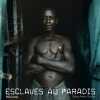
Bon état
Philology in Turbulent Times. Joseph Bosworth, His Dictionary, and the Recovery of Old English
, Brepols, 2023 Hardback, xxx + 314 pages, Size:152 x 229 mm, Language: English. ISBN 9780888449108.
Summary This book situates Joseph Bosworth's A Dictionary of the Anglo-Saxon Language (1838) and its revised 1898 version in their cultural context, reconstructing their history from a wealth of archival materials. It opens up a larger investigation into the central role played by Bosworth's work in the birth and growth of Old English studies in the nineteenth century. And it examines the challenges faced by T. Northcote Toller in completing the revision of the Dictionary after Bosworth's death, as well as his compilation of its Supplement in 1921. Overall, this study aims to rectify widespread disciplinary ignorance of the Dictionary's conception, compilation, and publication, and to examine its impact on the development of the discipline. TABLE OF CONTENTS List of Figures Abbreviations Chronology PREFACE Recovering Bosworth-Toller INTRODUCTION Building a Lexicographical Empire in Turbulent Times CHAPTER 1 Dictionary Bosworth: The Making of a Lexicographer CHAPTER 2 Beginning: Origins, Sources, and Method of A Dictionary of the Anglo-Saxon Language (1838) CHAPTER 3 Compiling: Antiquarian Foundations CHAPTER 4 Collaborating: The Bosworth Syndicate, the New Philology, and the Battle over Method CHAPTER 5 Revising: Expanding the Lexicon, 1840-1876 CHAPTER 6 Ending: An Anglo-Saxon Dictionary Based on the Manuscript Collections of the Late Joseph Bosworth (1898) CHAPTER 7 Supplementing: T. Northcote Toller's An Anglo-Saxon Dictionary Supplement (1921) APPENDIX 1 The Bosworth Donation APPENDIX 2 Sources: A Dictionary of the Anglo-Saxon Language (1838) APPENDIX 3 Bodleian Library Entry Books, 1813-1875 APPENDIX 4 Holograph Drafts of A Dictionary of the Anglo-Saxon Language (1838) Bibliography Index of Manuscripts and Archival Collections General Index
Dizionario tecnico e nautico di marina, Nautisch-technisches Wörterbuch der Marine, 1. Band und Ergänzung zum 1. Band. Deutsch, Italienisch, Französisch und Englisch - Italienisch, Deutsch, Französisch und Englisch - Dictionnaire technique et nautique de marine multilingue Tome 1 seul
1883 Pola : direzione del periodico "Mittheilungen aus dem Gebiete des Seewesens, 1883. "Verlag der Redaktion der "Mittheilungen aus dem Gebiete des Seewesens", Pola] kl.4°, OLn. mit reichlich schwarz- und goldgeprägten Titeln. 1.Band: XV + 1248 Seiten, 1883. 1. Ergänzungsband: bringt die Terminologie der seit zwanzig Jahren aufgetauchten Neuerungen, Tome 1 seul :XV + 1248 p, Fort IN4 cartonnage bleu decoré editeur,dos à ancre,texte à 2 colonnes multilingues,bon etat .Le tome 2 parut en 1910

Remise de 20% pour toutes commandes supérieures à 200 €
FRENCH LANDSCAPE. THE MODERN VISION 1880 - 1920,
, New York, The Museum of Modern Art, 1999**, Pictorial softcover, frontispice, 230 x 285mm., 143pp., 136 illustrations, including 45 in color and 28 in duotone. ISBN 0870700278.
This volume examines different styles of representing landscape throughout four decades (1880-1920) and investigates the changing attitudes of the artists and their approach to diverse locations in works that range from Atget to Seurat. Paintings, documentary photographs, plus maps and topographical descriptions of locations depicted. Book is new.
Son exigence Gaster.Roman nutritif, humoristique.Le ventre gouverne le monde.
Montluçon, imp. Deneuvy, s.d. (1920), 1 br., 4ème couverture manquante. in-8 de 292 pages, dessins de Maurice Rondest ;
Récit érotique et gastronomique.[...] 1re pipe. - Défloré. - Adultère. - Patisseries, glaces, fromages, fruits. - Etude des boissons: bière, cidre, rôle du vin, liqueur. - Epices, café, thé, aphrodisiaques et ana, tabac. - Gaz intestinaux. - Esthétique gastronomique. - L'amour libre. - Prémices préconjugales. Etc...
"DAGUERRE, LOUIS J.M. - (ARAGO, FRANCOIS). - THE FIRST DESCRIPTION OF THE PRODUCTION OF DAGUERREOTYPES.
Reference : 44903
(1839)
Le Daguerréotype.(Analyse de la communication faite à l'Academie par M. Arago).
Paris, Crochard et Comp., 1839. Orig. printed yellow wrappers (no backstrip). In 'Annales de Chimie et de Physique', 2e series, Volume 71, Juillet- issue, pp. 225-352 (entire July-issue offered with orig. wrappers and titlepage to vol. 71). Arago's paper: pp. 313-340.
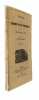
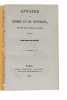
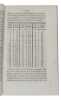
First printing of probably the first (the Juillet issue of Annales) official announcement of Daguerre's invention of the photographic process. The paper offered here preceeded the official report in Comptes Rendues which was published at the end of 1839 (in the July-December issue). The first report of on the discovery was presented to the Royal Academy on January 7, 1839 and delivered in full on August 19, 1839 (and printed in the July-Dec. issue of Comptes Rendues). The paper also preceeded Daguerre's own publication of 1839 ""Historique et description du daguerréotypie...""In 1839 Arago took a personal interest in announcing and popularizing the inventions of Niepce and Daguerre, who were awarded government pensions as a result of Arago’s recognition of their inventions’ potential significance.""In 1829 Daguerre went into partnership with Niepce, who had managed to produce images by the action of light some three years earlier but had failed to make the process really practical. Daguerre carried on and began to use copper plates on which silver salts were deposited. ight was made to focus upon that and an image was formed. The light portions of the image darkened the salts, while the shadowy portions left them unaffected. The unchanged salt was dissolved away by sodium thiosulfate (a process that had been suggested by John Herschel and a permanent image of sorts was left behind.""(Asimov).Together with JEAN CHARLES PELTIER ""Mémoire sur la Formation des Tables des Rapports qu'il y entre la Force d'un Courant électrique et la Déviation des aiguilles des multiplicateurs"" suivi de Recherches sur la Causes de Pertubation des couples thermo-électriques..."", pp. 225-313.
"DAGUERRE, LOUIS J.M. - (ARAGO, FRANCOIS). - THE FIRST DESCRIPTION OF THE PRODUCTION OF DAGUERREOTYPES.
Reference : 49078
(1839)
Le Daguerréotype.(Analyse de la communication faite à l'Academie par M. Arago).
Paris, Crochard et Comp., 1839. Contemp. hcloth. Gilt lettering to spine. In 'Annales de Chimie et de Physique', 2e series, Volume 71. (4),445,(3) pp. (Entire volume offered). Arago's paper: pp. 313-340. The first and last leaves with some browning. A few scattered brownspots.
First printing of probably the first (in the Juillet issue of Annales) official announcement of Daguerre's invention of the photographic process. The paper offered here preceeded the official report in Comptes Rendues which was published at the end of 1839 (in the July-December issue). The first report of on the discovery was presented to the Royal Academy on January 7, 1839 and delivered in full on August 19, 1839 (and printed in the July-Dec. issue of Comptes Rendues). The paper also preceeded Daguerre's own publication of 1839 ""Historique et description du daguerréotypie...""In 1839 Arago took a personal interest in announcing and popularizing the inventions of Niepce and Daguerre, who were awarded government pensions as a result of Arago’s recognition of their inventions’ potential significance.""In 1829 Daguerre went into partnership with Niepce, who had managed to produce images by the action of light some three years earlier but had failed to make the process really practical. Daguerre carried on and began to use copper plates on which silver salts were deposited. ight was made to focus upon that and an image was formed. The light portions of the image darkened the salts, while the shadowy portions left them unaffected. The unchanged salt was dissolved away by sodium thiosulfate (a process that had been suggested by John Herschel and a permanent image of sorts was left behind.""(Asimov).
Des procédés photogéniques considérés comme moyens de gravure. - Lettre de M. Daguerre à M. Arago. (Séance du undi 30 Septembre 1839).
(Paris, Bachelier, 1839). 4to. No wrappers. In: ""Comptes Rendus Hebdomadaires des Séances de L'Academie des Sciences"", Tome IX, No 14). Entire issue offered. Pp. 415-436. Daguerre's letter: pp. 423-429.
First printing of Daguerres letter to Arago in which he relates the process of heliography and describes his contract with Niépce to exploit the heliogrphis process. The Heliogravure was invented by Niépce.
Story of the War, January - December 1943. - T. III seul.
. 1944. in-12. Relié. Bon état, Couv. convenable, Dos satisfaisant, Intérieur frais. London, Hodder and Stoughton, 1944, in 12, rel. pl. toile, photos, 256 pp.. Avec Jaquette. . . Classification Dewey : 420-Langue anglaise. Anglo-saxon

OC-030 - Lieu d'édition : London Classification Dewey : 420-Langue anglaise. Anglo-saxon
"D'ALEMBERT, JEAN LE ROND. - D'ALEMBERT'S THEOREM - THE FUNDAMENTAL THEOREM OF ALGEBRA.
Reference : 46603
(1848)
Recherches sur le Calcul Intégral. Premier - (Seconde) Partie. (+) Suite des Recherches sur le Calcul Intégral. (= Troisieme Partie). (+) Additons aux Recherches sur le Calcul Integral. (+) Errata pour les Mémoires, imprimés dans les Volumes de 1746, ...
Berlin, Haude et Spener, 1848-52. 4to. No wrappers as extracted from ""Mémoires de l'Academie Royale des Sciences et Belles-Lettres"", tome II (1846), tome IV, tome VI a. tome VI. Pp. 182-224, pp. 249-291, pp. (361-) 378, pp. 413-416 and 1 folded engraved plate.
First apperance of d'Alembert's 3 importent papers on the Calculus of Integration, a branch of mathematical science which is greatly indepted to him. He here gives the proof of THE FUNDAMENTAL THEOREM OF ALGEBRA, called d'Alembert's theorem, and later corrected by Gauss (1799).The theorem is based on these three assumptions:Every polynomial with real coefficients which is of odd order has a real root. (This is a corollary of the intermediate value theorem. Every second order polynomial with complex coefficients has two complex roots. For every polynomial p with real coefficients, there exists a field E in which the polynomial may be factored into linear terms.Also with an importent paper by Leonhard Euler ""Mémoire sur l'Effet de la Propagation successive de la Lumiere dans l'Apparition tant des Planetes que des Cometes"" (Memoir on the effect of the successive propogation of light in the appeareance of both comets and planets). Pp. 141-181 and 2 folded engraved plates. - The paper is founded on Euler's theory of light as waves and not as particles. It is from the same year as his fundamental work on light as waves: ""Nova Theoria"" - Enestroem E 104.
Rethinking Virtue, Reforming Society New Directions in Renaissance Ethics, c.1350 - c.1650,
Turnhout, Brepols, 2012 Hardback, X+320 pages ., 156 x 234 mm. Languages : English, Italian, Latin.*New. ISBN 9782503525242.
Moral philosophy, and particularly ethics, was among the most contested disciplines in the Renaissance, as philosophers, theologians, and literary scholars all laid claim to it, while an expanding canon of sources made the ground shift under their feet. In this volume, eleven specialists drawn from literature, intellectual history, philosophy, and religious studies examine the configuration of ethics and how it changed in the period from Petrarch to Descartes. They show that the contexts in which ethics was explored, the approaches taken to it, and the conclusions it reached make Renaissance ethics something worthy of exploration in its own right, in distinction to both medieval and early modern ethics. Particular attention is given to the development of new audiences, settings, genres (essays, dialogues, commonplace books, biographies, short fiction), and mediums (especially the vernacular) in ethical discussions, as well as the continuities with the formal exploration of ethics through commentaries. Renaissance ethics emerges as a highly eclectic product, which combined Christian insights with the Aristotelian and Platonic traditions while increasingly incorporating elements from Stoicism and Epicureanism. This volume will be of particular interest to students and researchers who wish to gain an overall view of how ethics developed throughout Europe in response to the cultural, historical, and religious changes between 1350 and 1650. TABLE OF CONTENTS Preface Introduction - David A. Lines Part I. Contexts Sources for Ethics in the Renaissance: The Expanding Canon - David A. Lines and Jill Kraye From Schools to Courts: Renaissance Ethics in Context - David A. Lines Renaissance Ethics and the European Reformations - Risto Saarinen Part II. Approaches and Genres The Method of Moral Philosophy in Renaissance Humanism - Eckhard Kessler Renaissance Readings of the Nicomachean Ethics - Luca Bianchi Morals Stored and Ready for Use - Ann Moss Informal Ethics in the Renaissance - Peter Mack Biography as a Genre of Moral Philosophy - Alison K. Frazier Part III. Themes Happiness - Antonino Poppi Passions for this Life - Sabrina Ebbersmeyer Virtue of the Prince, Virtue of the Subject - Ullrich Langer Epilogue: After Renaissance Ethics - Sabrina Ebbersmeyer Index
Sequel to an Essay on the Constitution of the Atmosphere in the Philosophical Transactions for 1826" with some Account of the Sulphurets of Lime. Received June 9, - Read June 15, 1837.
(London, Richard and John E. Taylor, 1837). 4to. No wrappers as extracted from ""Philosophical Transactions"" 1837 - Part II. Pp. 347-363. Clean and fine.
First printing of Dalton's last paper submitted to the ""Transactions"". This paper, one of his last, deals with the constitution of the atmosphere, just as his first love was meteorology.""In an essay of mine on the constitution of the atmosphere, which was printed in the Transactions for 1826, I signified my intention of following it with a sequel of experiments to ascertain if possible which of the two views therein developed was most counntenanced by facts. I now proceed to give an account of such investigations relating to this subject as havee engaged my attention during a long period of years.""(John Dalton). - (Smith: John Dalton. A Bibliography. No. 78).

