 Write to the booksellers
-
Type
Book (7253)
Disk (45)
Drawings (1)
Engraving (9)
Magazine (89)
Maps (4)
Music sheets (134)
New book (4)
Old papers (1)
Photographs (19)
Posters (1)
-
Latest
Last 24h (2)
Last 3 days (107)
Last month (127)
Last week (751)
-
Language
Czech (1)
Dutch (9)
English (156)
French (7380)
German (4)
Italian (2)
Japanese (1)
Latin (3)
Russian (4)
-
Century
16th (17)
17th (43)
18th (199)
19th (882)
20th (2481)
21st (1568)
-
Countries
Belgium (1156)
Canada (34)
China (56)
Côte d'Ivoire (7)
Denmark (1063)
France (4891)
Germany (1)
Netherlands (181)
Switzerland (155)
United Kingdom (12)
United States of America (4)
-
Syndicate
ALAC (27)
CLAM (25)
CLAQ (2)
ILAB (2250)
NVVA (15)
SLACES (15)
SLAM (1037)
SNCAO (4)
Discoverers: Volumes I and II Deluxe Illustrated Set
, Abrams, 1991., Deluxe Illustrated Set, bound cloth with orig. slipcase, 1024pp., 19x27.5cm., ills. in col. and b/w., fine set. ISBN 9780810932074.
From Publishers Weekly In Boorstin's 1983 bestseller The Discoverers , the achievements of Galileo, Columbus, Darwin, Gutenberg and Freud emerged as upwellings of creativity and courage, ingenious acts of revolt against ingrained habit. This richly illustrated two-volume edition reveals the world as known to the discovers themselves. We see the tools of discovery--Egyptian obelisks, early clocks, Leeuwenhoek's microscope, Mercator's maps, botanical drawings from James Cook's voyages--and glimpse the social, cultural and political background, made concrete in 550 pictures including paintings, sculpture, engravings and architecture. A photograph of 15th-century cast bronze type from Korea underscores an Eastern invention that could have changed the course of printing, perhaps of science and culture. In a feast for the mind and eye, itself a delightful adventure in discovery, Boorstin, librarian of Congress emeritus, profiles--and places in context--scores of innovators who broke with dogma and tradition. Copyright 1991 Reed Business Information, Inc.
Further Obervations on Voltaic Combinations. In a Letter addressed to Michael Faraday. Received March 30, - Read April 6, 1837.
(London, Richard and John E. Taylor, 1837). 4to. No wrappers as extracted from ""Philosophical Transactions"" 1837 - Part I. Pp. 141-160 and 1 engraved plate.
First appearance of Daniell's second paper on the construction of the famous ""Daniell-Cell"". In 1836 (in a paper in the Transactions, also addressed to Faraday with the title ""On Voltaic Combinations""), he announced his invention of the battery. In his second paper, the paper offered here, he further develops his invention. In the new invention by Charles Wheatstone of the electric telegraph in 1837, the Daniell cell was used as the electric source.In 1831 Daniell was appointed proffesor of Chemistry at King's College London. He invented several scientific instruments, including a hygrometer for measuring humidity he is best known for his work in electrochemistry, his interests having been aroused by the work of his good friend faraday. Volta's battery had the defect of rapid diminution in current. What was needed, however, was a battery yielding a constant current over a considerable lenght of time. In 1836 Daniell succeeded, producing the Daniell cell, of copper and zinc. his was the first reliable source of electric current.

On Voltaic Combinations. In a Letter addressed to Michael Faraday. Received January 26, - Read February 11, 1836. (+) Additional Observations on Voltaic Combinations. In a Letter to Michael Faraday. Received April 14, - Read April 21, 1836. (2 Papers).
London, Richard Taylor, 1836. 4to. No wrappers as extracted from ""Philosophical Transactions"" 1836 - Part I. Pp.107-124 and 1 engraved plate. + Pp. 125-129 and 1 engraved plate. Both plates with a dampstain in upper part, not reaching the image. With titlepage to Part I of theTransacti
First appearance of Daniell's first paper on the construction of the famous ""Daniell-Cell"", in which he announced his invention of the battery, THE FIRST RELIABLE SOURCE OF AN ELECTRIC CURRENT. In the new invention by Charles Wheatstone of the electric telegraph in 1837, the Daniell cell was used as the electric source.In 1831 Daniell was appointed profesor of Chemistry at King's College London. He invented several scientific instruments, including a hygrometer for measuring humidity he is best known for his work in electrochemistry, his interests having been aroused by the work of his good friend Faraday. Volta's battery had the defect of rapid diminution in current. What was needed, however, was a battery yielding a constant current over a considerable lenght of time. In 1836 Daniell succeeded, producing the Daniell cell, of copper and zinc. his was the first reliable source of electric current.Parkinson ""Breakthroughs"" 1836 P.
Annales BAC 2020 Maths Term ES-L - Spécialité ES - Sujets & corrigés
Nathan 2019 335 pages 13 4x20 8x1 8cm. 2019. Broché. 335 pages.


Etat correct
The Danish Laws: or, the Code of Christian the Fifth. Faithfully translated for the Use of the English Inhabitants of the Danish Settlements in America.
London, N. Gibson, 1756. 8vo. Contemp. full calf. Raised bands. Titlelabel with gilt lettering. Blindtooling to covers. A neath repair at upper compartment. Spine slightly rubbed. VIII,476,(4) pp. A very faint dampstain to lower right corners. A few scattered brownspots. Printed on good paper.
Very scarce first edition in English, a translation of the relevant part of Chr. V's Danske Lov (1683) relating to the Danish West Indies. All laws and regulations on St. Thomas, St. Croix and St. John were based on this lawcomplex in the period of the Danish possession of these islands.Sabin No 18501.
Danmark-Ekspeditionen til Grønlands Nordøstkyst 1906-1908 under Ledelse af L. Mylius Erichsen. 6 Bd. (i 10 afdelinger, komplet).
Copenhagen, 1913-17. Lex8vo. Alle 10 dele i orig. bogtrykte omslag, ubeskåret og uopskåret. 474,516,39,346,286,175,320,236,436,387 pp., tekstillustrationer, 4 portrætter, 153 plancher og 1 kort.
Fist edition of the largest expedition ever undertaken to North-East Greenland. - ""The year 1908 will always remain a memorable year in the history of Greenland's exploration. With the return of the Denmark Expedition and the news of the magnificent results achieved by the Expedition, the coping stone was laid on a work, which had engaged the unwearied attention of numerous explorers for centuries. The last wide stretch of unknown coast on the north-east of Greenland had been investigated and surveyed by this Expedition and the extensive coast line of Greenland was now known in the whole of its lenght."" (G. Amdrup). - Meddelelser om Grønland, Bd. 41-46.
Creating New States in Central Asia (Adelphi series)
Routledge 1994 120 pages 14 478x1 27x21 336cm. 1994. Broché. 120 pages.
Très bon état
"DISQUE VINYLE 33T LET""S DO THE TWIST FOR ADULTS. SUGAR BLUES TWIST / RYE TWIST / BALLIN' THE JACK / MY BONNIE TWIST / JOHNSON RAG / LAZY RIVER / BANANA TWIST / I'M LOOKING OVER A FOUR LEAF CLOVER..."
MGM. non daté. In-12. Broché. Bon état, Couv. convenable, Dos satisfaisant, Intérieur frais. Photo de danseurs de Twist sur la couverture.. . . . Classification : 410-33 Tours

Classification : 410-33 Tours

Protokol over Forhandlingerne i Aarene 1919-39. Udg. af Nævnets Danske Afdeling.
K., 1944. Lex8vo. 382 pp.
LA DIVINE COMEDIE
3 volumes de 368, 360 et 352 pages, format 145 x 210 mm, 250 illustrations de Sandro Botticelli, reliés cuir, publiés en 1971-1972, Jean de Bonnot, bon état
Edition monumentale dans les deux langues italienne et française
Phone number : 04 74 33 45 19
THE VISION OF DANTE ALIGHIERI, OR HELL PURGATORY AND PARADISE
J. M. Dent & Sons Ltd. Non daté. In-12. Broché. Etat d'usage, Couv. convenable, Dos satisfaisant, Intérieur acceptable. 450 pages. Texte en anglais. Couverture se détachant. Annotations en page de garde.. . . . Classification Dewey : 850-Littératures italienne, roumaine, rhéto-romane

Everyman's Library, Edited by E. Rhys. Classification Dewey : 850-Littératures italienne, roumaine, rhéto-romane
Wanna Buy A Monkey ? - A Mixtape Session
Source UK CD EN TRES BON ETAT
Merci de nous contacter à l'avance si vous souhaitez consulter une référence dans notre boutique à Authon-du-Perche.
Partir sur les grands voiliers et bateaux de tradition
Editions André Balland 1996 224 pages 13 9x20 5x1 9cm. 1996. Broché. 224 pages.
Comme neuf
Sainthood, Scriptoria, and Secular Erudition in Medieval and Early Modern Scandinavia. Essays in Honour of Kirsten Wolf
, Brepols, 2022 Hardback, 466 pages, Size:156 x 234 mm, Illustrations:14 b/w, 26 col., 5 tables b/w., Language: English. ISBN 9782503595481.
Summary While medieval Iceland has long been celebrated and studied for its rich tradition of vernacular literature, in recent years attention has increasingly been paid to other areas of Old Norse-Icelandic scholarship, in particular the production of hagiographical and religious literature. At the same time, a similar renaissance has arisen in other fields, in particular Old Norse-Icelandic paleography, philology, and manuscript studies, thanks to the development of the so-called 'new philology', and its impact on our understanding of manuscripts. Central to these developments has been the scholarship of Kirsten Wolf, one of the foremost authorities in the fields of Old Norse-Icelandic hagiography, biblical literature, paleography, codicology, textual criticism, and lexicography, who is the honorand of this volume. Taking Prof. Wolf's own research interests as its inspiration, this volume takes an unprecedented interdisciplinary approach to the theme of Sainthood, Scriptoria, and Secular Erudition in Medieval and Early Modern Scandinavia in order both to celebrate Wolf's profound career, and to illustrate the many ways in which these seemingly different fields overlap and converse with each other in important and productive ways. From sculpture to sagas, and from skaldic verse to textual editions and the translation of hitherto unpublished works, the contributions gathered here offer new and important insights into our knowledge of medieval and early modern Scandinavian literature, history, and culture. TABLE OF CONTENTS List of Illustrations Acknowledgments List of Abbreviations Introduction ? DARIO BULLITTA AND NATALIE M. VAN DEUSEN Section I. Pictorial and Sculptural Sainthood In Hand and Underfoot: Reading Medieval Scandinavian Wooden Sculptures ? THOMAS A. DUBOIS Pictorial Hagiography: The Gotlandic Death of a German Emperor ? MARIANNE KALINKE Section II. Medieval Sainthood Miracles and Emotions in Old Norse-Icelandic Literature ? SD S EGILSD TTIR St Cecilia's Icelandic Miracles in Holm perg 2 fol ? MARGARET CORMACK St Michael: God's j nustuma r ? J N VI AR SIGUR SSON Section III. The Sagas of Gu mundr the Good The Evidence for the Lost *Vita et miracula Godemundi boni of Brother Arngr mr ? GOTTSK LK JENSSON Who is Selkolla and What is She? Disentangling Traditions in Gu mundar s?gur byskups ? SHAUN F.D. HUGHES Section IV. Spiritual Readings Fr v er Gu freista i Abraham: Genesis 22 in Old Norse-Icelandic Tradition ? SI N E. GR NLIE A ingeyrar Book for Spiritual Ascent: Scribes and Items of AM 624 4to ? DARIO BULLITTA Section V. Skaldic Poetry The Danish Tongue on Skaldic Lips ? RUSSELL POOLE Post-Classical Kennings ? MARGARET CLUNIES ROSS Kennings for Poetry in Late-Medieval Icelandic Tr arkv i ? MARTIN CHASE Section VI. Secular Erudition Sturla r arson: A Moral Witness ? LFAR BRAGASON Gu r n's Mysteriously Missing Husband ? TODD MICHELSON-AMBELANG Section VII. Postmedieval Sainthood Helga Arad ttir in gur: A Lutheran Saint? ? RUNN SIGUR ARD TTIR The Once-Popular and Now-Forgotten Ver nikukv i ? MARGR T EGGERTSD TTIR starbing: Marian Sentiments in Lbs 3013 8vo ? SVANHILDUR SKARSD TTIR A Tale of Model Women: An Edition of Kvend ma ttur ? NATALIE M. VAN DEUSEN List of Publications by Kirsten Wolf Tabula gratulatoria Index
LE MZAB ET LES PAYS CHAAMBA ( SAHARA ). Bois et dessins de Mlle F. de Rode. Couverture de Mme Y. Kleiss-Herzig
Alger Editions Baconnier 1934 in 4 (25,5x20,5) 1 volume broché, couverture illustrée rempliée illustrée par Mme Y. Kleiss-Herzig, 202 pages [3], avec des bois et dessins de Mlle F. de Rode, et 24 hors-texte en héliogravure. Préface du Général O. Meynier. Bel exemplaire
Très bon Couverture souple
L'Ouest dans la tourmente: La guerre civile française, 17931815.
Copernic, 1979 22 x 15 cm., 256 pp, Broché
- - VENTE PAR CORRESPONDANCE UNIQUEMENT - LIEN DE PAIEMENT, NOUS CONSULTER.
"DARWIN, CHARLES. - FIRST DANISH EDITION OF ""THE ORIGIN OF SPECIES"".
Reference : 47264
(1872)
Om Arternes Oprindelse ved Kvalitetsvalg eller ved de heldigst stillede Formers Sejr i Kampen for Tilværelsen. Efter Originalens femte Udgave oversat af J.P. Jacobsen.
Kjøbenhavn, Gyldendalske Boghandel (F. Hegel), 1872. Contemp. hcalf. Spine gilt and with gilt lettering. Spine slightly rubbed. Corners a bit bumped. (10),XIII,605,(1) pp. and 1 folded plate. A few faint brownspots to the first leaves.
Scarce first Danish edition of ""On the Origin of Species"" (1859).Freeman: 643.
The Botanic Garden
1795 A Poem in Two Parts. Part I containing The Economy of Vegetation. Part II. The Loves of The Plants. With Philosophical Notes J. Johnson, London, 1795. Leather cover. Third Edition. xx, 217; 124; iv, 200pp ::Illustrated with engraved frontispieces and 18 other plates including 1 fold out ::280mm x 230mm (11" x 9") ::Bound as a single volume G : in Good condition. Covers rubbed and bumped. Repair to 2 inch tear from spine on frontis engraving. 2 inch tear to fold out plate below crease but not impacting on illustration. Offsetting from some of the plates. Occasional browning and slight darkening to page ends but overall contents bright and clear. Tightly bound. Heraldic bookplate of 'Finborough Library' and previous owner's bookplate on paste down.
"DARWIN, G.H. - ANNOUNCING THE ""RESONANCE THEORY"" OF THE ORIGIN OF THE MOON.
Reference : 42425
(1880)
On the Procession of a Viscous Spheroid, and on the remote History of the Earth. Received July 22, - Read December 19, 1878.
(London, Harrison and Sons, 1880). 4to. No wrappers as extracted from ""Philosophical Transactions"", 1879, Vol. 170 - Part II. Pp. 447-538 and. 1 plate. Clean and fine.
First appearance of an importent paper, announcing Darwin's so-called ""Resonance Theory"" of the origin of the moon, according to which the moon might have originated from the fission of a parent earth as the result of an instability produced by resonant solar tides.""Darwin's most significant contribution to the history of science lies in his pioneering work in the application of detailled dynamical analysis to cosmological and geological problems. That many of his conclusions are now out of date should in no way diminish the historical interest in his experiments, nor the importent service thet he rendered cosmogony by the example he gave of putting various hypotheses to the test of actual calculations. Darwin's method remains a milestone in the development of cosmogony, and subsequent investigators have favored it over the merely qualitative arguments prevalent until that time.""(DSB).
"DARWIN, G.H. - A PIONEERING WORK IN COSMOLOGY BY THE ""FATHER OF GEOPHYSICS""
Reference : 42401
(1880)
On the Secular Changes in the Elements of the Orbit of a Satellite revolving about a Tidally distorted Planet. Received December 8, - Read December 18, 1879.
(London, Harrison and Sons, 1880). 4to. No wrappers as extracted from ""Philosophical Transactions"", Vol. 171 - Part II. Pp. 713-891. A few textilustr. Clean and fine.
First printing of a main work by the ""Father of Geophysics"", in which he set up the hypothesis, that the results from his earlier investigations on the relations between the tidal frictions on the earth and the motion of the moon away from the earth, could be used to explain the formation of satellites of the other planets and their movements in relation to the sun.. (In DSB it is called ""a monumental paper"").""Darwin's most significant contribution to the history of science lies in his pioneering work in the application of detailled dynamical analysis to cosmological and geological problems. That many of his conclusions are now out of date should in no way diminish the historical interest in his experiments, nor the importent service thet he rendered cosmogony by the example he gave of putting various hypotheses to the test of actual calculations. Darwin's method remains a milestone in the development of cosmogony, and subsequent investigators have favored it over the merely qualitative arguments prevalent until that time.""(DSB).
Problems connected with the Tides of a Viscous Spheroid. Received November 14, - Read December 19, 1878.
(London, Harrison and Sons, 1880). 4to. No wrappers as extracted from ""Philosophical Transactions"" 1879, Vol. 171 - Part II. Pp. 539-593.
First printing of a main paper by the ""Father of Geophysics"" in which he shows that the effect of the tides was to force a retreat of the moon from the earth - thus going backward in time in the history of the earth, he concludes that the earth had been in contact with the moon, and this represents the time at which the whirling earth threw off a portion of its outer crust by centrifugal action, loosing angular motion in that way.""Darwin's most significant contribution to the history of science lies in his pioneering work in the application of detailled dynamical analysis to cosmological and geological problems. That many of his conclusions are now out of date should in no way diminish the historical interest in his experiments, nor the importent service thet he rendered cosmogony by the example he gave of putting various hypotheses to the test of actual calculations. Darwin's method remains a milestone in the development of cosmogony, and subsequent investigators have favored it over the merely qualitative arguments prevalent until that time.""(DSB).
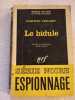
Le bidule
NRF Sans date. Le bidule est un roman d'espionnage de Darwin Teilhet publié en 1964 dans la collection Série Noire. L'histoire suit des péripéties d'espionnage typiques du genre


Bon état
Le bidule
NRF Sans date. Le bidule est un roman d'espionnage de Darwin Teilhet publié en 1964 dans la collection Série Noire. L'histoire suit des péripéties d'espionnage typiques du genre
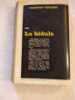
Bon état
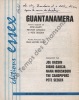
Dassin Joe,Mouskouri Nana,Garcia Digno,The Sandpipers,Seeger Pete - Seeger Pete,Marti Jose,Angulo Hector - Rivat Jean-Michel
Reference : 24766
(1963)
Le livre du Thé Vert
Plume 2002 Photographies de Sophie Boussahba
Les propriétés médicinales du thé vert, utilisées en Asie depuis des millénaires, sont aujourd’hui reconnues par la médecine occidentale, et de nombreuses marques de cosmétiques emploient également la précieuse plante ds des gammes de produits de beauté ou de soin du corps Bon état d’occasion

