 Write to the booksellers
-
Type
Book (7300)
Disk (1)
Drawings (1)
Engraving (9)
Magazine (140)
Maps (4)
Music sheets (136)
New book (4)
Old papers (1)
Photographs (7)
-
Latest
Last 24h (10)
Last 3 days (5)
Last month (124)
Last week (20)
-
Language
Czech (1)
Dutch (9)
English (158)
French (7421)
German (4)
Italian (2)
Japanese (1)
Latin (3)
Russian (4)
-
Century
16th (9)
17th (43)
18th (194)
19th (884)
20th (2517)
21st (1560)
-
Countries
Belgium (1156)
Canada (34)
China (56)
Côte d'Ivoire (7)
Denmark (1063)
France (4934)
Germany (1)
Netherlands (181)
Switzerland (155)
United Kingdom (12)
United States of America (4)
-
Syndicate
ALAC (27)
CLAM (25)
CLAQ (2)
ILAB (2251)
NVVA (15)
SLACES (15)
SLAM (1038)
SNCAO (4)
EISSFELDT,O. Palestine in the time of the 19th dynasty, (a) the exodus and wanderings. (And:) FRANKEN,H.J. Idem, (b) archaeological evidence.
Cambr., CUP, 1965 - 1968.
32,11 p. Wrs. (Fasc. 31 & 68: Vol. II,26)
FRANKFORT,H. The last predynastic period in Babylonia.
Cambr., CUP, 1968.
27 p. Wrs. (Fasc. 65: Vol. I,12)
GADD,C.J. Assyria and Babylon, c. 1370-1300 B.C.
Cambr., CUP, 1965.
36 p. Wrs. (Fasc. 42: Vol. II,18)
GADD,C.J. Hammurabi and the end of his dynasty.
Cambr., CUP, 1965.
62 p. Wrs. (Fasc. 35: Vol. II,5)
HINZ,W. Persia, c. 1800-1550 B.C.
Cambr., CUP, 1964.
37 p. Wrs. 2 3 cm (Fasc. 21: Vol. II,7)
HUGHES,D.R. & D.R. BROTHWELL. The earliest populations of man in Europe, Western Asia and Northern Africa.
Cambr., CUP, 1966.
19 p. Wrs. (Fasc. 50: Vol. I,5)
KENYON,K.M. Palestine in the Middle Bronze Age.
Cambr., CUP, 1966.
43 p. Wrs. (Fasc. 48: Vol. II,3)
KUPPER,J.-R. Northern Mesopotamia and Syria.
Cambr., CUP, 1966.
46 p. Wrs. (Fasc. 14: Vol. II,1)
LINTON,D.L. & F. MOSELEY. The geological ages.
Cambr., CUP, 1968.
37 p.; fold. map. Wrs. (Fasc. 61: Vol. I,1)
MATZ,F. Minoan civilization. Maturity and zenith.
Cambr., CUP, 1964.
48 p. Wrs. 23 cm (Fasc. 12: Vol. II, 4,b & 12)
MATZ,F. Minoan civilization. Maturity and zenith.
Cambr., CUP, 1964.
48 p. Wrs. 23 cm (Fasc. 12: Vol. II, 4,b & 12)
MUNN-RANKIN,J.M. Assyrian military power, 1300-1200 B.C.
Cambr., CUP, 1967.
38 p. Wrs. (Fasc. 49: Vol. II,25)
POSENER,G., J. BOTTÉRO & K.M. KENYON. Syria and Palestine, c. 2160-1780 B.C.
Cambr., CUP, 1965.
70 p. Wrs. (Fasc. 29: Vol. I,21)
STUBBINGS,F.H. The expansion of Mycenaean civilization.
Cambr., CUP, 1964.
25 p. Wrs. 23 cm (Fasc. 26, Vol. II, 22,a)
Third edition. Vol. II: the Middle East and the Aegean region, c. 1800-1000 B.C. Ed. by I.E.S.EDWARDS, C.J. GADD, N.G.L. HAMMOND, & E. SOLLBERGER.
Cambr., CUP, 1973 - 1975.
2 vols: 13,868;23,1128 p. Cl. 24 cm
Third edition. Vol. I, part 1: Prolegomena and Prehistory. Part 2: early history of the Middle East. Ed. by I.E.S.EDWARDS, C.J. GADD, & N.G.L. HAMMOND.
Cambr., CUP, 1970 - 1971.
2 vols: Cl. 22,758,23,1058 p. Cl. 24 cm (Last edition)
Vol. X. The Augustan empire, 44 B.C. - A.D. 69. Second Edition. Edited by A.K. BOWMAN, E. CHAMPLIN, A. LINTOTT.
Cambr., CUP, 1996.
XXII,1193 p.; ills. & maps. Cloth 24 cm (No dustjacket)
WEINBERG,S.S. The Stone age in the Aegean.
Cambr. CUP, 1965.
68 p., 3 folding maps. Wrappers 23 cm (Vol. I, chapter X)
Egyptian Background of the Septuagint. Lexical Items in Genesis, Exodus and Leviticus
, Brepols, 2026 Paperback, Pages: 263, Size:156 x 234 mm, Illustrations:6 tables b/w., Languages: English, Greek, Hebrew. ISBN 9782503618005.
Summary It is generally accepted that the Greek translation of the Pentateuch was undertaken in Egypt, in the 3rd century BCE. Then, it is only logical that the translators and the translation itself were influenced by the environment the translation took place in, by its languages, its usages and beliefs. Nevertheless, previous scholarly endeavours only partially address the issue of these contextual influences on the Greek translation. Although some valid attempts to uncover echoes of the Egyptian environment in the Septuagint translation have been made in the past century, no systematic study had been produced. In the wake of a renewed interest for Egyptian features in the Septuagint translation, the present volume aims at offering the first systematic study on Egyptian influences in the first three books of the Pentateuch: Genesis, Exodus, and Leviticus. An accurate analysis of various translational choices reflected in lexical elements which have been influenced by the Egyptian milieu such as proper names, toponyms, geographical images, job titles, weights and measures, animal names, realia, and theological accents demonstrates to what extent the translators were acquainted with the environment they lived in. Examining this phenomenon, which might initially appear marginal, reveals itself to be a pressing issue in the emerging trends of Septuagint studies. TABLE OF CONTENTS Preface List of Abbreviations Part I. Introduction and Methodological Considerations Introduction 1. Translation Technique Studies 2. LXX Lexicography 3. How to Define Egyptian Influences on the Vocabulary of the Septuagint Part II. The Egyptian Background of the Septuagint. Lexical Items in Genesis, Exodus and Leviticus 4. Proper Names 5. Toponyms 6. Geographical References and Natural Imagery 7. Occupational Terms and Hellenistic Job Titles 8. Weights and Measures 9. Identifying and Naming Kosher and Unkosher Animals 10. Realia 11. Theological Accents in Translation? 12. General Conclusions and Future Avenues Bibliography Index of Ancient Sources
Promenades lyriques - EO Numérotée
Nouvelle Librairie Nationale 1924 250 pages in8. 1924. broché. 250 pages.
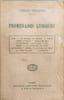
couverture légèrement usagée intérieur très propre
Campa Laurence Charpentier Henry Krémer Louis Charpentier-Morel Françoise Morel Paul
Reference : 14624
(2008)
ISBN : 2710330857
D'encre de fer et de feu: Lettres à Henry Charpentier (1914-1918)
TABLE RONDE 2008 272 pages 20 8x2 2x30 8cm. 2008. Broché couverture rempliée. 272 pages. Cet ouvrage rassemble les lettres proses et dessins que Louis Krémer a adressés à son ami poète Henry Charpentier entre 1914 et 1918 offrant un témoignage littéraire atypique sur la Grande Guerre mêlant révolte ironie et lyrisme
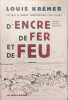
Très bon état
Sur la Figure des Dents des Roues, et des Aisles des Pignons, pour rendre les Horloges plus parfaites.
(Paris, L'Imprimerie Royale, 1735). 4to. Without wrappers. Extracted from ""Mémoires de l'Academie des Sciences. Année 1733"". Pp. 117-140 and 4 folded engraved plates. Fine and clean.
By this paper Camus was the first to work out the mathematical theory of gearteeth into a systematical and general theory of the mechanism.


