 Write to the booksellers
-
Type
Any type (1)
Art print (7)
Autograph (1)
Book (32623)
Disk (1)
Drawings (264)
Engraving (11)
Magazine (125)
Old papers (1)
Photographs (15)
Posters (1)
-
Latest
Last 24h (8)
Last 3 days (14)
Last month (482)
Last week (12)
-
Language
Dutch (78)
English (56)
French (32872)
German (6)
Italian (18)
Portuguese (9)
Spanish (11)
-
Century
16th (14)
17th (46)
18th (199)
19th (1525)
20th (9434)
21st (1683)
-
Countries
Belgium (10932)
Brazil (6)
Canada (116)
China (1)
Côte d'Ivoire (139)
Denmark (209)
France (18550)
Germany (1)
Greece (1)
Switzerland (3095)
-
Syndicate
ALAC (107)
CLAM (143)
CLAQ (102)
CNE (3)
ILAB (10475)
NVVA (1145)
SLACES (1145)
SLAM (7871)
SNCAO (10)
Kati Heck. (Signed with original drawing)
, Hannibal, 2016 Gebonden, Hardcover. 29 x 24,7 cm,144 bladzijden, Quadrichromie,Tweetalige editie Nederlands-Frans. Met handtekening en tekeningetje van Kati Heck. . ISBN 9789492081544.
Kati Heck wordt beschouwd als een erfgename van het Duitse expressionisme. Haar werk doet denken aan de bars, dansers en acteurs van Otto Dix en George Grosz, net als aan de oude meesters. Ze synthetiseert stijlen en is net zo goed een abstracte expressionist als een realist. Delen van haar schilderijen zijn minutieus weergegeven op gestikte doeken, met een unieke virtuositeit en acute aandacht voor detail, terwijl andere delen abstracter weergegeven of zelfs gebeeldhouwd worden. De manier waarop ze niet-traditionele materialen en alledaagse objecten in innovatieve en eigenzinnige combinaties verwerkt, herinnert aan Robert Rauschenberg. Hecks portretten belichamen een diepe, overtuigende en sociale visie, en zijn tegelijk ondoorgrondelijk persoonlijk. De weergegeven onderwerpen zijn meer dan enkel acteurs, het zijn meestal zelfportretten en personen uit haar directe omgeving. Haar werk werd onlangs geexposeerd in CAC Malaga en Mary Boone Gallery New York, en wordt de komende maanden getoond in Expo Chicago en het Antwerpse M HKA. Met tekstbijdragen van onder meer Ann Demeester (Frans Hals Museum/De Hallen Haarlem) en wijlen Jan Hoet, een verhaal door Woody Allen en een gesprek met Luc Tuymans.
Kursaal and Promenade. L on Spilliaert (1881-1946) and Atmospheric Solitude by the Sea Anne Adriaens-Pannier
, Hannibal Books, 2023 softcover, 112 pages, 21 x 14.8 cm, Quadrichromy Illustrated., English edition. . ISBN 9789464666458.
A lone walker at dawn in Ostend, L on Spilliaert (1881-1946) is entranced by the bleak and ominous desolation of the promenade. A fascination with spatiality and the expression of infinity underlie the numerous dyke scenes Spilliaert created between 1907 and 1909, heralding a unique, formal innovation. Learn more about the compelling Kursaal and Promenade that is the centrepiece of this Phoebus Focus.
KURSAAL AND PROMENADE (PHOEBUS FOCUS XXXII) L on Spilliaert (1881-1946) and Atmospheric Solitude by the Sea
, Phoebus Focus XXXII, 2023 PB+, 210 x 148 mm, 112 p, ENG, ill. in colour / b/w, New, ISBN 9789464666458.
Als eenzame wandelaar in het ochtendgloren van Oostende laat L on Spilliaert (1881-1946) zich begeesteren door de desolate en onheilspellende verlatenheid van de zeedijk. De fascinatie voor ruimtewerking en de expressie van oneindigheid liggen aan de grondslag van de talrijke dijkzichten die Spilliaert tussen 1907 en 1909 cre ert en waarmee hij een unieke formele vernieuwing inluidt. Ontdek het beklijvende werk Kursaal en zeedijk dat in deze Phoebus Focus centraal staat.
Kursaal en zeedijk L on Spilliaert (1881-1946) en atmosferische eenzaamheid bij de zee
, Hannibal Books, 2023 softcover, 112 pages, 21 x 14.8 cm, Quadrichromy Illustrated., Nederlandstalige editie . ISBN 9789464666441.
Als eenzame wandelaar in het ochtendgloren van Oostende laat L on Spilliaert (1881-1946) zich begeesteren door de desolate en onheilspellende verlatenheid van de zeedijk. De fascinatie voor ruimtewerking en de expressie van oneindigheid liggen aan de grondslag van de talrijke dijkzichten die Spilliaert tussen 1907 en 1909 cre ert en waarmee hij een unieke formele vernieuwing inluidt. Ontdek het beklijvende werk Kursaal en zeedijk dat in deze Phoebus Focus centraal staat.
Leon Spilliaert from the Depths of the Soul.
, ludion, 2026 Hardback, 290 x 250 mm, 336 pages, 400 illustrations. English edition. **Brandnew, updated edition. ISBN 9789464781274.
Rooted in the Symbolist tradition of the fin-de-siecle and drawn to the avant-garde, Leon Spilliaert (1881-1946), was a loner who never occupied a clear place in the art of his time. He shared not only his home port of Ostend with James Ensor, but also his sense of mockery and irony, non-conformity and an urge to view the world differently. Spilliaert, however, created a spiritual visual language of his own, experimenting with pastels and gouache, playing with purified expanses of colour and elegant lines. The moonlit sea, solitary, vacantly gazing figures, beaches stripped of all human presence, empty rooms and stylized, backlit silhouettes - Spilliaert invariably evoked an atmosphere of mystery, magic and alienation in line and colour. Anne Adriaens-Pannier, former curator at the Royal Museums of Fine Arts in Brussels, has been working on the catalogue raisonne of his oeuvre since 1995 at the Spilliaert family's request. She pays tribute to the artist with this beautifully illustrated book, in which she describes his drawings and paintings, as well as referring to his book illustrations and lithographs. The author presents Spilliaert as a link between the major art movements in the fascinating era in which he lived and worked. A unique book about an exceptional artist.
Leon Spilliaert. Le reve des autres, Illustrateur de Verhaeren, Maeterlinck, Hellens,
, Van de Wiele, 2018 Couverture reliee, HB, 300 x 220 mm, 240 p, throughout illustrations, Texte en Francais. ISBN 9789076297729.
Elles sont pratiquement inconnues de la plupart des amateurs d'art: les illustrations de Leon Spilliaert (1881-1946) dans des editions de l'oeuvre d'ecrivains belges comme Emile Verhaeren, Maurice Maeterlinck, Franz Hellens, Paul Neuhuys et bien d'autres. Spilliaert a illustre leurs recueils de poesie et pieces de theatre, et meme un livre pour enfants, de dessins a l'encre de Chine et a l'aquarelle, ou il a laisse libre cours a son inspiration dans sa visualisation de l'univers onirique des auteurs. Ce volet foisonnant de son art est enfin devoile au public par la specialiste de Spilliaert, Anne Adriaens-Pannier. L'ouvrage accompagne l'exposition Le reve des autres a La Maison Spilliaert a Ostende (du 19 novembre 2017 au 2 avril 2018), ou sont reunies les editions en question, rehaussees de dessins originaux ou d'illustrations imprimees, et des oeuvres autonomes de l'artiste en rapport avec son travail d'illustrateur. Les pieces exposees, issues de collections publiques et particulieres, presentent pour la premiere fois - et probablement la seule - un panorama complet des creations de Spilliaert inspirees de la litterature.
L ON SPILLIAERT. DE DROOM VAN ANDEREN
, Van de Wiele, hardcover, 290 x 215 mm, 240 pagina's, doorlopend illustraties NL editie. *nieuwstaat. ISBN 9789076297712.
Bij de meeste kunstliefhebbers zijn ze vrijwel onbekend: de illustraties van L on Spilliaert (1881-1946) in uitgaven van het werk van Belgische schrijvers als Emile Verhaeren, Maurice Maeterlinck, Franz Hellens, Paul Neuhuys en vele anderen. Spilliaert illustreerde hun dichtbundels en theaterstukken, en zelfs een kinderboek, met tekeningen in Oost-Indische inkt en aquarelverf, of liet zijn inspiratie de vrije loop bij het visualiseren van de droomwereld van de auteurs. Dit rijke deelgebied van zijn kunst wordt door Spilliaertspecialiste Anne Adriaens-Pannier eindelijk voor het publiek ontsloten. Dit boek begeleidt de tentoonstelling De droom van anderen in Het Spilliaert Huis in Oostende (van 19 november 2017 t.e.m. 2 april 2018), waar de uitgaven met originele tekeningen of gedrukte illustraties en aanverwante autonome werken samen te zien zijn. De stukken, uit openbare en particuliere collecties, bieden voor het eerst, en waarschijnlijk eenmalig, een volledig beeld van Spilliaerts literair ge nspireerde creaties.
L ON SPILLIAERT : LE R VE DES AUTRES ( FR )
, Van de Wiele 2018, 2018 Hardcover, 240 pages, FR, 295 x 220 mm, tres bon etat, illustrations en couleur et n/b. ISBN 9789076297729.
Elles sont pratiquement inconnues de la plupart des amateurs d'art: les illustrations de L on Spilliaert (1881-1946) dans des ditions de l'oeuvre d' crivains belges comme mile Verhaeren, Maurice Maeterlinck, Franz Hellens, Paul Neuhuys et bien d'autres. Spilliaert a illustr leurs recueils de po sie et pi ces de th tre, et m me un livre pour enfants, de dessins l'encre de Chine et l'aquarelle, o il a laiss libre cours son inspiration dans sa visualisation de l'univers onirique des auteurs. Ce volet foisonnant de son art est enfin d voil au public par la sp cialiste de Spilliaert, Anne Adriaens-Pannier. L'ouvrage accompagne l'exposition Le r ve des autres La Maison Spilliaert Ostende (du 19 novembre 2017 au 2 avril 2018), o sont r unies les ditions en question, rehauss es de dessins originaux ou d'illustrations imprim es, et des oeuvres autonomes de l'artiste en rapport avec son travail d'illustrateur. Les pi ces expos es, issues de collections publiques et particuli res, pr sentent pour la premi re fois - et probablement la seule - un panorama complet des cr ations de Spilliaert inspir es de la litt rature.
Anne Adriaens-Pannier, Adrian Locke, Will Stone, No mie Goldman, Anna Testar
Reference : 53321
LEON SPILLIAERT (1881 - 1946) English ed.
, Royal Academy (ACC), 2020 HB, 290 x 220 mm, 176 p, 130 colour illustrations. English edition. *BRANDNEW ISBN 9781912520220.
Belgium symbolist painter and graphic artist. Watercolourist, pastellist, painter (gouache), draughtsman. Portraits, genre scenes, still-lifes, landscapes, seascapes. From childhood he displayed an interest in art and drawing and was a prolific doodler, spending much time sketching scenes of ordinary life and the Belgium countryside. In 1889 he studied briefly at the Tekenacademie in Bruges. His early work, already Symbolist in style was informed by his readings of writers such as Friedrich Nietzsche and Maurice Maeterlinck. From February 1903 to January 1904 he worked for Edmond Deman in Brussels, a publisher of symbolist writers, whose work Spilliaert was to illustrate. In 1904 Spilliaert stayed in Paris, where he was on the fringe of Picasso's circle and discovered the work of Munch and Toulouse-Lautrec, whose influences he acknowledged. He continued to spend most winters in Paris to keep in touch with the city's cultural life. Although often associated with the key figures of Belgian Symbolism, L on Spilliaert in fact demonstrated a peculiarly individual style. Born in Ostend, he worked there for most of his career. An introvert and insomniac who suffered from poor health as a young man, Spilliaert wandered the night-time streets of the North Sea resort, creating mysterious and highly atmospheric depictions of its dark docks, beaches and promenades. Almost entirely self-taught, he drew influence from such painters as Odilon Redon and James Abbott McNeill Whistler, as well as the writers Edgar Allan Poe and Friedrich Nietzsche. This book brings together over a hundred works from international collections, including a series of haunting self-portraits that Spilliaert created in his twenties. Authoritative authors discuss the artist's singular approach and put his career in context alongside that of his more famous compatriot and contemporary James Ensor.
L ON SPILLIAERT : Dwalen door de stilte
, Snoeck Publishers (Belgium), HB, 260 x 215 mm, 48 pages, 30 Kleurenillustraties Nieuw NL edition. ISBN 9789461618948.
In de werken van L on Spilliaert (Oostende 1881-Brussel 1946) schuilt achter de beelden een mysterie dat fascineert. Steeds terugkerende motieven in zijn tekeningen zijn de eenzaamheid van de mens en de onmetelijkheid van de zee. Spilliaert gaat op zoek naar de ziel van voorwerpen uit zijn dagelijks leven en van plaatsen in zijn geboortestad Oostende. Uit zijn aangrijpende zelfportretten spreekt een huiver die door het afdalen in zijn diepste zelf teweeg wordt gebracht. Zijn werken geven blijk van een op reflectie en spirituele meditatie gerichte geest en getuigen van een verlangen om de symbolen van tijdloosheid van de natuur te doorgronden. Deze tentoonstelling presenteert eenentwintig werken die nauw aansluiten bij Spilliaerts artistieke zoeken en die rechtstreeks uit het familiebezit komen. De drietalige catalogus bij de tentoonstelling biedt een overzicht van de geschiedenis van de ontdekking van Spilliaerts werk in binnen- en buitenland, en plaatst zijn oeuvre in de bredere context van de kunst van zijn tijd. De publicatie bevat ook een uniek interview met de kleinzoon van de kunstenaar en beschrijft in korte hoofdstukken de bijzondere artistieke bijdrage van de gepresenteerde werken. Met teksten van Spilliaertspecialiste Anne Adriaens-Pannier, Edouard Derom en Jeffery Howe, en met een interview met Spilliaerts kleinzoon Johan van Rossum.
L ON SPILLIAERT : L'arpenteur du silence
, Snoeck Publishers, 2024 HB, 260 x 215 mm, 48 pages, 30 illustration color. FR edition. ISBN 9789461618955.
Les oeuvres de Spilliaert (Ostende 1881-Bruxelles 1946) fascinent par le myst re de leurs images. Dessinateur, il explore la solitude de l' tre humain et de l'immensit de la mer. Il voque la vie des lieux de sa ville natale d'Ostende et des objets de son quotidien. Ses autoportraits saisissants traduisent l'angoisse de la echerche vers le plus profond de son tre. Ses cr ations refl tent un esprit de r flexion et de m ditation spirituelle, qu'il exerce en sondant les symboles d'intemporalit de la nature. Cette exposition pr sente vingt et une oeuvres, au plus pr s de ses recherches et qui proviennent directement de la famille. L' dition d'un catalogue, en trois langues, accompagnant l'exposition donne un aper u de l'historique de la d couverte de l'oeuvre de Spilliaert en Belgique et l' tranger et situe l'oeuvre dans un contexte plus large dans l'art de son temps. Il pr sente le t moignage unique de son petit-fils et retrace dans des courts chapitres l'apport artistique original des oeuvres pr sent es. Avec des textes de (la sp cialiste de Spilliaert) Anne Adriaens-Pannier, Edouard Derom, Jeffery Howe et avec un entretien avec le petit-fils de Spilliaert, Johan van Rossum.
L ON SPILLIAERT : Wandering through Silence
, Snoeck Publishers, 2024 HB, 260 x 215 mm, 48 pages, 30 illustration color. ENG edition. ISBN 9789461618962.
The works of Spilliaert (Ostend 1881-Brussels 1946) fascinate for the mystery of their images. His drawings explore the solitude of human beings and of the sea's immensity. He evokes the life of various locations around his hometown of Ostend, and of objects drawn from his everyday life. His striking self-portraits translate the anguished plumbing of his deepest depths. His creations reflect a spirit of reflection and spiritual meditation, which he exercises by surveying the symbols of nature's timelessness. This exhibition presents twentyone works, intimately revealing his searches and studies, and directly provided by his family. The publication of a catalogue, in three languages, accompanying the exhibition provides an overview of the history of the discovery of Spilliaert's oeuvre in Belgium and abroad, and situates his body of work within a wider context of the art of his time. It presents a unique interview with his grandson, as well as brief chapters retracing the singular artistic contributions of the presented works. With texts by (the Spilliaert specialist) Anne Adriaens-Pannier, Edouard Derom and Jeffery Howe, as well as an interview with Spilliaert's grandson, Johan van Rossum.
Anne Adriaens-Pannier, Le la Jarbouai, Laurence Des Cars (Pr facier)
Reference : 57442
L on Spilliaert: Lumi re et solitude.
, R union des Mus es, , 2020 Hardcover- Couverture reliee 208 pages, 130 Illustrations, 29x23cm.Texte en Francais Exhibition catalogue. ISBN 9782711875276.
L on Spilliaert est consid r comme l'un des peintres belges les plus importants, c t de R. Magritte, J. Ensor, P. Delvaux.... Pourtant, il est moins connu... Homme des solitudes inqui tantes, des perspectives infinies, Spilliaert (1881-1946) surprend, d route par des ?uvres inclassables, inventant un symbolisme singulier de la nuit int rieure. Spilliaert est n Oostende. Ses promenades nocturnes dans la ville d serte seront une source d'inspiration pour son oeuvre. Il est presque enti rement autodidacte. Il est influenc par les courants artistiques de la fin de si cle : le symbolisme et l'expressionnisme. Spilliaert est un explorateur de l'inconscient et des angoisses existentielles au moment o les sciences humaines avancent dans la compr hension de la psych . Il est passionn par Nietzsche, Schopenhauer, Chateaubriand et Lautr amont. Le catalogue se concentre sur les ann es 1896 1919, les plus intenses dans la carri re de l'artiste, et pr sente ses oeuvres les plus radicales. Exposition du 13 octobre 2020 au 10 janvier 2021 au Mus e d'Orsay, Paris. L on Spilliaert: Lumi re et solitude (Mus e d'Orsay & Grand Palais) aantalIn winkelwagen L on Spilliaert is considered to be one of the most important Belgian painters, alongside R. Magritte, J. Ensor, P. Delvaux?. However, he is less well known? A man of disquieting solitudes and infinite perspectives, Spilliaert (1881-1946) surprised and disconcerted by unclassifiable works, inventing a singular symbolism of the inner night. Spilliaert was born in Oostende. His night walks in the deserted city were a source of inspiration for his work. He is almost entirely self-taught. It is influenced by the artistic currents of the end of the century: symbolism and expressionism. Spilliaert is an explorer of the unconscious and existential anxieties at a time when the human sciences are advancing in their understanding of the psyche. He is passionate about Nietzsche, Schopenhauer, Chateaubriand and Lautr amont. The catalogue focuses on the years 1896 to 1919, the most intense years in the artist?s career, and presents his most radical works. Exhibition from October 13, 2020 to January 10, 2021 at the Mus e d?Orsay. IN FRENCH!
COBRA, Catalogue d'exposition
, Lannoo/BOZAR, 2008 Couverture rigide illustr , 320 pages, 30 x 23 cm. FR.
Cr Paris en novembre 1948 par des artistes, peintre ou crivains, venus de Copenhague (Jorn), Bruxelles (Dotremont, Noiret) et Amsterdam (Appel, Corneille, Constant), le mouvement CoBrA reste m connu hors d?Europe. Assimil tant t une queue de com te surr aliste, tant t une manifestation nordique de l?art tachiste ou informel, Cobra est aussi per u comme une formule europ enne de l?expressionnisme abstrait tel qu?il fleurit alors aux tats-Unis.
L on Spilliaert: Interieurs & Interiors & Still Lifes (EN)
, Hannibal Books, 29-06-2026 Hardcover, 128 pages, 32.8 x 25.3 x 1.7cm, English. New. . ISBN 9789493531000.
Step into the silent, mysterious world of L on Spilliaert A modest but essential part of Spilliaert?s oeuvre consists of his interiors and still lifes. These intimate compositions reveal the depth of his vision, as well as his exceptional ability to transform everyday spaces into places of contemplation. Empty rooms, familiar corners and simple objects are rendered with austere clarity, yet carry an intense, almost tangible presence ? despite the absence of human figures. Silence reigns in these works. This richly illustrated publication brings together new essays by leading Spilliaert scholars, each casting fresh light ? from within their own field of research ? on the genesis of this exceptional body of work by the Ostend artist. With contributions by Anne Adriaens?Pannier (ed.), Edouard Derom (ed.), Stefan Huygebaert and Marie?No lle Grison. This book is published on the occasion of the exhibition L on Spilliaert: Through Half-Open Doors at the Patrick Derom Gallery, Brussels, from June 3 to August 14, 2026.
L on Spilliaert: Interieurs & natures mortes (FR)
, Hannibal Books, 29-06-2026 Couverture rigide, 128 pages, 32.8 x 25.3 x 1.7cm, Fran ais. Nouveau. . ISBN 9789493531000.
Les int rieurs et les natures mortes constituent un volet modeste, mais essentiel de l??uvre de L on Spilliaert. Dans ces compositions intimistes se d ploient la profondeur de son regard et sa capacit remarquable transformer des espaces quotidiens en lieux de contemplation. Bien que rendus avec une sobri t limpide, pi ces vides, recoins familiers et objets simples sont habit s par une pr sence intense, presque tangible, malgr l?absence de figures humaines. Dans ces ?uvres, le silence r gne en ma tre. Cette publication richement illustr e r unit des essais in dits r dig s par des sp cialistes de la vie et de l??uvre de Spilliaert. Chacun d?eux porte, depuis son propre domaine de recherche, un regard neuf sur la gen se de cet ensemble exceptionnel du peintre ostendais. Avec des contributions d?Anne Adriaens?Pannier ( d.), Edouard Derom ( d.), Stefan Huygebaert et Marie?No lle Grison.
L on Spilliaert: Interieurs & stillevens
, Hannibal Books, 29-06-2026 Hardcover, 128 pagina's, 32.8 (hoogte) x 25.3 (breedte) x 1.7 (dikte) cm, Nederlands. Nieuw. . ISBN 9789493531000.
Een verrassende kijk op de minst bekende, maar meest persoonlijke zijde van L on Spilliaert Dit rijk ge llustreerde boek verkent de intrigerende wereld van de interieurs en stillevens van L on Spilliaert. In negen thematische hoofdstukken ontrafelt Anne Adriaens-Pannier de ?geheime alchemie? van zijn verstilde ruimtes, waar interieurs fungeren als zelfportretten in absentia. Zijn sobere kamers, tafels en alledaagse voorwerpen onthullen een intens innerlijk leven. Met talloze paginagrote reproducties biedt deze publicatie een gelaagd perspectief op een van de meest introspectieve figuren van het Belgisch modernisme. Met tekstbijdragen van Anne Adriaens-Pannier, Edouard Derom, Stefan Huygebaert, Marie-No lle Grison en Franz Hellens.
UITBUNDIG VERLEDEN De Bourgondi rs door Romantische ogen
, Snoeck Publishers , 2021 PB+, 280 x 250 mm, 160 pages , 132 illustraties. NL edition. fine. ISBN 9789461616777.
Teruggrijpen naar het verleden, het is iets van alle tijden. Net als vandaag was geschiedenis ook in de negentiende eeuw populair. Het is de eeuw waarin verschillende nieuwe naties ontstaan en andere zich sterker gaan profileren op het internationale toneel. Tijdens de Romantiek groeit een hernieuwde belangstelling voor de Bourgondische hertogen, van Filips de Stoute tot de roemrijke keizer Karel. Zo treden de vijftiende- en zestiende-eeuwse Bourgondische vorsten in verschillende Europese landen opnieuw op de voorgrond. Als de aartsvaders van de Lage Landen verschijnen ze op schilderijen, in de literatuur en beeldhouwkunst. Maar het beeld van de vorsten verschilt sterk van land tot land: wat vertellen ze ons over de negentiende-eeuwse visie op het verleden? En over de manier waarop wij vandaag omgaan met onze geschiedenis? In Uitbundig Verleden. De Bourgondi rs door Romantische ogen kijk je vanuit een hedendaagse context, met een kritische blik en een veranderend perspectief naar het verleden. De ondergrondse exporuimte van Museum Hof van Busleyden doet aan als eennegentiende-eeuws monumentaal museum en toont met een veertigtal werken het verlangen naar de grootsheid van weleer. Museum Hof van Busleyden - 27.11.2021 - 27.02.2022. Uitbundig Verleden is een samenwerking tussen Museum Hof van Busleyden en het Monast re royal de Brou in Bourg-en-Bresse (Frankrijk).
Ic nes de l'Art moderne: La collection Morozov
, Co dition Gallimard/Fondation Louis Vuitton, 2021 cartonnage illustre de l'editeur, 524 pages Illustrated. 28.5 x 5.1 x 30.5, Texte en Francais Exhibition catalogue. ISBN 9782072904585.
Le second volet de la grande manifestation "Ic nes de l'art moderne" organis e par la Fondation Louis Vuitton r unit plus de 170 chefs-d'oeuvre inestimables de la collection d'art moderne fran ais et russe des fr res moscovites Mikha l et Ivan Morozov.Apr s celui de Sergue Chtchoukine, la Fondation Louis Vuitton poursuit son exploration de l'univers culturel et intellectuel des collectionneurs m c nes russes, pionniers de l'art moderne. Pr sent e pour la premi re fois hors de Russie, la Collection Morozov rassemble des oeuvres iconiques de Manet, Rodin, Monet, Pissarro, Toulouse-Lautrec, Renoir, Sisley, C zanne, Gauguin, Van Gogh, Bonnard, Denis, Maillol, Matisse, Marquet, Vlaminck, Derain et Picasso aux c t s d'artistes embl matiques de l'art russe au tournant du si cle tels que R pine, Vroubel, Korovine, Golovine, S rov, Larionov, Gontcharova, Mal vitch, Machkov, Kontchalovski, Outkine, Sarian ou Konenkov. La pr sentation in dite de ces artistes constitue une red couverte exceptionnelle.Philanthropes des arts, les fr res Mikha l Abramovitch Morozov (1870-1903) et Ivan Abramovitch Morozov (1871-1921) ont domin la vie culturelle moscovite entre la fin du XIX? et le d but du XX? si cle, au m me titre que les Tr tiakov, Mamontov, Riabouchinski et Chtchoukine. Leur soutien inconditionnel l'art contemporain europ en et russe contribuera largement la reconnaissance internationale des peintres modernes fran ais.
Icons of Modern Art: The Shchukin Collection
, Editions Gallimard, 2022 Paperback, 456 pages, ENG, 230 x 215 x 28 mm, NEW, illustrations in colour, . ISBN 9782072760778.
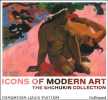
- An exceptional exhibition catalog, a dive into the 19th and 20th century painting - Gathers 130 masterpieces together The Fondation Louis Vuitton's unprecedented 2016 exhibition brought together 130 masterpieces, among the most iconic of the collection created in Moscow by the great Russian art patron, Sergei Shchukin. From Le D jeuner sur l'herbe (1866) by Claude Monet, the Mardi gras (1888-90) by Paul C zanne, Paul Gauguin's Tahitian odalisque Eh quoi, tu es jalouse? (1892), the luminescent panel L'Atelier du peintre (1911) by Henri Matisse, to conclude with Pablo Picasso's Trois femmes (1908), the magnificence of Shchukin's collection is exhibited here. Extended by a group of some 30 major works from the Russian avant-gardes, including Counter Relief (1916) by Vladimir Tatlin, Green Stripe (1917) by Olga Rozanova, and Kazimir Malevich's monochrome painting, Black Suprematie Square (1929), Icons of Modern Art covers the extreme breadth of this journey through 19th- and 20th-century creation. The presentation of these exceptional works, where our collective gaze comes together, constitutes an exemplary painting lesson.
Anne Baldassari, Marcel Pochard, Thomas Grenon, Francine Mariani-Ducray
Reference : 63151
Picasso/Dora Maar : Il faisait tellement noir.
, Flammarion, 2006 Paperback, 319 pages, Texte en Francais, 280 x 220 x 25 mm, Tres bon condition, illustrations de couleur / n/b. ISBN 9782080115829.
A travers les photographies que Dora Maar prend de Picasso ou de ses oeuvres en cours d'ex cution, comme des dessins, peintures, sculptures et po mes que Picasso d die Dora, c'est l'histoire d'une d cennie tragique allant de Guernica 1937 l'Aubade 1942 et au Charnier 1945, que cette exposition et ce catalogue veulent rendre compte. Portant le masque de Minotaure, Picasso conf re successivement Dora les figures de la Sphinge, de la Femme qui pleure, suppliante ou de la mort elle-m me, tandis qu'elle sera son t moin.
Infirmeries monastiques et hospices. Lieux de soin du Moyen ge l' poque moderne
, Brepols, 2026 Paperback, Pages: 460, Size:210 x 270 mm, Illustrations:94 b/w, 40 col., 5 tables b/w., 2 tables col., Languages: French, English. ISBN 9782503619248.
Summary How were healthcare spaces set up in medieval and early modern Europe, who worked in them, and who were the patients? These questions were considered by archaeologists and historians during a conference at the abbey of Cluny in 2022. The contributions in this collection display a wide variety of approaches: some chapters focus on specific places, while others address the historical conditions of places of care in specific regions, countries, or religious orders. The first part of the volume is dedicated to Cluny, with seven articles covering the period from the tenth to the sixteenth century. They explore different phases of the monastic infirmary-drawing on manuscripts and material remains, particularly those brought to light by the archaeological excavations carried out between 2015 and 2019-as well as the town's hospices. The second part broadens the perspective to western Europe, with nine contributions. Reflecting a diversity of approaches, these studies combine specificity with synthesis, greatly enhancing our understanding of places of care in premodern Europe. Comment les espaces de soins taient-ils am nag s, et quels individus y travaillaient ou y taient soign s en Europe, du Moyen ge la fin de l' poque moderne ? Arch ologues et historiens se sont pench s sur ces questions l'occasion d'un colloque organis Cluny en 2022. Les contributions r unies dans cet ouvrage offrent une grande diversit d'approches : certaines se concentrent sur un lieu pr cis, tandis que d'autres abordent des r alit s r gionales, nationales ou li es des ordres religieux sp cifiques. La premi re partie de l'ouvrage est consacr e Cluny, avec sept articles couvrant la p riode du Xe au XVIe si cle. Ils explorent les diff rentes phases de l'infirmerie monastique - travers les sources manuscrites et les vestiges mat riels, notamment mis en lumi re par les fouilles arch ologiques r alis es entre 2015 et 2019 - ainsi que les hospices de la ville. La seconde partie largit la perspective l' chelle europ enne, avec neuf contributions. Par la diversit de leurs angles d'approche, ces tudes offrent un regard la fois pr cis et panoramique, renouvelant en profondeur la compr hension des lieux de soin dans l'Europe pr moderne. TABLE OF CONTENTS Eleonora Destefanis, Introduction Premi re Partie. Cluny (Abbaye et ville), du Moyen ge central jusqu'au XVIIe si cle Anne Baud et Anne Flammin, L'infirmerie monastique de Cluny du Xe au XVIIIe si cle Isabelle Cochelin, Infirmerie et infirmier Cluny au prisme des coutumiers Frederick S. Paxton, End-of-Life Care at Cluny, and Today Arlette Maquet, Infirmeries, malades et difices : la vision normative des statuts clunisiens depuis Pierre le V n rable Beno t Clavel et Philippe Pauthier, Les paradoxes de la table monastique : une enqu te arch ozoologique l'infirmerie de Cluny Elma Brenner, Rem des et soins autour de l'abbaye de Cluny au XVe-XVIe si cle : Londres, Wellcome Collection, MS. 626 Clarisse Couderc, tablissements d'accueil et de soins dans l'espace urbain et p ri-urbain de la ville de Cluny Deuxi me Partie. Ailleurs en Europe, du Moyen ge central jusqu'au XVIIe si cle Diane Carron, Au pied du mur : l'ordonnancement des tablissements d'accueil et de soin de la ville d'Orl ans (VIIe-XIIIe si cles) Alfons Zettler, The Medical Facilities and domus infirmorum on the Plan of Saint Gall Gaby Lindenmann-Merz, Cella - domus - ecclesia. Remarks on the Architectural Evolution of Cistercian Infirmaries Adam J. Davis, La nature des soins hospitaliers en milieu urbain aux XIIe et XIIIe si cles Arnaud Delerce, Les infirmeries de l'abbaye cistercienne de Beaulieu (Hampshire), d'apr s ses comptes (1269-1270) Caroline Bolle et Michel Dubuisson, Infirmeries et soins de sant dans les abbayes de Wallonie (13e-18e si cle) Bert Roest, Capuchin Medical Care: Traditions, Context, and Literary Offspring Laurent D'Agostino, Entre Mal des ardents et d membr s . Le grand h pital de l'abbaye de Saint-Antoine (Is re), d'apr s les donn es historiques et les tudes arch ologiques Emma Bouvard-Mor et Cyrille Ducourthial, La population malade de l'H tel-Dieu de Lyon (1529-1629). Archives versus arch othanatologie Daniel-Odon Hurel avec la collaboration de Pascale Chevalier, Conclusions
PIERRE CULOT : 1938 - 2011
, Mercatorfonds, 2023 HB, 335 x 250 x 30 mm, 296 p, 75 illustrations, ENG edition, Fine. ISBN 9789462303416.
Pierre Culot (1938-2011) was a Belgian ceramicist and sculptor. After training with Antoine de Vinck and English master potter Bernard Leach, he worked to build a bridge between British, Japanese and French traditions. He passionately expressed his resolution to be in the world, to be on Earth and in nature, which he understood as the sole generator of life and beauty. Throughout his life he remained faithful to his earliest experiences as a potter, evolving his ceramic works from basic forms (bowls, plates, jugs) to more daring shapes (cruciform vases, gourds, compound pots, inkwells). Shifting his imagination beyond functionality, he created sculptures and by composing outdoor sculpture-walls moved into the landscape.
PIERRE CULOT : 1938 - 2011 c ramiste/sculpteur Belge.
, Mercatorfonds, 2023 HB, 335 x 250 x 30 mm, 296 pages, 75 illustrations, FR edition, ISBN 9789462303409.
Pierre Culot (1938-2011) tait un c ramiste/sculpteur Belge. Pierre Culot a t form par Antoine de Vinck et le ma tre potier anglais Bernard Leach. Il appartient la g n ration des c ramistes des ann es 1950 qui ont fait de leur m tier une forme d'art. L'argile qu'il a tourn e, fa onn e en plaques, gratt e et vernie est devenue un ustensile quotidien d'une pr sence majestueuse. Tout au long de sa vie, il est rest fid le son exp rience initiale de la poterie et a laiss son travail voluer de la c ramique aux formes basiques (bols, assiettes, carafes) d'autres ?uvres plus audacieuses (vases cruciformes, calebasses, pots composites, encriers). Attach la beaut du geste, qu'il ma trise la perfection, il fait voluer ses pi ces, les faisant voluer dans la taille et l'effet de surface, m lant dans chacune terre crue et gla ure exub rante dans des variations uniques. Son nergie vitale irr sistible s'est nourrie au contact de la nature. Son imagination a transcend la fonctionnalit et il s'est fondu dans le paysage avec des murs sculpt s. A partir de 1967, il collecte des blocs de pierre pour cr er des cicatrices min rales dans les jardins. Le rythme, la solidit et le poids de ces murs de pierre et de b ton surprennent tant par leur audace que par leur humilit . Pierre Culot a laiss la nature le soin d'achever l'?uvre. Il a con u une douzaine de ces murs. Il a conserv cette chelle monumentale pour cr er, parall lement aux murs, de grandes sculptures de pierre, ou un m lange de brique et de granit, de brique et de brique, ou de brique et de gr s. Ils sont install s dans la verdure et invitent le spectateur p n trer dans cet entre-deux, le vide, pour une exp rience exceptionnelle. Les ?uvres de Pierre Culot expriment la dualit , le passage, la compl mentarit des forces, dans un langage architectural librement interpr t d'arcs, de portails et de contreforts. Ses sculptures ont galement t r alis es pour des galeries et des mus es (Bruxelles, Londres, Paris, Amsterdam, Luxembourg). Les tuiles de gr s qu'il r unit dans de petites architectures anim es sont baptis es chapiteaux, rang e de st les, sculptures-tours, ouverture de la terre ou homme debout. Dans son ?uvre, Pierre Culot exprime avec passion son d sir d' tre au monde, d' tre sur terre, dans la nature, seule g n ratrice de vie et de beaut . De nombreuses photographies en couleurs et en noir et blanc t moignent du travail de cet artiste-artisan au parcours unique et aux multiples facettes.
Jean-Michel Wilmotte Product Design
, Skira, 2023 Hardcover,560 pages, ENG / FR., 290 x 250 x 55 mm, NEW, illustrated in colour / b/w. ISBN 9782370741899.
More than 50 years of product and furniture design from an iconic French architect This is the first publication on the product and interior-design oeuvre of French architect Jean-Michel Wilmotte (born 1948). After founding his own firm in Paris in 1975, Wilmotte became a highly influential figure in interior design and was commissioned for many high-profile projects, including his work on Fran ois Mitterrand's private apartment in the Elys e Palace in 1982. Over the years, the agency has continued its work across architecture, interior and product design, museology and urbanism. Including examples of nearly 1,500 objects and spanning over nearly 50 years, this catalogue raisonn epitomizes Wilmotte's lifelong commitment to design and his strong attention to detail across all endeavors.

