 Write to the booksellers
-
Latest
Last 24h (78)
Last 3 days (393)
Last month (3856)
Last week (126)
-
Century
14th (1)
16th (250)
17th (1006)
18th (4251)
19th (23871)
20th (83865)
21st (9969)
-
Countries
Belgium (28610)
Brazil (1)
Canada (516)
China (11)
Côte d'Ivoire (692)
Denmark (1976)
France (161426)
Germany (618)
Greece (68)
Italy (7)
Netherlands (1610)
Switzerland (16211)
-
Syndicate
ALAC (512)
CLAM (322)
CLAQ (461)
CNE (35)
ILAB (91156)
NVVA (5605)
SLACES (5428)
SLAM (81591)
SNCAO (27)
Histoire de l'anticlericalisme francais
Mame, 1966. Format 14x22 cm, broche, 496 pages.Bon etat, petites traces d'usage sur un livre d'occasion, dos solarise.
LORD CHESTERFIELDUN GRAND EUROPEEN
Broché avec jaquette - 14 x 21,5 - 338 pp - année 1970 - Editions Mame -

ANTHROLOGIE HISTOIR PHILOSOPHIE LITTERATURE PARADES
Robert Surcouf 1773-1827
Paris. 14 cm x 18 5 cm. 1945. Cartonné. 245 pages. Paris Éditions Gedalge 1945. Cartonné 14 cm x 18 5 cm 245 pages illustrations hors-texte noir & blanc. Texte de A. Le Corbeiller illustrations de Pierre Rousseau sources et bibliographie. Tampons d'une Ecole de Jeunes Filles sinon bon état Tampons d'une Ecole de Jeunes Filles sinon bon état
La fondation de la France du quatrième au sixième siècle.
Desclée de Brouwer et cie. 1893. In-8. Broché. Etat d'usage, Couv. défraîchie, Dos satisfaisant, Papier jauni. 294 pages - plats jaunis avec des rousseurs - adhésif sur les coiffes - quelques illustrations en noir et blanc dans et hors texte - lettrines et culs de lampe en noir et blanc - tampon, annotation sur la page de faux titre - gommette rouge sur la coiffe en pied - 2ème plat tâché.. . . . Classification Dewey : 944-Histoire de France varia
Classification Dewey : 944-Histoire de France varia


LES RECENTS PROGRES DE L'HISTOIRE
EMMANUEL VITTE. 1893. In-8. Broché. Etat d'usage, Couv. défraîchie, Dos abîmé, Intérieur frais. 286 pages. Premier plat illustré en noir et blanc. Frontispice et nombreuses planches illustrés en noir et blanc. Manque au dos, coupé en deux. Auréole sur le premier plat.. . . . Classification Dewey : 900-GEOGRAPHIE, HISTOIRE, SCIENCES AUXILIAIRES DE L'HISTOIRE
Classification Dewey : 900-GEOGRAPHIE, HISTOIRE, SCIENCES AUXILIAIRES DE L'HISTOIRE
Saint Louis - Son gouvernement - Sa politique
Tours, Alfred Mame, 1891. Format 18x27 cm, demi-reliure cuir fonce, 368 pages.Bon etat.
Odilon Redon Catalogue Raisonne de L'oeuvre et Dessine ; VOLUME 1 / Portraits et Figures.
, Wildenstein Institute / Bibliotheque des Arts, 1992 Cloth with dust jacket, 344 pages, illustre coleur / b/w 28,5 x 34 cm Texte en Francais, *Tres belle exemplaire. ISBN 9782908063073.
Odilon Redon Catalogue Raisonne de L'oeuvre et Dessine ; VOLUME. III: Fleurs et Paysages
, Wildenstein Institute / Bibliotheque des Arts, 1996 Cloth with dust jacket, 420 pages, illustre coleur / b/w 28,5 x 34 cm Texte en Francais, *Tres belle exemplaire. ISBN 9782908063127.
Odilon Redon Catalogue Raisonne de L'oeuvre et Dessine ; VOLUME. III: Fleurs et Paysages
Odilon Redon Catalogue Raisonne de L'oeuvre et Dessine ; VOLUME IV: Etudes et Grandes. Decorations
, Wildenstein Institute / Bibliotheque des Arts, 1998 Cloth with dust jacket, 433 pages, illustre coleur / b/w 28,5 x 34 cm Texte en Francais, *Tres belle exemplaire. ISBN 9782908063134.
Le fer et l'acier et leurs emplois dans l'industrie - Manuel à l'usage des constructeurs et des mécaniciens
1806. Paris J. Fritsch éditeur 1806 - Cartonné 13 cm x 19 cm 179 pages - Texte de A. Ledebur professeur de métallurgie à l'Ecole des Mines de Freiberg - Traduit de l'allemand par Th. Seeligmann chimiste industriel - Couv. insolée sinon bon état
Annales du Centre Régional de Documentation Pédagogique de Lille - ESSAI DE TOPOGRAPHIE HISTORIQUE SUR LA MORINIE - mémoire de Diplôme de l'Ecole Pratique des Hautes Etudes, VIème section - Ouvrage publié avec le concours du Conseil Général du Pas-de-Calais - CRDP Institut pédagogique National 1968
in4 agrafé, 157 pp+ cartes. Plans nb

couverture légèrement tachée sinon RAS - PAS-DE-CALAIS - NORD - REGIONALISME - THEROUANNE - BOULOGNE - HISTOIRE - ANTIQUITE - THESE
Sous le signe des abeilles - préface de Jean Bourguignon
Du pavois 1943 in8. 1943. Broché.
Bon état couverture un peu défraîchie intérieur propre pages non coupées
Sous le signe des abeilles - Valérie Mazuyer dame d'honneur de la reine Hortense.
Editions du Pavois. 1943. In-8. Broché. Etat d'usage, Tâchée, Manque en coiffe de pied, Quelques rousseurs. 363 pages - quelques planches en noir et blanc dont une en frontispice - quelques rousseurs sans conséquence sur la lecture - tâches brunes sur les plats - manque sur le dos.. . . . Classification Dewey : 929.2-Histoire des familles célèbres
Préface de Jean Bourguignon. Classification Dewey : 929.2-Histoire des familles célèbres
XIXe SIECLE L'AGE DU MOUVEMENT - EXPRESSION FRANCAISE
MASSON & CIE. 1972. In-8. Broché. Bon état, Couv. convenable, Dos satisfaisant, Intérieur frais. 240 pages - nombreuses illustrations en noir et blanc dans et hors texte.. . . . Classification Dewey : 944-Histoire de France varia
Classification Dewey : 944-Histoire de France varia
XIX e siècle, l'âge du mouvement.
Couverture souple. Broché. 240 pages.
Livre. Editions Masson et Cie, 1972.
XVIII EME SIECLE. L'AGE DES LUMIERES. EXPRESSION FRANCAISE.
MASSON ET CIE. 1970. In-8. Broché. Bon état, Couv. convenable, Dos frotté, Intérieur acceptable. 173 pages. Nombreuses illustrations en noir et blanc dans le texte et hors texte.. . . . Classification Dewey : 900-GEOGRAPHIE, HISTOIRE, SCIENCES AUXILIAIRES DE L'HISTOIRE

Classification Dewey : 900-GEOGRAPHIE, HISTOIRE, SCIENCES AUXILIAIRES DE L'HISTOIRE
BAGNOLS EN 1787
1887 BAGNOLS,Imp.vve Alban BROCHE 1887 ,IN 12br.,couv.ill., illustrations et portrait de l'auteur,321p,dos cassé avec manque ,à relier,texte frais
Né à Bagnols-sur-Cèze, le peintre et dessinateur Léon Alègre (1813-1884) consacra une partie de son temps à sa ville natale qu'il dota abondamment d'un musée et d'une bibliothèque. Remise de 20% pour toutes commandes supérieures à 200 €
NOTICES BIOGRAPHIQUES DU GARD (Canton de Bagnols) TOME I.
Bagnols Auguste Baile 1880. In-8 broché 310pp. Dos légèrement fendillé.
Tome I seul, sur 2: de Mathieu Alary à Jean-Baptiste Gentil. (1546)
Notices biographiques du Gard,( canton de Bagnols), tome 2 seul
1880 chez Alban Broche, imprimeur-libraire à Bagnols-sur-Cèze.1880,in8 broché,dos cassé,320p, texte frais ,à relier
rare Remise de 20% pour toutes commandes supérieures à 200 €
Le Puy de Dôme.
Couverture rigide. Cartonné. 100 pages.
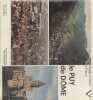
Livre en français . Editions S.A.E.P, 1975.
Baracoa bakermat van Cubaanse cacao
, Stockmans Kalenders 2011, 2011 Hardcover, 247 pagina's/pages, Nederlands/ Francais, 240 x 205 mm, met illustraties en foto's, nieuwstaat, . ISBN 9789077207239.
Baracoa, bakermat van de Cubaanse cacao, is een noodzakelijk boek. Cacao is immers een autochtoon product waarvan het belang nog niet voldoende wordt benadrukt. Het boek exploreert de kenmerken die Baracoa onderscheiden als de Cubaanse en misschien zelfs Latijns-Amerikaanse en Caraïbische stad waar cacao de sterkste sporen heeft achtergelaten en waar in vergelijking met andere producerende landen, reeds lang vervlogen tradities werden bewaard. Baracoa, hoofdstad van de Cubaanse cacao, is een complexe en rijke culturele ruimte waar een eeuwenoude landbouwactiviteit specifieke culturele kenmerken heeft, die bepalend zijn voor de identiteit van die plek.
El Quechua y el Aymara
1992, editorial Mapfre, in-8 broché de 285 pages, El Quechua y el Aymara, colección lenguas y literaturas indígenas, ouvrage en espagnol | Etat : bon état (Ref.: ref88929)
editorial Mapfre
What is Quality in Art? A Meditation Based on European Paintings from the 15th to the 18th Centuries"
, Hannibal Books, 2024 Hardcover, 127 pages, ENG. edition, 220 x 145 mm, NEW, illustr. in color / b/w, Quadrichromie. ISBN 9789464941197.
In-depth art-historical reflection on value judgments in art by one of Europe?s leading curators "This is a necessary book. The concept of quality is key in the history of art, and often little understood." ? Miguel Falomir, Director, Museo del Prado "That this is a legitimate question, even a necessary one, is argued by Vergara in a pleasurable manner, with the pace and attitude of a peripatetic thinker. There is something here that reminds one of Montaigne or Stendhal." ? Antonio Muñoz Molina, El País "This wonderful and wise book made me look at the artwork without intimidation or any confusion. It is a great pleasure to be guided by the experienced eye of Alejandro Vergara." ? Olga Tokarczuk, winner of the Nobel Prize in Literature Throughout history, human beings have excelled at creating art of the highest quality. Aristotle wrote that Homer ?surpassed all others? while Pliny the Elder referred to ?masterpieces that we never tire of admiring?. Velázquez distinguished between portraits ?made with art? and those that were not. What did they all mean exactly? And what do we mean when we say that a work of art is good, of high quality? This book is an attempt to explain this central question, which remains surprisingly unexplored. Alejandro Vergara-Sharp argues that ?a deep knowledge of the history of art provides us with the tools to approach this issue objectively?. He then invites the reader to share with him a Socratic voyage of discovery, gradually unveiling arguments that can assist us in understanding this elusive and crucial concept. Alejandro Vergara-Sharp (b. 1960, Washington DC) is Senior Curator of Flemish and Northern European Paintings at the Museo Nacional del Prado in Madrid.
Integrated Peasant Economy in Central and Eastern Europe. A Comparative Approach
, Brepols, 2024 Paperback, 264 pages, Size:156 x 234 mm, Illustrations:30 tables b/w., 5 maps b/w, Language: English. ISBN 9782503590042.
Summary Income integration based on the peasants' engagement in non-agrarian sectors is a prominent and widespread feature in the history of the European countryside. While listing a multitude of activities outside the narrow scope of farm management aimed at self-consumption, prevailing interpretations emphasize how survival was the goal of peasant economies and societies. The "integrated peasant economy" is a new concept that considers the peasant economy as a comprehensive system of agrarian and non-agrarian activities, disclosing how peasants demonstrate agency, aspirations and the ability to proactively change and improve their economic and social condition. After having been successfully applied to the Alpine and Scandinavian areas, the book tests this innovative concept through a range of case studies on central and eastern European regions comprising Poland, the Czech Republic, Slovenia, Serbia, Bosnia and Herzegovina and Ukraine. By enhancing our knowledge on central and eastern Europe and questioning the assumption that these regions were "different", it helps overcome interpretive simplifications and common places, as well as the underrepresentation of the "eastern half" of Europe in scholarly literature on rural history. That's why the book represents a refreshing methodological contribution and a new insight into European rural history. TABLE OF CONTENTS Results of a comparative approach Aleksander Panjek Concepts of Income Integration and the Integrated Peasant Economy: Western and Eastern Europe Reconsidered Aleksander Panjek Nonagricultural Sources of Polish Peasants' Income from the Perspective of Sixteenth-Century Nobility Piotr Guzowski and Rados?aw Poniat Rural Non-Agricultural Activities in South Bohemia During the Second Half of the Seventeenth and in the Eighteenth Century Josef Grulich At the Roots of the Integrated Peasant Economy Concept: Early Modern Western and Central Slovenia Ines Begu? and Aleksander Panjek Diversity of the Peasant Economy in Medieval Serbia (Thirteenth to Fifteenth Century) Milo? Ivanovi? The Autarky of Peasantry in Ottoman Bosnia (1463-1878), Between Myth and Reality Philippe Gelez Peasant Agency in Off-Farm Incomes: A Case Study on the Ukrainian Provinces of the Late Russian Empire Volodymyr Kulikov 'Those who had paid jobs and worked on farms were living the best lives': Integrated peasant economy in socialist Slovenia Lev Centrih and Polona Sitar
Moving Sculptures Southern Netherlandish alabasters from the 16th to 17th centuries in Central and Northern Europe
, Brill, 2016 Hardcover, xxii, 385 pp., 205 color & b/w illus. Illustrated. Fine. ISBN 9789004270930.
The Low Countries are generally considered to be the land of painting. Consequently, sculpture, especially that of the 16th century, has been insufficiently explored. In Moving Sculptures Aleksandra Lipi?ska presents a little-known chapter of the history of Netherlandish sculpture: the serial production of small-scale alabaster reliefs, altarpieces and statuettes in the workshops of Mechelen and Antwerp between c. 1525 and 1650. She gives the reader an insight into the rules of this craft, the specificity of the material, and the marketing methods employed. But the innovative element of this study lies in the fact that Lipi?ska analyses the phenomenon from the perspective of its distant recipients in Central and Northern Europe on the basis of works largely unknown to the broader public.At the Source: Production of the Alabaster Sculpture in the Southern Netherlands 1 Alabaster as a Sculpture Material 17 2 Alabaster in Netherlandish Sculpture from the Late Gothic to the Early Baroque 44 3 Serial Production of Alabaster Sculpture in Mechelen 96 4 The Spread of Alabaster Sculpture from the Low Countries 124 Part 2 At the Destination: Southern Netherlandish Alabaster Sculpture in Central and Northern Europe 5 Altarpieces 143 6 Tombs and Epitaphs 205 7 Exhibits of Real and ?Imagined? Collections 254 8 Alabaster Chambers 271

