 Write to the booksellers
-
Type
Autograph (15)
Book (50972)
Magazine (288)
Manuscript (2)
Maps (1)
New book (1)
Old papers (1)
Photographs (1)
-
Latest
Last 24h (24)
Last 3 days (18)
Last month (707)
Last week (496)
-
Language
Dutch (6)
English (43)
Finnish (1)
French (51152)
German (19)
Greek (5)
Italian (20)
Japanese (2)
Latin (20)
Polish (1)
Portuguese (3)
Spanish (7)
Swedish (2)
-
Century
16th (60)
17th (192)
18th (1266)
19th (3614)
20th (22039)
21st (3744)
-
Countries
Belgium (6718)
Brazil (24)
Canada (6)
China (2)
Côte d'Ivoire (69)
Denmark (1046)
France (38744)
Germany (3)
Greece (3)
Netherlands (269)
Switzerland (4397)
-
Syndicate
ALAC (6)
CLAM (37)
CNE (6)
ILAB (20064)
NVVA (998)
SLACES (907)
SLAM (17733)
SNCAO (41)
KREBS Engelbert & MEISTER DIETRICH (THEODORICUS TEUTONICUS DE VRIBERG)
Reference : F116559
(1906)
Meister Dietrich (Theodoricus Teutonicus de Vriberg) : Sein Leben, seine Werke, seine Wissenschaft
Münster i.W., Aschendorff 1906 xii + 155 + 230pp., 25cm., in the series "Beiträge zur Geschichte der Philosophie des Mittelalters" Band V Heft 5-6, original softcover (bit stained and with a stamp), pages still uncut, text is clean and bright, good condition, [contains 215pp. Latin text edition], F116559
"Etudes sur l'origine et le développement de la vie religieuse; tome 1 : Les primitifs, l'Egypte, l'Inde, la Perse."
Bruxelles, Maurice Lamertin, 1919. 13 x 19, 370 pp., broché, bon état (couverture légèrement défraîchie).
"Etudes sur l'origine et le développement de la vie religieuse; tome 2 : La religion chez les Grecs et les Romains."
Bruxelles, Maurice Lamertin, 1920. 13 x 19, 268 pp., broché, bon état (dos défraîchi).
tome 2 seul.
Farben des Lebens - Sieger Köder
Schwabenverlag 2006 176 pages 19x1 8x28 4cm. 2006. Relié. 176 pages.
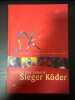
Très bon état
Pour Descartes. Le processus logique de la pensée confuse.
P., Albin Michel (Collection "Meta"),1982, in 8° broché, 145 pages ; rares annotations au crayon.
PHOTOS sur DEMANDE. ...................... Photos sur demande ...................


Phone number : 04 77 32 63 69
Pour Descartes.Le processus logique de la pensée confuse.
1982 1 Paris, Albin Michel, 1982, in-8 broché.
"L'homme et ses labyrinthes; essais sur Friedrich Nietzsche. Collection : 10-18, N° 729."
Paris, Union Générale d'Editions, 10/18, 1972. 11 x 18, 314 pp., broché, très bon état.
Die neuplatonische Seinsphilosophie und ihre Wirkung auf Thomas von Aquin
Leiden, Brill 1971 xxx + 541pp., "Photomechanischer Nachrdruck" (of the 1966-edition), 25cm., publisher's hardcvoer in orange cloth with gilt lettering, in the series "Studien zur Problemgeschichte der antiken und mittelalterlichen Philosophie" volume 1, text in German, good condition, weight: 1.2kg., F116974
"Nietzsche et la rhétorique (Collection ""L'interrogation philosophique"")"
Presses Universitaires de France. 1992. In-8. Broché. Etat d'usage, Couv. légèrement passée, Dos plié, Intérieur frais. 269 pages.. . . . Classification Dewey : 190-Philosophie occidentale moderne
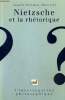
"Collection ""L'interrogation philosophique"". Classification Dewey : 190-Philosophie occidentale moderne"
L'anthropologie positiviste d'Auguste Comte (avec un envoi de l’auteur)
Diffusion H. Champion 1980 In-4 broché 24 cm sur 15,7. 576 pages. Bon état d’occasion.
Exemplaire enrichi d’un envoi autographe Bon état d’occasion
Jaspers et la scission de l'être. Présentation, choix de texte, bibliographie par Angèle Kremer-Marietti
,Paris, Seghers Coll. 'Philosophie' 1974, 197 pp., 1 vol. in 8 br.

La symbolicité ou le problème de la symbolisation. Avec la traduction de l'article de Freud La (dé)négation.
Paris PUF, coll. "Croisées" 1977 1 vol. broché in-8, broché, 232 pp. Edition originale avec un envoi autographe signé de l'auteur à Maurice Nadeau "L'ami des poètes". Bon état.
Les apories de l’action. Essai d’une épistémologie de l’action morale et politique.
Paris, Kimé 1993, 240x140mm, 247pages, broché. Bel exemplaire.
Pour un paiement via PayPal, veuillez nous en faire la demande et nous vous enverrons une facture PayPal
Les racines philosophiques de la science moderne.
Paris Mardaga, coll. "Philosophie et langage" 1995 1 vol. broché in-8, broché, 239 pp., index, bibliographie. Cachet du service de presse. Très bon état.
Philosophie des sciences de la nature
Presses Universitaires de France Broché 1999 In-8 (15 x 21,7 cm), broché, 279 pages ; pliure au dos et dans le coin inférieur du premier plat, assez bon état. Livraison a domicile (La Poste) ou en Mondial Relay sur simple demande.
LA THEORIE DE LA CONNAISSANCE CHEZ LES NEO-REALISTES ANGLAIS
Maurice Lamertin, Bruxelles. 1928. In-8. Broché. Etat d'usage, Plats abîmés, Dos abîmé, Intérieur acceptable. 204 pages. Etiquette de code sur la couverture. Quelques tampons et annotations de bibliothèque. 1er plat taché.. . . . Classification Dewey : 100-PHILOSOPHIE ET DISCIPLINES CONNEXES
Académie Royale de Belgique, Mémoires, Collection in-8°, T. XXIV, Fasc. 1. Mémoire couronné le 7 mars 1927. Classification Dewey : 100-PHILOSOPHIE ET DISCIPLINES CONNEXES
La théorie de la connaissance chez les Néo-réalistes anglais
, Louvain/ Paris, Institut Supérieur de Philosophie/ Vrin, 1928, 204pp., dans la série "Classe des lettres et des sciences morales et politiques, Mémoires" Tome XXIV fasc.1, brochure originale, non coupé, bon état, F14097
La théorie de la connaissance chez les Néo-réalistes anglais
Louvain/ Paris, Institut Supérieur de Philosophie/ Vrin 1928 204pp., signé avec dédicace par l'auteur à M. De Wulf, dans la série "Classe des lettres et des sciences morales et politiques, Mémoires" Tome XXIV fasc.1, br.orig. (dos restauré), bon état, F53459
Le Néo-réalisme Américain
, Louvain/ Paris, Institut de Philosophie / Libr.Félix Alcan, 1920, x + 310pp., bon état, F14098
Le problème spirituel de la beauté
Presses Universitaires de France, 1948. In-8 broché de VIII + 204 pages. Papier légèrement jauni, bords de couverture insolées sinon bon exemplaire
Toutes les expéditions sont faites en suivi au-dessus de 25 euros. Expédition quotidienne pour les envois simples, suivis, recommandés ou Colissimo.
Über den physikalischen Sinn der Relativitätspostulate. A. Einsteins neue und seine ursprüngliche Relativitätstheorie. - [CLAIMING THE GENERAL RELATIVITY IS VACUOUS]
Leipzig, Barth, 1917. 8vo. In full black cloth with gilt lettering to spine. In ""Annalen der Physik"", Vol. 53, 1917. Entire volume offered. Library labels pasted on to front free end papers, stamp to title page. Otherwise fine and clean. Pp. 575-614. [Entire volume: VIII, 650 pp. + 4 plates.].
First printing of Kretschmann famous paper in which he claimed that Einstein's use of the principle of covariance in General Relativity is vacuous. Kretschmann claimed that the demand that a theory be put in generally covariant form does not limit or restrict the range of acceptable theories, but is simply a challenge to the mathematician's ingenuity. According to Kretschmann, any theory can be put in generally covariant form. Einstein responded that even if general covariance is not a purely formal limitation on acceptable theories, it plays ""an important heuristic role"" in the formulation of General Relativity.""Erich Justus Kretschmann (born in Berlin in 1887) had just gotten his doctorate under the guidance of Max Planck by attempting to provide a Lorentzcovariant theory of gravitation. In December 1915 he published a two-part paper with a certain epistemological flavor (Kretschmann, 1915), in which, by relying on the work of Henri Poincaré and Ernst Mach, he argued that only ""topological"" relations encoded in pointcoincidences are directly accessible to experience (Sect. 3). It was only shortly after the paper was distributed that Einstein started to use the expression ""point-coincidences"" in private correspondence with Paul Ehrenfest, MicheleBesso and Hendrik Lorentz, in order to convince them that solutions of the field-equations that differ only by a coordinate transformation are physically equivalent (Sect. 2). Einstein then abruptly inserted the argument into thequite different mathematical tradition that had culminated in Ricci and Levi-Civita’s absolute differential calculus (Sect. 4). Kretschmann himself swiftly realized this, and in August 1917 he turned the public version of the pointcoincidence argument against Einstein in a paper that would make him famous [The present]. The paper rediscovered by James L. Anderson in the mid-1960s was destined to become a classic and has therefore been widely discussed in the historical and philosophical literature.""
The metaphysics of creation - Aquinas's natural theology in 'Summa contra Gentiles' II
Oxford, Clarendon Press 1999 xiii + 483pp., hardback, dustwrapper, 22cm., VG
The metaphysics of theism - Aquinas's natural theology in Summa contra Gentiles' I
Oxford, Clarendon Press 1997 xii + 302pp., hardback, dustwrapper, 23cm., VG

