 Write to the booksellers
-
Type
Autograph (15)
Book (50881)
Magazine (288)
Manuscript (2)
Maps (1)
New book (1)
Old papers (1)
Photographs (1)
-
Latest
Last 24h (1)
Last 3 days (472)
Last month (238)
Last week (522)
-
Language
Dutch (6)
English (43)
Finnish (1)
French (51061)
German (19)
Greek (5)
Italian (20)
Japanese (2)
Latin (20)
Polish (1)
Portuguese (3)
Spanish (7)
Swedish (2)
-
Century
16th (61)
17th (195)
18th (1293)
19th (3620)
20th (22050)
21st (3745)
-
Countries
Belgium (6717)
Brazil (24)
Canada (6)
China (2)
Côte d'Ivoire (69)
Denmark (1046)
France (38654)
Germany (3)
Greece (3)
Netherlands (269)
Switzerland (4397)
-
Syndicate
ALAC (6)
CLAM (37)
CNE (6)
ILAB (20060)
NVVA (998)
SLACES (907)
SLAM (17729)
SNCAO (41)
Über den physikalischen Sinn der Relativitätspostulate. A. Einsteins neue und seine ursprüngliche Relativitätstheorie. - [CLAIMING THE GENERAL RELATIVITY IS VACUOUS]
Leipzig, Barth, 1917. 8vo. In full black cloth with gilt lettering to spine. In ""Annalen der Physik"", Vol. 53, 1917. Entire volume offered. Library labels pasted on to front free end papers, stamp to title page. Otherwise fine and clean. Pp. 575-614. [Entire volume: VIII, 650 pp. + 4 plates.].
First printing of Kretschmann famous paper in which he claimed that Einstein's use of the principle of covariance in General Relativity is vacuous. Kretschmann claimed that the demand that a theory be put in generally covariant form does not limit or restrict the range of acceptable theories, but is simply a challenge to the mathematician's ingenuity. According to Kretschmann, any theory can be put in generally covariant form. Einstein responded that even if general covariance is not a purely formal limitation on acceptable theories, it plays ""an important heuristic role"" in the formulation of General Relativity.""Erich Justus Kretschmann (born in Berlin in 1887) had just gotten his doctorate under the guidance of Max Planck by attempting to provide a Lorentzcovariant theory of gravitation. In December 1915 he published a two-part paper with a certain epistemological flavor (Kretschmann, 1915), in which, by relying on the work of Henri Poincaré and Ernst Mach, he argued that only ""topological"" relations encoded in pointcoincidences are directly accessible to experience (Sect. 3). It was only shortly after the paper was distributed that Einstein started to use the expression ""point-coincidences"" in private correspondence with Paul Ehrenfest, MicheleBesso and Hendrik Lorentz, in order to convince them that solutions of the field-equations that differ only by a coordinate transformation are physically equivalent (Sect. 2). Einstein then abruptly inserted the argument into thequite different mathematical tradition that had culminated in Ricci and Levi-Civita’s absolute differential calculus (Sect. 4). Kretschmann himself swiftly realized this, and in August 1917 he turned the public version of the pointcoincidence argument against Einstein in a paper that would make him famous [The present]. The paper rediscovered by James L. Anderson in the mid-1960s was destined to become a classic and has therefore been widely discussed in the historical and philosophical literature.""

The metaphysics of creation - Aquinas's natural theology in 'Summa contra Gentiles' II
Oxford, Clarendon Press 1999 xiii + 483pp., hardback, dustwrapper, 22cm., VG
The metaphysics of theism - Aquinas's natural theology in Summa contra Gentiles' I
Oxford, Clarendon Press 1997 xii + 302pp., hardback, dustwrapper, 23cm., VG
Logic and the philosophy of language
Cambridge, Cambridge University Press 1993 viii + 531pp., 23cm., in the series "The Cambridge translations of medieval philosophical texts" vol.1, previous owner's name on first page, softcover, VG, ISBN 0-521-28063-X, [English translation]
Gestalten mittelalterlicher Philosophie. Augustinus, Eriugena, Eckhart, Tauler, Nikolaus von Kues.
München, Wilhelm Fink Verlag 2000, 215x155mm, 231Seiten, broschiert. Sehr schönes Exemplar.
Pour un paiement via PayPal, veuillez nous en faire la demande et nous vous enverrons une facture PayPal
Der unbeteiligte Zuschauer. Über die Begründung der theoretischen Einstellung in Husserls Spätphilosophie
Köln, 1969 125pp., 21cm., Academic dissertation (Inaugural-Dissertation zur Erlangung des Doktorgrades der philosophischen Fakultät der Universität zu Köln)
COURS DE PHILOSOPHIE POLITIQUE
Paris, LE LIVRE DE POCHE, Références, Philosophie, 1997, in-12 broché, 153 pp. TRES BON ETAT
Nombreux titres disponibles en Philosophie.
Cours de philosophie politique - Etat de droit, droits de l'homme, république et démocratie, libertés publiques, nations et nationalismes, la liberté moderne - Collection le livre de poche références philosophie n°535.
Le livre de poche. 1996. In-12. Broché. Bon état, Couv. convenable, Dos satisfaisant, Intérieur frais. 153 pages.. . . . Classification Dewey : 100-PHILOSOPHIE ET DISCIPLINES CONNEXES
Collection le livre de poche références philosophie n°535. Classification Dewey : 100-PHILOSOPHIE ET DISCIPLINES CONNEXES

Michel Foucault aujourd'hui.
Plon. 2004. In-8. Broché. Bon état, Couv. convenable, Dos satisfaisant, Intérieur frais. 116 pages.. . . . Classification Dewey : 100-PHILOSOPHIE ET DISCIPLINES CONNEXES
Classification Dewey : 100-PHILOSOPHIE ET DISCIPLINES CONNEXES
Michel Foucault aujourd'hui
Paris, Plon 2004 1 in 12 Broché couverture Illustrée 117[p.p]
Comme Neuf Disponibilité sous réserve de vente en boutique, prix valable, frais de port en plus, La Poste ou Mondial Relay
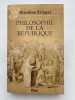
Philosophie de la République
Paris, Plon, 1998, 15,5 x 24, 400 pages sous couverture illustrée.
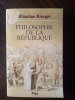
Très bon état.
Philosophie de la République.
Plon. 1998. In-8. Broché. Bon état, Couv. convenable, Dos satisfaisant, Papier jauni. 401 pages.. . . . Classification Dewey : 100-PHILOSOPHIE ET DISCIPLINES CONNEXES
Classification Dewey : 100-PHILOSOPHIE ET DISCIPLINES CONNEXES
Philosophie de la République
Plon Plon, 1998. Grand In-8 broché, 401 pages, avec un index. Très bon état.
Toutes les expéditions sont faites en suivi au-dessus de 25 euros. Expédition quotidienne pour les envois simples, suivis, recommandés ou Colissimo.
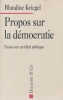
Propos sur la démocratie. Essais sur un idéal politique
Descartes, 1994. In-8 Descartes, 1994. In-8 broché, couverture à rabats de 131 pages. Des passages soulignés sinon Bon état
Toutes les expéditions sont faites en suivi au-dessus de 25 euros. Expédition quotidienne pour les envois simples, suivis, recommandés ou Colissimo.
The Politics of Discretion. Pufendorf and the Acceptance of Natural Law.
Chicago & London, 1965. 8vo. In the original full cloth binding. Ex-libris to verso of front board, otherwise fine and clean. 311 pp.

GESCHIEDENIS VAN DE JEUGDPSYCHOLOGIE.
, Tielt / Den Haag, Lannoo, 1967,, Gebonden, uitgeverslinnen, met omslagwikkel, 22,5x13,5cm, 439pp.
Genetische Psychologie - systematisch en historisch, vol. 12.
Zur Genealogie von Episteme und Techne sowie ihr Verhältnis zur Gesellschaftlichen Synthesis
Kassel, 1990 iv + 309pp., 21cm., softcover, text in German, Doctoral dissertation (Dissertation zur Erlangung des akademischen Grades eines Doktors der Wirtschafts- und Sozialwissenschaften im Fachbereich Gesellschaftswissenschaften der Gesamthochschule Kassel-Universität), stamp at verso of title page, text is clean and bright, good condition, F108805
Die drei Leben der Hannah Arendt. Graphic novel.
Couverture souple. Broché. 243 pages.
Livre en allemand. En allemand. Editions dtv, 2019.
Esistenza e necessità. Saggi scelti
Ponte alle Grazie 1993 43x610x406cm. 1993. Broché.
Bon état
A Completeness Theorem in Modal Logic. [In: The Journal of Symbolic Logic. Edited by Alonza Church, Leon Henkin, S.C. Kleene, Alice A. Lezerowitz & Alfons Borgers. Volume 24, Number 1, March 1959]. - [KRIPKE MODELS FOR MODAL LOGIC]
(No place), The Association for Symbolic Logic, 1959. 8vo. Orig. printed wrappers. An excellent copy in near mint condition, in- as well as externally. Pp. (1) - 14. (The entire volume: 96 pp.).
The seminal first printing of Kripke's debut article, which provided the basis for his logic and for the model theory for modal logic in general. The work constitutes the very beginning of Kripke Semantics (often called possible world semantics). Kripke's works in general are rare in fist editions. Many of them remain unpublished and are only known in privately circulated manuscripts.The American philosopher Saul A. Kripke (born 1940) is an exceedingly important logician and philosopher of language and one of the most powerful and influential thinkers of analytic and Anglo-American philosophy. He is considered the greatest living philosopher and perhaps the greatest since Wittgenstein. In 2001 he was awarded the Schock Prize in Logic and Philosophy, which is considered the philosopical equivalent of the Nobel Prize.Kripke, who grew up in Omaha in a religious Jewish family, was somewhat of a prodigy child. During grammar school he got intimately acquainted with and mastered to perfection algebra, geometry and calculus, and very early on he took up philosophy, which later became his career. Still a teenager, in high school, he wrote a work that was to change the face of philosophical logic forever, namely the groundbreaking paper ""A Completeness Theorem for Modal Logic"", which was printed a few years later, in 1959, in the Journal of Symbolic Logic, while he was in his first year at Harvard University. This seminal debut work proposed what later came to be known as Kripke models for modal logic. The story goes that the paper earned a letter from the department of mathematics urging Kripke to apply for a job there, to which he is said to have written an answer explaining ""My mother said that I should finish high school and go to college first.""In 1962 he graduated from Harvard University, where he remained until 1968, first as a member of the Harvard Society of Fellows and then as a lecturer. During these years he developed the logical theories founded in the ""Completeness Theorem"" further and made seminal contributions to the field of logic and semantics. Kripke Semantics is a formal semantics for non-classical logic systems that Kripke began developing in his teenage years, first published something on in 1959 (the present work) and further developed in the 60'ies and. The development of Kripke Semantics was no less than a breakthrough in the making of non-classical logics, of which no model theory existed before Kripke's. With this work, Kripke laid the foundation for proving completeness theorems for modal logic, and for identifying the weakest normal modal logic, which is now named K after him.
Naming and Necessity (Library of Philosophy & Logic)
Blackwell Publishers 1980 180 pages 14 6x2 6x21 4cm. 1980. Cartonné jaquette. 180 pages.
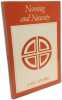
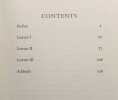
Très bon état ex-libris dos de la jaquette insolé très bonne tenue intérieur propre
Wittgenstein on Rules and Private Language. An Elementary Exposition. - [THE FIRST WRITTEN PRESENTATION OF KRIPKENSTEIN]
Oxford, Blackwell, (1982). 8vo. Orig. full cloth w. gilt lettering to spine, minor bumping to capitals, otherwise a near mint copy in the orig. d-j., which is also near mint. X, 150 pp.
First edition of the immensely influential work on Wittgenstein by the exceedingly influential and important logician and philosopher of language, Saul Aaron Kripke. Kripke was professor of philosophy in America, and his works are quite rare, since many of them remain unpublished and are only known in privately circulated manuscripts. In 2001 he received the Schock Prize in Logic and Philosophy. Kripke is renowned for his studies of Wittgenstein, which are printed in this work for the first time. The subject of Kripke's book is usually referred to as ""Kripkenstein"", since the results (as well as the method) have very little to do with what is commonly accepted as the philosophy of Wittgenstein. Kripke's main claim in this (in)famous book is that all previous commentaries on Wittgenstein's Philosophische Untersuchungen (Philosophical Investigations) have failed to understand W.'s argument against ""private language"". According to Kripke Wittgenstein's ""private language argument"" is principally to be explicated in terms of the problem of ""following a rule"". The ""meaning scepticism"" presented in this work has caused a wide range of secondary litterature and very harsh critique. The book has been called a scandal of philosophy, and the number of well-esteemed philosophers who have lined up to criticise the book is very large indeed. Among these can be found Noam Chomsky, John Searle, Peter Winch, Gordon Baker etc etc. However flawed the reading of Wittgenstein is considered to be, though, the work has received overwhealming attention, and is considered highly important and interesting.
"KRIPKE, SAUL A. - KRIPKE MODELS FOR MODAL LOGIC ""POSSIBLE WORLD SEMANTICS""
Reference : 46888
(1959)
A Completeness Theorem in Modal Logic. [In: The Journal of Symbolic Logic. Edited by Alonza Church, Leon Henkin, S.C. Kleene, Alice A. Lezerowitz & Alfons Borgers. Volume 24, Number 1, March 1959].
(No place), The Association for Symbolic Logic, 1959. 8vo. Wrappers blank with printed title on spine. Entire issue No. 1 of vol. 24, offered. Fine and clean.
The seminal first printing of Kripke's debut article, which provided the basis for his logic and for the model theory for modal logic in general. The work constitutes the very beginning of Kripke Semantics (often called possible world semantics). Kripke's works in general are rare in fist editions. Many of them remain unpublished and are only known in privately circulated manuscripts.The American philosopher Saul A. Kripke (born 1940) is an exceedingly important logician and philosopher of language and one of the most powerful and influential thinkers of analytic and Anglo-American philosophy. He is considered the greatest living philosopher and perhaps the greatest since Wittgenstein. In 2001 he was awarded the Schock Prize in Logic and Philosophy, which is considered the philosopical equivalent of the Nobel Prize.Kripke, who grew up in Omaha in a religious Jewish family, was somewhat of a prodigy child. During grammar school he got intimately acquainted with and mastered to perfection algebra, geometry and calculus, and very early on he took up philosophy, which later became his career. Still a teenager, in high school, he wrote a work that was to change the face of philosophical logic forever, namely the groundbreaking paper ""A Completeness Theorem for Modal Logic"", which was printed a few years later, in 1959, in the Journal of Symbolic Logic, while he was in his first year at Harvard University. This seminal debut work proposed what later came to be known as Kripke models for modal logic. The story goes that the paper earned a letter from the department of mathematics urging Kripke to apply for a job there, to which he is said to have written an answer explaining ""My mother said that I should finish high school and go to college first.""In 1962 he graduated from Harvard University, where he remained until 1968, first as a member of the Harvard Society of Fellows and then as a lecturer. During these years he developed the logical theories founded in the ""Completeness Theorem"" further and made seminal contributions to the field of logic and semantics. Kripke Semantics is a formal semantics for non-classical logic systems that Kripke began developing in his teenage years, first published something on in 1959 (the present work) and further developed in the 60'ies and. The development of Kripke Semantics was no less than a breakthrough in the making of non-classical logics, of which no model theory existed before Kripke's. With this work, Kripke laid the foundation for proving completeness theorems for modal logic, and for identifying the weakest normal modal logic, which is now named K after him.

