 Write to the booksellers
-
Type
Autograph (15)
Book (51423)
Magazine (288)
Manuscript (2)
Maps (1)
New book (1)
Old papers (1)
Photographs (1)
-
Latest
Last 24h (9)
Last 3 days (11)
Last month (230)
Last week (1418)
-
Language
Dutch (6)
English (43)
Finnish (1)
French (51603)
German (19)
Greek (5)
Italian (20)
Japanese (2)
Latin (20)
Polish (1)
Portuguese (3)
Spanish (7)
Swedish (2)
-
Century
16th (61)
17th (196)
18th (1303)
19th (3635)
20th (22400)
21st (3804)
-
Countries
Belgium (6714)
Brazil (24)
Canada (6)
China (2)
Côte d'Ivoire (69)
Denmark (1046)
France (39199)
Germany (3)
Greece (3)
Netherlands (269)
Switzerland (4397)
-
Syndicate
ALAC (6)
CLAM (37)
CNE (6)
ILAB (20057)
NVVA (998)
SLACES (907)
SLAM (17726)
SNCAO (41)
L'HERNE : Martin Heidegger.
CAHIER DE L'HERNE, n° 45, 1983. Fort volume in-4 br. de 520 p. Numéro dirigé par Michel Haar. Nombreux textes d'Heidegger et contributions de H. Marcus, R. Munier, E. Jünger, J.-M. Palmier, J. Derrida, J. Beaufret, D. Janicaud, W. Biemel, etc. Illustrations, chronologie, bibliographie par R. Gonner. E.O.
L'histoire de l'estre
Paris, NRF Gallimard 2022 1 in -8 Broché 243[p.p]
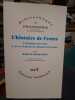
Comme Neuf Disponibilité sous réserve de vente en boutique, prix valable, frais de port en plus, La Poste ou Mondial Relay
Nietzsche
2 tomes EXEMPLAIRES DE TRAVAIL ENTIÈREMENT SOULIGNÉS AU CRAYON À PAPIER Jaunis par endroits sinon bon état 512 et402 pages Traduit de l'allemand par Pierre Klossowski
Nietzsche. 2 Bde. - [NIETZSCHE'S PHILOSOPHY AS THE METAPHYSICS OF OUR TIMES]
Stuttgart, Neske, 1961. 8vo. 2 orig. black full cloth w. orig. orange dust-jackets, white and black lettering to spines and front. A very good set w. only minor bumping to upper capital of vol. 1, otherwise near min, in- as well as externally. 661, (3)" 492, (2) pp.
The first edition of Heidegger's famous Nietzsche-book, in which he equals Nietzsche's notion of the super-human with the realization of modern technical humanity.Like his lectures on Nietzsche in the 1930'ies and '40'ies, the work also focuses on Nietzsche's posthumously published fragments ""Die Wille zur Macht"" (""The Will to Power""). According to Heidegger, these fragments form the culmination of Western Metaphysics, -though Metaphysics when turned upside-down, but far from abolished.""Nietzsche denkt das, was die metaphysische Tradition das Sein des Seienden nennt, als den ewig wiederkehrenden Willen zur Macht. Durch den Gedanken-Gang zum Willen zur macht zieht Nietzshe eine ""Spur"" in die ""Geschichte des Seins"" und d.h. ""in die noch unbegangenen Bezirke künftiger Entscheidungen"" (I, 475)."" (Pöggeler, Der Denkweg Martin Heideggers).With the word ""Sein"" (""Being""), Heidegger seems to have coined the ""essence"" of European thought. Metaphysically ""Sein"" is put into words as the ""Wahrheit des Seienden"" (""The Truth of Being"") in European thought. According to Heidegger, also Nietzsche's philosophy of thought is Metaphysics, but not Metaphysics as a particular philosophical discipline, rather Metaphysics as the ""Wahrheit über das Seiende"" (the truth about that, which is). Thus viewed, Nietzsche's philosophy becomes the Metaphysics of our times.
Original machine-written letter with original hand-written signature (in full) for ""Lieber Herr Giustiniani!"". - [SIGNED LETTER FROM HEIDEGGER]
Dated ""Freiburg i Brsg. 6. März 1958"". 1/2 page 4to. Heidegger thanks Giustiniani for a very nice evening in his house together with his Italian students. He furthermore thanks him for an admittance card to the Italian national museaum and asks G. to thank the Government Department for it as well. Heidegger, who was not fond of travelling, hopes to be able to visit soon, since he has long wished to visit Italy.
The letter is for the Italian Freiburger colleague, Vito R. Giustiniani (1916 - 1998). Enclosed it the carbon copy of the letter written by Giustiniani to Heidegger on ""5.3.1958"", in which he thanks him in very warm tones for having visited him and spent time with his students, and in which he tells him about the entrance card for the national Italian museum and the excavations, which the Italian Ministery of Teching has made for Heidegger and his wife.
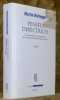
Pensées directrices. Sur la genèse de la métaphysique, de la science et de la technique modernes. Inédit. Traduit de l’allemand par Jean-François Courtine, Françoise Dastur, Mard de Launay et Dominique Pradelle. Collection L’ordre philosophique.
Paris, Editions du Seuil 2019, 205x135mm, 453pages, broché. Exemplaire à l'état de neuf.
Pour un paiement via PayPal, veuillez nous en faire la demande et nous vous enverrons une facture PayPal
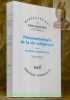
Phénoménologie de la vie religieuse. Texte établi par Matthias Jung, Thomas Regehly et Claudius Strube. Traduit de l’allemand par Jean Greisch. Collection Bibliothèque de Philosophie.
Paris, Editions Gallimard 2011, 225x140mm, 415pages, broché. Exemplaire à l'état de neuf.
Pour un paiement via PayPal, veuillez nous en faire la demande et nous vous enverrons une facture PayPal
Platon: Le Sophiste. Traduit de l’allemand par Jean-François Courtine, Pascal David, Dominique Pradelle, Philippe Quesne, sous la direction de Jean-François Courtine et Pascal David. Collection Bibliothèque de Philosophie, Série: Oeuvres de Martin Heidegger.
Paris, Editions Gallimard 2001, 225x140mm, 661pages, broché. Etiquette de cotation sur le revers de la couverture supérieure, autrement très bel exemplaire.

Pour un paiement via PayPal, veuillez nous en faire la demande et nous vous enverrons une facture PayPal
Qu'appelle t-on penser ?
Paris, PUF, "Epiméthée - Essais philosophiques", 1959, 14,5 x 19, 264 pages cousues sous couverture souple illustrée. Traduit de l'allemand par Aloys Becker et Gérard Granel. Première édition de la traduction française sur papier ordinaire - nulle mention d'autre tirage.
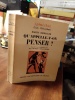
Couverture insolée ; dos plissé.
Qu'appelle-t-on penser ?
PUF, 1973, pt in-8°, 262 pp, (Coll. Epiméthée)
Désormais les frais d'envoi sont de 6 € seulement pour les livres jusqu'à 1 kg (colissimo suivi), pour la France métropolitaine.
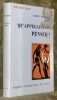
Qu'appelle-t-on penser ? Traduit de l’allemand par Aloys Becker et Gérard Granel. Collection Epiméthée, Essais philosophiques, fondée par Jean Hyppolite.
Paris, PUF, Presses Universitaires de France 1973, 180x135mm, 262pages, broché. Couverture à rabats. Bel exemplaire.
Pour un paiement via PayPal, veuillez nous en faire la demande et nous vous enverrons une facture PayPal
Qu'appelle-t-on penser ? Traduit de l'allemand par Aloys Becker et Gérard Granel. Deuxième édition.
P., PUF (Collection "Epiméthée"), 1967, petit in 8° broché, 263 pages ; couverture fanée.
...................... Photos sur demande ...................


Phone number : 04 77 32 63 69
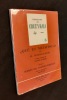
Que es Matafisica ? Version espanola de Xavier Zubiri, seguido de Sermon del Maestro Eckehart, version esapnola de Eugenio Imaz -
1958 Santiago de Chile / Madrid : Cruz del Sur (Col. "Cruz y Raya"), 1963 - In-12 broché sous couverture à rabats, 76 pages - texte en espagnol - bon état -
Tous nos livres sont visibles sur notre site : https://www.livrepoesie.com/
Qu'est- ce que la philosophie? Traduit de l'allemand par Kostas Axelos et Jean Beaufret.
P., NRF (Collection "Classiques de la philosophie"), 1963, in 8° broché, 54 pages ; quelques passages soulignés et annotations marginales au crayon ; piqûres à la couverture.
PHOTOS sur DEMANDE. ...................... Photos sur demande ...................
Phone number : 04 77 32 63 69
Questions II
Gallimard Classiques de la philosophie Broché 1983 In-12 (12x18,5cm), broché, 276 pages , contient : Qu'est-ce que la philosophie? / Hegel et les Grecs / La thèse de Kant sur l'être / La doctrine de Platon sur la vérité / Ce qu'est et comment se détermine la Physis ; pliures au dos, coiffes et bords frottés, taches d'usage aux plats défraîchis, par ailleurs bon état général. Livraison a domicile (La Poste) ou en Mondial Relay sur simple demande.
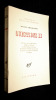
Questions IV (4): Temps et être. - La fin de la philosophie et le tournant. - Phénoménologie et pensée de l'être. - Le séminaire du Thor. - Le séminaire de Zähringen
Gallimard, Classiques de la philosophie, 1976, 339 pp., broché, quelques passages soulignés au crayon, plis de lecture sur le dos, état correct.
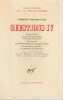
Schelling : le traité de 1809 sur l'essence de la liberté humaine.
Paris Gallimard, coll. "Classiques de la philosophie" 1977 1 vol. broché in-8, broché, 349 pp., index. Traduit de l'allemand par Jean-François Courtine. Premières et dernières pages légèrement brunies au coin inférieur. Sinon en bon état.
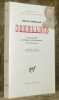
Schelling. Le traité de 1809 sur l’essence de la liberté humaine édité par Hildegard Feick. Traduit de l’allemand par Jean-François Courtine. Collection Classiques de la Philosophie.
Paris, Editions Gallimard 1977, 225x140mm, 349pages, broché. Etiquette de cotation sur le revers de la couverture supérieure, autrement très bel exemplaire.
Pour un paiement via PayPal, veuillez nous en faire la demande et nous vous enverrons une facture PayPal
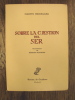
Sobre la cuestion del Ser -
1958 Traduccion de German Bleiberg - Madrid : Revista de Occidente, 1958 - un volume 13x18,4 cm broché sous couverture rempliée imprimée en deux tons, 76 pages non coupées - texte en espagnol - très bon état -
Tous nos livres sont visibles sur notre site : https://www.livrepoesie.com/
Séjours. Aufenthalte.
Editions du Rocher, Paris, 1992. Un volume in-8 couverture illustrée à rabats, 113 pages et 1 f. d'ill. couleurs. Bel état.
La librairie est ouverte du mardi au samedi de 9h30 à 12h30 et de 13h30 à 19h00. Commandes par courriel ou téléphone. Envoi rapide, emballage soigné. La librairie est ouverte du mardi au samedi de 9h30 à 12h30 et de 13h30 à 19h00. Commandes par courriel ou téléphone. Envoi rapide, emballage soigné.
Séjours. Aufenthalte. Edition bilingue. Traduction, postface et notes de François Vezin. Collection Alphée.
Monaco, Editions du Rocher Jean-Paul Bertrand 1992, 200x130mm, 112pages, broché. Couverture à rabats. Très bel exemplaire.
Pour un paiement via PayPal, veuillez nous en faire la demande et nous vous enverrons une facture PayPal
TRAITE DES CATEGORIES ET DE LA SIGNIFICATION CHEZ DUNS SCOT
Format moyen, couverture souple. 236 pages. Bon état. Une expédition par Mondial Relay vous sera proposée 1970 NRF Gallimard
Traité des catégories et de la signification chet Duns Scot. Traduit de l’allemand et présenté par Florent Gaboriau. Collection Classiques de la Philosophie.
Paris, Editions Gallimard 1970, 225x140mm, 236pages, broché. Couverture à rabats. Etiquette de cotation sur le revers de la couverture supérieure, autrement très bel exemplaire.
Pour un paiement via PayPal, veuillez nous en faire la demande et nous vous enverrons une facture PayPal
Vom Wesen des Grundes. Sonderdruck aus der Festschrift für Edmund Husserl. - [REINTERPRETING REASON]
Halle, Niemeyer, 1929. 4to. Uncut in original printed wrappers. Front wrapper loose, spine wit minor lacks. Otherwise nice and clean. (2) pp., pp. 72 [2] - 110 [40]. With card stating ""Überreicht vom Verfasser"" (presented by the author).
First edition, off-print, of Heidegger's influential work, in which he radically reinterpretates the fundamental philosophical significance of the Leibnitzian principle of reason, and the origin and essence of reason in general. In this early work, Heidegger sets out to derive the principle of reason from the transcendent and temporal structure of Dasein and thereby totally redefines and redetermines the notion.
Vorträge und Aufsätze. - [PRESENTATION-COPY OF ONE OF THE MOST IMPORTANT COLLECTIONS OF MODERN PHILOSOPHY]
Pfullingen, Günter Neske, (1954). 8vo. Original full black cloth with white lettering to spine. Very clean, bright, and fresh, also internally. Original orange dust-jacket with black lettering to spine and white lettering to front. Minimal edge wear. An excellent and clean dust-jacket with just minor signs of wear. Very slight soiling to title-page, otherwise no wear or markings to text. Letter from Heidegger inserted to inside of front board. Front free end-paper signed and dated by Heidegger and with an inserted note in ink from the person that Heidegger gave the book to stating that this highly personal memento from his student time in Freiburg and his memorable encounters with Heidegger was given to his son Matthias for his 40th birthday, in 1995. 283, (1) pp.
First edition, presentation-copy signed by Heidgger and with an inserted letter, also signed and dated by Heidegger, of this seminal collection of lectures and essays, which was of decisive importance to the immense influence of Heidegger’s thinking upon post World War Europe. This collection of Heidegger’s lectures and essays contains such groundbreaking works as “Die Frage nach der Technik” (The Question Concerning Technology) and “Wissenschaft und Besinnung” (Science and Reflection), “”Dichterisch Wohnet der Mensch…” “, along with other important works written between 1936 and 1953 collected here for the first time. This collection would later be reprinted and serve as volume 7 of Heidegger’s collected works (the Gesamtausgabe). This copy is signed “Martin Heidegger” and dated (1954 – the year of publication) to the front free end-paper, and on the inside of the front board is inserted an autograph signed letter in Heidegger’s hand to “Sehr geehrter Herr Doktor” (honourable doctor), in which Heidegger asks to meet up the following day, suggesting different times of the day. The letter is dated Freiburg 10th of February, 1954, which is two days before Heidegger gave his groundbreaking lecture “The Question Concerning Technology” at the University of Freiburg, suggesting that the letter was given to someone attending the lecture, possibly someone with whom he wanted to discuss it beforehand. “The Question Concerning Technology” still serves as one of the most pertinent philosophical essays of modern time, foreshadowing what is arguably the greatest philosophical and moral dilemmas that we struggle with today due to modern technology. Heidegger begins with asking the question what technology is, in an attempt to fully understand its essence and to ultimately prepare a free relationship to it – a theme that could hardly be more relevant today. “As relevant now as ever before, this accessible collection is an essential landmark in the philosophy of science from one of the most profound thinkers of the twentieth century (New York Times). The advent of machine technology has given rise to some of the deepest problems of modern thought. Featuring the celebrated essay The Question Concerning Technology, this prescient volume contains Martin Heidegger's groundbreaking investigation into the pervasive enframing character of our understanding of ourselves and the world.” (Harper Collins: The Question Concerning Technology And Other Essays By Martin Heidegger, 2013). “Science and Reflection” (here published for the first time), a lecture delivered on August 4, 1953, to a small circle of attendees, is Heidegger’s meditation on the difference between science and “mindfulness”, and an as-relevant-as-ever attempt at uniting science as such, in itself, with its application and meaning, combatting scientific fragmentation. In line with the other foreshadowing lectures, “Dichterisch wohnet der Mensch”, given on October 6, 1951, in Bühlerhöhe, seeks to explore how to reach a peace or dwelling in a modern, technological world. Heidegger uses the quote by Hölderlin to explore how human existence is deeply intertwined with language and poetry and reaches the conclusion that to truly dwell is to live in a poetic way, allowing for the meaningful unfolding of the world through language. The other essays/lectures printed in this seminal volume are: Überwindung der Metaphysik (1936-1946) Wer ist Nietzsches Zarathustra (1953) Was heißt Denken? (1952) Bauen Wohnen Denken (1951) Das Ding (1950) Logos (Heraklit, Fragment 50) (1951) Moira (Parmenides, Fragment VIII, 34-41) (1952) Aletheia (Heraklit, Fragment 16) (1954)

