 Write to the booksellers
Librairie Noisette
Rua Dom Aguirre 41, Centro
12900-430 Bragança Paulista
SP Brazil
E-mail : knoisette@gmail.com
Phone number : 11 921 408 070-
Type
Autograph (1)
Book (54)
-
Latest
Last month (21)
Last week (1)
-
Language
Czech (1)
English (13)
French (31)
Italian (1)
Polish (1)
Portuguese (6)
Spanish (2)
-
Century
19th (3)
20th (42)
21st (7)
Tambourines to Glory [signed 1st edition
New York, John Day Company, 1958. First edition. An octavo volume of 217 x 142 mm for 188 pp. Bound in full black publisher's cloth with dust jacket with flaps. Blank covers, author's name, title and publisher written vertically on the spine on a pink background. Dust jacket with a drawing of African-Americans playing drums, black and red on a yellow background. Autograph dedication from Langston Hughes on the first white guard: "For Paula-Lima, with a hearty welcome to our U.S.A. Sincerely, Langston Hughes, New York, July 26, 1960" in turquoise blue pen. The table of contents, at the beginning of the book, was also annotated by Hughes with the same pen p. 11. A major figure in the African-American cultural movement known as the Harlem Renaissance, the poet and novelist Langston Hughes (1901-1967) wrote works depicting the lives of black proletarians shared between joys, disillusions, hope, etc. all tinged with jazz and blues. "Through his work, he sought to show the importance of a "black consciousness" and a cultural nationalism that unites men rather than sets them against each other. This pride was subsequently taken up by many men of letters such as Jacques Roumain, Nicolás Guillén, Léopold Sédar Senghor and Aimé Césaire." (Wikipedia) ******************************************** New York, John Day Company, 1958. En anglais. Édition originale. Un volume in-8 de 217 x 142 mm pour 188 pp. Relié plein tissu noir éditeur avec jaquette à rabats. Plats muets, nom d'auteur, titre et éditeur écrits à la verticale au dos sur fond rose. Jaquette à dessin d'Afro-Américains jouant du tambour, noir et rouge sur fond jaune. Envoi autographe de Langston Hughes sur la première garde blanche : "Pour Paula-Lima, chaleureusement la bienvenue chez nous aux États-Unis. Sincèrement, Langston Hughes, New York, 26 juillet 1960" (traduit) au stylo bleu turquoise. La table des matières, en début d'ouvrage, est également annotée par Hughes avec le même stylo p. 11. Figure majeure du mouvement culturel afro-américain dit de la Renaissance de Harlem, le poète et romancier Langston Hughes (1901-1967) écrivit des œuvres dépeignant la vie des prolétaires noirs partagée entre joies, désillusions, espoir, etc. le tout teinté de jazz et de blues. "Par son travail, il a cherché à montrer l'importance d'une « conscience noire » et d'un nationalisme culturel qui unit les hommes plutôt que les oppose. Cette fierté a par la suite été reprise par de nombreux hommes de lettres comme Jacques Roumain, Nicolás Guillén, Léopold Sédar Senghor ou encore Aimé Césaire." (Wikipédia)
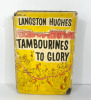
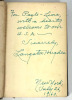
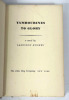
Rare first signed edition of one of Hughes' funniest novels with a dedication and generous annotations. Damaged dust jacket, rubbed edges, upper and lower extremities of the spine missing. Solid binding, preserved interior. Good general condition. *************************************** Rare édition originale signée de l'un des romans les plus drôlatiques de Hughes avec une dédicace et des annotations généreuses. Jaquette abîmée, chasses frottées, manques en coiffe et en queue. Reliure solide, intérieur préservé. Bon état général.
Waves of the Blue River: Survival and triumph through one of history's greatest crimes in China [signed]
São Paulo, self-edited, 2017. One octavo softcover book of 228 x 154 mm, 118 pp. Many black and white pictures throughout the book. Translated from Chinese to English by David Curtis Wright with the author's help. SIGNED by the author on the half-title page. A heart-wrenching and powerful story about a Chinese man who overcame many hurdles to escape an authoritarian government to ultimately land in Brazil, where he and his family fared well in peace. "Born in 1933, Li Mu, pseudonym of Dr. Yeung Chi Bor, is a Chinese-Brazilian doctor and acupuncturist. He grew up in the Chinese province of Guangdong under the Chinese Communist Regime. Targeted by the authorities as 'landlords', Yeung and his family were persecuted, defamed, tortured, and had their possessions confiscated. His father was executed and he was sent to labor camps. Throughout his struggle for survival, Yeung bore witness to one of the worst atrocities in history. He ultimately escaped as a refugee into Hong Kong in 1962 and, in 1977, made a great leap into the unknown, immigrating to Brazil at the age of 44. Dr. Yeung has three daughters and one son, and lives with his wife in the Brazilian city of Belo Horizonte, in the state of Minas Gerais."
![Waves of the Blue River: Survival and triumph through one of history's greatest crimes in China [signed]. Li Mu](https://static.livre-rare-book.com/pictures/QZI/0298_1_thumb.jpg)
![Waves of the Blue River: Survival and triumph through one of history's greatest crimes in China [signed]. Li Mu](https://static.livre-rare-book.com/pictures/QZI/0298_2_thumb.jpg)
![Waves of the Blue River: Survival and triumph through one of history's greatest crimes in China [signed]. Li Mu](https://static.livre-rare-book.com/pictures/QZI/0298_3_thumb.jpg)
This copy was obtained from the author himself and remained in a cabinet since then. Like new.
Lucjan Paff (edited and translated by), Józef Piłsudski (signed by)
Reference : 517
(1945)
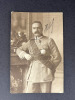
W Walce O Wolnosc / In Fight For Freedom / In Lotta Per La Libertà + three original Polish WW2 pictures, including a photograph of Marshal Jozef Pilsudski signed by himself
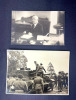
This is a set which belonged to Janusz Gluchowski, a high-ranking Polish military officer at the time of the WW2. The set contains three original B&W pictures. First one: undated postcard showing Marshal Jozef Pilsudski, signed by himself in black ink, 8.5 x 13.5 cm, with two embossed mentions above and below. Second picture: undated postcard showing Poland President Gabriel Narutowicz, with a written mention on the back. Third picture: 11 x 15.5 cm photograph. General Tadeusz Bór-Komorowski inspecting a British Cromwell tank, accompanied by Polish officers of the 3rd Armored Regiment (3 puk pancerny). The image was captured during an official ceremony in the city of Kelso, Scotland, in the immediate post-war period, on June 15, 1945. The scene shows the General in an observation position, climbing onto the tank while surrounded by Polish soldiers. The tank corresponds to a British model widely used by Polish forces in exile during the Western European campaign. On the reverse, the following handwritten inscriptions appear: VI 1945, Kelso. N. Wódz gen. Bór-Komorowski dokonuje inspekcji 3 p. panc. N. Wódz w towarzystwie bryg. puku na czogu." / June 15, 1945, Kelso The book is an illustrated three-languages (Polish, English and Italian) set commemorating the struggles of the Polish II Corps. Edited by Wyda Rererat [Referat] Kultury i Prasy Kresowej Dywizji Piechoty in Rome, 1945. Oblong book of 21 x 19 cm, unpaginated (144 pp.). Cover detached. Endpapers and first page show Janusz Gluchowski's stamp. In publisher's photographically illustrated wrappers. Each page contains a photographic image or a photomontage accompanied with a short text in three languages. Front cover shows some wear and tear, the binding is a bit loose - we would advise having this book bound. The Polish II Corps was a major tactical and operational unit recruited from Polish deportees in the Soviet Gulags in 1943. First they fought in the Middle East, and in 1944 February they were transferred to Italy and as independent part of the British Army to fight in the Italian campaign, in the battles of Monte Cassino and Ancona and also the Battle of Bologna during the final offensive in Italy in 1945. The book goes through the story of Poland and the later established Polish II Corps, starting with the German and Soviet occupation in 1939. It shows the deportation of Poles to forced labour to the Gulag and, after the Polish-Russian Military Agreement in 1941, the establishment of the Polish Army on Soviet soil, also their military training and their fights in various battles. Janusz Julian Gluchowski was a Major General in the Polish Army during the Second Polish Republic. He was born on August 6, 1888, in Bukowa. He fought in the Polish Legions in World War I, the Polish-Ukrainian War, the Polish-Soviet War, and the invasion of Poland by Nazi Germany, Slovakia, and the Soviet Union in 1939, which culminated in the start of World War II. In his adolescence, he attended high school in Czstochowa. In 1905, he became a member of the Combat Organization of the Polish Socialist Party and was wounded in the hand during an attack near Czstochowa. To avoid arrest by the Russian authorities, he left for Belgium, where he studied at the University of Liège. He returned to divided Poland around 1910 and settled in Austrian Galicia. In 1912 he graduated from the Officers' School of the Riflemen's Association in Stroza, near Krakow. In the early hours of August 1914, he commanded a platoon in Oleandria and was Wadysaw Belina-Pramowski's representative during the legendary attack of the so-called Seven Lancers of Belina (Uaska siódemka). On August 6th, together with the First Cadre Company, he left Krakow and marched to Miechów. In October 1914 he was promoted to Lieutenant (Poruchik) and, in November 1916, to Rittmeister (Cavalry Master). Until 1917 he served in the First Uhlan Regiment of the Polish Legions. After the Oath Crisis (Kryzys przysigowy) he was interned first in Fort Beniaminów and later in Werl. Released in October 1918, he went to Lublin, where, in early November, he formed the Third Ulan Regiment (later renamed the Seventh Ulan Regiment of Lublin). Along with his unit, he fought in the Polish-Soviet War. On May 29, 1920, he was promoted to Polkovnik. He was transferred in July 1920 to Eastern Galicia, taking command of the First Cavalry Brigade, fighting against the Soviets in Galicia and Volhynia. After the war, he remained in this position until 1925, when he was transferred to the Fourth Cavalry Brigade. Promoted to Brigadier General on March 16, 1927. Appointed commander of the Center for Higher Military Studies on June 4, 1930, and three years later, after the death of General Stanislaw Tessaro, he was appointed commander of Military District X in Przemyl. In October 1935, he became Deputy Minister of Military Affairs. In the early days of the 1939 invasion of Poland, Gluchowski ordered General Walerian Czuma to prepare the defense of Warsaw. In mid-September 1939, he fled to Romania. After his escape, he managed to travel to the Middle East and, in January 1941, received orders to go to London. In October 1941, he was appointed Commander of the Training Brigade stationed in Scotland. On September 23, 1943, he was appointed commander of all Polish Army units stationed in Great Britain, except the First Independent Parachute Brigade, which remained under the authority of the Commander-in-Chief. He was promoted to Major General on June 1, 1945. He decided not to return to Soviet-occupied Poland and remained in Great Britain. He frequently criticized the Soviet regime and the Soviet occupation authorities in postwar Poland. Furthermore, he was one of the founders and president of the Jozef Pilsudski Institute in London. He was, therefore, an active member of the Polish community in Great Britain. He was president and honorary member of several Polish veterans' organizations. He died on June 11, 1964, in London, England.
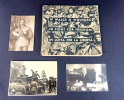
An incredible set. Hold some high Polish history between your hands!
Alexis ou le traité du vain combat [signé]
Paris, Plon / Nouvelle bibliothèque française, 1965 [1952]. Signé par Marguerite Yourcenar "avec hommage et affection" sur la page de faux-titre. Édition révisée avec préface. In-8, 205 x 140 mm pour 191 pp. Reliure toilée beige, pièce de titre verte avec pour mentions "YOURCENAR" et "ALEXIS". Tampon de librairie et rousseurs à la garde blanche. Tranchefile. "Comme tout récit écrit à la première personne, Alexis est le portrait d'une voix. Il fallait laisser à cette voix son propre registre, son propre timbre, ne rien lui enlever, par exemple, de ses inflexions courtoises qui semblent quelque peu d'un autre âge, et le semblaient déjà il y a près de trente-cinq ans, ou encore de ces accents de tendresse presque cajoleuse qui en disent peut-être plus long sur les rapports d'Alexis et de sa jeune femme que sa confidence elle-même. Alexis quittant sa femme donne pour motif à son départ la recherche d'une liberté sexuelle plus entière et moins entachée de mensonge, et cette raison reste certes la plus décisive ; il est pourtant probable qu'il s'y mêle d'autres motivations plus difficiles encore à avouer par celui qui s'en va..." (Préface)
![Alexis ou le traité du vain combat [signé]. Marguerite Yourcenar](https://static.livre-rare-book.com/pictures/QZI/0051_1_thumb.jpg)
![Alexis ou le traité du vain combat [signé]. Marguerite Yourcenar](https://static.livre-rare-book.com/pictures/QZI/0051_2_thumb.jpg)
![Alexis ou le traité du vain combat [signé]. Marguerite Yourcenar](https://static.livre-rare-book.com/pictures/QZI/0051_3_thumb.jpg)
Menues rousseurs en marge de toutes premières et dernières pages, quelques soulignements au stylo noir aux marges des premières pp. de la préface, sinon intérieur frais. Bel exemplaire signé par la première femme élue à l'Académie française.
Any objections? [signed]
London, Phaidon, 1999. A hardbound in-quarto volume with dust jacket and protective mylar, 278 x 200 mm, 146 pp. SIGNED by Mario Testino at the top of the title page. "Provocative and unexpected, Any Objections? is a lightning roller-coaster of unpublished images which brilliantly illuminates the vision of one of photography's shrewdest eyes. Fashion and the gutter, nature and artifice, high life and low, jostle for his attention. Faces of the very famous in the least expected places, bodies of the very beautiful, landscapes and cities, close friends and extraordinary passersby all find their place in a pattern which is held together by Testino's evident sense of the absurd. The book is an insight into the raw material of fashion, where a glimpse of life from a street in Tangier can be the inspiration for a fashion story in New York. At once diary and commentary, picture after picture (all reproduced full-page) provoke reactions as diverse as their subject-matter: from shock to amusement and from surprise to delight. Whether or not you have any objections, you can't help being intrigued by Testino's very personal view of the world that surrounds him." (Front flap)
![Any objections? [signed]. Mario Testino](https://static.livre-rare-book.com/pictures/QZI/0109_1_thumb.jpg)
![Any objections? [signed]. Mario Testino](https://static.livre-rare-book.com/pictures/QZI/0109_2_thumb.jpg)
![Any objections? [signed]. Mario Testino](https://static.livre-rare-book.com/pictures/QZI/0109_3_thumb.jpg)
The mylar and title page show a bit of wear and tear. Otherwise in fine condition.
Mirobolus, Macadam & cie. Hautes pâtes de Jean Dubuffet
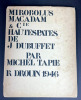
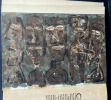
Paris, R. Drouin, 1946. Édition originale. L'un des rarissimes 30 exemplaires sur grand papier, celui-ci non justifié (pourrait-il y en avoir eu plus de 30 ?) mais bien complet de la lithographie en début d'ouvrage et des signatures de l'auteur, de l'artiste et de l'éditeur-galeriste au colophon. Grand volume broché de 25,5 x 35,cm. Couverture rempliée typographiée, dos muet. 56 (ii) pp. Imprimé sur fort vélin d'Arches à la forme comprenant une lithographie originale en couleur de Jean Dubuffet, "Suite de visages bronzés", juste après la page de titre. Garni de 31 reproductions en noir et blanc contrecollées, dont le frontispice. Texte de Michel Tapié. Pages irrégulières, beaucoup plus petites que le format total du livre, ce qui créée un effet de volumes et de lignes successives d'une page à l'autre. Signatures de Michel Tapié, Jean Dubuffet et René Drouin en fin d'ouvrage, chacune d'un stylo différent, la première en noir et les deux autres en bleus doux et légèrement violacé. Première édition du catalogue de la seconde exposition de Dubuffet, « Macrobolus et Cie », où il a présenté de nombreuses peintures en « hautes pâtes » composées de terre, de gravier, de goudron et de sable. Cet événement marqua un tournant dans le mouvement d'art brut de l'après-guerre, qui s'opposait à l'art savant et à la culture conventionnelle, et provoqua une réaction très polémique tant auprès des critiques que dans le public de la galerie. Deux toiles furent lacérées et six autres endommagées. L'exposition reçut un accueil fut plus favorable à New York l'année suivante. Si l'on retrouve assez facilement l'édition standard tirée à 1000 exemplaires de Macrobolus, les tirages de tête sur fort vélin d'Arches sont nettement plus rares.
Légère marque de mouillure au coin supérieur droit de la couverture. Manque au bas de la reliure. Papier jauni, mais en très bon état, ensemble solide au toucher. Plus de photos sur demande.
Pathways of Hope. The Jewish Presence in Rio Grande do Sul - Caminhos da Esperança. A presença judaica no Rio Grande do Sul [signed/assinado]
Porto Alegre, Gráfica Editora Pallotti, no date [circa 1990]. First and only edition. Bilingual text, English and Portuguese. SIGNED by author on free endpaper: "Para Jayme Albek, o abraço do MOACYR. Maio, 1991" (For Jayme Albek, with a hug from Moacyr, May 1991) An oblong hardcover book of 297 x 217 mm and 120 pp. Widely illustrated with archive black & white photos, along with a few colored maps and drawings. Co-edited by the Instituto Judaico Marc Chagall, with a foreword of the president of the Institute Evelyn Berg. The book recalls the difficult arrival and settlement of Eastern European Jews, by the beginning and middle of the twentieth century, in the most southern state of Brazil. The author, Moacyr Jaime Scliar (1937-2011), spent most of his life in Porto Alegre. He worked as a physician and university professor while also constantly researching and churning literature: short stories, novels, essays, children's literature and some columns in several Brazilian newspapers. ********************************************** Porto Alegre, Gráfica Editora Pallotti, sem data [circa 1990]. Primeira e única edição. Texto bilíngue inglês e português. ASSINADO pelo autor em folha de guarda livre: "Para Jayme Albek, o abraço do MOACYR. Maio, 1991" Livro oblongo de capa dura, 297 x 217 mm, 120 páginas. Amplamente ilustrado com fotos em preto e branco de arquivo, além de alguns mapas e desenhos coloridos. Coeditado pelo Instituto Judaico Marc Chagall, com prefácio da presidente do Instituto, Evelyn Berg. O livro conta a difícil chegada e fixação de judeus do Leste Europeu, no início e meados do século XX, no estado mais ao sul do Brasil. O autor, Moacyr Jaime Scliar (1937-2011), passou a maior parte de sua vida em Porto Alegre. Trabalhou como médico e professor universitário, além de pesquisar e produzir constantemente literatura: contos, romances, ensaios, literatura infantil e algumas colunas em diversos jornais brasileiros.
![Pathways of Hope. The Jewish Presence in Rio Grande do Sul - Caminhos da Esperança. A presença judaica no Rio Grande do Sul [signed/assinado]. Moacyr ...](https://static.livre-rare-book.com/pictures/QZI/0485_1_thumb.jpg)
![Pathways of Hope. The Jewish Presence in Rio Grande do Sul - Caminhos da Esperança. A presença judaica no Rio Grande do Sul [signed/assinado]. Moacyr ...](https://static.livre-rare-book.com/pictures/QZI/0485_2_thumb.jpg)
![Pathways of Hope. The Jewish Presence in Rio Grande do Sul - Caminhos da Esperança. A presença judaica no Rio Grande do Sul [signed/assinado]. Moacyr ...](https://static.livre-rare-book.com/pictures/QZI/0485_3_thumb.jpg)
Boards slightly soiled, pages are clean and toned. A good copy with a rare signature. ********************* Capas levemente sujas, páginas limpas e tonalizadas. Um bom exemplar com uma assinatura rara.
Moi, Juif-Arabe en Israël [signé]
Paris, Encre, 1985. Un in-8 broché de 240 x 155 mm, 233 pp. Dédicacé par l'auteur au stylo bleu sur la première page en 1985. "Être Juif arabe en Israël est encore une véritable malédiction, la marque de Caïn dont on ne peut se libérer... Devenir ashkénaze quand on est sépharade, comment faire ? Combien de temps peut-on vivre en rupture avec soi-même ? La culture occidentale, celle de l'élite sociale et politique dominante en Israël, tente d'écraser la culture arabe, orientale. À la base, un conflit d'identité entre l'Orient et l'Occident exacerbé par le contexte des luttes israélo-arabes. La seule solution réside dans le dialogue véritable, la coexistence par l'acceptation mutuelle des uns et des autres."
![Moi, Juif-Arabe en Israël [signé]. Mordecai Soussan](https://static.livre-rare-book.com/pictures/QZI/0319_1_thumb.jpg)
![Moi, Juif-Arabe en Israël [signé]. Mordecai Soussan](https://static.livre-rare-book.com/pictures/QZI/0319_2_thumb.jpg)
![Moi, Juif-Arabe en Israël [signé]. Mordecai Soussan](https://static.livre-rare-book.com/pictures/QZI/0319_3_thumb.jpg)
Bon état. Rousseurs à la première page, quelques traces de frottement sur la couverture et en quatrième de couverture, papier légèrement jauni, à part ça en bonne condition. Rare signature de l'auteur.
Honoring the Self. Personal integrity and the heroic potentials of human nature [signed]
Los Angeles, Jeremy P. Tarcher / Houghton Miffin, 1983. First edition, second printing. Boldly signed by Nathaniel Branden on the first free endpaper (not a tip-in). In-4, 23 x 27 cm, 271 pp. Original dust jacket with flaps. Table of contents at the beginning. A small defect at the top of the DJ and at the bottom of the spine, otherwise VG. Pages are crisp and clear. Nathaniel Branden's Honoring the Self is a cornerstone of self-esteem psychology. The author was a long friend of Ayn Rand before launching his own, close yet unmistakably his, brand of worldview and knowledge of the human mind. "Tell me how a person judges his or her self-esteem," says pioneering psychologist Nathaniel Branden, "and I will tell you how that person operates at work, in love, in sex, in parenting, in every important aspect of existence--and how high he or she is likely to rise. The reputation you have with yourself--your self-esteem--is the single most important factor for a fulfilling life." (Inside flap)
![Honoring the Self. Personal integrity and the heroic potentials of human nature [signed]. Nathaniel Branden](https://static.livre-rare-book.com/pictures/QZI/0119_1_thumb.jpg)
![Honoring the Self. Personal integrity and the heroic potentials of human nature [signed]. Nathaniel Branden](https://static.livre-rare-book.com/pictures/QZI/0119_2_thumb.jpg)
![Honoring the Self. Personal integrity and the heroic potentials of human nature [signed]. Nathaniel Branden](https://static.livre-rare-book.com/pictures/QZI/0119_3_thumb.jpg)
Scarce when signed. An underrated signature!
Signed Autograph by Nat King Cole
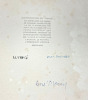
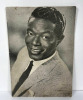
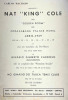
This is a 17-pages softcover document AUTOGRAPHED by Jazz legend Nat King Cole (1919-1965). Penned by him with blue ball pen on the front cover. A 250 x 158 mm brochure in Portuguese with a black and white photograph of the legendary jazzman on the cover. Nat King Cole performed in Rio de Janeiro, Brazil, at the renowned hotel Copacabana Palace in Abril 1959, from the 13th to the 19th. Presented by Carlos Machado (1908-1992) and the charity Pro Matre. The inside describes who Machado and King Cole are, with many ads and black-and-white illustrations. Of note: a picture of Cole with Sammy Davis, Harry Belafonte, Frank Sinatra and other stars. He is even shown looking at Da Vinci's Mona Lisa in France! Very little wear and tear/foxing on the covers. Yellowed margins inside. King Cole's dedication is very legible and easy to recognize. VG-.
Not only is this a rare signature from a short-lived legend, this is also a rare document from one of the few performances he did in Brazil!
[Alexandre Pires do Prado Baptista, Cândida Maria Vuolo, Glauco França, Ivon Lubarino Piccolli dos Santos, Maria Helena Saburido Villar, Paulo Henrique Camargo Batista, Roberto Bogo, Stepan Norair Chahinian, Alex Salim.] - Nestor Goulart Reis
Reference : 0123
(2004)
São Paulo: Vila, Cidade, Metrópole [com dedicatória]
São Paulo, Prefeitura do Município de São Paulo, 2004. Formato grande (288 x 310 mm), 257 pp. em português. Encadernação original do editor, capa ilustrada com fotografia em preto e branco de uma fileira de prédios paulistanos com título em prata, subtítulo colorido e gravura colorida; lombada e contracapa ilustradas com fotografia de um céu cinza e outra fileira de prédios, com o título e o nome do autor na lombada e um desenho abstrato branco na contracapa. Dedicatória do autor na página de rosto, nome do destinatário riscado. O livro é ricamente ilustrado, com texto impresso em duas linhas. Prefácio da Prefeita de São Paulo, Marta Suplicy, e do Presidente do BankBoston, Geraldo Carbone. Sumário no início do livro, bibliografia no final. Este livro foi publicado para comemorar o 450º aniversário da cidade de São Paulo. Cofinanciado pelo Estado de São Paulo, o livro exigiu uma grande equipe (listada no início da obra) e é um dos trabalhos mais abrangentes sobre o tema. Cada era da história de São Paulo é narrada, desde a humilde vila fundada em 1554 pelos primeiros colonizadores portugueses até a metrópole cafeeira do século XIX, e, posteriormente, à megalópole que se tornou nas últimas décadas. O livro recebeu nada menos que três prêmios, entre 2004 e 2006! ************************* São Paulo, Prefeitura do Município de São Paulo, 2004. Grand in-4 de 288 x 310 mm, 257 pp. en portugais. Relié éditeur, plat avant illustré d'une photo d'une rangée d'immeubles paulistanais en noir et blanc avec titre frappé argent, sous-titre en couleurs et gravure colorée, dos et plat arrière illustrés d'une photo de ciel gris et d'une autre rangée d'immeubles avec titre et nom d'auteur sur le dos et résumé en blanc en 4e de couverture. DÉDICACE de l'auteur en page de titre, nom du destinataire biffé. Ouvrage abondamment illustré, texte écrit sur deux lignes. Préface de la maire de São Paulo Marta Suplicy et du président de la BankBoston Geraldo Carbone. Table des matières en début d'ouvrage, bibliographie à la fin. Ce livre a été publié à l'occasion des 450 ans de la ville de São Paulo. Co-financé par l'État de São Paulo, il a mobilisé un personnel abondant (liste en début d'ouvrage) et constitue l'une des œuvres les plus complètes sur le sujet. Chaque époque de São Paulo y est retracée, de la simple vila fondée en 1554 par les premiers arrivants portugais à la métropole caféière du XIXe siècle, puis à la mégalopole qu'elle est devenue ces dernières décennies. Le livre a été récompensé par pas moins de trois prix en 2004 et 2006 !
![São Paulo: Vila, Cidade, Metrópole [com dedicatória]. Nestor Goulart Reis](https://static.livre-rare-book.com/pictures/QZI/0123_1_thumb.jpg)
![São Paulo: Vila, Cidade, Metrópole [com dedicatória]. Nestor Goulart Reis](https://static.livre-rare-book.com/pictures/QZI/0123_2_thumb.jpg)
![São Paulo: Vila, Cidade, Metrópole [com dedicatória]. Nestor Goulart Reis](https://static.livre-rare-book.com/pictures/QZI/0123_3_thumb.jpg)
Très légers frottements aux mors et au plat avant, léger pli en haut d'une page en fin d'ouvrage, à part ça comme neuf. Agréable exemplaire qui rend un hommage mérité à la ville la plus peuplée d'Amérique du Sud. **************************** Leve desgaste nas bordas e na capa frontal, um pequeno vinco na parte superior de uma página perto do final do livro, de resto, como novo. Um exemplar agradável que presta uma merecida homenagem à cidade mais populosa da América do Sul.
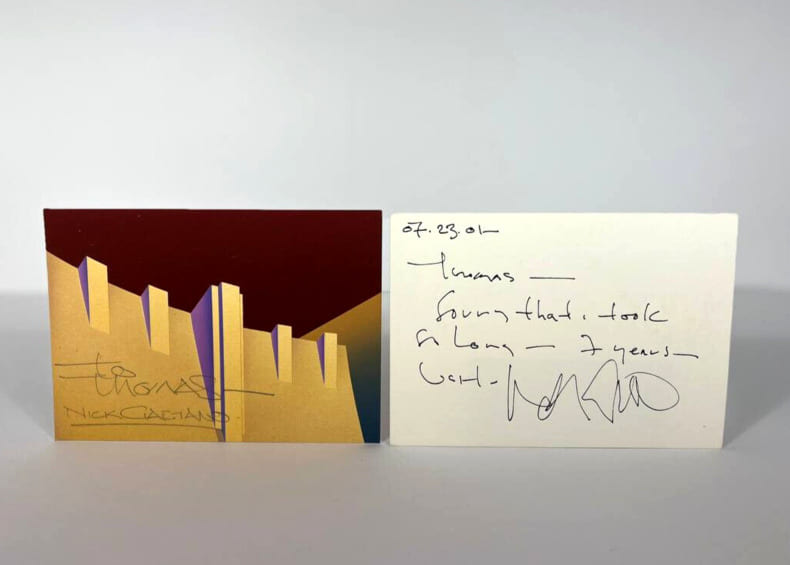
Nick Gaetano: two postcards, signed by the artist
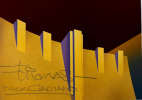
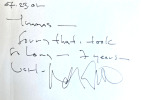
Two 4" x 6" (105 x 148 mm) postcards. The first postcard shows a dam, drawn Art Deco style with clearcut geometric ocher and purple shapes with the illustrator's characteristic style upon a burgundy background. This postcard is SIGNED by Nick Gaetano with the mention "Thomas" on pencil. Back of the postcard features the pencil-written mention "Nick Gaetano, airbrush." The second postcard is white. Instead of an illustration, it features a handwritten note with pen: "07.23.[20]01 Thomas — sorry that it took so long — 7 years — [unreadable]" boldly SIGNED. Back of the postcard features the pencil-written mention "Nick Gaetano" and a pencil tracing of a dollar bill. The second postcard show a very light crease on the left half. Aside from that, both are in neat condition. Dubbed "the accidental Objectivist" in 2011, Nicholas Gaetano (1944-) is mostly known for designing covers for 10 Ayn Rand books. His 25th Anniversary Edition cover art for Atlas Shrugged made him seen in the whole United States. However, he "is also an award-winning artist, illustrator, and photographer whose work is in the collections of the Library of Congress and the Smithsonian. He’s created covers for F. Scott Fitzgerald, Tom Wolfe, Dominick Dunne, H. P. Lovecraft, Agatha Christie, among many others. As an illustrator, he is best known for his distinctive Art Deco style, but Gaetano’s paintings tend toward the abstract. Cy Twombly is a recognizable influence. A recent series features fluid spills of black paint on plastic sheets. Gaetano has exhibited widely, most recently at Roberts & Tilton and the Los Angeles Center for Digital Art." (Interview Magazine, "The Accidental Objectivist", 2011) He now sells Ayn Rand-related or -inspired art at the Cordair art gallery. Gaetano's hand signatures are scarce and quite hard to find. This one stems from a personal friendship and from the pre-9/11 period. Whether framed and hung on a wall, placed on a support or simply put on a buffet top, this will be a fine piece for any Ayn Rand or Art Deco collector.
In good condition. Postcard signed on the front. Both postcards signed on the back. The white postcard features a pencil tracing of a dollar bill.
Formation historique de la nationalité brésilienne. Série de conférences faites à la Sorbonne
Paris, Garnier Frères, 1911. In-8 de 230 x 160 mm, xxiii + 249 pp. Édition originale. Reliure récente demi-cuir glacé noir, dos à 5 nerfs avec fleurs de lys dorées en fleurons, titre et nom d'auteur en doré. Signature à la plume sur la page de titre, préface d'Ernest Martinenche, avant-propos de José Verissimo. Sommaire en début d'ouvrage. Tampon "Ce volume ne peut pas être retiré" à la page de titre, tampon et annotation au stylo au bas de la page en revers de celle-ci, tampon bleuté discret du musée de la Marine de Rio de Janeiro au début du premier chapitre. "Comment s'est formée la nationalité brésilienne ? Par quelles étapes a passé ce pays, ou plutôt ce continent dans lequel l'Europe moins la Russie pourrait tenir à l'aise ? On verra dans ce livre les difficultés presque insurmontables qu'imposaient au Brésil son climat et son étendue, et les conditions mêmes de son développement. Avoir réussi à résoudre par l'assimilation et non par la destruction le problème des races, et à maintenir une unité morale dans la diversité des provinces fédérées... il y a dans cette évolution, si rapide malgré son apparente lenteur, et si sagement progressive, de quoi permettre et justifier tous les espoirs." (Préface, p. x) Ce livre est issu d'une série de conférences prononcées en français par Manuel de Oliveira Lima (1867-1928) du 15 mars au 6 mai 1911 à l'amphithéâtre Turgot (futur Paris I !) pour inaugurer la chaire des études brésiliennes. Francophile autant que bibliophile, cet historien brésilien a participé à la fondation de l'Académie brésilienne des lettres et créé l'une des plus importantes collections de livres privées du pays. À sa mort, il léguera à l'Université catholique de Washington "pas moins de 58 000 ouvrages, la correspondance de son fondateur avec quantité d'intellectuels, plus de 400 tableaux et d'innombrables albums contenant des coupures de presse" (Wikipédia).
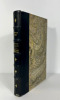
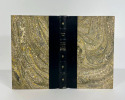
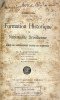
Reliure en très bon état si ce n'est un discret frottement en queue. Premières pages roussies, reste de l’œuvre très frais. Agréable exemplaire d'un livre jamais réédité.
Niente e Così Sia [signed]
Milan, Rizzoli, 1990 [1969]. Book in Italian, sixtieth edition (printing). Inscribed by the author. One octavo paperback volume. 218 x 138 mm, (ix) 353 pp. Black and white photograph of the journalist on the cover. Signed in blue pen by Oriana Fallaci on December 23, 1993, on the title page. Preface, ten chapters, table of contents at the end. "Nothing, and So Be It" (Italian title: niente e Cosi sia) is a firsthand account by Italian journalist Oriana Fallaci, written after a year as a war correspondent in Saigon, Vietnam, in 1967 and 1968. To write it, Fallaci relied on the testimonies of several American soldiers who participated in the My Lai massacre and on the reports of some survivors. The book earned her the Bancarella Prize (1970). (Wikipedia) *************** Milan, Rizzoli, 1990 [1969]. Livre en italien, mention de soixantième édition (tirage). Envoi autographe de l'auteur. Un volume broché in-8. 218 x 138 mm, (ix) 353 pp. Photo de la journaliste en noir et blanc sur la couverture. Signé au stylo bleu par Oriana Fallaci le 23 décembre 1993 sur la page de titre. Préface, dix chapitres, table des matières en fin d'ouvrage. "Rien, et ainsi soit-il (titre en italien : niente e Cosi sia) est un récit de première main de la journaliste italienne Oriana Fallaci écrit après un an en tant que correspondante de guerre à Saigon, au Vietnam, en 1967 et 1968. Pour le rédiger, Oriana Fallaci s'est appuyé sur les témoignages de plusieurs soldats américains ayant participé au massacre de Mỹ Lai et sur les rapports de certains survivants. Le livre lui a valu le prix Bancarella (1970)." (Wikipédia)
![Niente e Così Sia [signed]. Oriana Fallaci](https://static.livre-rare-book.com/pictures/QZI/0099_1_thumb.jpg)
![Niente e Così Sia [signed]. Oriana Fallaci](https://static.livre-rare-book.com/pictures/QZI/0099_2_thumb.jpg)
![Niente e Così Sia [signed]. Oriana Fallaci](https://static.livre-rare-book.com/pictures/QZI/0099_3_thumb.jpg)
Covers slightly rubbed, top corner slightly bumped, mounting visible on the dedication page, paper slightly yellowed. Minor pencil underlining on some pages. Copy in good overall condition. Rare signature of one of Italy's best-known journalists, renowned both for her interviews with heads of state over several decades and for her pioneering stances on Islam in the 2000s. *********************** Plats un peu frottés, coin supérieur légèrement corné, contrecollage visible à la page de dédicace, papier légèrement jauni. Menus soulignements au crayon à certaines pages. Exemplaire en bon état général. Rare signature de l'une des journalistes les plus connues d'Italie, tant pour ses interviews de présidents de pays sur plusieurs décennies que pour ses prises de position avant-gardistes autour de l'Islam dans les années 2000.
Meu sósia e eu (Mon sosie et moi) [livre signé par Niemeyer]
São Paulo, Revan, 1992. En portugais et en anglais. Édition originale. Un volume quasi carré de 260 x 257 mm de 121 pp. + 19 pp. de texte en anglais. Relié avec jaquette, charnières à la Bradel. Mot de Murillo Valle Mendes en incipit, préface de Darcy Ribeiro. Chapitres : Architecture, Témoignage, Quelques projets à l'extérieur (du Brésil), Urbanisme, Textes, Sculptures, Dessins, Oeuvres et projets, Hommages, Bibliographie. Nombreuses photos, dessins et croquis, sommaire en fin d'ouvrage. Beaucoup de contenus sur Brasilia et, de manière plus surprenante, sur l'espace Oscar Niemeyer du Havre et l'Université de Constantine en Algérie. Dédicacé à Geraldo par Niemeyer au bas de la page 93, avec sa signature bien reconnaissable, au feutre noir. *************************************** São Paulo, Revan, 1992. In Portuguese and English. First edition. A nearly square volume of 260 x 257 mm of 121 pp. + 19 pp. of text in English. Hardbound with dust jacket, Bradel-style hinges. A word by Murillo Valle Mendes opening the book, preface by Darcy Ribeiro. Chapters: Architecture, Testimony, Some projects overseas (outside Brazil), Urban planning, Texts, Sculptures, Drawings, Works and projects, Tributes, Bibliography. Many photos, drawings and sketches, summary at the end of the book. A lot of content on Brasilia and, more surprisingly, on the Oscar Niemeyer space in Le Havre, France, and the University of Constantine, Algeria. Dedicated to Geraldo by Niemeyer at the bottom of page 93, with his very recognizable signature, in black felt pen.
![Meu sósia e eu
(Mon sosie et moi) [livre signé par Niemeyer]. Oscar Niemeyer](https://static.livre-rare-book.com/pictures/QZI/0503_1_thumb.jpg)
![Meu sósia e eu
(Mon sosie et moi) [livre signé par Niemeyer]. Oscar Niemeyer](https://static.livre-rare-book.com/pictures/QZI/0503_2_thumb.jpg)
![Meu sósia e eu
(Mon sosie et moi) [livre signé par Niemeyer]. Oscar Niemeyer](https://static.livre-rare-book.com/pictures/QZI/0503_3_thumb.jpg)
Jaquette et première garde blanche salies, jaquette un peu froissée, léger jaunissement aux marges. Photos et images en excellent état, page signée en bon état. ************************* Dust jacket and first white guard soiled, dust jacket a little creased, slight yellowing at the margins. Photos and images in excellent condition, signed page in good condition.
Nattier. Peintre de la cour de Louis XV [signé, avec lettres, belle reliure]
Paris, Goupil & cie, 1910. Édition originale. Un épais volume in-8 de 224 x 148 mm, (XI) 263 pp., relié demi-maroquin bleu roi avec dos à nerfs soulignés pointillés, titre et nom d'auteur en doré dans un caisson, doubles caissons filetés et richement ornés aux entrenerfs, bandeaux floraux en tête et en queue. Plats jaspés bleutés, gardes colorées marbrées avec ex-libris. Blason du Château de Vertcoeur frappé or en haut à droite du premier plat. Tranches supérieures dorées. Signet tricolore. Couverture originale conservée, dos conservé en fin d'ouvrage, richement illustré de reproductions couleur et noir et blanc des peintures de Nattier collées sur les pages du livre avec par-dessus un papier de soie avec mention de la ou des personnes peintes. Précieux exemplaire ENRICHI d'une lettre manuscrite de l'auteur datée du 20 octobre 1920, avec l'enveloppe originale, adressée au comte René Philipon (1870-1936), châtelain de Vertcoeur à Milon-la-Chapelle, ancien propriétaire de ce volume et y ayant placé son ex-libris à la licorne signé "J. de Andrada 1917". La lettre et son enveloppe sont reliées avec les premières pages. "Depuis qu'il est à la mode de posséder un Nattier, comme il l'était autrefois d'avoir un Téniers ou un Raphaël, les Nattier se sont multipliés et courent le monde. Le moindre vente de tableaux présente au catalogue ce nom devenu fameux... On ne lutte par contre le plaisir qu'il nous donne, on ne se défend point contre les séductions de ce pinceau adroit et nonchalant, qui connaît toutes les ruses d'un métier charmant et quelques-unes des ressources de la grande maîtrise... [T]outes les fois que Nattier a travaillé consciencieusement et suivant son génie propre, il a réalisé des portraits qui nous font pleinement partager la joie qu'il eut à les peindre." (Préface, pp. i-iii)
![Nattier. Peintre de la cour de Louis XV [signé, avec lettres, belle reliure]. Pierre de Nolhac](https://static.livre-rare-book.com/pictures/QZI/0463_1_thumb.jpg)
![Nattier. Peintre de la cour de Louis XV [signé, avec lettres, belle reliure]. Pierre de Nolhac](https://static.livre-rare-book.com/pictures/QZI/0463_2_thumb.jpg)
![Nattier. Peintre de la cour de Louis XV [signé, avec lettres, belle reliure]. Pierre de Nolhac](https://static.livre-rare-book.com/pictures/QZI/0463_3_thumb.jpg)
Légers frottements à la charnière avant et aux nerfs, chasses légèrement jaunies et frottées, rousseurs aux premières pages et à certaines marges sans perte au texte ou aux illustrations, sinon excellent état.
[Pierre Fatumbi Verger] - Pierre Fatumbi Verger, Arlete Soares (ed.), Maria Aparecida de Nóbrega (traduction)
Reference : 0378
(1981)
Orixás. Deuses Iorubás na África e no Novo Mundo [signé/signed/assinado]
São Paulo, Editora Corrupio, 1981. Édition originale. En portugais. Inscrit et signé par Pierre Verger aux premières pages. Grand volume in-4, 288 x 222 mm, 295 pp. Relié plein tissu noir éditeur, plats muets, nom d'auteur et titre sur la reliure. Jaquette absente. Carte de l'Afrique de l'Ouest (du Ghana au Bénin) en pages de garde colorées blanc sur rouge. Inscrit en portugais par l'auteur sur la page de faux-titre, avec son écriture bien reconnaissable : "Para a Mama Helena e o Tumang, com um grande, enorme, beijo do Pierre 13/01/82" (pour Mama Helena e Tumang, avec un grand, un énorme bisou de Pierre, le 13 janvier 1982), avec une signature sur un morceau de papier inséré à la page de titre. Traduit du français au portugais, ce livre est à la fois une analyse du culte des Orixás en Afrique de l'Ouest et au Brésil et un album de photos de l'auteur. Abondamment illustré en noir et blanc, il saisit des instants de la religion de Xangô, Oxálá, Oxóssi et bien d'autres dieux du panthéon Ioruba. Léger manque en haut de la charnière avant, manques au tissu de l'intérieur de la chasse supérieure arrière, quelques griffures aux plats, rousseurs aux parties blanches sans atteinte aux photos. ********************************************** São Paulo, Editora Corrupio, 1981. First edition. In Portuguese. Inscribed and signed by Pierre Verger on the first pages. Large quarto hardcover, 288 x 222 mm, 295 pp. Bound in full black publisher's cloth, blank covers, author's name and title on the binding. Dust jacket missing. Map of West Africa (from Ghana to Benin) on endpapers colored white on red. Inscribed in Portuguese by the author on the half-title page, in his recognizable handwriting: "Para a Mama Helena e o Tumang, com um grande, enorme, beijo do Pierre 13/01/82" (for Mama Helena e Tumang, with a big, huge kiss from Pierre, January 13, 1982), with a signature on a piece of paper inserted on the title page. Translated from French to Portuguese, this book is both an analysis of the cult of the Orixás in West Africa and Brazil and a photo album by the author. Profusely illustrated in black and white, it captures moments of the religion of Xangô, Oxálá, Oxóssi and many other gods of the Ioruba pantheon. Slight loss at the top of the front hinge, damages to the cloth inside the upper rear chase, some scratches on the covers, lots of foxing on the white parts of the pages without affecting the photos.
![Orixás. Deuses Iorubás na África e no Novo Mundo [signé/signed/assinado]. Pierre Fatumbi Verger, Arlete Soares (ed.), Maria Aparecida de Nóbrega ...](https://static.livre-rare-book.com/pictures/QZI/0378_1_thumb.jpg)
![Orixás. Deuses Iorubás na África e no Novo Mundo [signé/signed/assinado]. Pierre Fatumbi Verger, Arlete Soares (ed.), Maria Aparecida de Nóbrega ...](https://static.livre-rare-book.com/pictures/QZI/0378_2_thumb.jpg)
![Orixás. Deuses Iorubás na África e no Novo Mundo [signé/signed/assinado]. Pierre Fatumbi Verger, Arlete Soares (ed.), Maria Aparecida de Nóbrega ...](https://static.livre-rare-book.com/pictures/QZI/0378_3_thumb.jpg)
Rare édition originale signée par Pierre Verger. Intime des Orixás, grand familier du Nordeste brésilien et du sud de l'Afrique de l'Ouest, ce grand voyageur laissa derrière lui plusieurs milliers de photos noir et blanc et un véritable trésor culturel. Rare first edition signed by Pierre Verger. Intimate with the Orixás, very familiar with the Brazilian Northeast and southern West Africa, this great traveler left behind several thousand black and white photos and a true cultural treasure.
Pionniers et planteurs de Sao Paulo
Paris, Armand Colin, 1952. Seule édition. Avec 15 planches hors texte et 45 figures. Co-édité par la Fondation Nationale des Sciences politiques. In-8 broché, 16 x 24 cm, 376 pp. Envoi signé : "Pour Rubens [Borba de Moraes], en affectueux hommage, ce livre qui lui doit beaucoup. Pierre Monbeig" à la pointe-feutre sur la page de faux-titre. Sommaire et glossaire en fin d'ouvrage. Considéré comme un livre de référence dès sa pré-parution sous forme de thèse de doctorat, Pionniers et planteurs de São Paulo refait l'histoire des vagues pionnières d'une région qui était encore un bourg fin XIXe mais connaissait déjà une croissance vertigineuse quand l'auteur écrivait : précurseurs de la culture du café, pionniers de la Belle Époque et de 1929, défrichement, pâturages, villes nouvelles... Monbeig participera plus tard à la création de l'USP, université fédérale la plus réputée du Brésil, avec Claude Lévy-Strauss et Roger Bastide.
![Pionniers et planteurs de Sao Paulo. Pierre Monbeig, Borba de Moraes [signé pour]](https://static.livre-rare-book.com/pictures/QZI/490_1_thumb.jpg)
![Pionniers et planteurs de Sao Paulo. Pierre Monbeig, Borba de Moraes [signé pour]](https://static.livre-rare-book.com/pictures/QZI/490_2_thumb.jpg)
![Pionniers et planteurs de Sao Paulo. Pierre Monbeig, Borba de Moraes [signé pour]](https://static.livre-rare-book.com/pictures/QZI/490_3_thumb.jpg)
Le livre est plutôt courant, mais cet exemplaire est celui que son auteur a pris le temps de dédicacer pour un ami et que Borba de Moraes a tenu entre les mains. Un agréable morceau d'histoire universitaire franco-brésilienne. Marges légèrement jaunies, sinon bon état.
Sur la poésie [signé]
Paris, Guy Lévis Mano (GLM), 1976. Nouvelle édition augmentée. Brochure in-16, 158 x 122 mm pour (5 ff.) 50 pp. (3 ff.). Envoi autographe de l'auteur "à Irène" d'août 1971 à l'encre noire sur la page de faux-titre. L'un des 968 sur papier bouffant fleur d'alpha, celui-ci portant le numéro 471. Exemplaire non coupé. Justification du tirage à la fin. Sous cartonnage éditeur, bloc des pages quasi décollé du dos, à part ce détail excellent état, intérieur propre et frais. Jamais lu au vu de l'absence totale de coupe passé le faux-titre. Envoyé sous mylar (film plastique).
![Sur la poésie [signé]. René Char](https://static.livre-rare-book.com/pictures/QZI/0430_1_thumb.jpg)
![Sur la poésie [signé]. René Char](https://static.livre-rare-book.com/pictures/QZI/0430_2_thumb.jpg)
![Sur la poésie [signé]. René Char](https://static.livre-rare-book.com/pictures/QZI/0430_3_thumb.jpg)
Élégante petite pièce avec un envoi autographe jamais lu.
Jeux de l'apprenti animalier [signé]
Paris, Seghers, 1955. Édition originale numérotée à 500 exemplaires, celui-ci portant le numéro 264. Envoi autographe de l'auteur en page de faux-titre depuis Paris en 1956, plus signature manuscrite sous la numérotation. Un livre broché. Grand in-8 de 252 x 193 mm pour 81 (6) pp. Sur pur fil des papeteries d'Arches. Brefs poèmes illustrés de dessins de l'auteur. Discret tampon noir en bas au coin de la garde volante, de la page de faux-titre et du dernier feuillet de l'ouvrage. Quelques poèmes surlignés en marge, probablement de la main de Ribeiro Couto. Marque au stylo bille sur le dernier feuillet indiquant que l'ouvrage a été offert en cadeau en 2001.
![Jeux de l'apprenti animalier [signé]. Ribeiro Couto](https://static.livre-rare-book.com/pictures/QZI/0473_1_thumb.jpg)
![Jeux de l'apprenti animalier [signé]. Ribeiro Couto](https://static.livre-rare-book.com/pictures/QZI/0473_2_thumb.jpg)
![Jeux de l'apprenti animalier [signé]. Ribeiro Couto](https://static.livre-rare-book.com/pictures/QZI/0473_3_thumb.jpg)
Agréable exemplaire dédicacé. Légers plis aux coins du plat de couverture, une tache au dos, rousseurs légères éparses, papier couleur sable clair. Double signature si l'on additionne celle de la dédicace et celle sous la numérotation.
Le jour est long. Prix international de poésie "Les amitiés françaises" de 1958 [signé]
Paris, Pierre Seghers, 1958. Première édition, signée par son auteur. Bilingue français-portugais. Plaquette in-12 de 13 x 19 cm pour 123 (2) pp. Relié avec jaquette à rabats et bandeau. Dessin de sablier beige sur turquoise-vert clair typique de l'éditeur aux plats, ex-libris au premier contreplat. Généreuse dédicace à l'encre bleu de Ribeiro Couto en page de faux-titre à un ami "maître des arts magiques". Il s'agit d'une anthologie de poèmes de Ribeiro Couto, traduits en français, l'original faisant face à la traduction. Diplomate, membre de l'Académie des lettres brésiliennes, Rui Esteves Ribeiro de Almeida Couto (1898-1963) fut l'auteur de nombreux poèmes et romans, notamment des Jeux de l'apprenti animalier (1955) dont nous proposons l'exemplaire le plus accessible du marché envoyé directement du Brésil. "Dans ce village où il me faut vivre La nuit est paisible, oh, tellement paisible ! On n'entend pas de voix, et les feux sont rares. En vérité, j'appris à connaître la nuit Dans ce village où je vis à présent. Autour de moi tout est calme et douceur, En moi aussi tout est calme et douceur Au long de la nuit."
![Le jour est long. Prix international de poésie "Les amitiés françaises" de 1958 [signé]. Ribeiro Couto](https://static.livre-rare-book.com/pictures/QZI/qzi-20_1_thumb.jpg)
![Le jour est long. Prix international de poésie "Les amitiés françaises" de 1958 [signé]. Ribeiro Couto](https://static.livre-rare-book.com/pictures/QZI/qzi-20_2_thumb.jpg)
![Le jour est long. Prix international de poésie "Les amitiés françaises" de 1958 [signé]. Ribeiro Couto](https://static.livre-rare-book.com/pictures/QZI/qzi-20_3_thumb.jpg)
Manque en haut de la couverture de la jaquette, rousseurs éparses à l'extérieur mais papier propre à l'intérieur.
Penumbras Poesías Líricas
Barcelone, Typographie privée de Dionisio Brull, 1898. En espagnol. Édition originale. Grand in-8, 247 x 178 mm. 301 + 4 pp. Reliure artistique éditeur, dessin d'une jeune femme et titre en vert de style Art Nouveau, richement ornementé, le tout rehaussé de dorures. Dos lisse orné en vert et or, nom du livre à la verticale, nom d'auteur à l'horizontale au milieu dans une pièce de titre. Date au dos dans une plaque verte avec encadrement vert et dorure. Minuscule indication "J. Roca Barcelona" au bas de la couverture. Gardes bleutées à motif en croix, cercles et octogones à entrelacs celtiques. Photo de l'auteur en frontispice avec une remarquable dédicace à la plume, à l'écriture élégante, de 1915. Gravures d'inspiration romantique et bandeaux variés à travers l'ouvrage. La dédicace est adressée à Silvino Gurgel do Amaral (1874-1961), diplomate brésilien au long cours qui commença sa carrière à l'ambassade du Brésil à Saint-Pétersbourg, alors capitale de l'Empire russe, avant de représenter son pays dans de nombreuses villes d'Europe et d'Amérique du Sud. La dédicace, datée de 1915, coïncide avec sa période de service à l'ambassade du Brésil à Asunción en Bolivie. Né à Sucre, en Bolivie, Ricardo Mujía (1860-1938) fut avocat, professeur de littérature et d'histoire à Sucre et à Chuquisaca, où il assuma les fonctions de recteur d'université. Acteur enthousiaste de la révolution libérale de 1898, il occupe les postes de secrétaire de la présidence de la République, haut fonctionnaire du ministère de l'Instruction publique, ministre du Gouvernement et des Affaires étrangères. Diplomate, il a été secrétaire de la Légation au Brésil, chargé d'affaires au Pérou et ministre de la Légation bolivienne au Paraguay et en Argentine. Lorsque les libéraux perdent le pouvoir face à la révolution républicaine de 1920, Ricardo Mujía se retire de la vie publique et s'établit définitivement dans sa ville natale, d'où il part en 1927 rejoindre Buenos Aires, à la demande du gouvernement, où il contribue à la négociation de la frontière entre l'Argentine et le Paraguay. Poète de transition entre le romantisme et le mouvement moderniste initié par Rubén Darío, Mujía se distingue surtout par ses poèmes épiques d'inspiration patriotique. En 1925, il obtient le Flor Natural et la Banda del Gay Sabre au concours poétique du premier centenaire de la république pour son poème "La creación de Bolivia", une composition de 324 vers, dans laquelle il chante tout au long des vicissitudes de la république et ses cent ans d’histoire. Penumbras constitue son recueil poétique le plus connu. Il a également écrit divers ouvrages sur les limites de la frontière avec le Paraguay et d'autres ouvrages historiques. ********************************************************************************************************** Large octavo, 247 x 178 mm. 301 + 4 pp. Artistic publisher's binding, drawing of a young woman and title in green in the Art Nouveau style, richly ornamented, all enhanced with gilt. Smooth spine decorated in green and gold, book name vertically, author's name horizontally in the center in a title label. Date on the spine in a green plate with a green and gold frame. Tiny inscription "J. Roca Barcelona" at the bottom of the cover. Blue endpapers with a motif of crosses, circles, and octagons with Celtic interlacing. Photo of the author on the frontispiece with a remarkable dedication in elegant penmanship from 1915. Romantic-inspired engravings and various banners throughout the work. The dedication is addressed to Silvino Gurgel do Amaral (1874-1961), a long-serving Brazilian diplomat who began his career at the Brazilian Embassy in Saint Petersburg, then the capital of the Russian Empire, before representing his country in numerous cities throughout Europe and South America. The dedication, dated 1915, coincides with his period of service at the Brazilian Embassy in Asunción, Bolivia. Born in Sucre, Bolivia, Ricardo Mujía (1860-1938) was a lawyer and professor of literature and history in Sucre and Chuquisaca, where he served as university rector. An enthusiastic participant in the liberal revolution of 1898, he held the positions of Secretary to the Presidency of the Republic, senior official in the Ministry of Public Instruction, and Minister of Government and Foreign Affairs. A diplomat, he served as Secretary of the Legation in Brazil, Chargé d'Affaires in Peru, and Minister of the Bolivian Legation in Paraguay and Argentina. When the Liberals lost power in the Republican Revolution of 1920, Ricardo Mujía withdrew from public life and settled permanently in his hometown. From there, he moved to Buenos Aires in 1927 at the government's request, where he contributed to the negotiation of the border between Argentina and Paraguay. A poet of transition between Romanticism and the Modernist movement initiated by Rubén Darío, Mujía is particularly distinguished by his epic poems of patriotic inspiration. In 1925, he won the Flor Natural and the Banda del Gay Saber awards in the poetry competition for the first centenary of the republic for his poem "La creación de Bolivia", a 324-line composition in which he sings about the turmoils of the republic and its hundred years of history. Penumbras is his best-known collection of poetry. He also wrote various works on the limits of the border with Paraguay and other historical works.
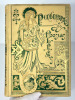
Très bel exemplaire. Papier peu jauni, menues rousseurs qui ne gênent pas la lecture. Doublement rare au regard de la rareté du livre proprement dit et de la dédicace. ************************ A very fine copy. Slightly yellowed paper, minor foxing that does not interfere with reading. Doubly rare given the rarity of the book itself and the dedication.
Behind the baton: A who's who of conductors [signed]
London, Frederick Muller, 1981. First edition. Black cloth hardcover, 24 x 16 cm, 152 pp. No dust jacket (you can find one easily in the UK or USA if you wish so). With title, author's name and editor's name on spine. Signed by author on free end paper. Illustrated with numerous black and white pictures. This is a series of orchestra conductor's profiles sorted by alphabetical order. An interesting, perhaps even encyclopedical reading for the connoisseurs of classical music. Cloth shows some defect at the bottom of the spine and front cover, some foxing on the first pages, otherwise a good copy. Other pages are clean and the binding is sturdy.
![Behind the baton: A who's who of conductors [signed]. Robin May](https://static.livre-rare-book.com/pictures/QZI/0231_1_thumb.jpg)
![Behind the baton: A who's who of conductors [signed]. Robin May](https://static.livre-rare-book.com/pictures/QZI/0231_2_thumb.jpg)
![Behind the baton: A who's who of conductors [signed]. Robin May](https://static.livre-rare-book.com/pictures/QZI/0231_3_thumb.jpg)
A rare signature from the important historian Robin May, who also authored Operamania, Theatremania, Who was Shakespeare?, A Concise Encyclopedia of the Theatre and several books on American history.
Les rhapsodies [signé]
Rio de Janeiro, F. Briguiet & Cie, 1938. 180 x 130 mm, 140 p. Relié plein cuir bleu roi avec un dos à 4 nerfs à pointillés dorés, titre et nom d'auteur en dorés, filets dorés aux nerfs, à la coiffe et à la queue, plats encadrés par des filets dorés à motifs. Garde colorée à motif vert. Frises de style art déco, lettrines et culs de lampe rouges. Préfacé par George Duhamel de l'Académie française. Exemplaire dédicacé par l'auteur à un "illustre ami", le médecin urgentiste carioca Paulo César de Andrade (Diario da Noite, 1945, ed. 03875), dont une rue de Rio de Janeiro porte toujours le nom. Trois rhapsodies : 1) Le chant des eaux, "rhapsodie bucolique", 2) Le roman du vieux tronc, "rhapsodie platonique", et 3) La voix du minaret, "rhapsodie tragique". Membre de l'Académie brésilienne des Lettres et père d'un autre académicien, Rodrigo Octavio (1866-1944) fut un écrivain brésilien francophile et francophone. Son livre Rhapsodies, qu'il signera volontiers à de nombreux amis, remportera un succès d'estime en France. "J'aime ces petits tableaux", écrit George Duhamel dans la préface de l'ouvrage, "aux proportions mesurées, j'aime cette voix égale et fraternelle qui nous arrive, portée par les brises, de l'autre face du monde et qui, pourtant, nous entretient de nous-mêmes, de ce que nous aimons, de ce que nous voulons sauver dans le désordre des temps... Par un tel ouvrage, vous nous prouvez que notre civilisation est impérissable, qu'elle a refait de belles et fortes racines dans un sol nouveau, que l'esprit classique a trouvé ses refuges, ses nouveaux temples, ses nouveaux prêtres et que le flambeau, dès maintenant, est remis à des mains vigilantes."
![Les rhapsodies [signé]. Rodrigo Octavio](https://static.livre-rare-book.com/pictures/QZI/0310_1_thumb.jpg)
![Les rhapsodies [signé]. Rodrigo Octavio](https://static.livre-rare-book.com/pictures/QZI/0310_2_thumb.jpg)
![Les rhapsodies [signé]. Rodrigo Octavio](https://static.livre-rare-book.com/pictures/QZI/0310_3_thumb.jpg)
Bon état. Plein cuir bleu roi, filets dorés aux plats, dos à nerfs. Mors frottés. Tranchefile de coiffe en partie décollée. Marges jaunies, mais quasi exempt de rousseurs. Texte lisible.
Sleeping Beauties [signed]
London, Hodder & Stoughton, 2017. First UK edition. Hardback in dark blue cloth with dust jacket. SIGNED by Owen King on a tipped-in paper stuck on the half-title page, below an ex-dono by a previous owner. Interestingly, the paper King signed refers to a bookstore localized in Bangor, MA, so in the USA. The colored endpapers feature a butterfly design in clear blue over navy blue. A brick of a book with its 16 x 24 cm and 718 pp. size! An interesting collaboration between Stephen King and his son.
![Sleeping Beauties [signed]. Stephen King, Owen King](https://static.livre-rare-book.com/pictures/QZI/qzi-22_1_thumb.jpg)
![Sleeping Beauties [signed]. Stephen King, Owen King](https://static.livre-rare-book.com/pictures/QZI/qzi-22_2_thumb.jpg)
![Sleeping Beauties [signed]. Stephen King, Owen King](https://static.livre-rare-book.com/pictures/QZI/qzi-22_3_thumb.jpg)
Some foxing on the fore-edges and in the margins of some pages. Paper slightly yellowed. A complete copy bearing Owen King's signature.

