 Write to the booksellers
256 books for « von goethe johann wolf... »Edit
-
Latest
Last 3 days (1)
Last month (4)
-
Century
18th (10)
19th (51)
20th (65)
21st (4)
-
Countries
Belgium (13)
Denmark (6)
France (177)
Germany (3)
Switzerland (57)
-
Syndicate
CLAM (3)
CNE (1)
ILAB (110)
NVVA (9)
SLACES (9)
SLAM (72)
Topics
- Ancien régime (3)
- Architecture (1)
- Autographs (1)
- Benoist - méchin (1)
- Berry (2)
- Billy-goat (1)
- Binding w/arms (1)
- Blaze (1)
- Books from the xviiith (1)
- Botany (1)
- Calbet (5)
- Chapront henry (1)
- Cinema (1)
- Daragnes (2)
- Delacroix eugène (2)
- Early printed books (3)
- Encyclopaedia (1)
- Erotic (1)
- Etchings (1)
- Faust (4)
- Fine arts (1)
- First edition (11)
- First empire (1)
- Flammarion camille (1)
- Geology (1)
- German literature (1)
- Goethe johann wolfgang (247)
- History (1)
- Horticulture (1)
- Icart l. (2)
- Illustrated books (6)
- Illustrated books 19th (1)
- Industrial arts & crafts - fine arts (1)
- Leisure (1)
- Leroux pierre (1)
- Lessing (1)
- Literature (1)
- Littérature 18ème (1)
- Love (1)
- Marold (1)
- Memories (4)
- Morocco (1)
- Newspapers press (1)
- Optics (1)
- Pascal Blaise (1)
- Philosophy (1)
- Prussia (1)
- Revolution 1789 (3)
- Schiller (4)
- Sciences (1)
- Sculpture (2)
- Shapes & colours (1)
- Tales (3)
- Theatre (10)
- Vibert pierre eugène (1)
- Youth (1)
Theatre de Goethe Traduction nouvelle revue corigee et augmentee de notices et d'une preface
1839 Paris: Charpentier, 1839. in12 ,reliure demi chagrin noir,dos à nerfs et filets dorés,tranches marbrées,texte frais sans rousseurs,bon état
Remise de 20% pour toutes commandes supérieures à 200 €
Die Lyrischen meisterstücke von Johann Wolfgang von Goethe in Zwei Band. Erster Band
Wilhelm Weicher. 1908. In-18. Broché. Etat passable, Plats abîmés, Dos abîmé, Papier jauni. 141 pages. Texte en allemand. Rousseurs. Quelques annotations à l'encre sur la page de faux titre. Un ex-libris à l'encre sur la page titre.. . . . Classification Dewey : 430-Langues germaniques. Allemand
Classification Dewey : 430-Langues germaniques. Allemand

Bedichte von Johann Wolgang von Goethe
Globus Berlag. Non daté. In-12. Cartonnage d'éditeurs. Bon état, Coins frottés, Dos satisfaisant, Intérieur frais. 378 pages. Texte en allemand, police gothique. Tranches dorées. Contre-plats dorés.. . . . Classification Dewey : 0-GENERALITES
Classification Dewey : 0-GENERALITES
Reineke Fuchs. Mit Zeichnungen von Wilhelm von Kaulbach, gestochen von R. Rahn und A. Schleich.
Stuttgart und Tübingen. J.G. Cotta'scher Verlag 1846. 33,8x27 cm. 2 Bl. 257 S. Mit einem gestochenen Frontispiz, gestochenem Titel und 35 Stahlstichtafeln von Kaulbach, gestochen von Rahn und Schleich und Holzstichvignetten. RoterLederband der Zeit mit reicher goldgeprägter Einbandverzierung und Ganzolgschnitt.
Goedke IV/III, 307. - Vergl. Rümann 1094. - Erste von Kaulbach illustrierte Ausgabe. - Einband stark berieben und an beiden Kapitalen unschön mit Leder verstärkt. Stockfleckig, v.a. Frontispiz und gestochener Titel. Eine Tafel mit kleinem Randausriss ausserhalb der Platte. Ab S. 196 wasserrandig.
"Die Lyrischen Meisterstücke von Goethe. Volume II (Collection ""Gowan's International Library"", n°22)"
Gowans & Gray. 1908. In-18. Broché. Etat passable, Plats abîmés, Dos abîmé, Papier jauni. 142 pages. Texte en allemand. Rousseurs. Une annotation à l'encre sur la page de garde. Un ex-libris à l'encre sur la page titre.. . . . Classification Dewey : 430-Langues germaniques. Allemand
Classification Dewey : 430-Langues germaniques. Allemand
Die Leiden des Jungen Werthers - mit einem nachtwort, einer zeittafel zu goethe, erlauterungen und bibliographischen hinweisen von hans-wolf jager - N°7540
Goldmann. Non daté. In-12. Broché. Bon état, Couv. convenable, Dos satisfaisant, Intérieur frais. 182 pages. En allemand.. . . . Classification Dewey : 430-Langues germaniques. Allemand
Goldmann 990. Classification Dewey : 430-Langues germaniques. Allemand
Voyage en Italie - 2e édition revue et corrigée.
Bartillat. 2003. In-8. Broché. Bon état, Couv. convenable, Dos plié, Intérieur frais. XLIII+642 pages - couverture contrepliée - frontispice en noir et blanc - quelques illustrations en noir et blanc dans le texte.. . . . Classification Dewey : 830-Littératures des langues germaniques
"Traduit de l'allemand par Jacques Porchat - traduction révisée, complétée et annotée par Jean Lacoste - Préface de Jean Lacoste "" Goethe, ou la nostalgie du voyageur"". Classification Dewey : 830-Littératures des langues germaniques"
Cinéma et littérature - Literaturverfilmungen
Inter Nationes/Goethe-Institut. 1999. In-18. Broché. Bon état, Couv. convenable, Dos satisfaisant, Intérieur frais. 103 + 103 pages - nombreuses photos en noir et blanc dans le texte. Livre réversible, en français et en allemand.. . . . Classification Dewey : 430-Langues germaniques. Allemand
Classification Dewey : 430-Langues germaniques. Allemand
Gotz von Berlichingen mit der eisernen hand - Ein Schauspiel.
Hamburger Lesehefte. non daté. In-8. Broché. Etat d'usage, Coins frottés, Dos abîmé, Papier jauni. 96 pages - Livre en allemand - accro sur le dos.. . . . Classification Dewey : 430-Langues germaniques. Allemand
Classification Dewey : 430-Langues germaniques. Allemand
Faust der tragödie erster teil.
Volk und wissen volkseigener verlag berlin. 1956. In-8. Broché. Etat d'usage, Couv. convenable, Dos satisfaisant, Papier jauni. 132 pages - ouvrage en allemand - quelques annotations au crayon à papier à l'intérieur du livre sans conséquence sur la lecture.. . . . Classification Dewey : 430-Langues germaniques. Allemand
Ouvrage en allemand. Classification Dewey : 430-Langues germaniques. Allemand
"Hermann und Dorothea (Collection ""Bibliothek der Gesamt-Litteratur"", n°9)"
Otto Hendel. Non daté. In-12. Relié. Etat d'usage, Couv. convenable, Dos satisfaisant, Papier jauni. 66 pages. Texte en allemand. Rousseurs. Frontispice en noir et blanc. Un ex-libris au crayon sur la page titre. Quelques annotations au crayon dans le texte. Tranches rouges. Titre et auteur dorés au dos.. . . . Classification Dewey : 430-Langues germaniques. Allemand
Classification Dewey : 430-Langues germaniques. Allemand
"Iphigenie auf Tauris (Collection ""Bibliothek der Gesamt-Litteratur"", n°44)"
Otto Hendel. Non daté. In-12. Relié. Bon état, Couv. convenable, Dos satisfaisant, Intérieur frais. 59 pages. Texte en allemand. Rousseurs. Nombreuses annotations au crayon dans le texte. Un ex-libris au crayon sur la page titre. Tranches rouges. Quelques pages de texte désolidarisées. Frontispice en noir et blanc. Titre et auteur dorés au dos.. . . . Classification Dewey : 430-Langues germaniques. Allemand
Classification Dewey : 430-Langues germaniques. Allemand
Les Affinités électives - 1809.
LE GRAND LIVRE DU MOIS. 1999. In-12. Cartonné. Très bon état, Couv. fraîche, Dos impeccable, Intérieur frais. 317 pages.. . . . Classification Dewey : 944.05-Premier Empire, 1804-1815
"Traduit par Camille Selden. Collection ""Les Trésors de la Littérature"". Classification Dewey : 944.05-Premier Empire, 1804-1815"
Faust - 1774.
LE GRAND LIVRE DU MOIS. 1999. In-8. Cartonné. Très bon état, Couv. fraîche, Dos satisfaisant, Intérieur frais. 182 pages.. . . . Classification Dewey : 780.92-Musiciens, concertistes
Choix de ballades et poésies. Traduit par Gérard de Nerval. Classification Dewey : 780.92-Musiciens, concertistes
Faust. Ein Fragment. - [PMM 298 - THE FAUST LEGEND]
Leipzig, Göschen, 1790. Orange cardboard binding (presumably the original!) with gilt title-labet to top of spine. Corners bumped, and wear along hinges and capitals. Overall a very nice and charming copy, tight, and completely unrestored. Some brownspotting throughout, but overall very nice. With the famous engraved frontispiece depicting Faust in his study, by Lips, after Rembrandt (loose) and the tittle-page stating ""Goethe's Schriften. Siebenter Band."", with the large engraved vignette by Lips, picturing Bätely bandaging Jery's hand (different from the ones in the seven other volumes), and the half-title stating ""Faust. Ein Fragment"" with ""Goethe's W. 7. B."" to the foot (repeated on all quires). Old owner's name to verso of frontispiece, otherwise no markings or annotations of any kind.
![Faust. Ein Fragment. - [PMM 298 - THE FAUST LEGEND]. "GOETHE, JOHANN WOLFGANG von.](https://static.livre-rare-book.com/pictures/LLX/63278_1_thumb.jpg)
![Faust. Ein Fragment. - [PMM 298 - THE FAUST LEGEND]. "GOETHE, JOHANN WOLFGANG von.](https://static.livre-rare-book.com/pictures/LLX/63278_2_thumb.jpg)
![Faust. Ein Fragment. - [PMM 298 - THE FAUST LEGEND]. "GOETHE, JOHANN WOLFGANG von.](https://static.livre-rare-book.com/pictures/LLX/63278_3_thumb.jpg)
The scarce first printing, in the corrected variant Hagen So, of one of the peaks of world literature, the main work by the greatest German poet ever, and one of the all-times greatest writers of the world, Johann Wolfgang von Goethe. ""Faust"" was first printed, as it is here, as volume seven of Goethe's Schriften in eight volumes from 1787-1790, and was also published separately, likewise under the title ""Faust. Ein Fragment"". The printing of Faust in the seventh volume of Goethe's works is the original printing after the manuscript of the poet. There are two printings of this volume, between which there is traditionally said to be no precedency, although So has been corrected, which Sm has not. The present copy is Hagen variant So, without the misprints (see Hagen 11:7, So), which can be identified by eg. the lack of the repetition of the three lines in pp. 144-145, which appear in Sm (see Hagen, p. 12). Few other writers have been as influential as Goethe, and his works were an immense source of inspiration to everything from drama and music to science and philosophy. He is generally accepted as one of the most important thinkers within Western culture, and his main work, Faust, is considered one of the most important and influential works of world literature. ""If Goethe may justly be called the last representative of the renaissance ideal of the ""oumo universale"", his ""Faust"" embodies the sum total of his poetical growth."" (Printing and the Mind of Man: 298).""Faust"" is arguably the work for which Goethe is most famous, and this is not without reason. The novel emphasizes the strength of the individual and the right to freely investigate aspects of human and divine character. The novel also fights for man's right to determine his own destiny, and is thus considered the first great literary work in the spirit of modern individualism. Faust is also considered highly relevant to science and scientific thought, as Goethe here offers a holistic and non-analytic approach to these areas. The present volume 7 from 1790 has two vignettes: ""Bätely verbindet dem Jery die Hand"", H. Lips fec."" and ""Faust im Studierzimmer, ein am Fenster erscheinendes magisches Zeichen betrachtend"", H. Lips sc. (nach Rembrandt) (see Hagen 11:7). On the last page is written ""Leipzig, gedruckt bey Christian Friedrich Solbrig"" (see Hagen 11). It also includes the separate texts ""Jery und Bätely"" (pp. 169-224) and ""Scherz, List und Rache"" (pp. 225-320). PMM 298 (being the 1834 ed., not the real first)" Hagen 11,7 - So.
Le Romantisme. Wolfgang Goethe. Faust : . Texte français de Gérard de Nerval. Le Second Faust. Texte français de Alexandre Arnoux et R. Rainer Biemel [Unknown Binding] Goethe, Johann Wolfgang von; Arnoux, Alexandre; Biemel, Rainer and Nerval, Gérard de
L. Mazenod impr. Lang, Grandemange Le Romantisme. Wolfgang Goethe. Faust : . Texte français de Gérard de Nerval. Le Second Faust. Texte français de Alexandre Arnoux et R. Rainer Biemel.L. Mazenod 1963 RELIE SOUS TOILE DE EDITEUR EN TRES BON ETAT. ILLUSTRATION ET TEXTE IMPECCABLES. COUVERTURE TRES PROPRE.
Merci de nous contacter à l'avance si vous souhaitez consulter une référence dans notre boutique à Authon-du-Perche.
Goethe Johann Wolfgang Von 1749-1832 Marmier Xavier 1809-1892 Xavier Johann Wolfgang Von 1749-1832 1809-1892
Reference : 231523
(1840)
Theatre de Goethe traduction nouvelle revue corrigee et augmentee d'une pref. par X. Marmier
Charpentier 1840 567 pages in12. 1840. Broché. 567 pages.
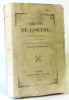
Etat Passable dos recollée extérieur défraîchi et terni gondolé intérieur clair texte net
Renard (Le) goethe johann-wolfgang
Attention édition de 1983. cartonné.
Merci de nous contacter à l'avance si vous souhaitez consulter une référence dans notre boutique à Authon-du-Perche.
Goethe. Faust : 1er cycle, 1re partie et 1er acte de la 2e partie. Texte allemand. Traduction en vers par P. Brégeault de Chastenay [Unknown Binding] Goethe, Johann Wolfgang von and Brégeault de Chastenay, P.
Broché bon état sous papier cristal . Un des exemplaire numéroté sur vélin glacé. Quelques pages non coupées . 1948. 270 pages . Goethe. Faust : 1er cycle, 1re partie et 1er acte de la 2e partie. Texte allemand. Traduction en vers par P. Brégeault de Chastenay
Merci de nous contacter à l'avance si vous souhaitez consulter une référence dans notre boutique à Authon-du-Perche.
LE FAUST de GOETHE. Traduction complète précédée d'un essai sur Goethe. Accompagné de notes et de commentaires et suivie d'une étude sur la mystique du poéme par M. Henri Blaze
Paris Charpentier, Libraire-Editeur 1844 in 12 (18x11,5) 1 volume reliure demi chagrin vert de l'époque, dos lisse orné d'un grand fer doré de style rocaille, tranches peignées, 535 pages, quelques rares rousseurs éparses. Johann Wolfgang von Goethe, 1749-1832. Bel exemplaire ( Photographies sur demande / We can send pictures of this book on simple request )
Bon Couverture rigide
Confessions d'une belle âme.
Paris, Librairie Stock, Delamain et Boutelleau, "A la promenade", 1931 1 volume In-8° tellière (11 x 17,2cm) Broché sous couverture rouge rempliée. 162p., 1 feuillet. Dos insolé; petites rousseurs sur les gardes, faux-titre et dernière page de texte.
Edition originale de la traduction, par Albert BEGUIN (1901-1957) de ces "confessions" écrites en 1795 et qui, introduites par Johann Wolfgang von GOETHE (1749-1832) dans les "Années d'apprentissage de Wilhelm Meister" (6è livre), en sont "facilement détachables": présentant un "fidèle portrait d'une amie de sa mère, Susanna-Katharina von Klettenberg" (Albert BEGUIN), elles ont été composées, dit GOETHE dans ses "Mémoires", "d'après [ses] lettres et [...] entretiens"; introduction d'Albert BEGUIN. Tirage à 2750 exemplaires sur vélin: exemplaire justifié n° 171.
Goethe's Werke. Vollständige Ausgabe letzter Hand. Unter des durchlauchtigsten deutschen Bundes schützender Privilegien.
55 Bände in 28. Stuttgart und Tübingen, in der J. G. Cotta'schen Buchhandlung (gedruckt bei Cotta in Augsburg), 1828-1835. Kl.-8°. Marmorierte Pappbände der Zeit mit hs. Papier-Rückenschildchen.
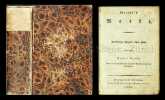
Hagen 23, Ausgabe C2beta, mit Bogennorm "Goethe's Werke". - Ausgabe letzter Hand in der sogenannten Taschen- oder Kleinoktav-Ausgabe auf Druckpapier. "Von Goethe unter Mitwirkung von Göttling, Eckermann und Riemer sorgfältig vorbereitete Ausgabe. Beruht in ihren bereits früher gedruckten Teilen auf den vorwiegend von Göttling, in geringem Masse von Goethe selbst korrigierten Bänden von B bzw. auf den inzwischen erschienenen Eindzeldrucken" (Hagen). Die Bände 1-10 tragen das Erscheinunsjahr 1828 (bei Hagen 1827) "ein wahrscheinlich erst nach 1830 entstandener Neudruck" (Hagen). Die Bände 41-55 mit dem Vortitel "Goethe's nachgelassene Werke. Erster - Fünfzehnter Band". Letzterer enthält die "Inhalts- und Namen-Verzeichnisse über sämmtliche Goethe'schen Werke" von Carl Theodor Musculus und Riemer, sowie die Anzeige für die 55bändige Ausgabe in gross Octav. Die erst 1842 erschienenen Nachtragsbände sind, wie meist, nicht vorhanden. - Teilweise etwas gebräunt, Kanten und Rückenschildchen etwas berieben.

Phone number : 41 (0)44 261 57 50
Dir selbst sei treu. Gedichte und Sprüche von Johann Wolfgang von Goethe. Mit fünf farbigen lithographien von Hans Erni.
Bern, Alfred Scherz Verlag ohne Jahr, ca. 1958, 100x75mm, 47Seiten, Verlegereinband. Mit Shuber. Schönes Exemplar.
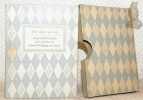
Kontrolle durchgeführt: vollständig mit 5 Farblithografien und einer zusätzlichen Originalzeichnung auf der oberen Deckblattseite, vom Künstler signiert, Pour un paiement via PayPal, veuillez nous en faire la demande et nous vous enverrons une facture PayPal
Schiller Goethe Johann Wolfgang von Herr Lucien
Reference : 015592VPSH
ISBN : B001D4VCQ8
Correspondance entre Schiller et Goethe. 1794-1805. Traduite d'apr¿s l'dition dfinitive allemande et prcde d'une introduction par Lucien Herr. III. 2 janvier 1798-17 aot 1799. IV. 27 aot 1799-26-27 avril 1805. 2e dition
Gnrique Broch D'occasion tat correct 01/01/1923 150 pages
La Vocation théâtrale de Wilhelm Meister - Première version de Wilhelm Meister, écrite par Goethe dans sa jeunesse.
Paris, Bernard Grasset, "Les Cahiers verts", 1924 1 volume In-8° (11,8 x 18,9cm) Broché. 2 feuillets, 538p., 1 feuillet. Couverture insolée (1er plat et dos plus jaunes que verts); petite fente le long de la couture de la 1ère garde (de papier fin).
Edition originale de la traduction de Florence HALEVY de "Wilhelm Meisters theatralische Sendung", première version du roman "Wilhelm Meister", composée entre 1777 et 1785 par Johann Wolfgang von GOETHE (1749-1832) et qui ne sera publiée qu'en 1912; introduction de Michel ARNAULT. Tirage à 7150 exemplaires: 1 des 6600 sur vergé, justifié n°1955, dans la collection dirigée par Daniel Halévy.

