 Write to the booksellers
36 books for « meursius j »Edit
-
Language
French (35)
Latin (1)
-
Century
17th (6)
18th (2)
20th (1)
-
Countries
Belgium (12)
Denmark (5)
France (9)
Greece (1)
Netherlands (6)
Switzerland (3)
-
Syndicate
ILAB (10)
SLAM (3)
Topics
- Bibliophilism (1)
- Books from the xviiith (1)
- Christianity (1)
- Classic literature (1)
- Curiosa (4)
- Early printed books (1)
- Elzevier (1)
- Erotic (2)
- Europe (1)
- First edition (1)
- Games toys (1)
- Greece (1)
- History (6)
- Holland (1)
- Isaac (1)
- Linnean society of lyons (1)
- Literature (1)
- Lyons and area (1)
- Lyons college (1)
- Lyons college pc (1)
- Lyons revue (1)
- Protestantism (1)
- Reliure (1)
- Scandinavian (2)
- Theophrastus (1)
- Vocabulary (1)
Ioannis Meursii Glossarium Graeco-Barbarum. In quo praeter vocabula quinque millia quadringenta, Officia atque Dignitates Imperii Constantinop. tam in Palatio, quam Ecclesia aut Militia, explicantur, & illustrantur. Editio altera emendata, & circiter MDCCC vocabulis aucta.
Leiden (Lugduni Batavorum), Apud Ludovicum Elzevirium, 1614.
4to. (XVI),672 (recte 674),(2 blank) p. Calf . 24 cm <The first important dictionary of medieval and modern Greek> (Ref: STCN ppn 832945064; Willems 91; Rahir 72; Berghman 710; Graesse 4,510; Ebert 13952; Brunet 3,1684) (Details: Back gilt and with 5 raised bands. Red morocco lettring label. Marbled endpapers. Title page printed in red and black. Woodcut of Elsevier's first printer's mark on the title, depicting an aegle that holds a bundle of 7 arrows in its beak, the bird is surrounded by the motto: 'A. 1595, Concordia Res Parvae crescunt'; the seven arrows represent the union of the Seven Provinces of the Dutch republic. Engraved on the verso of the title page the wellknown portrait of Meursius. Printed in 2 columns) (Condition: Binding scuffed, especially at the extremes. Corner of the letterpiece on the back gone. Name on the front flyleaf and on the verso of the title. Small underlinings and marginal notes in ink. Paper slightly foxed, yellowing, and sometimes slightly browning) (Note: The Dutch classicist and historian Johannes Meursius (Johannes van Meurs), 1579-1639, was professor of History and Greek in the university of Leiden from 1610 till 1620. He studied under the genius J.J. Scaliger, and is best known for the 'editiones principes' of a number of Byzantine authors that he produced, his lexicographical works, and the 'editio princeps' of the 'Elementa Harmonica' of Aristoxenus (1616). He edited also the 'Timaeus' of Plato with the commentary and translation of Chalcidius (1617). Meursius' indefatigable labours concerned also the history of ancient Greece, and especially Eleusis, and the antiquities of Athens and Attica, and of Sparta. His work was widely used as source by later ancient historians. Nothing that related to the history of Athens he left untouched, law, government, festivals, institutions, manners, literature, religion etc. The dazzling variety of titles of part of his pioneering work seems almost to exhaust the subject 'ancient Athens'. Meursius' work was widely used as source by later ancient historians, and they laid the foundations of much later learning. Meursius work was incorporated in Jacobus Gronovius' 'Thesaurus Graecarum antiquitatum', Leiden 1697-1702. The first edition of Meursius' lexicographic work 'Glossarium Graeco-Barbarum' was published by Elsevier at Leiden in 1610. This second augmented edition of 1614 contains more than 5400 words, arranged in alphabetical order, with a translation, explanation and elucidation in Latin. Meursius compiled the glossarium from the works of hitherto published works of Byzantine authors, and from a number of manuscripts of the Library of the Leiden University. The greater part of the 'Glossarium' was later incorporated in the still indespensable 'Glossarium ad scriptores mediae et infimae Graecitatis' (Paris 1688) of the famous French Charles philologist and historian of Byzantium and the Middle Ages, Charles du Fresne, sieur du Cange) (Provenance: On the front flyleaf: 'Jo. Aug. Henr. Tittmanni, Dr. P.'. The German theologian and philosopher Johann August Heinrich Tittmann, 1773-1831, was appointed after his 'Habilitation' in 1793 professor of philosophy (1796) and theology (1800) at the University of Leipzig and became known as a writer of numerous philosophical and theological works. (See his Wikipedia article) On the blank margin below Meursius' portrait the name: 'M. Joh. Frider. Fischerus, Coburgensis a C.N. 1751'. This is the philosopher and classical scholar Johann Friedrich Fischer, born at Coburg in 1726. He died in Leipzig in 1799. Fischer was from 1751 'Konrektor', and from 1767 till 1799 Rektor of the 'Thomasschule' at Leipzig, and he was from 1762 also professor of classics at the University of Leipzig. He produced several editions of classical authors and wrote works on Biblical criticism.(See his Wikipedia article)) (Collation: *-2*4, A-4P4 (4P4 blank) (The pagination jumps between the gathering 4C and 4D from 576 to 579. Otherwise nothing irregular, the catchword connects and the text continues as it should) (Photographs on request)
Ioannis Meursii Theophrastus. Sive de illius libris, qui injuria temporis interciderunt, liber singularis. Accedit Theophrastarum lectionum libellus.
Leiden (Lugduni Batavorum), Ex officina Elseviriana, 1640.
12mo. 111,(5 index),10,(3),(3 blank) p. Modern boards. 13.5 cm (Ref: STCN ppn 061216267; Willems 504; Rahir 499; Berghman 1285; Hoffmann 537/38) (Details: Elsevier's woodcut printer's mark on the title, depicting an old man standing in the shade of a vine-entwined elmtree, symbolising the symbiotic relationship between scholar and publisher. The motto is: 'Non solus'. After the index at the end we find: 'Adolphi Vorstii Epistola de obitu V.Cl. Ioannis Meursii ad filium ejus Joannem, iuvenem praestantissimum', followed by a short 'epitaphium' for Meursius by his friend A. Buchellius, and an elegiac couplet of Nicolaus Heinsius) (Condition: Title page soiled, and a small piece removed from the tip of its right lower corner. Small stamp on the title. 3rd leaf slightly soiled) (Note: The Greek scholar Theophrastus, ca. 370-287? B.C., was a pupil, collaborator and successor of Aristotle. He was a scientific researcher rather than a speculative philosophers. Only a small part of Theophrastus' output has been preserved, or as Meursius observes at the beginning of this 'liber singularis' of 1640: 'paucis conservatis, pleraque interciderunt', 'few works have been saved, most have perished'. (p. 5) The importance of classification runs through all his extant works, including even the brochure known as the Characters' (Charaktêres). This collection of 30 descriptive sketches of types of people exhibiting deviations from proper norms of behaviour is nowadays his most famous and most imitated work. This title of 1640 is the only edition of the last work of the Dutch classicist and historian Johannes Meursius (Johannes van Meurs), 1579-1639. It consists of 2 parts, the first of which (p. 1/82) is on the lost works of Theophrastus. Meursius list here 234 works, with sources and testimonia. The second part (p. 83/111) contains notes and emendations by Meursius on a number of Theophrastus' extant works, 'Ioannis Meursii Lectiones Theophrasteae, in quibus eorum librorum, qui supersunt loca aliquot emendantur'. Meursius was professor of History and Greek in the university of Leiden from 1610 till 1620. He studied under the genius J.J. Scaliger, and is best known for the 'editiones principes' of a number of Byzantine authors that he produced. Meursius' indefatigable labours concerned also the history of ancient Greece, and especially Eleusis, and the antiquities of Athens and Attica. Meursius laid with his works the foundations of much later learning) (Provenance: The stamp on the title is a crown with 7 pearls (of a Dutch/German/Austrian baron?) Beneath the crown 2 intertwined initials 'C.C'. or 'C.D') (Collation: A-E12, F6 (leaf F5 verso and F6 blank)) (Photographs on request)
Ioannis Meursii Criticus Arnobianus tributus in libros septem. Item Hypocriticus Minutianus, & Excerpta MS. Regii Parisiensis. Editio altera, & melior.
Leiden (Lugduni Batavorum), Ex officina Ludovici Elzevirii, 1599.
8vo. (XX),167,(23)(1 blank) 18th century half calf 17.3 cm (Ref: STCN ppn 119504200; Dibdin 1,215: 'an indispensable work to peruse, for those who are curious in the learning of the author'. Willems 44; Rahir 26; Berghman 1283; Schoenemann 1,166/67) (Details: Back gilt and with 5 raised bands. Red shield in second compartment. Colophon at the end: 'Lugduni Batavorum, Excudebat Ioannes Balduini. Anno 1599, mense Julio') (Condition: Binding worn at the extremes. Joints split, but still tight. Small piece at the head of the spine gone. Ownership inscription on the front flyleaf. Stamp on the title. Foxed) (Note: Arnobius, a teacher of rhetoric at Sicca Veneria in Numidia 'was suddenly converted to Christianity (ca. A.D. 295) and a year or 2 later, at the instance of his bishop, wrote seven books 'Adversus Nationes', Against the Pagans. His work throws light on the Christian-pagan debate immediately before the Great Persecution, while the venom of his attack on traditional Roman paganism shows that this was by no means dead'. (OCD 2nd edition p. 122) His style is easy-flowing. Arnobius makes little use of the New, and none of the Old Testament. His view of God is platonic. The unintended side effect of the efforts Arnobius and other Church Fathers to ridicule or crush paganism, was that their writings form an archive which preserves knowledge and practices of polytheism in the years of its decline in late antiquity. Just as the early christians bolstered their piety by contrasting it with the demonic foulness of pagan religion, so the protestants of the 16th century used their knowledge of pagan idolatry to scourge their catholic adversaries. Critics of Catholicism, like Calvin, compared catholic mass e.g. with the bloody rituals of the pagans, and used the sacrifices of the ancients to score theological points against their opponents. 'Protestants detected in the Catholic cult of images, the pagan idols so well described by late antique critics like Arnobius'. (The Classical Tradition, Cambr. Mass., 2010, p. 678, s.v. Paganism) The work of Arnobius was first published in Rome in1542 (although the preface is dated 1543), containing as Book Eight the 'Octavius' of Minucius Felix. Other editions followed in 1546, 1560, 1580, 1582, 1583 & 1586. Joannes Meursius, or in Dutch 'Jan de Meurs', 1579-1639, was only 19 years old when he published the first edition of this celebrated 'Criticus Arnobianus' in Leyden in 1598. He was a pupil of the genius J.J. Scaliger, who helped him to publish it. It was a work of philology and not of theology, and it enjoyed a mixed reception. Schoeneman observes that the book showed indeed the 'acumen' of the author's genius, but that it is more on others classical authors than on Arnobius and Minucius Felix. Meursius offers for the greater part animadversions, critical notes, conjectures and emendations. He did not consult manuscripts, but used his 'ingenium'. The next year, 1599, Elsevier published this second improved edition of the 'Criticus Arnobianus'. It was not 'augmented', as is usual with second editions, on the contrary, Meursius wisely cut a number of his rash suggestions. In 1610 Meursius became professor of Greek in his own university. There, in Leyden, he produced the 'editiones principes' of a number of Byzantine authors, the 'editio princeps' of the 'Elementa Harmonica' of Aristoxenus (1616), and edited the 'Timaeus' of Plato with the commentary and translation of Chalcidius (1617). He wrote much on the antiquities of Athens and Attica. (J.E. Sandys, 'A history of classical scholarship', 1964, p. 311)) (Provenance: In ink on the front flyleaf: 'Robinson Ellis from I. Bywater, Oct. 1887'. Robinson Ellis, 1834-1913, is a crucial figure in the history of textual and literary criticism of Catullus. He was elected to a fellowship at Trinity College, Oxford, in 1858, appointed professor of Latin at Univerisity College London (1870-1876). In 1893 he succeeded Henry Nettleship as Corpus Professor of Latin. (DBC 1,285) See for a charming portrait of Ellis his Wikipedia lemma. Ingram Bywater, 1840-1914, succeeded in Oxford Benjamin Jowett as Regius professor of Greek in 1893. He was a noted bibliophile whose collection now rests in the Bodleian Library. He 'occupies an important place in the modern history of ancient philosophy in Britain. (...) He is best known for his contribution to Aristotelian studies. His text of the Nicomachean Ethics (1890) was used as a model for the series, Oxford Classical Texts, inaugurated in 1898'. (DBC 1.145) On the front flyleaf also in ink: 'Ex libris Gal. Barrovi, 18o mensis Iunii 1948'. This is probably Walter Barrow, 1867-1954, Pro-chancellor, 1933-1939, of the University of Birmingham) (Collation: +10, A-M8 (leaf M8 verso blank)) (Photographs on request)
Ioannis Meursi Regnum Atticum. Sive de regibus Atheniensium, eorumque rebus gestis, libri III.
(Amsterdam (Amstelodami), Apud Ioannem Iansonium, 1633.
4to. 238;(25 index),(1 blank) p. Contemporary mottled calf 20 cm (Ref: STCN ppn 085747009) (Details: Back gilt and with 5 raised bands. Red morocco letterpiece. Woodcut printer's device on the title, depicting a farmer with a shovel, and a man with a Jacob's staff before his eye, between them a celestial sphere, above them Fama blowing 2 trumpets, motto: 'Vivitur ingenio', short for 'Vivitur ingenio, caetera mortis erunt'. Edges dyed red) (Condition: Upper margin of the title dustsoiled and with some minute tears. Armorial bookplate on the front pastedown) (Note: The Dutch classicist and historian Johannes Meursius (Johannes van Meurs), 1579-1639, was professor of History and Greek in the university of Leiden from 1610 till 1620. He studied under the genius J.J. Scaliger, and is best known for the 'editiones principes' of a number of Byzantine authors that he produced, and the 'editio princeps' of the 'Elementa Harmonica' of Aristoxenus (1616). He edited also the 'Timaeus' of Plato with the commentary and translation of Chalcidius (1617). Meursius' indefatigable labours concerned also the history of ancient Greece, and especially Eleusis, and the antiquities of Athens and Attica. His work was widely used as source by later ancient historians. Nothing that related to the history of Athens he left untouched, law, government, festivals, institutions, manners, literature, religion etc. The dazzling variety of titles of part of his pioneering work seems almost to exhaust the subject 'ancient Athens': De populis Atticae (1616), Atticarum lectionum libri VI (1617), Aeschylus, Sophocles, Euripides. Sive de tragoediis eorum (1619), Panathenaea. Sive de Minervae illo gemino festo (1619), Eleusinia. Sive, de Cereris Eleusinae sacro, ac festo (1619), Fortuna Attica. Sive, de Athenarum origine (1622), Archontes Athenienses. Sive, de ijs, qui Athenis summum istum magistratum obierunt (1622), Cecropia. Sive de Athenarum arce, & ejusdem antiquitatibus (1622), De ludis Graecorum (1622), Pisistratus. Sive, de ejus vita, & tyrannide (1623), Athenae Atticae. Sive, de praecipuis Athenarum antiquitatibus (1624), Areopagus. Sive, de senatu areopagitico (1624), Regnum Atticum. Sive, de regibus Atheniensium (1633), Reliqua Attica; sive, ad librum De populis Atticae, paralipomena (1684), Theseus, sive de ejus vita rebusque gestis (1684), Themis Attica sive De legibus Atticis (1685) It is manifest that Meursius with these works laid the foundations of much later learning. This title of 1633 was incorporated in Jacobus Gronovius' 'Thesaurus Graecarum antiquitatum', Lugduni Batavorum 1697-1702, vol. IV, col. 1021-1140) (Provenance: Bookplate of 'William Markham Esq., Becca Lodge Yorkshire'. In the 'History, Directory and Gazetteer of the County York', London 1823, p. 643, in a chapter 'Seat of the nobility and Gentry of the West Riding of Yorkshire' a William Markham Esq., who lived at Becca Lodge, 1 mile North of Aberbord, is mentioned. In 1804 he was a member of the Grand Jury of York. He was the eldest son of William Markham, Archbishop of York, who died in 1807. He was born on 5th of April 1760. He 'was private secretary to Warren Hastings, and subsequently resident for some time at Benares, India. Eventually returning to Yorkshire, he seated himself at Becca Hall. He married 20 Aug. 1795, Elizabeth, dau. of the late Oldfied Bowles, Esq. of North Aston, and died 1841'. (B. Burke, 'Genealogical and Heraldic History of the Landed Gentry of Great Britain & Irland', London 1871, Volume 2 p. 885) (Collation: A-2K4 (leaf 2K4 verso blank)) (Photographs on request)
Ioannis Meursii Reliqua Attica; sive ad librum De populis Atticae Paralipomena. Liber singularis. Cui accedit Auctarium ex Itinerario (de Pagis Atticis) Jacobi Sponii. (Bound with:) Ioannis Meursii Theseus, sive de ejus vita rebusque gestis liber postumus. Accedunt ejusdem Paralipomena de Pagis Atticis, et Excerpta ex v.cl. Jacobi Sponii Itinerario de iisdem pagis. (And with:) Ioannis Meursii Themis Attica, sive De legibus Atticis libri II.
Ad 1 & 2: Utrecht (Ultrajecti), Apud Franciscum Halma, 1684. 3: Utrecht (Trajecti ad Rhenum), Apud Joannem vande Water, Joannem Ribbium, Franciscum Halma, 1685.
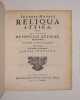
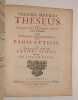
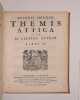
4to. 3 volumes in 1: 52,(8 index),40; (VIII),136,(12 index); (IV),152,(20 index) p. Vellum 20 cm (Ref: STCN ppn 066811074; STCN ppn 066811007; STCN ppn 840519370; Haitsma Mulier/Van der Lem 334u & 334t) (Details: 6 thongs laced through the joints. Short title calligraphed with black ink on the back. Title of 'Theseus' printed in red & black. Emblematic woodcut printer's device on the third title, depicting Ceres and Athena, labour and science, the motto is: 'vivitur in genio', 'only through his genius man survives') (Condition: Vellum slightly soiled) (Note: The Dutch classicist and historian Johannes Meursius (Johannes van Meurs), 1579-1639, was professor of History and Greek in the university of Leiden from 1610 till 1620. He studied under the genius J.J. Scaliger, and is best known for the 'editiones principes' of a number of Byzantine authors he produced, and the 'editio princeps' of the 'Elementa Harmonica' of Aristoxenus (1616). He edited also the 'Timaeus' of Plato with the commentary and translation of Chalcidius (1617). Meursius' indefatigable labours concerned also the history of ancient Greece, and especially Eleusis, and the antiquities of Athens and Attica. His work was widely used as a source by later ancient historians. Nothing that related to the history of Athens he left untouched, law, government, festivals, institutions, manners, literature, religion etc. The dazzling variety of titles of part of his pioneering work seems almost to exhaust the subject 'ancient Athens': De populis Atticae (1616), Atticarum lectionum libri VI (1617), Aeschylus, Sophocles, Euripides. Sive de tragoediis eorum (1619), Panathenaea. Sive de Minervae illo gemino festo (1619), Eleusinia. Sive, de Cereris Eleusinae sacro, ac festo (1619), Fortuna Attica. Sive, de Athenarum origine (1622), Archontes Athenienses. Sive, de ijs, qui Athenis summum istum magistratum obierunt (1622), Cecropia. Sive de Athenarum arce, & ejusdem antiquitatibus (1622), De ludis Graecorum (1622), Pisistratus. Sive, de ejus vita, & tyrannide (1623), Athenae Atticae. Sive, de praecipuis Athenarum antiquitatibus (1624), Areopagus. Sive, de senatu areopagitico (1624), Regnum Atticum. Sive, de regibus Atheniensium (1633), Reliqua Attica; sive, ad librum De populis Atticae, paralipomena (1684), Theseus, sive de ejus vita rebusque gestis (1684), Themis Attica sive De legibus Atticis (1685) It is manifest that Meursius with these works laid the foundations of much later learning. The works in this convolute have been edited by J.G. Graevius, who has added at the beginning of the 'Theseus' a dedicatio to Carolus Sanctamauraeus, tutor of the Dauphin of France) (Collation: A-G4, H2; 2A-E4; *4, A-R4, chiS4, S2; (after the last textpage of the Theseus (leaf R4) a gathering (chiS) with an 'Index rerum' has been inserted, before the 'Index auctorum' to which the catchword of R4-verso is referring. STCN errs in indicating S2 as chiS2); *2, A-X4, Y2) (Photographs on request)
Ioannis Meursii Panathenaea, sive de Minervae illo gemino festo liber singularis.
Leiden (Lugduni Batavorum), Ex officina Elzeviriana, 1619.
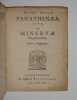
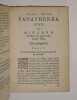
4to. (VIII),48 p. Calf 18 cm (Ref: Wiilems 161; Rahir 131; Berghman 1977) (Details: Woodcut printer's mark on the title, depicting an eagle with spread wings on a pedestal; the bird holds in its beak a set of 7 arrows bound together; the motto reads: 'Concordia res parvae crescunt'; the bundle of arrows symbolizes The Dutch Republic of the Seven United Netherlands (also Provinces); since its foundation in 1588 the motto of the United Provinces was 'Concordia res parvae crescunt', in Dutch: 'Eendracht maakt macht', a still popular motto in the coat of arms of many countries. The saying was coined by the Roman historian Sallust. (Bellum Jugurthinum, caput 10)) (Condition: Binding very scuffed: leather on the back wearing away; scratches on the boards; front joint partly split and broken; corners bumped. Front flyleaf gone. Title dustsoiled. Some light foxing on the first and last pages. Right lower corner of the last gathering faintly waterstained) (Note: The Dutch classicist and ancient historian Johannes Meursius (Johannes van Meurs), 1579-1639, was professor of History and Greek since 1610/13 in the university of Leiden. He studied under the genius J.J. Scaliger, and is best known for the 'editiones principes' of a number of Byzantine authors he produced, and the 'editio princeps' of the 'Elementa Harmonica' of Aristoxenus (1616). He edited also the 'Timaeus' of Plato with the commentary and translation of Chalcidius (1617). He wrote much on the history of ancient Greece, on Eleusis, and especially on the antiquities and festivals of Athens and Attica. His work was widely used as source by later ancient historians. (J.E. Sandys, 'A history of classical scholarship', 1964, p. 311) The tradition of studying the 'Athenian Festivals' goes back to antiquity, was kept alive during the Renaissance, and is still flourishing today. The real mark of a festival is the breadth of participation, i.e. whether large groups of the population participate in the celebration. The Panathenaea, or Panathenaic Games, were held every four years in ancient Athens and are doubtless the best known of all Greek festivals, with the exeption of Eleusis. It was held in honour of Athena, in the form of Athena Polias, the protectress of the city. There were two kinds of Panathenaea, the lesser one, often called Panathenaea, without any epithet, and greater Panathenaea, which had the adjective µe???a. The difference between the two festivals was, that the greater one was more solemn and luxurious, and that the peplus of Athena was brought to the Parthenon on the Akropolis in a magnificent procession. The great Panathenaea were held every fourth year, in the third year of every Olympiad, and lasted a number of days. There were solemn and very munificent offerings and rituals, a torch-race, or lampadephoria/lampadarium, was held between the Athenian phylai, athletic competitions, chariot races, musical, dance and reciting contests were organized, and there was an abundance of food and entertainment. The chief solemnity was the procession to the temple of Athena Polias, where a vestment, the peplos, was consecrated and offered to the goddess. Meursius treats all these aspects, constantly referring to ancient sources. It is clear that all later research on the subject is based on the foundations he laid) (Collation: *4, A-F4) (Photographs on request)
LOYOLA Ignatius de - JESUITS ANTWERP 1635 - Johannes MEURSIUS (publisher ) : :
Reference : 30758
Regulæ Societatis Jesu. Auctoritate Septimæ Congregationis Generalis auctæ. ( Bound with) . Decreta Congregationum Generalium Societatis Iesu
" Antverpiae (Antwerpen), Johannes Meursius, 1635, in-8°, 276 + (49)nn pp (index). Contemporary leather, raised and gilt decorated spine, extremeties worn away, binding with many traces of use, speckled edges, handwritten ex-libris, ex-library with two 19th century stamps on title, part of margin torn on p. 37 of second work, and wormholes at corner of final pages. Still an acceptable copy. Bound with; Decreta Congregationum Generalium Societatis Iesu, Johannes Meursius, 1635, 474 + (30) nn pp The rules of the Jesuit Society. These two volumes (bound in one) belong to the first complete edition of the ''Corpus Institutorum S. Iesu'' which was published by Meursius in 1635 in 16 parts, all with a separate title. Accoding the list by De Backer these are items 15 and 5. (See De Backer-Sommervogel Vol. V col. 81). (Jesuit, Jesuits)."
LOYOLA Ignatius de - JESUITS ANTWERP 1635 - Johannes MEURSIUS ( publisher) ::
Reference : 53315
Regulæ Societatis Jesu. Auctoritate Septimæ Congregationis Generalis auctæ. ( Bound with) . Decreta Congregationum Generalium Societatis Iesu
" Antverpiae (Antwerpen), Johannes Meursius, 1635, in-8°, 276 + (49)nn pp (index). Contemporary vellum, edges painted red, binding a bit soiled, lower turn-in damaged. With a contemporary handwritten ex-libris of the Carmelite order at Saint-Omer. (Northern France) , further two rubber stamps ex-libris of this order, one with the name ''Collège St. Bertin à Saint-Omer''. With the modern printed ex-libris of Lieven Spyckerelle ( Flemish collector). Bound with; Decreta Congregationum Generalium Societatis Iesu, Johannes Meursius, 1635, 474 + (30) nn pp The rules of the Jesuit Society. These two volumes (bound in one) belong to the first complete edition of the ''Corpus Institutorum S. Iesu'' which was published by Meursius in 1635 in 16 parts, all with a separate title. These two titles are listed in 15th and 5th postion by De Backer.. (De Backer-Sommervogel Vol. V col. 81). (Jesuit, Jesuits)."
LOYOLA Ignatius de - [ ] JESUITS ANTWERP 1635 - MEURSIUS ( publisher ) ::
Reference : 55793
Litterae Apostolicae, quibus Institutio, confirmatio, et varia Privilegia continentur Societatis Jesu. [1] (Bound with) [2] Constitutiones Societatis Iesu et Examen cum Declarationibus. (Bound with) [3] Regulae Societatis Jesu. Auctoritate Septimae Congrgationis Generalis auctae.. ( 3 vols. bound in one volume).
" Antverpiae (Antwerpen), Johannes Meursius, 1635, in-8°, [1] 384 pp + index ; [2] 368 pp + index ; [3] 276 pp + index. , each part with a separate title page. Bound in contemporary full calf, , binding with some wear, 1 small library label on front cover. Interior fine. (On spine in gilt lettering: ''Bulla et decreta Societatis''. The rules of the Jesuit Society. This volume belongs to the first complete edition of the ''Corpus Institutorum S. Iesu'' which was published by Meursius in 1635 in 16 parts, all with a separate title. These three parts are listed as items 1 ; 3 and 15 by De Backer.. (See De Backer-Sommervogel Vol. V col. 81). (Jesuit, Jesuits, rules,constitution). 448 pp + index ; [3] 228 pp. , each part with a separate title page. Bound in contemporary full calf, , binding with some wear, 1 small library label on front cover. Interior fine. (On spine in gilt lettering: ''Bulla et decreta Societatis - Tome IV). The rules of the Jesuit Society. This volume belongs to the first complete edition of the ''Corpus Institutorum S. Iesu'' which was published by Meursius in 1635 in 16 parts, all with a separate title. These three parts are listed as items 12 ; 14 and 16 (= index, last part). (De Backer-Sommervogel Vol. V col. 81). (Jesuit, Jesuits, rules,constitution)."
LOYOLA Ignatius de - [ ] JESUITS ANTWERP 1635 - MEURSIUS ( publisher ) ::
Reference : 55794
Litterae Apostolicae, quibus Institutio, confirmatio, et varia Privilegia continentur Societatis Jesu. [1] (Bound with) [2] Constitutiones Societatis Iesu et Examen cum Declarationibus. . ( 2 parts. bound in one volume).
" Antverpiae (Antwerpen), Johannes Meursius, 1635, in-8°, [1] 384 pp + index ; [2] 368 pp + index , each part with a separate title page. Bound in contemporary full calf, , binding with some wear, especially at the extremities. some loss of leather at lower end of spine, two small library stamps on title. Interior fine. (On spine an old paper label.. The rules of the Jesuit Society. This volume belongs to the first complete edition of the ''Corpus Institutorum S. Iesu'' which was published by Meursius in 1635 in 16 parts, all with a separate title. These two parts are listed as items 1 and 3 by De Backer.. (See De Backer-Sommervogel Vol. V col. 81). (Jesuit, Jesuits, rules,constitution). 448 pp + index ; [3] 228 pp. , each part with a separate title page. Bound in contemporary full calf, , binding with some wear, 1 small library label on front cover. Interior fine. (On spine in gilt lettering: ''Bulla et decreta Societatis - Tome IV). The rules of the Jesuit Society. This volume belongs to the first complete edition of the ''Corpus Institutorum S. Iesu'' which was published by Meursius in 1635 in 16 parts, all with a separate title. These three parts are listed as items 12 ; 14 and 16 (= index, last part). (De Backer-Sommervogel Vol. V col. 81). (Jesuit, Jesuits, rules,constitution)."
Historiae Danicae libri III in quibus commemorantur gestae a Christiano I.
Hafniae (Copenhagen), J. Moltkenius, 1630. 4to (180 x 143 mm). In a bit later half vellum binding with title in later hand to spine. Ex-libris pasted on to pasted down front end-paper and a few notes to front free end-paper. A fine copy. (20), 252, (4) pp.
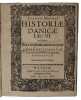
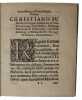
The uncommon first published part (being part III) of Meursius extensive history of Denmark. Christian IV of Denmark offered Meursius to become professor of history and politics at Sorø, in Zealand, combined with the office of historiographer royal, in which role he the present work. Thesaurus 260 Bibl. Dan. III, 43.

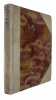
PALAMEDES , SIVE DE TABULA LUSORIA ALEA ET VARIIS LUDIS Libri tres Quorum I , Philologus ; II Historicus ; III Ethicus , seu Moralis ( relié avec : ) DE LUDIS GRAECORUM Liber singularis
Lugduni Batavorum ( Leyde ) Ex officina Isaaci Elzeviri Academiae Typographi 1622 2 ouvrages en 1 vol. petit in-8 (16 x 10,5 cm ) ( 16 ) ff. , 248 pp. + ( 4 ) ff. , 70 pp. , ( 5 ) ff. En latin avec de nombreux passages en grec . Notes marginales . Le 1er ouvrage contient : Epistola dedicatoria Per illustri Domino ac Genrosissimo Heroi D. Edwardo Zouche (....) , Epistola nuncupatoria ad juventutem , Epistola ad benevolum lectorem , In aleam , Monitum ad juventutem , In aleam & aleatores Martialis Monerii elegia , Index capitum , les 3 Livres , et , in fine , Addenda ad cap. III lib. II . Le 2 ème ouvrage contient : Epistola dedicatoria Petro Scriverio , dédicace Benigne lector , et in fine , Auctorum (...) Index , Rerum et verborum (...) Index . Marques typographiques aux deux titres ; lettrines. Plein vélin de l ' époque . Dos lisse , titres et noms des auteurs à l 'encre . Ex-libris manuscrit sur une garde blanche . Petits manques au plat sup. ; 5 ou 6 trous de vers superficiels au plat inf. . Papier jauni , certains cahiers plus que d ' autres . Petit manque marginal au f. 195-196 .
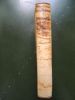
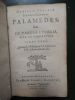
" Tout ce qui regarde les jeux de dez et des osselets chez les anciens a été épuisé par Meursius dans son livre de ludis Graecorum , et par Daniel Souterius dans son Palamède " , lit-on dans l ' Encyclopédie de Diderot et d ' Alembert ( 1780 , T. 24 , p. 109 ) . Et l ' universitaire écossais D ' Arcy Wentworth Thompson ajoutait au sujet du " de ludis Graecorum " : " il y a là davantage de faits et de citations sur les jeux grecs qu ' on en pourrait réunir en une vie de lecture . " ( Alliage n° 44 :jeux et jouets ) . Daniel SOUTER ou SOUTERIUS ( Vlissingen 1571 - Haarlem 1634 ) : prédicateur d ' origine flammande et écossaise , auteur de divers ouvrages . Jan ou Johannes MEURSIUS ou Jean de MEURS dit l ' Ancien ( La Haye 1579 - 1636 ) : professeur d ' histoire à Leyde en 1610 , puis de langue grecque , il reprit la chaire de Scaliger . Il éduqua les enfants du grand pensionnaire Oldenbarnevelt que Maurice Nassau fit décapiter en 1619 . Le roi du Danemark l ' emmena avec lui , et le nomma à l ' université de Sohoe ( Soroë ) . Il laissa des éditions précieuses d ' auteurs classiques et contribua , par sa critique érudite , à faciliter l ' étude des antiquités grecques et latines . [ Rahir n° 176 et 171 ; Willems 207 et 203 ]
[Portraits].
S.l. [Leyde], s.d. (1625) in-4, [17] ff. n. ch., regroupant 30 portraits contrecollés, basane fauve marbrée, dos à nerfs cloisonné et fleuronné, pièce de titre, tranches rouges (rel. du XVIIIe s.). Coiffes rognées, coins abîmés.
![[Portraits].. [MEURSIUS (Jan Van Meurs, dit Joannes)]](https://static.livre-rare-book.com/pictures/CFT/195420_1_thumb.jpg)
![[Portraits].. [MEURSIUS (Jan Van Meurs, dit Joannes)]](https://static.livre-rare-book.com/pictures/CFT/195420_2_thumb.jpg)
![[Portraits].. [MEURSIUS (Jan Van Meurs, dit Joannes)]](https://static.livre-rare-book.com/pictures/CFT/195420_3_thumb.jpg)
Très curieux recueil d'amateur de portraits et de vues découpés dans l'ouvrage du célèbre philologue hollandais Jan Meurs (1579-1639), intitulé , virisque claris qui utramque ingenio suo, atque scriptis, illustrarunt, libri duo (Leyde, 1625), sorte de répertoire des célébrités et des savants de cette ville. Les deux vues représentent le fort de Leyde (Burgus) et les jardins de l'Académie. Les portraits sont ceux de professeurs, de théologiens calvinistes, de médecins et de membres de l'Académie (cf. liste infra). Ils recouvrent des feuillets de texte en français empruntés à un autre ouvrage, et dont certains semblent avoir été intentionnellement découpés (cf. collation), pour aboutir à une adéquation entre le nombre de planches et leurs feuillets de support.1. Ludolph Van Ceulen (1540-1610, mathématicien de Delft). - 2. Daniel Heinsius (1580-1655, philologue). - 3. Anton Thysius (1565-1640, théologien réformé). - 4. Frans Gomaer (1553-1641, théologien calviniste célèbre, à l'origine de la fameuse querelle sur la prédestination qui déchira les Pays-Bas au début du XVIIe siècle). - 5. Jeremias Bastinck / Bastingius (1551-1595, théologien réformé). - 6. Willebrord Snell Van Royen (1580-1626, mathématicien, élève de Ludolph Van Ceulen). - 7. Gilbert Jack (1578-1628, philosophe aristotélicien écossais). - 8. Pieter Pauw (1564-1617, botaniste et médecin). - 9. Philip Clüver (1580-1622, géographe). - 10. Gerhard Johann Voss (Vossius, 1577-1649, philologue). - 11. Thomas Van Erpe (Erpenius, 1584-1624, orientaliste). - 12. Peter Van der Kun (Cunaeus, 1586-1638, juriste). - 13. Festus Hommius (1576-1642, théologien calviniste). - 14. Guillaume d'Orange, comte de Nassau. - 15. Jan Van den Driesche (1550-1616, orientaliste). - 16. Huig De Groot (Grotius, 1583-1643, juriste). - 17. Pieter Schryver (Scriverius, 1576-1660, philologue). - 18. Pierre Du Moulin l'Ancien (1568-1658, théologien français). - 19. Pier Bertius (1565-1629, mathématicien). - 20. Adriaen De Jonghe (Junius, 1511-1575, médecin). - 21. Jan Van der Does (Dousa, 1545-1604, historien, premier bibliothécaire de l'Université de Leyde). - 22. Pieter Tara (1514-1586, philologue). - 23. Eberhard von dem Vorst (Vortius, 1565-1624, médecin). - 24. Jacob Harmensen (Arminius, 1569-1609, théologien calviniste, adversaire de Gomaer dans la querelle de la prédestination). - 25. Jan Van Meurs (Meursius, 1579-1639, philologue, auteur du recueil). - 26. André Rivet (1572-1651, théologien français). - 27. Franck Pieterszoon Burgersdijk (1590-1635, logicien). - 28. Anton Van Waele (1573-1639, théologien calviniste). - 29. Luc Trelcat (1542-1602, théologien réformé né à Arras). - 30. Jan Polyander van den Kerckhoven (1568-1646, théologien calviniste).Exemplaire provenant de la maison provençale de Castellane, avec ex-libris armorié du XVIIIe siècle, colorisé à la main (cf. Rietstap I, 383 et OHR 2348 et 2349, pour deux autres possesseurs de cette famille). - - VENTE PAR CORRESPONDANCE UNIQUEMENT - LIEN DE PAIEMENT, NOUS CONSULTER.

1. Historiæ Danicæ, sive de Regibus Daniæ, qui familiam Oldenburgicam...Libri qvinqve priores. 2. Hist. Danicæ...continuato, sive de Regibus Daniæ...Libri qvinqve posteriores..3. Historiæ Danicæ Libri III. In quibus res commemorantur Gestæ à Christian...
Amsterdam, G.& J. Blaeu, 1638. Folio. Samt. hollandsk helpergamentsbind, forlagsbind med stor blindtrykt roset på begge permer. Øverste 2 cm. af ryg fint repareret. Lidt slid ved hjørner. Det 3. værk også med det andet titelblad, her indsat forrest. Kobberstukket portræt af Meursius ved Simon de Pas. (6),118 - (6),133 - (6),87 - (4),150,(2) - (4),112 pp. Frisk, rent eksemplar.
Samlingsbind bestående af 5 værker, alle udgivet af Blaeu- Ehr.-Müller V:377 anfører ikke tryk 4 og 5, ej heller Bibl. Dan. III:13-14.
Athenae Atticae. Sive, de praecipuis Athenarum antiquitatibus libri III. Lugduni Batavorum (Leiden) apud Commelinos Frattes 1624. 4 f., 184 p., 12 f. - Panathenaea. Sive, de Minervae illo gemino festo, liber singularis. Leiden, Elzevir 1619. 4 f., 48 p. - Cecropia. Sive de Athenarum arce, & ejusdem antiquitatibus, liber singularis. idem 1622. 4 f., 93 p., 7 f. - Eleusinia. Sive, de Cereris Eleusinae sacro, ac festo. Liber singularis. idem 1619. 8 f., 104 p. - Fortuna Attica. Sive, de Athenarum origine, incremento, magnitudine, potentia, gloria, vario statu, decremento, & occasu. Liber singularis. Leiden, apud God. Basson 1622. 4 f., 114 f., 7 f.
J. van Meurs was professor of Greek and history at Leiden, with extensive studies on Athenean democracy, holidays, history, state, laws and customs."Most authors have agreed in extolling the ingenuity, learning, and merit of Meursius: he excelled particularly in the knowledge of Greek language and antiquities; and applied himself with such indefatigable pains to correct, explain, translate, and publish many works of the ancients.." [Chalmers]. Contemporary full calf rubed binding, four raised bands, coloured edges, printers mark on the title pages, some occasional light spotting.Title page of the first book formerly restored, ex libris stamp. Title vignettes, second title page in red and black. Willems 161, 201, 159.
LOYOLA Ignatius de - JESUITS ANTWERP 1635 - Johannes MEURSIUS ( printer-publisher) :
Reference : 15062
"Exercitia Spiritualia S.P.Ignatii Loyolae 153 pp.[I] (Bound with) (II) Directorium in Exercitia Spiritualia S.P. Ignatii. 128 pp.(Bound with) (III) Epistolae Praepositorum Generalium ad Patres et Fratres Societatis Jesu 448 pp. (Bound with) (IV) Index Generalis in Omnes Libros Instituti Societatis Iesu. 288 pp. (4 parts of the first edition of the constitution and rules of the Jesuit Order ; bound in 1 contemporary volume."
"4. Antverpiae (Antwerpen), Johannes Meursius ( Meursium ) , 1635, thick in-8°, cont. vellum. Vellum a bit soiled but in good condition; (first imprint with rather serious worming in the frst 100 pp., and also some clear old waterstains; other parts are fine.). This volume with its four parts belongs to the first complete edition of the ''Corpus Institutorum S.Iesu'' which was publishededited by Meursius in 1635 in 16 parts all with a separate title. The parts present here are among the last parts of four, including a general index. Parts as listed by De Backer 11, 12, 14, & 16 (last part = index). (De Backer-Sommervogel Vol. V col. 81). (Jesuit, Jesuits)."
LOYOLA Ignatius de - [ ] JESUITS ANTWERP 1635 - MEURSIUS ( publisher ) ::
Reference : 30759
Constitutiones Societatis Jesu. et examen cum declarationibus..
Antverpiae (Antwerpen), Johannes Meursius, 1635, in-8°, 368 + (76)nn pp (index). cont. vellum, (spine with some minor damage) , ex-library copy with old stamp, some index leaves with clear old waterstains, but a good copy. The rules of the Jesuit Society. This volume belongs to the first complete edition of the ''Corpus Institutorum S. Iesu'' which was published by Meursius in 1635 in 16 parts, all with a separate title. This is item 3. (De Backer-Sommervogel Vol. V col. 81). (Jesuit, Jesuits, rules,constitution).
LOYOLA Ignatius de - [ ] JESUITS ANTWERP 1635 - MEURSIUS ( publisher ) ::
Reference : 55792
Directorium in exercitia spiritualia S.P.N. Ignatii. [1] (Bound with) [2] Epistolae Praepositorum Generalium ad Patres et Fratres Societatis Jesu.. (Bound with) [3] Index Generalis in omnes libros Instituti Societatis Iesu. ( 3 vols. bound in one volume).
" Antverpiae (Antwerpen), Johannes Meursius, 1635, in-8°, [1] 128 pp + index ; [2] 448 pp + index ; [3] 228 pp. , each part with a separate title page. Bound in contemporary full calf, , binding with some wear, 1 small library label on front cover. Interior fine. (On spine in gilt lettering: ''Bulla et decreta Societatis'' - Tome IV). The rules of the Jesuit Society. This volume belongs to the first complete edition of the ''Corpus Institutorum S. Iesu'' which was published by Meursius in 1635 in 16 parts, all with a separate title. These three parts are listed as items 12 ; 14 and 16 (= index, last part). (De Backer-Sommervogel Vol. V col. 81). (Jesuit, Jesuits, rules,constitution)."
LOYOLA Ignatius de - [ ] JESUITS ANTWERP 1635 - MEURSIUS ( publisher ) ::
Reference : 55795
Directorium in exercitia spiritualia S.P.N. Ignatii. [1] (Bound with) [2] Epistolae Praepositorum Generalium ad Patres et Fratres Societatis Jesu.. (Bound with) [3] Formulae Congregationum in quarti generali Congregatione..... ( 3 parts bound in one volume).
" Antverpiae (Antwerpen), Johannes Meursius, 1635, in-8°, [1] 474 pp + index ; [2] 80 pp + index ; [3] 136 pp. , each part with a separate title page. Bound in contemporary full calf, , binding with some wear, 1 small library label on front cover. Interior fine. (On spine in gilt lettering: ''Bulla et decreta Societatis'' ). The rules of the Jesuit Society. This volume belongs to the first complete edition of the ''Corpus Institutorum S. Iesu'' which was published by Meursius in 1635 in 16 parts, all with a separate title. These three parts are listed as items 5, 6, and 7 by De Backer (see note De Backer-Sommervogel Vol. V col. 81). (Jesuit, Jesuits, rules,constitution)."
Joannis. Elegantiae latini sermonis seu Aloisia sigeae Toletana De arcanis Amoris & Veneris. Adjunctis fragmentis quibusdam Eroticis.
Lugdunum Batavorum [Paris], ex typis Elzevirianis [Barbou] 1774 Deux parties en un volume. In-8, plein-veau marbré de l’époque, dos lisse, caissons ornés, pièce de titre rouge, filet sur les coupes, XXIV-211-172 pp. Titre gravé, frontispice. Petites usures et coins lég. émoussés. Bon exemplaire frais.
Texte en latin. Ce célèbre poème érotique circula au début du siècle dans les milieux libertins et connut plusieurs éditions en latin sous des titres différents. L'oeuvre originale avait prétendument été écrit en espagnol par Aloysia ou Luisa Sigea, poétesse érudite et fille d'honneur à la cour de Lisbonne, puis traduit ensuite en latin par un certain Jean ou Joannes Meursius, humaniste hollandais. L’auteur en est l’avocat, écrivain et latiniste Nicolas Chorier. Bon état d’occasion Livres anciens
GRAECIA FERIATA. Sive, de festis Graecorum, libri VI. [&] ELEUSINIA. Sive, de cereris Eleusinae sacro, ac festo. Liber Singularis. [&] PANATHENAEA. Sive, de Minervae illo gemino festo, liber Singularis.
1619 Lugduni Batavorum [Leyde], ex officinâ Elzeviriana [Isaac Elzevier], 1619. Trois ouvrages reliés en un volume petit in-quarto (153 X 210) veau havane foncé, double encadrement de filet doré sur les plats, dos cinq nerfs, caissons de double encadrement de filet doré avec fleuron central, dentelle dorée en queue et tête, titre doré (reliure de l'époque). (3) ff. blancs, 341 pages (dont titre), (1) page d'achevé d'imprimer, (1) f. blanc ; (8) ff. (dont titre), 104 pages ; (4) ff. (dont titre), 48 pages, (3) ff. blancs. Restauration à la coiffe supérieure, trace de frottement sur les nerfs.
![GRAECIA FERIATA. Sive, de festis Graecorum, libri VI. [&] ELEUSINIA. Sive, de cereris Eleusinae sacro, ac festo. Liber Singularis. [&] PANATHENAEA. ...](https://static.livre-rare-book.com/pictures/CTE/003666_1_thumb.jpg)
![GRAECIA FERIATA. Sive, de festis Graecorum, libri VI. [&] ELEUSINIA. Sive, de cereris Eleusinae sacro, ac festo. Liber Singularis. [&] PANATHENAEA. ...](https://static.livre-rare-book.com/pictures/CTE/003666_2_thumb.jpg)
![GRAECIA FERIATA. Sive, de festis Graecorum, libri VI. [&] ELEUSINIA. Sive, de cereris Eleusinae sacro, ac festo. Liber Singularis. [&] PANATHENAEA. ...](https://static.livre-rare-book.com/pictures/CTE/003666_3_thumb.jpg)
EDITION ORIGINALE de ces trois rares ouvrages imprimés en caractères grecs et latins par Isaac ELZEVIER. Ils traitent des fêtes et mystères de la Grèce, notamment des fêtes en l'honneur de Cérès ("Eleusinies") et d'Athènes ("Panathénées"). Jean de MEURS, dit "MEURSIUS" (1579-1639), savant philologue hollandais, tient une place distinguée parmi les érudits précoces. Le nom de sa famille était "De Meurs", qu'il latinisa suivant l'usage des érudits de son temps. On doit à ce savant toute une suite de dissertations d'une grande autorité sur une foule de points de littérature et d'histoire critique. (WILLEMS, Les Elzevier, 160, 159, 161 - RAHIR, Catalogue d'une collection unique de volumes imprimés par les Elzevier, 130, 128, 131). BEL EXEMPLAIRE. NICE COPY. PICTURES AND MORE DETAILS ON REQUEST.
"Joannis Meursii elegantiae latini sermonis; Aloisiae sigeae toletanae satyrae sotadicae de Arcanis Amoris et Veneris, pars altera veneres."
s.l., s.e, s.d. "8 x 14, 166 + 238 pages, reliure ancienne plein cuir crème, plats ornés de décor en creux, bon état (quasi pas de rousseurs; papier du deuxième plat déchiré)."
Imprimé vraissemblablement en Hollande vers 1680.
Joannis Meursii elegantiae latini sermonis seu Aloisia Sigaea Toletana de arcanis amoris & veneris adjunctis fragmentis quibusdam eroticis. Nova editio emendatior.
Londini (Paris ?), s.n., 1781. 2 volumes in-18, 3 ff. (titre gravé, titre imprimé, Testimonium), 330 pp. et 2 ff., 233-(3 bl.) pp., ex-libris du xxe siècle non identifié collé sur la garde volante, il manque les deux frontispices gravés. Reliure de l'époque en maroquin rouge, dos lisse orné, triple filet en encadrement des plats, tranches dorées. Manque de cuir aux coins du volume 2, bel exemplaire.
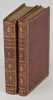
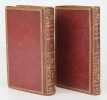
Pascal Pia, Les Livres de l'Enfer, 353, donne cette édition à Cazin d'après celle que Meusnier de Querlon avait fait paraître chez Barbou en 1774. Jean-Paul Fontaine, Cazin l'éponyme galvaudé, 2012, p. 203, classe cette édition dans les faux-Cazin. VACANCES D'ÉTÉ : la librairie sera fermée du samedi 11 juillet au lundi 3 août 2026 inclus, vous pouvez toujours passer vos commandes, elles seront traitées dès notre retour.
ELEGANTIAE LATINI SERMONIS seu Aloisia sigeae Toletana De arcanis Amoris & Veneris. Adjunctis fragmentis quibusdam Eroticis. Pars Prima-Secunda
Lugd. Batavorum [Leiden] Ex typis Elzevirianiis (Paris, Barbou) 1757 in 8 (17x11) 1 volume reliure plein veau glacé fauve de l'époque, dos lisse orné, pièce de titre de maroquin noir, triple filet doré d'encadrement sur les plats, filet doré sur les coupes, tranches dorées, frontispice gravé qui parait être de Gravelot (femme nue), titre avec petite vignette gravée, XXIV, 211 pages; [2] 172 pages. Premier tirage. Ex-libris armorié du Comte Albéric de Marcieu. Très bel exemplaire ( Photographies sur demande / We can send pictures of this book on simple request )
Très bon Reliure
ELEGANTIAE LATINI SERMONIS seu Aloisia sigeae Toletana De arcanis Amoris & Veneris. Adjunctis fragmentis quibusdam Eroticis. Pars Prima-Secunda
Lugduni Batavorum (Paris) Ex typis Elzevirianis (Barbou) 1774 in 8 (20x13,5) 1 volume reliure plein veau fauve de l'époque, dos lisse orné, pièce de titre de cuir vert, triple filet doré d'encadrement sur les plats avec fleurons d'angle a la lyre, filet doré sur les coupes, tranches dorées, frontispice gravé (femme nue), titre gravé, XXIV, 211 pages; [2] 172 pages [1]. Bel exemplaire ( Photographies sur demande / We can send pictures of this book on simple request )
Très bon Reliure

