 Write to the booksellers
MEURSIUS,J.
Ioannis Meursii Panathenaea, sive de Minervae illo gemino festo liber singularis.
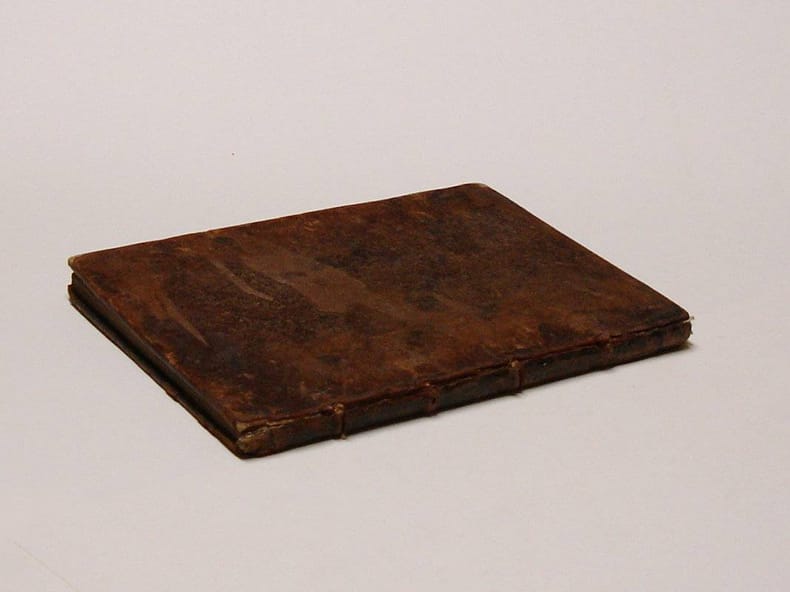
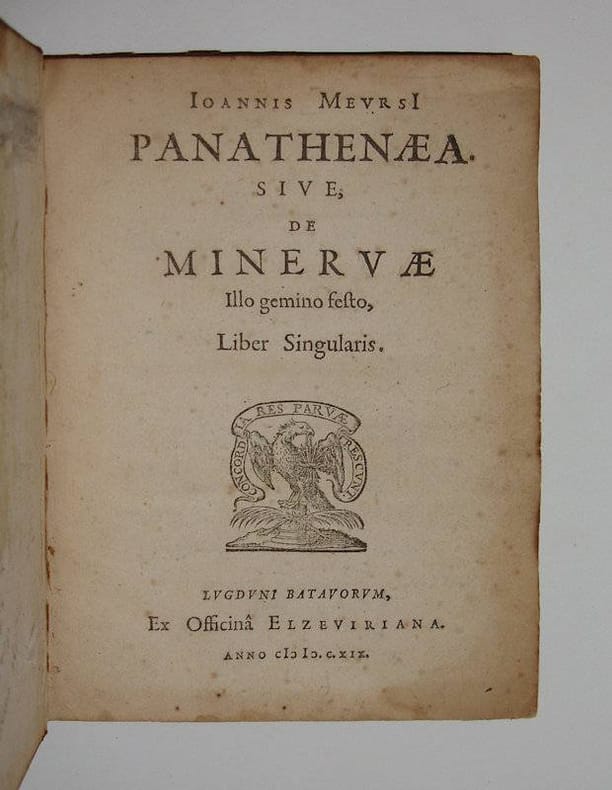
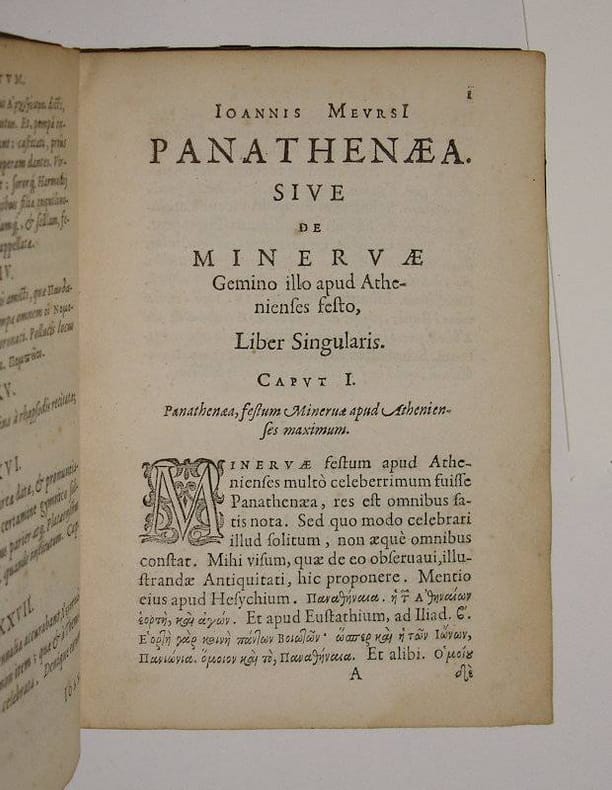
Leiden (Lugduni Batavorum), Ex officina Elzeviriana, 1619.
Reference : 120282
4to. (VIII),48 p. Calf 18 cm (Ref: Wiilems 161; Rahir 131; Berghman 1977) (Details: Woodcut printer's mark on the title, depicting an eagle with spread wings on a pedestal; the bird holds in its beak a set of 7 arrows bound together; the motto reads: 'Concordia res parvae crescunt'; the bundle of arrows symbolizes The Dutch Republic of the Seven United Netherlands (also Provinces); since its foundation in 1588 the motto of the United Provinces was 'Concordia res parvae crescunt', in Dutch: 'Eendracht maakt macht', a still popular motto in the coat of arms of many countries. The saying was coined by the Roman historian Sallust. (Bellum Jugurthinum, caput 10)) (Condition: Binding very scuffed: leather on the back wearing away; scratches on the boards; front joint partly split and broken; corners bumped. Front flyleaf gone. Title dustsoiled. Some light foxing on the first and last pages. Right lower corner of the last gathering faintly waterstained) (Note: The Dutch classicist and ancient historian Johannes Meursius (Johannes van Meurs), 1579-1639, was professor of History and Greek since 1610/13 in the university of Leiden. He studied under the genius J.J. Scaliger, and is best known for the 'editiones principes' of a number of Byzantine authors he produced, and the 'editio princeps' of the 'Elementa Harmonica' of Aristoxenus (1616). He edited also the 'Timaeus' of Plato with the commentary and translation of Chalcidius (1617). He wrote much on the history of ancient Greece, on Eleusis, and especially on the antiquities and festivals of Athens and Attica. His work was widely used as source by later ancient historians. (J.E. Sandys, 'A history of classical scholarship', 1964, p. 311) The tradition of studying the 'Athenian Festivals' goes back to antiquity, was kept alive during the Renaissance, and is still flourishing today. The real mark of a festival is the breadth of participation, i.e. whether large groups of the population participate in the celebration. The Panathenaea, or Panathenaic Games, were held every four years in ancient Athens and are doubtless the best known of all Greek festivals, with the exeption of Eleusis. It was held in honour of Athena, in the form of Athena Polias, the protectress of the city. There were two kinds of Panathenaea, the lesser one, often called Panathenaea, without any epithet, and greater Panathenaea, which had the adjective µe???a. The difference between the two festivals was, that the greater one was more solemn and luxurious, and that the peplus of Athena was brought to the Parthenon on the Akropolis in a magnificent procession. The great Panathenaea were held every fourth year, in the third year of every Olympiad, and lasted a number of days. There were solemn and very munificent offerings and rituals, a torch-race, or lampadephoria/lampadarium, was held between the Athenian phylai, athletic competitions, chariot races, musical, dance and reciting contests were organized, and there was an abundance of food and entertainment. The chief solemnity was the procession to the temple of Athena Polias, where a vestment, the peplos, was consecrated and offered to the goddess. Meursius treats all these aspects, constantly referring to ancient sources. It is clear that all later research on the subject is based on the foundations he laid) (Collation: *4, A-F4) (Photographs on request)
Bookseller's contact details
Antiquariaat Fragmenta Selecta
+31 20 418 55 65
Payment mode

Sale conditions
Terms of Sale All items offered are subject to prior sale. Your order will be final after you have received our confirmation, with a specification of the availability of the items and the shipping costs. All books are complete and in good antiquarian condition, unless otherwise described. Prices are in EURO. Postage and insurance are not included. Postage will be calculated at cost (no extra charges). Returns Books may be returned within 14 days of receipt, if returned in the same condition as sent, and packed, shipped and insured as received (please always notify us). We will refund the shipping costs of a return shipment only if our descriptions were not correct. How to pay Pre-payment is necessary for new customers. Our order confirmation will provide detailed information and a specification of the shipping costs. Customers who are known to us and libraries will be invoiced as usual. We accept Visa and Mastercard. You can submit your card information through our SECURE PAYMENT FORM. PayPal: we will send you a personal link to the PayPal website. Banktransfers: payment can be made into our bank account in The Netherlands.

