 Write to the booksellers
6 books for « lycophron »Edit
-
Topics
Greek (3)
Latin (2)
Philology (1)
-
Countries
France (2)
Netherlands (4)
-
Syndicate
ILAB (1)
SLAM (1)
Lycophronis Chalcidensis Alexandra. Poëma obscurum. Ioannes Meursius recensuit, & libro commentario illustravit. Altera editio aucta & innovata. Accessit Iosephi Scaligeri Iulii Caes. F. versio centum locis emendatior.
Leiden (Lugduni Batavorum), Ex officina Ludovici Elzevirii. 1599.
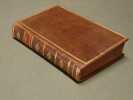
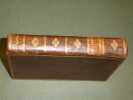
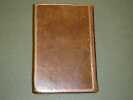
8vo. (XVI),350,(18 index) p. Calf (19th century) 16 cm (Ref: STCN ppn 15153098; Willems 39; Rahir 25; Berghman 835; Hoffmann 2,569; cf. Smitskamp, The Scaliger collection, no.93 for the first edition of 1597; Brunet 3,1247-1248; Ebert 12543; Graesse 4,309) (Details: Greek text and Latin translation. Back elaborately gilt with four ornamental lozenges. Brown letter label. Boards with a triple gilt fillet border, and gilt edges. Edges of the book block sprinkled. Marbled endpapers. The colophon on the last page reads: 'Lugduni Batavorum. Excudebat Ioannes Balduini. VIII. Kal. Maias. anno 1599') (Condition: Nice copy, some slight wear to the extremities, just a bit of rubbing to the joints. Some small, old ink marginalia. Last gathering slightly browning, otherwise a clean and fresh copy) (Note: Lycophron, 3rd cent. BC, was called to Alexandria in Egypt by King Ptolemaeus Philadelphos. There this tragedian wrote his 'Alexandra' (or Kassandra), ca. 1474 iambic trimeters, in which Kassandra tells about the fall of Troy, and the fates of the Greek and Trojan Heroes. It is his only surviving work, which is full of the extreme and designed obscurity that the Alexandrians, who were fond of a style full of learned allusions and playful riddles, loved. Rose calls the 'Alexandra' a monstruous riddle. 'In form it is the speech of a messenger, a servant of Priam, (...), coming to tell his master that Kassandra (= Alexandra) has just delivered a mysterious oracle. (...) The prophecy concerns the whole history of Troy, the Trojans and their descendants, together with the fates of the Greeks for many generations to come, and from beginning to end it calls nothing and no one by any wellknown name, personal or geographical'. (H.J. Rose, A handbook of Greek literature', London 1964, p. 336). For instance, Lycophron calls the mythical hero Heracles the 'Lion of the triple evening', expecting the reader to know that Heracles, when he was begotten, the night was thrice its normal length. This edition of 1599 is a revised and improved second edition. The first edition was produced two years earlier, in 1597, by the then 18 years old Dutchman Joannes Meursius, or in Dutch 'Jan van Meurs', 1579-1639. He was a student of the genius Joseph Justus Scaliger, born in 1540, who lectured since 1593 in Leiden, till his death in 1609. Scaliger helped and encouraged his pupil in the production of this edition. In the preface Meursius tells us that he wouldnot have dared to edit such a dark and difficult text without the help of Scaliger. Scaliger helped him with the commentary and gave him permission to reprint his verse translation, with corrections. This metrical and smooth Latin translation had been published previously in Basel in 1566. The last 251 pages of the book contain the commentary of Meursius, 'quod sine interprete vix est ut quisquam intellegat'. (preface, leaf A8 recto) Meursius was later appointed professor of History, and of Greek (1610/13) at his own university. He is best known for his editions of byzantine authors, and for the books he wrote on the history of ancient Greece, for example on festivals, Eleusis, and the antiquities of Athens and Attica. His work was widely used as source by later ancient historians. (Sandys 2,310/11)) (Collation: A-Z8 a8) (Photographs on request)
(First title:) LUKOPHRONOS TOU CHALKIDEÔS ALEXANDRA, to skoteinon poiêma, kai eis auto touto ISAAKIOU, mallon de IÔANNOU, tou TZETZOU EXÊGÊMA. (Second title:) Lycophronis Chalcidensis Alexandra, obscurum poema. Cum graeco Isaacii, seu potius Johannis Tzetzae commentario. Versiones, variantes lectiones, emendationes, adnotationes, & indices necessarios adjecit Johannes Potterus, A.M. & Collegii Lincolniensis Socius. Editio secunda, priori auctior.
Oxford (Oxonii), E Theatro Sheldoniano, impensis Joannis Oweni, 1702.
Folio. (XVIII, including a frontispiece & a title in Greek):183,(1 blank),(28 index),(2),(4),174,(17 index),(1 blank) p. Vellum 33 cm (Ref: ESTC Citation No. T107442; Hoffmann 2,569; Dibdin 2,209/210; Brunet 3,1248; Sandys 2,356; Graesse 4,309; Ebert 12546: 'This 2nd edition is particularly scarce') (Details: 8 thongs laced through the joints. Red morocco shield on the back. The frontispiece, an engraving of 'M. Burghers', depicts Alexandra, she points at Troy in fire in the background. Burghers was one of the leading engravers of England during that period. The book has 2 titles, the first one is in Greek, and is adorned with an big engraving of the Sheldonian Theatre, also made by Burghers. The second title is in Latin, and has a woodcut printer's mark, which shows the wellknown coat of arms of the University of Oxford) (Condition: Vellum soiled. Boards somewhat outstanding) (Note: Lycophron, 3rd cent. BC, was called to Alexandria by King Ptolemaeus Philadelphos. There he wrote his Alexandra (or Cassandra), ca. 1474 iambic trimeters in which Kassandra (=Alexandra) tells about the fall of Troy, and the fates of the Greek and Trojan Heroes. Dibdin calls this edition 'beautiful' and the 'editio optima'. He cites Harwood, who declares this work to be 'an everlasting monument of the learning of the illustrious editor'. The illustrious editor was the learned cleric John Potter, 1674-1747, who later in life, in 1737, was appointed bishop of Canterbury. Young Potter corrected in this edition the commentaries of Tzetzes using 3 new manuscripts; he added indices, and annotations of himself. At the age of 14 Potter was sent to Oxford, University College. There he distinguished himself by his knowledge of Greek. Still a young man, in 1697, he produced his first edition of Lycophron. In 1698 Potter published his greatest success, the 'Archaeologia Graeca', which long remained a standard book for Greek students in Britain. In 1715 Potter produced his splendid edition of Clemens Alexandrinus. (Chalmers' Biography, 25,231) The first 146 p. of this 1702 edition contain the Greek text, with iuxtaposed the Latin prose translation of the Dutch classical scholar Willlem Canter (1545-1572), dating from 1566. The scholia are printed on the lower half of the page, together with the 'variantes lectiones' and the 'emendationes'. After the Greek text follows the metrical (iambico carmine) translation into smooth Latin made by J.J. Scaliger (1540-1609), which was published toghether with Canter's translation in 1566 in Basel. The second half of the book contains the notes (annotationes) of Canter and a specimen of Canter's versatility in Greek and Latin verse, the 'Epitome Cassandrae graeco-Latina, versibus Anacreontiis conscripta'. Added is also the commentary of the Dutch classical scholar Johannes Meursius (1579-1639), published in 1597 & 1599. At the end we find the commentary of John Potter himself) (Provenance: Small bookplate of the Swiss politician Karl Zeerleder, 1780-1851, on the front pastedown. Small blind stamped owner's mark of Mark Pattison, 1813-1884, in the right margin of the title. Pattison was like Potter a tutor at Lincoln College. In 1861 Pattison was elected rector. He is best known for his biography of the French classical scholar Isaac Casaubon, and for being Mr. Casaubon, a chief character in Middlemarch, the famous novel of George Eliot) (Collation: Frontispiece, pi2, a-b2, A-D2 E-2C4, 2D-2I2, chi1; *A-*Z4, *Aa4, *Bb2) (Photographs on request) (Heavy book, may require extra shipping costs)
La Cassandre de Lycophron. éditée, traduite, annotée par F. D. Dehèque
Paris, Auguste Durand, Friedrich Klincksieck, 1853 in-8, [6]-VIII-[2]-71 pp., texte sur deux colonnes (grec et traduction française en regard), demi-veau vert, dos lisse orné de filets dorés, tranches mouchetées (reliure de l'époque). Dos insolé, rousseurs.

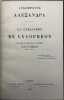
L'Alexandra ou la Cassandre est le seul poème qui ait survécu de Lycophron de Chalcis, qui aurait vécu à la cour de Ptolémée II. Il s'agit d'une longue prédiction des malheurs qui attendent tant les Troyens que les Grecs à la suite du rapt d'Hélène. La prophétie est rapportée à Priam par un messager qui récite mot à mot ce que Cassandre a proféré : cette "litanie rapportée" est écrite dans un style "oraculaire", énigmatique et difficile à souhait (vocabulaire, syntaxe, références mythologiques, énigmes, anagrammes, assonances, allitérations, autres artifices tels que les palindromes et à la tradition du boustrophédon...), qui font de ce texte un véritable casse-tête philologique.L'helléniste Félix-Désiré Dehèque (1794-1870) est plus connu pour ses traductions de ou en grec moderne.Brunet III, 1248. - - ACTUELLEMENT EN CONGÉS, DE RETOUR LE 17 AOÛT - VENTE PAR CORRESPONDANCE UNIQUEMENT - LIEN DE PAIEMENT, NOUS CONSULTER.


LUKOPHRONOS TOU CHALKIDEÔS KASSANDRA. To skoteinon Poiêma; Kai eis auto touto ISAAKOU mallon de IÔANNOU TOU TZETZOU EXÊGÊMA. Lycophrois Chalcidensis Cassandra, obscurum poema ope XVI. codicum MSS. sanioribus subinde lectionibus restitutum, fideliori interpretatione exornatum, et accurata paraphrasi explicatum; cum Isaaci vel potius Johannis Tzetzae commentario. Ex postrema Oxoniensi editione ad fidem XIII. exemplarium bis mille ferme in locis emendato, notabiliter aucto, latine reddito, et illustrato. Accedunt fragmenta undique collecta, variantes lectiones, emendationes, et indices necessarii, studio et impensis Leopoldi Sebastiani.
Roma, Apud Antonium Fulgonium, 1803.
4to. (IV),XL,416,210 p., frontispiece, 1 plate. Calf 29.5 cm (Ref: Hoffmann 2,569: 'Im Text des Lykophron liess der Herausgeber vieles unverbessert, obwohl er einiges trefflich verbesserte. Mehr leistete er in dem Commentar des Tzetzes, den er auch latein. übersetzte'; Brunet 3,1248: Cette édition, peu commune en France'; Ebert 12548; Graesse 4,309) (Details: Brown morocco, first half 19th century, at any rate before 1857, the work of the English bookbinder 'C. Smith' according to a very tiny stamp on the verso of the first flyleaf. In the 'Database of Bookbindings' of the British Library one can find images of 3 other beautiful specimens of this master-binder, c155b17, c151k16 & Davis259. The back has 5 raised bands, and is gilt with palmette motifs; gilt lettering in second compartment; other compartments of the back strip gilt with repeated voluté's and triangles; boards with double fillet gilt borders; gilt corner pieces with floral motifs; thrice gilt fillet borders on the sides, and on inside of the boards; all edges gilt; marbled endpapers. Engraved armorial bookplate on the front pastedown. Frontispiece of Cassandra as a prophetes, engraved by Aloysius Agricola, with at the foot the text of Aeneis 2, vss. 246/74. Engraving of the 'Gemma Maffei' by G. Petrini on the title, at the foot another Cassandra quote from the second book of the Aeneis, vss. 403/4. 1 engraved plate, showing two Cassandra gemmae, by Dom Campiglia & Vin. Francescini) (Condition: A fine copy. A touch of rubbing to the joints; 1 small scratch on the 3rd compartment. Some surface wear to the upper corner of the lower board. The binder has bound by mistake the 'commentarius' of 210 pages before the Greek text) (Note: Leopoldo Sebastiani, Italian classical scholar, priest and missionary. His exact dates are sofar unknown. At the end of the 18th century he was still a young man, for in the 'Bibliothecae Josephi Garampii cardinalis catalogus', Rome, 1796, p. 40, he is called 'Juvenis in recondita Graecorum eruditione valde versatus'. In this catalogue a future edition of the scholia to Homer of Eustathius is announced, a project that was apparantly aborted. The young man then turned to the Greek poet Lycophron, 3rd. century A.D. for an edition of his Cassandra, also known as Alexandra. The poem of 1500 iambic trimeters tells the profecies of the Trojan princes Kassandra, the fall of Troy and the fate of the Greek heroes. At the end are the profecies of the future supremacy of Rome. Sebastiani's edition is an ambitious one. After an introduction we find the Greek text, with a facing translation into Latin, made by the Dutch classicist Canter (Basel, 1566). Below the translation comes a Latin paraphrasis produced by Sebastiani. Added are the 'variantes lectiones', the extensive scholia, and the emendations to the Scholia. At the end a 'Selecta discrepantium lectionum silva'. Then an index to the Cassandra and the scholia; then follow 210 p. with the Latin translation of 'Isaaci sive Johannis Tzetzae Commentarius', and notes to the commentary. (The byzantine scholars Isaac and Johannes Tzetzes, who were brothers, lived in the 12th century) Three indices disclose this commentary. The contemporary reviewer of the GGA (Göttingische Gelehrte Anzeigen) calls the translation of the commentarius 'unendlich besser' than the translation of Basel, 1558. GGA praises Sebastiani's search for manuscripts of the Cassandra, the oldest of which dates from the 9th or 10th century, and which was once the property of Fulvius Ursinus. GGA: 'Alle Codices habe er mit der grössten Genauigkeit vergliche; das grösste Verdienst eignet er sich um die Scholien zu, worin er an 2000 Fehler verbessert habe'. (...) 'Diese (i.e. Gelehrten) wirden finden, dass ihnen ihre Forschungen durch das was S. geleistet hat, sehr erleichtert sind'. The German reviewer is impressed, because Sebastiani produced this edition in the turmoil of an adventurous life as a missionary and a diplomat. He records 2 long travels to the Orient, up to Ispahan in Persia. Back in Constantinople Sebastiani was an honoured guest of Lord Elgin, because he had saved two Englishman. From another source we learn that the English held Sebastiani in high esteem 'for the losses he sustained, and misfortunes he suffered in consequence of important services which he gratuitously rendered to the British government while resident in Persia as president of the missionaries sent by the Church of Rome'. (Th.H. Horne, 'An introduction to the critical study and knowledge of the Holy Scriptures', London, 1818, vol. 2, p. 189). The reviewer of GGA rebukes the Latin of Sebastiani, he calls it 'oft sehr Orientalisch'. (Göttingische gelehrte Anzeigen, Göttingen, 1804 p. 340/4). A later French reviewer exclaimed: 'Mais quel latin!' Sebastiani is probably best known for his excellent translation of the New Testament, published in London in 1817. Th.H. Horne places this translation alongside those of the giants Erasmus and Beza, 'those of Erasmus, Beza and Sebastiani are particularly worth of notice'. 'In all doctrinal points, this version is made conformable to the tenets inculcated by the church of Rome'. (Horne p. vol. 2, p. 226). Sebastiani is also known for his 'Storia dell'Indostan' a history of India, published in 1820. He also translated parts of the Bible into Persian) (Provenance: bookplate with the coat of arms of 'Joseph Neeld', with a banner reading: 'Nomen extendere factis'. Neeld, 1789-1856, was a wealthy English philanthropist, who had a good library and art collection. He was in 1830 Member of Parliament for Gatton, a rotten borough with six houses and one elector, but sending 2 members, which was abolished by the Reform Act of 1832. (Source Wikipedia)) (Collation: a6, b-e4, A-3F4) (Photographs on request) (Heavy book, may require extra postage)
Alejandra. Texto revisado y traducido por Lorenzo Mascialino.
Barcelona, Ediciones Alma Mater, 1956.
LIV,88 p. Cloth. 22 cm (Back faded. Some pencil underlinings in the introduction)
Cassandre traduction, notes et commentaire Pascale Hummel
Editions Comp'act ,2006, in-8 de 231 pages ,ill. in-t., , br. ,Bon état , .Isbn : 9782876613805.(4 photos du livre sur mon site https://www.vieuxlivre.fr) .Les frais de port pour la France sont offerts à partir de 25 euros d'achat (Mondial relay ). (colissimo suivi +6,90 ).

