Write to the booksellers
673 books for « h bergson »Edit
-
Type
Book (689)
Disk (1)
-
Latest
Last 3 days (2)
Last month (24)
-
Language
French (661)
Russian (29)
-
Century
19th (2)
20th (343)
21st (20)
-
Countries
Belgium (50)
Canada (1)
Denmark (4)
France (551)
Germany (2)
Switzerland (52)
United States of America (30)
-
Syndicate
ALAC (1)
ILAB (209)
NVVA (2)
SLACES (2)
SLAM (201)
Topics
- Academy (1)
- Aesthetics (2)
- Autographs (7)
- Bergson henri (254)
- Boule marcellin (1)
- Brain (1)
- Catholicism (2)
- Churches (1)
- Collaboration (3)
- Darwin (1)
- Devil (2)
- Economics (2)
- Economics (2)
- Education (2)
- Epistemology (2)
- Esotericism (1)
- Essays (19)
- Ethic (35)
- Ethic (5)
- Feminism (1)
- First edition (5)
- Geneva (1)
- Gillouin rené (1)
- Grammar (1)
- Historical general points (6)
- History (4)
- Humanism (1)
- Humour anecdotes (2)
- Literature (16)
- Logic (1)
- Maine (1)
- Manuscripts (4)
- Medicine (1)
- Meditation (1)
- Metaphysics (11)
- Mysticisme (2)
- North america (1)
- Philology (1)
- Philosophy (216)
- Poincaré raymond (4)
- Policy (3)
- Political economy (1)
- Praise (1)
- Psychology (19)
- Rationalism (1)
- Religions (26)
- Renoir auguste (1)
- Review (11)
- Russia (2)
- Savoir faire (1)
- Schumann (1)
- Sciences (1)
- Shapes & colours (1)
- Skira (1)
- Social sciences (1)
- Socialism (1)
- Sociology (4)
- Speeches (3)
- Theology (4)
- Ussr (1)
- Various (1)
- Vibert pierre eugène (1)
- Wagner richard (1)
- Western (2)
- Wisdom (1)
- Youth (2)
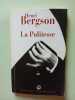
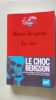
La Politesse : Et autres essais
Rivages 2008 76 pages poche. 2008. Broché. 76 pages. Ce livre rassemble trois discours prononcés par Henri Bergson lors de remises de prix à de jeunes lycéens à la fin du XIXe siècle. Il y explore le concept de politesse la définissant comme une "souplesse intellectuelle" et un amour de l'égalité et l'étend à la politesse de l'esprit des manières et du cœur
Bom estado
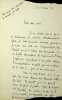
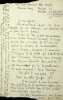
Henri Bergson Prix Nobel de Littérature 1927. Autographes à propos de la rédaction de son discours de réception à Stockholm en décembre 1928.
Trois documents autographes signés d'Henri Bergson : carte de visite du philosophe, recto verso (6x10cm), adressée de Saint-Sergue en Suisse. Lettre de quatre pages (17,8x11,4cm) datée du 19 novembre 1928 et papillon recto verso (9x11,5cm) daté du 20 novembre 1928, tous trois adressés au conservateur de la bibliothèque de l’Institut de France, Henri Dehérain. Après l’avoir remercier de ses félicitations, sur sa carte de visite, Henri Bergson demande au bibliothécaire, par lettre datée du 19 novembre 1928, de l’aider à trouver des livres sur la pensée suédoise, «pour rédiger la petite allocution dont on donnera lecture en mon nom à Stockholm (car il m’est impossible d’aller là-bas, comme le voudrait l’usage).» En effet, à demi paralysé par un rhumatisme déformant, c’est en effet l'ambassadeur français de Suède Armand Bernard qui lira à Stockolm le discours de Bergson le 10 décembre 1928. Le troisième document daté du 20 novembre 1928, comporte 7 lignes pour remercier le bibliothécaire de lui avoir fourni toute la documentation demandée, du jour au lendemain. Bel ensemble complet autour du discours de réception du Prix Nobel de Littérature décerné à Henri Bergson en 1927.
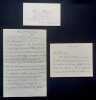
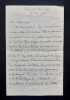
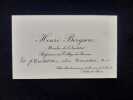
Three autograph documents signed by Henri Bergson: philosopher’s business card, double-sided (6x10cm), addressed from Saint-Sergue in Switzerland. Four-page letter (17.8x11.4cm) dated 19 November 1928 and two-sided card (9x11.5cm) dated 20 November 1928, all three addressed to the curator of the library of the Institut de France, Henri Dehérain. After thanking him for his congratulations, on his business card, Henri Bergson asked the librarian, in a letter dated 19 November 1928, to help him find books on Swedish thought, "... to write the short speech that will be read on my behalf in Stockholm (for it is impossible for me to go there, as is customary)." (Indeed, half paralyzed by a distorting rheumatism, it is indeed the French ambassador of Sweden Armand Bernard who will read in Stockolm the speech of Bergson on December 10, 1928.) The third document, dated 20 November 1928, contains 7 lines thanking the librarian for having provided him with all the requested documentation overnight. Beautiful complete set around the reception speech of the Nobel Prize for Literature awarded to Henri Bergson in 1927. Tous nos livres sont visibles sur notre site : https://www.livrepoesie.com/
Schöpferische Entwicklung [Translated by Dr. Gertrud Kantorowicz].
Jena, Eugen Diederichs, 1912. 8vo. Orig. brown full cloth with gilt lettering and publisher's symbol to front board, gilt lettering to spine. Spine a bit soiled and darkened. Internally very nice and clean. (2), 371, (3) pp. + 2 pp. advertisements.
First German edition, first issue (Erstes bis drittes Tausend) of Bergson's seminal main work, the ""Creative Evolution"", his most famous and influential book, which constitutes the great philosopher's cult-like showdown with Darwinian mechanism, which resulted in a theory of cosmic evolution that covered everything from biology and other sciences to metaphysics and religion.In 1907, when Henri Bergson's third book, ""Creative Evolution"", was originally published in French, the seminal French philosopher, who had studied both mathematics and philosophy, possessed the professor chair of modern philosophy at the Collège de France. Though the book was the result of several years of extremely thorough research, Bergson himself could have hardly foreseen the effect that this book was going to have throughout the 19th century with an amazing revival in the 20th century, making him one of the most important philosophers of his time.Always committed to the reality of time as the basis and as a source of creative change, Bergson, in his magnum opus, sets out to free the sciences of psychology and biology from the materialism and mechanism that had dominated them in the late nineteenth century and due to which they had been made unable to explain creativity, growth and change. He makes an amazing new contribution to the theory of knowledge by providing an account of creative evolution and the creative mind, thereby freeing psychology and biology from a number of problems otherwise unsolvable through philosophical and scientific explanations. Bergson accepts the historical facts of evolution but rejects all the mechanistic and materialistic explanations of the evolutionary process. Like Darwin, he accepts natural selection as an explanation of extinction, but he does not accept it as an explanation of evolutionary change, and likewise with Lamarck, Spencer, and the orthogenesists, he accepts the foundational theories of evolution but only to the point at which mechanism or materialism sets in, instead of which, he basically explains further change and growth with a basic vital principle that accounts for creative changes.As such, ""Creative Evolution"" sets out to found a philosophy that can account for the continuity of all living things, for both the creation of life and the diversity that results from creation, and Bergson does this with his idea of an original vital principle, a governing immaterial force of life, a sort of natural creative impulse, that embraces the whole of life in one. The book was hugely popular when it appeared, and its immediate immense influence throughout Europe, also mediated throgh the main translations of it (German, English) lasted a couple of decades, making Bergson an internationally acknowledged cult-like hero of a French intellectual. After the Second World War, though, the interest in Bergson decreased, only to be reawakened in the late 1960'ies where a growing interest in his works re-emerged, making him to this day one of the most read philosophers of the early 20th century. There can be no doubt as to the continued influence of his works.

L'ENERGIE SPIRITUELLE 132eme edition
Presses universitaires de France 1967 214 pages in8. 1967. Broché. 214 pages. Chaque maison cache un secret les murs ont des oreilles mais la bouche cousue. Il faut poser longtemps la joue contre leur sein comme un docteur fiévreux pour les entendre respirer. A Dun-le-Palestel dans la Creuse la maison de famille du narrateur en a si gros sur le c?ur et tant à dire qu'on va la confesser pièce après pièce l'écouter se raconter souvenirs dérangés vérités arrangées les choses et les gens tels qu'ils furent les échos et les ombres qu'il en reste. Elle finira bien par lâcher cequ'elle sait. Elle sait l'histoire d'un père qui lui avait choisi de se taire
french édition - Quelques marques plis de lecture et/ou de stockage mais du reste en bon état. Envoi rapide et soigné dans enveloppe à bulles depuis France
Henri Bergson Guillaume Sibertin-Blanc Frédéric Worms Frédéric Worms Guillaume Sibertin-Blanc
Reference : 89379
(2007)
ISBN : 9782130562740
Le rire : Essai sur la signification du comique (Edition critique)
Presses Universitaires de France - PUF 2007 359 pages 19x12x2cm. 2007. Broché. 359 pages.
FRENCH édition - légères marques plis de lecture et/ou de stockage sur couverture et coins dont une marque de plis sur dos de couverture quelques rousseurs sur tranche de page mais du reste en bon état de lecture - Expédition sous blister
L'énergie spirituelle
Presses Universitaires de France - PUF 1993 224 pages 12x19x2cm. 1993. Broché. 224 pages.
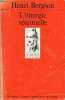
French édition - Livre présentant des annotations plis marques de stockage et/ou de lecture sur la couverture et/ou les pourtours mais demeurant tout a fait lisible.Expédition sous blister dans une enveloppe matelassée depuis la France
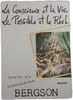
La Conscience et la Vie Le Possible et le Réel
Magnard 1985 collection TEXTE ET CONTEXTES. 1985.
Bon état
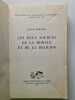
Les deuz sources de la morale et de la religion
Presses Universitaires de France - PUF 1969 1969.
Etat correct
La Conscience et la vie. Le Possible et le réel
Magnard 1997 13 4x18 8x1cm. 1997. Relié.
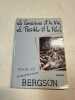
Très bon état
La Conscience et la vie. Le Possible et le réel
Magnard 1997 13 4x18 8x1cm. 1997. Relié.
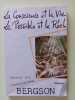
Etat correct
Essai sur Les Données Immédiates de la Conscience
Presses Universitaires de France - PUF 1965 1965.
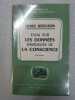
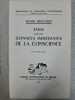
Etat correct
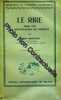
Le rire essai sur la signification du comique- bibliotheque de philosophie contemporaine - quarante-septieme edition
Presses universitaires de France 1940 1940.
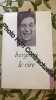
Emmanuel Mounier (1905-1950), philosophe, fondateur de la revue Esprit, père du personnalisme, disciple d'Henri Bergson, Charles Péguy et Jacques Chevalier, secrétaire de Chevalier après Jean Guitton.
Reference : 013210
Lettre autographe signée à Jean Guitton
Emmanuel Mounier (1905-1950), philosophe, fondateur de la revue Esprit, père du personnalisme, disciple d'Henri Bergson, Charles Péguy et Jacques Chevalier, secrétaire de Chevalier après Jean Guitton. L.A.S., 17 mai 1927, 2p in-8 Très intéressante lettre du jeune Mounier au jeune Jean Guitton (1901-1999). Il parle notamment de son maître Jacques Chevalier (1882-1962), d'Henri Bergson, de René Cadiou (1900-1973). « Mon cher ami, Je ne réalise pas ce qu'a de douloureux ce sacrifice volontairement offert, et libéralement consenti puisque je reçois une note sur l'organisation du travail que je n'avais pas demandée, et, en double exemplaire, la conférence du Pr Berry [ou Perry]. J'apprécie cependant à sa juste valeur l'amputation acceptée par vos archives de la note 2, qui m'est précieuse. Vous m'avez trouvé, m'a-t-on dit, très ému dans ma dernière lettre. Du tout. Ou plutôt je n'ai pas été ému des faits signalés, mais de ce que Mr Chevalier, du moins le soir où il m'en a parlé, en ressentait un fort découragement. Voici maintenant nos comptes : Vous me devez Bergson 35 Blondel 44 (l'ex que je vous avais annoncé à 40 est à 42F) 79 Je vous apporte : Cotisation Pa. + Anglès [? Noms illisibles] - 40 (Je vous rappelle que ma cotisation s'est volatilisée ici en frais pour le groupe). En plus de cela, je vous demanderais de me rendre le service suivant. D'accord avec M. Chev., j'emploie les 25F qui me restent, en surplus de la souscription pour le Bergson - maroquin, à remercier M. Bergson de la photo qu'il a donnée pour l'ouvrage. Pourriez-vous commander chez un fleuriste une gerbe de 25F et demander qu'on la portât avec la carte ci-jointe ? Merci beaucoup. Cela fait à mon passif 65F Reste au vôtre 70-65 = 14F. Il est inutile de me les envoyer. Vous profiterez de la prochaine affaire que vous aurezà traiter avec M. Chev. ou tout autre philosophe grenoblois. J'ai fait connaissance avec les yeux [mots manquants] ami Cadiou. Je ne l'ai vu qu'une courte 1/2 heure après une réunion à Primerose, mais ce fut assez pour me faire regretter de ne pouvoir, par la faute des circonstances, accepter son invitation pour lendemain. J'espère le retrouver auprès de vous à Paris. Toujours bien à vous et tout autant à mon diplôme qui touche à sa fin. E Mounier [la fin de la signature manque] [Note en tête] Vous serez bien aimable de cacheter la carte ». Manque de papier en haut et en bas, dûs à l'ouverture de la lettre, avec quelques mots manquants. Cette lettre provient des papiers de l'abbé Fabre que Jean Guitton avait connu en captivité pendant la seconde guerre mondiale. [308-2]

Bergson A. Creative Evolution. In Russian /Bergson A. Tvorcheskaya evolyutsiya.
Bergson A. Creative Evolution. In Russian /Bergson A. Tvorcheskaya evolyutsiya. Exclusive Classics of M. ACT 2023. 416 We have thousands of titles and often several copies of each title may be available. Please feel free to contact us for a detailed description of the copies available. The delivery of this book might be delayed beyond the usual timeframe due to extended processing and preparation before shipment, and faster shipping options are not offered. Please inform us if you need the order by a certain date or have a deadline. SKUalb38abc699418dc27c
Bergson A. Duration and Simultaneous. In Russian /Bergson A. Dlitelnost i odnov
Bergson A. Duration and Simultaneous. In Russian /Bergson A. Dlitelnost i odnovremennost. M. KDU 2015. We have thousands of titles and often several copies of each title may be available. Please feel free to contact us for a detailed description of the copies available. The delivery of this book might be delayed beyond the usual timeframe due to extended processing and preparation before shipment, and faster shipping options are not offered. Please inform us if you need the order by a certain date or have a deadline. SKUalbbc3c855e301eb6a7

Bergson Henri: Creative Evolution. In Russian /Bergson Anri. Tvorcheskaya evoly
Bergson Henri: Creative Evolution. In Russian /Bergson Anri. Tvorcheskaya evolyutsiya. Series: Exclusive Classics. Moscow: AST, 2023. 416 We have thousands of titles and often several copies of each title may be available. Please feel free to contact us for a detailed description of the copies available. The delivery of this book might be delayed beyond the usual timeframe due to extended processing and preparation before shipment, and faster shipping options are not offered. Please inform us if you need the order by a certain date or have a deadline. SKUalbbaa7c384a7ac68fc

Bergson Henri: Creative Evolution. In Russian /Bergson Anri. Tvorcheskaya evoly
Bergson Henri: Creative Evolution. In Russian /Bergson Anri. Tvorcheskaya evolyutsiya. Translation from French by V. Flerova. Moscow Kuchkovo field 2006. 384 p. You are welcome to reach out to us for a detailed description of the copies currently available. Delivery of this book may take longer than usual including extended processing and pre-shipping time, no expedited shipping is available. Please advise us if you have a set date or a deadline to receive your order.SKUalb5701fb51cd93da15
Bergson A. Creative Evolution. In Russian /Bergson A. Tvorcheskaya evolyutsiya.
Bergson A. Creative Evolution. In Russian /Bergson A. Tvorcheskaya evolyutsiya. M. Terra 2001. 384 p. You are welcome to reach out to us for a detailed description of the copies currently available. Delivery of this book may take longer than usual including extended processing and pre-shipping time, no expedited shipping is available. Please advise us if you have a set date or a deadline to receive your order.SKUalb545f51e199bbbb2a