 Write to the booksellers
18 books for « gellius »Edit
-
Language
Dutch (1)
French (16)
Latin (1)
-
Century
16th (2)
17th (1)
18th (1)
19th (1)
-
Topics
Geometry (1)
Greek (1)
Industrial arts & crafts - fine arts (1)
Latin (2)
Law (1)
Literature (1)
Medicine (1)
Meteorology (1)
Philology (1)
Philosophy (2)
-
Countries
Belgium (4)
Denmark (3)
France (4)
Netherlands (6)
Switzerland (1)
-
Syndicate
CLAM (1)
ILAB (5)
SLAM (1)
Auli Gellii Noctes Atticae, seu Vigiliae Atticae, quas nunc primum a magno mendorum numero magnus veterum exemplarium numerus repurgavit. Henrici Stephani Noctes aliquot Parisinae, Atticis A. Gellii Noctibus seu Vigiliis invigilatae. Eiusdem H. Stephani annotationes in alios Gellii locos prodibunt cum notis Lud. Carrionis (qui vet. exemplaria contulit) prelo iam traditis.
Paris (Parisiis), (H. Stephanus), 1585. Cum privilegio Caesaris, et Gallorum regis in decennium.
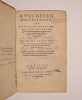
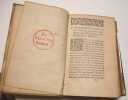
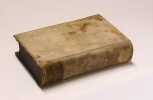
8vo. (VI),23,(1 blank),587,(1 blank);(74 index),(2 blank),205,(3 blank) p. Vellum 18 cm (Ref: Renouard p. 450/51, 1585,2: 'édition rare et estimable', Schweiger 2,378; Brunet 1523/24; Graesse 3,46; Ebert 8284) (Details: 5 thongs laced through both joints. Short title on the back) (Condition: Vellum soiled and spotted, big red stain on the lower board. Occasional old ink underlinings & marginalia. Small and old inscription on the verso of the front flyleaf. A small reference written on the title. On the verso of the title a round red stamp. Upper corner of the last gatherings slightly waterstained. Paper somewhat yellowing) (Note: The Roman author Aulus Gellius, ca. 125-180 AD, was never counted as a major author in antiquity, nor later. His only work 'Noctes Atticae' or 'Attic Nights', is a miscellany that 'ranges from literature to law, from wondrous tales to moral philosophy; one of his favorite topics is the Latin language'. (...) The exposition, in a mildly archaizing but never difficult Latin, often takes the form of dialogues with or between culturally eminent persons whom Gellius had known'. It derives its name from the fact of its having been written during the long nights of a winter which the author spent in Attica as a young itinerant student. The Noctes Atticae were exploited by pagans and Christians alike in late antiquity. In medieval florilegia he is much quoted for piquant tales and moral sentiments. 'From Petrarch onward Gellius became a favorite author of the Renaissance'. 'More than 100 manuscripts were copied'. He was used as a valuable source of information on the Latin language, and had preserved numerous quotations from lost authors, which were presented with grace and elegance. Gellius became a model for the 'Miscellanea' of the Italian humanist Angelo Poliziano. 'In the 18th century, however, new canons of elegance caused his style to seem less attractive, and compilation sank to minor merit' (Quotations from 'The Classical Tradition', Cambr. Mass., 2010, p. 386/7) The notes of Louis Carrion, latinized as Ludovicus Carrio (Brugensis), ca. 1547-1595, which are promised on the title page, are lacking in this edition. Carrion had promised the Parisian scholar/publisher Henri Estienne II, ca. 1530-1598, to manufacture notes for his Gellius edition. Estienne printed the text of Gellius, and waited eight months. In the meantime Carrion delivered material for only 7 leaves. Tired of waiting Estienne published his Gellius, replacing Carrion's notes with work of his own: 'Noctes aliquot Parisinae'. Ultimately Carrion sent Estienne notes concerning the first 24 chapters of the first book only, together 120 pages. These notes Estienne thereupon published separately in the same year. Most copies are like ours, in only a few copies both works have been bound together. The 'Noctes Parisinae' are 27 in number, 7 of which are dedicated to Estienne's friend, the historian, politician and bookcollector Jacques Auguste de Thou, 1553-1617, who was in 1585 'maître des requêtes au parlement de Paris'. Estienne extols his friend 'for his erudition, and his extraordinary zeal for the collection of books: noticing the exquisite literary treasures in which his library abounds, his judgment in the selection of editions, his liberal disbursement in purchasing, and his profuse expenditure on binding and decoration'. (William Parr Greswell, 'A View of the Early Parisian Greek Press', London 1833, volume 2, p. 350) The 'Noctes Parisinae' opens with a defence of Gellius against attacks of the Spanish scholar Juan Luis Vives, who mentioned Gellius e.g. 'loquaculus sine eruditione'; and 'quae de significatu vocum disserit, sunt frivola, et plerumque imperita ac falsa'. (Opera, Basel 1555, Tom. I, p. 480/81)) (Provenance: In pencil on the front flyleaf: '15 sept. 1965', written by the Flemish linguist Walter Couvreur, 1914-1996, who was an Orientalist, and professor of Indoeuropean linguistics at the University of Gent. It indicates the date of aquisition. On the pastedown in the rear he wrote the place where he bought it: 'Leipzig, Zentralantiquariat, DDR'. On the verso of the title a red stamp: 'Ex Biblioth. Regia Berolinensi') (Collation: A-B8 (minus blank leaf B8), a-z8, A-R8, S4 (leaf S4 blank), A-N8 (a leaf signed A2 inserted as a kind of half title between leaf C1 and C2; leaf N7 verso and N8 blank) (Photographs on request)
Auli Gellii luculentissimi scriptoris Noctes Atticae.
Lyon (Lugduni), Apud Haered. Seb. Gryphii, 1560.
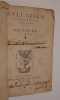
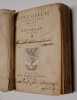
(LXIII)(I blank),533,(3 blank) p. Limp vellum 17 cm (Ref: Schweiger 378; Dibdin 1,340: 'beautiful and accurate edition, (..) deserving of the student's notice'; Moss 1,203; Graesse 3,46; Ebert 8283) (Details: Gryphius' woodcut printer's mark on the title, depicting a griffin, which mythological animal symbolizes courage, diligence, watchfulness, and rapidity of execution, used as a pun of his family name Gryph or Greif. From the claws of this creature hangs a big rectangular stone, beneath which is a winged orb. The motto is 'Virtute duce / comite fortuna', 'Virtue thy leader, fortune thy comrade', a quote from a letter of Cicero to Plancus (Epistulae ad Familiares, liber X,3). At the end a woodcut griffin. The text is printed completely in italics, except for the title) (Condition: Vellum shabby, wrinkled and showing some old repairs. Corners somewhat dog-eared at the end and beginning. Two old ownership inscriptions on the title, one on the front pastedown. Upper margin of the first gatherings and a number of gatherings halfway slightly waterstained. Front flyleaf removed. Paper yellowing. A few small ink stains on the edge of the bookblock) (Note: The Latin author Aulus Gellius, ca. 125-180 AD, was never counted as a major author in antiquity, nor later. His only work 'Noctes Atticae' or 'Attic Nights', is a miscellany that 'ranges from literature to law, from wondrous tales to moral philosophy; one of his favorite topics is the Latin language'. (...) The exposition, in a mildly archaizing but never difficult Latin, often takes the form of dialogues with or between culturally eminent persons whom Gellius had known'. It derives its name from the fact of its having been written during the long nights of a winter which the author spent in Attica as a young itinerant student. The Noctes Atticae were exploited by pagans and Christians alike in late antiquity. In medieval florilegia he is much quoted for piquant tales and moral sentiments. 'From Petrarch onward Gellius became a favorite author of the Renaissance'. 'More than 100 manuscripts were copied'. He was used as a valuable source of information on the Latin language, and had preserved numerous quotations from lost authors, which were presented with grace and elegance. Gellius became a model for the 'Miscellanea' of the Italian humanist Angelo Poliziano. 'In the 18th century, however, new canons of elegance caused his style to seem less attractive, and compilation sank to minor merit' (Quotations from 'The Classical Tradition', Cambr. Mass., 2010, p. 386/7) According to Graesse this 1560 edition of Gellius is a reissue of the edition of Badius Ascensius of 1532. If this is correct, than it was reissued without the preliminaries and the notes. Sebastianus Gryphius was an excellent Latin scholar himself, and the printer of a host of handy and relatively cheap editions of Latin authors. Gellius was for him a moneyspinner, for he published Gellius editions in 1537, 1539, 1546, 1559, 1560 & 1566) (Provenance: Provenance the Tuscan city Gallicano. The first ownership inscription below the imprint is very legible: 'Bartholomaei Landi Gallicanensis', probably a Bartolomeo Landi from Gallicano. The second name on the title is crossed out: '.... Johannis Mamanti Gallicanensis'. 'Johannis' and Gallicanensis' bear a contraction sign. The first name is illegible, it is also contracted and ends probably on '-bri' The inscription on the front pastedown is a problem: 'Di Prese (?) Gio. Mamanti da Gallicano'. Gallicano is a comune (municipality) in the Province of Lucca in the Italian region Tuscany, located about 70 kilometres northwest of Florence) (Collation: A-D8 (gathering C bound before B); a-z8, A-K8, L4 (leaf L3 verso printer's mark, leaf L4 blank) (Photographs on request)
Auli Gellii Noctium Atticarum libri XX prout supersunt, quos ad libros MSStos novo & multo labore exegerunt, perpetuis notis & emendationibus illustraverunt Johannes Fredericus et Jacobus Gronovii. Accedunt Gasp. Scioppii integra MSStorum duorum codicum collatio, Petri Lambecii lucubrationes Gellianae, & ex Lud. Carrionis castigationibus utilia excerpta, ut & selecta variaque commentaria ab Ant. Thysio & Jac. Oiselio congesta.
Leiden (Lugduni Batavorum), Apud Cornelium Boutesteyn & Johannem du Vivié, 1706.
4to. (XXXVI),903,(63 indices) p. Vellum 25.5 cm (Ref: STCN ppn 227931653; Neue Pauly Suppl. 2, p. 261; Schweiger 2,379: 'Noch immer sehr gesuchte Ausgabe und durch die neueste Bearbeitung nicht entbehrlich gemacht'; Dibdin 1,341: 'This edition (...) has as much literary merit as any of the Dutch editions of the classics in 4to. The notes of other critics are selected with judgment, and the explanatory remarks of Gronovius must give every scholar the most exalted idea of his singular erudition'; Moss 2,204/5; Fabricius/Ernesti 3,10: 'Haec editio repetita est'. Ernesti calls this edition 'luculenta'; Brunet 2,2 1524: 'Édition la meilleure qui ait paru jusqu'ici'; Spoelder p. 527, Delft 1) (Details: Prize copy of the Schola Latina of the city of Delft, without the prize. Back with 5 raised bands. Short title in ink in the second compartment. Gilt double fillet borders on both boards, gilt fleur-de-lis in all 4 corners; gilt Y in the center of both boards. Engraved frontispiece by Goeree/Sluyter, depicting the Roman author in his study at his desk; he has just started writing the first sentence of the last chapter of his book (liber XX, caput 11) on the role of papyrus in front of him; we read: 'P. Lavinii liber est non'; in front of Gellius are burning oil lamps; through the window one sees a moonlit Athens. Title in red and black. Engraved scene of a walled city, presumably Athens, on the title) (Condition: Vellum age-toned, somewhat soiled and scratched. Small stain on the frontcover. Front flyleaf and the prize gone. Front joint partly split. Small stamp on the title. Some foxing) (Note: The 'Noctes Atticae' of the Roman author Aulus Gellius, ca. A.D. 130 - ca. 180, contain many delightful scenes which he collected during his student days at Athens. The 'Attic Nights' is in fact a 'collection of mainly short chapters, dealing with a great variety of topics: philosophy, history, law, grammar, literary criticism, textual questions and many others'. (...) 'the great usefulness of the Noctes Atticae is derived from the preservation of countless fragments of earlier writers'. (OCD 2nd ed. p. 460) The editions of classical writers of Latin prose produced by the Dutch scholar of German origin Johann Friedrich Gronov, 1611-1671, mark a epoch in the study of Livy, the Senecas, Tacitus and Gellius. (Sandys 2,319/21) He published his first Gellius edition in 1651, which is praised by Fabricius/Ernesti as 'emendatissimam'. Johann Friedrich was appointed 'professor eloquentiae' at the 'Athenaeum Illustre' of Deventer in 1642. Here he started a period of continuous and fruitful scholarly activity. In 1658 he came to Leiden to succeed Daniel Heinsius as professor of Greek and History. In 1687 the son of Johann Friedrich, Jacobus (Jakob) Gronovius, 1645-1716, who was professor of classics at Leiden from 1679 till his death, produced a new edition of his father's Gellius. He added to it the commentary written by his father at an earlier date. This commentary only covers the books I-IX. In 1706 Jacobus Gronovius published another revised and augmented edition. It contains a great number of observations of Antony Thys, or Antonius Thysius, ca. 1603-1665, professor of 'Poiesis' of the University at Leiden, and Jacobus Oiselius, 1631-1686, and Johannes Fredricus Gronovius, the father of Jacobus. It offers also the collations of 2 manuscripts made by the German scholar Kasper Schoppe, or Gasparus Scioppius, 1599-1649. Jacobus Gronovius received those collations, he tells in the 'Dedicatio' from the Italian publisher/librarian Antonio Magliabechi, 1633-1714, who possessed a Gellius edition once owned and annotated by Schioppius. ('Scias' writes Magliabechi to Gronovius, 'igitur servari in mea Bibliotheca (...) Gellium ipsa Scioppii manu adnotatum, & variantibus lectionibus non uno in loco illustratum'. (p. *4 recto) This edition also offers some 'excerpta' from the corrections of the Belgian latinist Louis Carrion, or Ludovicus Carrio, 1547-1595, who had published a Gellius edition in 1585 in Paris) (Provenance: The stamp on the title reads: 'P.C. Molhuijsen'. Philipp Christiaan Molhuijsen, 1870-1944, is best known as chief librarian of the Royal Library at The Hague, as editor of the Correspondence of Grotius, and editor of the NNBW, the 'Nieuw Nederlandsch Biographisch Woordenboek'. He studied classics in Leyden, and published in 1896 a dissertation, 'De tribus Homeri Odysseae codicibus antiquissimis'. In 1897 he started his bibliographic career as librarian of the Library of the University at Leiden. From 1911 on he was the leading force of the Dutch Biographic Dictionary, the 'Nieuw Nederlandsch Biographisch Woordenboek', better known as NNBW. In 1921 he was appointed chief librarian of the 'Koninklijke Bibliotheek' at The Hague. He also produced the first 2 volumes of the correspondence of Hugo Grotius, 1928-1937) (Collation: *4 (including frontispiece and title), 2*2, 3*-5*4; A - 6F4 (leaf 6F4 blank) (Photographs on request) (Heavy book, may require extra shipping costs)
Auli Gellii Noctes Atticae. Editio nova et prioribus omnibus docti hominis cura multo castigatior.
Amsterdam (Amstelodami), Apud Ludovicum Elzevirium, 1651.
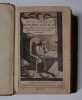
12mo. (XLVIII),498,(122 index) p. 19th cent. marbled boards. 13 cm (Ref: Neue Pauly, Suppl. 2, p. 261; Willems 1127: 'Édition fort jolie et qui passe pour très correcte'; Berghman 2065 ; Rahir 1145; Graesse 3,46; Ebert 8287; Dibdin 1,340/41; Fabricius/Ernesti 3,10: 'emendatissima editio'; Schweiger 2,378: 'Neue, werthvolle Recens. nach Handschr. von Jo.Frd. Gronovius'; Brunet 2,1524: 'Jolie édition') (Details: 5 thongs laced through the joints; engraved title, depicting a learned writer at work under the light of an oil lamp) (Condition: Cover worn at the extremities; marbled paper on the back scuffed; lower corner of a few leaves vaguely waterstained; without the last two blank leaves. Paper somewhat yellowing) (Note: A favorite author of the Renaissance. The Latin author Aulus Gellius, ca. 125-180 AD, was never counted as a major author in antiquity, nor later. His only work 'Noctes Atticae' or 'Attic Nights', is a miscellany that 'ranges from literature to law, from wondrous tales to moral philosophy; one of his favorite topics is the Latin language'. (...) The exposition, in a mildly archaizing but never difficult Latin, often takes the form of dialogues with or between culturally eminent persons whom Gellius had known'. It derives its name from the fact of its having been written during the long nights of a winter which the author spent in Attica as a young itinerant student. The Noctes Atticae were exploited by pagans and Christians alike in late antiquity. In medieval florilegia he is much quoted for piquant tales and moral sentiments. 'From Petrarch onward Gellius became a favorite author of the Renaissance'. 'More than 100 manuscripts were copied'. He was used as a valuable source of information on the Latin language, and had preserved numerous quotations from lost authors, which were presented with grace and elegance. Gellius became a model for the 'Miscellanea' of the Italian humanist Angelo Poliziano. 'In the 18th century, however, new canons of elegance caused his style to seem less attractive, and compilation sank to minor merit' (Quotations from 'The Classical Tradition', Cambr. Mass., 2010, p. 386/7) The 20 books of the Noctes Atticae were ably edited 'cura docti hominis'. This learned editor was the Dutch classicist of German origin Johann Friedrich Gronov, or Gronovius, 1611-1671, He was the successor of Heinsius at the University of Leiden, and he was influenced by Vossius, Grotius, Heinsius & Scriverius. His editions mark an epoch in the study of Livy, of Seneca, Tacitus & Gellius. (Sandys, History of Classical Scholarship, 2,321) (Provenance: On the front pastedown in ink the name of 'Berend van Marle' or 'Barend van Marle', and in pencil the name of a collector of Elzeviers 'J. van Dijck') (Collation: * - 2*-12; A - 2C-12 (lacking the blanks 2C11 & 2C12) (Photographs on request)
A. Gellii luculentissimi scriptoris Noctes Atticae. Nunc denuo ab infinitis quibus scatebant mendis, summa ac diligenti cura repurgatae, atque pristinae integritati restitutae.
Venice, (Venetiis), Apud Hieronymum Scotum, 1569.
8vo. (XVI),543,(1 blank) p. 18th/19th century half vellum 16 cm (Ref: Edit16, CNCE 20612; Not in Schweiger, Didbin, Moss, Ebert, Graesse, Brunet or Fabricius/Ernesti) (Details: Evidently a rare book. Not a single copy in Rare Book Hub (Americana Exchange). KVK (Karlsruher Virtueller Katalog) refers only to copies in Italian libraries. Marbled boards. Printer's mark on the title, depicting a winged leopard (a kind of griffin) carrying a winged orb or ball. Woodcut initial at the beginning of each of the 20 books. Printed almost completely in italics. At the end is a 35 page list of Greek passages found in the text with their translation into Latin, called dictionum graecarum interpretatio) (Condition: Cover slightly worn, especially to the extremes; back slightly spotted and soiled with some faint pencil stripes. Ownership entry on the lower part of the title erased. A pinpoint wormhole in the right upper corner of the last 4 leaves, far away from the text) (Note: The Venetian publishing firm of the Scotto family printed in the 16th century in 2 fields, it specialised in the printing of music and texts of the Latin classics. The Scotto firm contributed also in the area of Aristotelian studies. The most important of this printing dynasty is Girolamo Scotto, or Hieronymus Scotus. He composed music himself, but he is best known as the most inflential music printer of the Renaissance. He has even a lemma in wikipedia. When Girolamo took over in 1539 the firm had already earned great finance with classic texts, Latin translations and commentaries by various humanists. He made however a huge fortune with mass produced music. Still he continued to print texts of classical authors. An example is this Gellius edition. It has some remarkable features, it looks exactly like a Gryphius edition. It imitates the handy small format, the lay-out, the italic fypeface, the catch-words and the lectiones variantes printed in the margins, of the Gellius editions which Gryphius had published earlier. The books of this Lyonaise firm were often cheap pirated reprints of successfull texts, which were sold all over Europe. It seems that the Scotto firm tried to imitate the Gryphius edition to join in its success. Scotto even had the nerve of repeating verbatim the title of the Gellius edition of Gryphius which was published in 1556. Remarkable is that the editor of the Scottus edition very often took the trouble of swapping the lectio varians printed in the margin of the Gryphius edition and the reading in the text. The Scotus edition repeats almost verbatim the dictionum graecarum interpretatio of the Gryphius edition at the end, including the Ad lectorem. Scotus perhaps produced this edition solely for the Italian market, for KVK records only copies in Italian libraries) (Provenance: Old name on the lower margin of the title erased, difficult to read: Caesaris Crispoliti Perugini. We found one Caesar Crispolitus, or Cesare Crispolti, 1563-1608, a Perugian local historian, a jurist and canon of the Perugian cathedral. He is best known for his Perugia augusta descritta which was published posthumously in 1648. He was once the owner of a manuscript now in the Biblioteca comunale Augusta of Perugia, Manoscritti, 1058. He is described there as I.U.D., Iuris Utriusque Doctor. The library holds some manuscripts with lectures he held at the local Accademia. See manus.iccu.sbn.it//opac_SchedaScheda.php?ID=0000188440. His Raccolta delle cose segnalate, of 1597, one of the oldest guide to Perugia, was republished in 2001 by Olschki as «Raccolta delle cose segnalate» di Cesare Crispolti. La più antica guida di Perugia (1597). 1604 saw his dissertation Idea dello scolare che versa negli studi affine di prendre il grado del Dottorato) (Collation: *8, A - 2L8) (Photographs on request)
Auli Gellii Noctes Atticae (Les Nuits attiques). Interpretatione et notis illustravit Jacobus Proust & Soc. Jesu. Jussu Christianissimi Regis Ad Usum Serenissimi Delphini.
Parisiis, Apud Simonem Bernard, viâ Jacobeâ è regione Collegii Claromontani Soc. Jesu, 1681, 1 volume in-4 de 260x185x50 mm environ, 8ff.(titre avec vignette, Epistola, Lectori, De A. Gellii nomine &vita, Testimonia de A. Gellio, errata), 563 pages, 114 ff. (Index Capitum, Novus Index Scriptorum, Index Vocabulorum, Index Graecorum), plein veau granité fauve, dos à nerfs portant titre doré sur pièce de titre en maroquin bordeaux, orné ce caissons à fleurons et motifs dorés, coupes dorées, gardes marbrées, tranches mouchetées de rouge et brun. Petite mouillure par endroits dans la marge supérieure, quelques rousseurs et pages brunies, rares petits trous de ver sur le dos et sur une bordure du premier plat, frottements et petites rayures sur le cuir, cahier O (p. 105 à 112) mal numéroté, sans manque confirmé par les réclames et signatures, bon état général. Edition du XVIIe siècle, "Nuits attiques", recueil de souvenirs, résumés d'ouvrages, recherches personnelles...
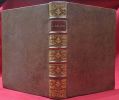
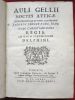
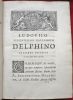
Aulu-Gelle (en latin Aulus Gellius), né à Rome entre 123 et 1301 et mort vers 180, est un magistrat, grammairien et compilateur latin du IIe siècle.Il est l'auteur d'un ouvrage d'érudition en vingt livres intitulé les Nuits attiques. C'est un ouvrage foisonnant d'érudition, en 20 livres (dont le huitième, perdu, n'est connu que par un sommaire), où il aborde pêle-mêle (et délibérément sans ordre) littérature, arts, philosophie, histoire, droit, géométrie, médecine, sciences naturelles et météorologie. L'objectif de l'auteur a été notamment d'offrir à ses enfants un moyen agréable pour s'instruire. Merci de nous contacter à l'avance si vous souhaitez consulter une référence au sein de notre librairie.
Noctium atticarum libri undeviginti : In easdem encomium carmine Luscinii ad Huttenum ...
Argentinae (Strassburg) 1521 P. Goetz et J. Knoblochii Full-Leather
Langue: néerlandais. Aulus Gellius Livres des Nuits Attiques dix-neuf : Dans le même éloge en vers de Luscinius à Huttenum Lieu : Argentine (Strasbourg) Éditeur : Dans les maisons de Knoblochiis, dépenses communes P. Goetz et J. Knoblochii, mois de mars Année : 1521 (23) 336 p (44), In-8°, reliure moderne Son unique oeuvre connue, les Nuits Attiques (latin : Noctes Atticae), tire son nom du fait qu'elle a été commencée pendant les longues nuits d'un hiver qu'il a passé en Attique. Il l'a ensuite poursuivie à Rome. Elle est compilée à partir d'un Adversaria, ou livre de notes, dans lequel il avait noté tout ce qui était d'un intérêt inhabituel qu'il avait entendu en conversation ou lu dans des livres, et elle comprend des notes sur la grammaire, la géométrie, la philosophie, l'histoire et de nombreux autres sujets. [Cette description peut avoir été traduite par une IA.]

Gellius the satirist. Roman cultural authority in Attic Nights.
Leiden, Boston, Brill, 2009.
XI,362 p., illustrations. Hardbound. 24 cm (Mnemosyne Supplement 297; new 166 Euro)
Auli Gellii luculentissimi scriptoris Noctes Atticae
1565 Lugduni [Lyon] ; Haered Seb. Gryphii, 1565 - 1 volume petit In-12° 523 pages - Reliure d'epoque , velin , Dos à cnq nerfs , titre et date manuscrits au dos, parfait état . " Nuits Antiques "
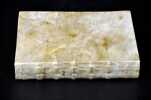
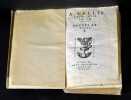
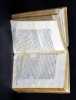
Terentii Comoediae sex, tum ex Donati commentariis, tum ex optimorum, praesertim veterum, exemplarium collatione, diligentius quàm antehac, emendate. Paris, Robert Estienne, 1529. [A la suite] : Auli Gellii Noctium Atticarum Libri Undeviginti (na[m] octavus desideratur praepter capita) cum indicio diligentissime collecto : & graecoru[m] explanatione suis locis insertur : eu[m]q[ue] scholiis Asce[n]sianis in singula capita, collectis fere ex annotatis sane docti hominis Aegidii Maserii... Paris, Josse Bade, 1530. [A la suite] : Annotationes Petri Mosellani (...) in clarissimas Aulu Gellii Noctes Atticas.
Paris, Josse Bade, [au colophon :] 1528. 3 ouvrages en 1 vol. in-folio, veau brun estampé à froid, dos à nerfs, triple encadrement de roulettes estampées à froid sur les plats dont deux à décor de têtes dans des médaillons, la troisième à décor de fleurettes dans des losanges. Reliure de l'époque restaurée, dos entièrement refait, gardes renouvelées, estampage altéré, gardes renouvelées. Titre orné de la marque d'Estienne, (12) ff., 182 ff., (22) ff.; Titre en rouge et noir dans un encadrement typographique gravé sur bois avec la belle marque à la presse de Josse Bade, impression en car. romains avec nombreux passages en grec, belles lettrines à décor floral sur fond criblé, (8) ff., CXXXVI ff., (7) ff., (1) f. blanc; Titre dans une encadrement gravé sur bois avec la marque (n°2) de Josse Bade, lettrines à décor floral sur fond criblé, impr. en car. rom., XXVIII ff. Signatures : Térence : *8 [a-z]8 A8 [B-C]6; Aulu Gelle : A8 [a-s]8; Moselan : [a-b]8 [c-d]6. Annotations marginales d'une main du XVIe s. Déchirure au bas d'un feuillet d'Aulu Gelle sans manque, qq. cernes marginaux en début de volume, galeries de vers dans la marge int. de l'Aulu Gelle sans atteinte au texte, trou de vers traversant qq. ff. du Térence.
Bel ensemble de trois éditions savantes parisiennes de textes classiques latins. Première édition du Térence de Robert Estienne, avec les commentaires de Donat. Le célèbre imprimeur et libraire parisien propose ici une nouvelle recension du texte, surtout en ce qui concerne le commentaire de Donat dont son beau-père, Josse Bade, lui avait communiqué un manuscrit. Aidé dans son travail par le poète Pierre Rosset, il rectifia le texte, identifia les citations dont il était rempli et corrigea les passages en grec. Comme le fait remarquer Schreiber, Térence fut l'un des auteurs latins les plus imprimés au XVIe siècle car il faisait partie des principaux auteurs utilisés pour les études classiques. Estienne, grand pourvoyeur de livres pour l'Université, en publia de très nombreuses éditions, presque chaque année, certaines destinées aux professeurs et aux humanistes (comme celle-ci), d'autres, avec un commentaire abrégé ou sans commentaire, destinées aux étudiants. En 1529, il publia une autre édition in-folio avec le texte seul et une édition in-octavo. Renouard, Estienne, 30; Graesse VII, 56; Moreau-Renouard III, n°1920; Adams, T322 Belle édition des Nuits attiques d'Aulu Gelle, établie par Josse Bade, Gilles de Maizières et Peter Schode. Il s'agit d'une édition révisée du texte déjà publié plusieurs fois par Bade en 1511, 1517, 1519 et 1524. Renouard II, n°627; Graesse III, 45; Moreau-Renouard III, n°2110. Première édition parisienne du commentaire de Peter Schode (alias Pierre Mosellan) sur les Nuits Attiques d'Aulu Gelle. Il avait d'abord été imprimé à Bâle en 1526. Renouard II, n°601; Moreau-Renouard III, n°1605.

Noctes Atticae. Preterea Petri Mosellani in easdem annotiationes.
Basel, Heinrich Petri, (1565). Kl.-8vo (150 x 120 mm). Mit Holzschnitt-Druckermarke auf Titel und Schlussblatt verso. 850 [recte 852] S., [22] Bl. Lederband des 18. Jhs. ber 5 erhabenen B nden (stark berieben, R cken stellenweise besch digt).
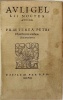
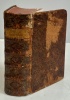
Basler Druck dieses usserst beliebten und viel gelesenen antiken Sammel- und Exzerptenwerks. Nach griechischem Vorbild im zweiten Jahrhundert von Aulus Gellius in langen Wintern chten auf dem Lande nahe bei Athen begonnen und daher Noctes Atticae genannt, ist es eine buntgemischte Sammlung von reizvollen Essays aus den verschiedensten Wissensgebieten, wie der Philosophie und Rechtsgelehrsamkeit, Medizin und Geographie, Geschichte und Literatur, ganz besonders aber auch aus der Grammatik. Der besondere Wert liegt darin, dass es manches kostbare St ck aus verlorenen Originalwerken der lteren r mischen Literatur beinhaltet. Mit der Widmung von Heinrich Petris Sohn Adam an seinen Lehrer in Nozeroi, Claude Frontin. - Durchgehend etwas gebr unt. VD 16 G-1044; Adams G-363; Schweiger II/1, 378; Hieronymus, Petri-Schwabe, 439.
Les Nuits Attiques (traduction nouvelle par E.De Chaumont, F.Flambart, E.Buisson)- 2 volumes [bilingue: latin/fr.]
, Paris, C.L.F.Panckoucke 1846, Complet en 2 volumes: 458 + 416pp., couv. en toile avec dos en cuir, cachet de bibl., qqs.rousseurs, bel état, K551
Noctes Atticae. Nunc denuo ab infinitis, quibus scate-bant mendis, summa ac diligenti cura repurgatae atque pristine integritati restitutae.
11. Venetiis ( Venezia ), apud Io. Gryphium, 1573, in-8°, title with woodcut printer's mark + (47)nn pp + 591 pp + (1)(printer's mark), bound in old supple vellum, old owner's name in ink on title page, some minor stains as usual but still a good/fine copy. Small modern woodcut ex-libris on inside frontcover, paste down partially removed. Born and educated in Rome Aulus Gellius (125 AD- after 180 AD) spent some time in Greece. This work (Attic Nights) is his only work known..
Hoc volumine continentur. Macrobii Interpretatio in Somnium Scipionis a Cicerone confictum. Eiusdem Saternaliorum libri septem. Accuratius recogniti. In quibus Graeca suis cum acentibus suo nitori restituta reperiuntur. Haec omnia Nicolaus Angelius vir ...correxit... (bound with) Auli Gelii Noctium Atticarum commentaria per Bonfinem Asculanum.....
" Venezia, [ Giovanni Tacuino ], Impressum Venaetiis ; in aedibus Ioannis Tacuini de Tridino, 1521, Die XVIII Iulii , in-folio, 30 x 21 cm, (8)nn pp + 110 pp (numbered 1-105) + (2)(blank) (complete collation identical with USTC 839412). Title page printed in red & black, with printer's device ''St. John the Baptist'' with motto '' Ecce agnus''. Several woodcuts in the text, on pp. 26verso a large worldmap showing the ''Alveus Oceani''. Bound in 16th century vellum, edges painted blue, gilt title on smooth spine. Very nice copy notwithstanding a very few minor perpendicular worm galleries (not in the text) and a clear very faint waterstain at a few pages. With the manuscript ex-libris of '' Francisci Pontij Placentini'' in the upper margin of the title page. BOUND WITH Aulus GELLIUS , Auli Gelii Noctium Atticarum commentaria per Bonfinem Asculanum..., Venezia, [ Giovanni Tacuino ], Impressum Venetiis ; per Ioannem de Tridino alias Tacuinum, 1517 die primo Decemb. (44)nn pp + 270 pp (numbered 1-135) , complete but for the last blank leaf. (USTC 832153). Copy with some darker marginal stains at the first 10 leaves, some faint clear waterstains at some pages and marginal stains at the last pages, still a fine/good copy. Convolute containing two postincunables printed by Giovanni Tacuino. This printer is represented with 28 imprints in Adams (not the Macrobius)."
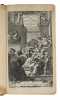
Noctes Atticæ Cum Selectis Novisque Commentariis, etAccuratà Recensione Antonii Thysii, J.C. & Jacobi Oiselii, J.C. Lugd. Batavorum (Leiden), Petri Leffen, 1666.
8vo. Old hcalf. Gilt. 4 raised bands. Back loose. Internally fine. Engraved & printed title. (44),1129 pp. + Indexes.
Brunet II,1524.
LES NUITS ATTIQUES. Traduites en français, avec le texte en regard et accompagnées de remarques, par Victor VERGER. (trois volumes).
Paris F.I. FOURNIER 1820 Trois volumes in-8°, VII 497, 600 et 553 pp. Reliure époque en demi-veau blond, dos lisses ornés de pièces de titre et de tomaison en maroquin vert et rouge, pointillés, roulettes et fers dorés, gardes de papier caillouté. (dos légèrement frottés et légèrement tâchés, défaut d' impression page 549 au tome II, petite cerne claire à une dizaine de feuillet en début des tomes 1 et 2, erreurs de pagination à quelques feuillets au tome 3, présence de pâles et éparses rousseurs).
Noctes Atticae. Editio nova et prioribus ominibus docti hominis cura multo castigatior.
Amstelodami, Apud Joannem Jambonium a Waesberge et Elyseum Weyerstraet, 1666. 12mo. Bound in contemporary full vellum with handwritten title to spine. ""296"" written in contemporary hand to top of front board. Light soiling to extremities, otherwise a fine copy.
Noctium Atticarum libri XX. accuratissime recensiti Distincto quoque capite articulis minoribus Veterum quae excitantur locis ex hodierno more nominatis Graecis quam potuit fieri ad verbum Latine redditis Ad marginem adscriptis aliis veterum idem trac...
Curiae Regnitianae, Vierling, 1741. 8vo. Contemp. full vellum. Ms title on spine (weak). Engraved title-vignette. Title-page printed in red/black. (62),688,(152) pp. Clean and fine.
Brunet II,1524.

