 Write to the booksellers
12 books for « diogenes laertius »Edit
-
Language
French (11)
Greek (1)
-
Century
16th (1)
17th (1)
19th (2)
20th (1)
-
Topics
Diogenes (11)
Early printed books (1)
Greek (3)
Latin (3)
Philosophy (3)
-
Countries
Denmark (2)
France (2)
Germany (1)
Greece (1)
Netherlands (5)
Switzerland (1)
-
Syndicate
ILAB (4)
SLAM (1)
Diogenis Laertii De vitis, dogmatibus et apophthegmatibus clarorum philosophorum libri decem, graece et latine.
Leipzig (Lipsiae), Impensis Ioannis Pauli Krausii, Bibliop. Viennens., 1759. (Colophon at the end: 'Lipsiae, Ex officina I.G.I. Breitkopfii')
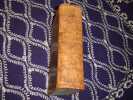
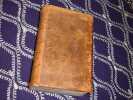
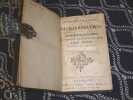
8vo. (XIV),756 (recte 736),(94 index) p. Contemporary calf. 19.5 cm The greatest known source of information about the philosophers of antiquity (Ref: VD18 10213392-008; Hoffmann 1,566; Dibdin 1,504; Moss 1,400/01; Brunet 2,720; Graesse 2,396; Ebert 6177) (Details: Printed in 2 colums, Greek text with facing Latin translation) (Condition: Binding scuffed & chafed, especially at the extremes. Back & boards rubbed. Paper foxing, yellowing and occasionally browning. Right upper corner of the last 80 p. is slightly waterstained. Some small and old ink annotations and underlinings) (Note: The 'Lives and Doctrines of the Philosophers' of the Greek author Diogenes Laertius, who lived probably in the first half of the third century A.D., is still 'our best indirect source of knowledge for classical philosophy'. The 'Lives' comprises both a biographical and a doxographical account, basically focused on Greek thinkers from the 6th to the 3rd century B.C. (from Thales to Epicurus), although references to schools and individuals extend to at least the 2nd century A.D.' (The Classical Tradition, Cambr. Mass. 2010, p. 271) Diogenes Laertius drew his material from earlier compilations, and his doxographic account offers long excerpts from primary texts not transmitted elsewhere, for example Epicurus' 'Principal Doctrines'. Diogenes' reliability and value differ from passage to passage. Some give invaluable information, other passages offer mere caricature. His approach is not a 'systematic analysis, but rather a eulogistic narrative of the course of ancient philosophy, and of the four main classical schools, the Academy, Peripatetics, Stoics and Epicureans. Anecdotal and perhaps largely apocryphal in nature, still it gave to Renaissance humanists, like Leonardo Bruni, Machiavelli, Erasmus et alii, some conception of ancient philosophy, especially of Platonic and Epicurean thought.' (Ch.L. Stinger, 'Humanism and the Church Fathers: Ambrogio Traversari (1386-1439) and Christian antiquity in the Italian Renaissance', Albany 1977, p. 71) The 'editio princeps' was published in Basel in 1533. The Latin translation was published much earlier in Rome in 1472. This translation was later revised several times and appears also in this book. It was made by the Italian Hellenist Ambrogio Traversari, also known as Ambrosius Traversari, 1386-1439. Our 1759 edition is a reissue of the edition of 1731 of Longolius, which in turn was a revision of the 1692 edition, which was produced by the Danish philologist Marcus Meibom, or Marcus Meibomius. The edition of 1731 was produced by the German philologist and historian Paulus Daniel Longolius, 1704-1779, from 1735 till his death Rector of the Gymnasium in Hof. He wrote on local history and was an editor of Zedler's Universallexikon. He also published three texts of classical authors: 'Plinii epistolae' (Amsterdam 1734), this Diogenes edition (Curiae, i.e. Hof, Saale, 1739), and a Gellius edition (Curiae, 1741). (ADB 19, 156/57) The 1731 edition contained, besides the Greek text and Latin translation, a preface, commentaries and engraved portraits. Because this edition was out of print, and there was much demand for it, the publisher Paulus Krausius decided to produce this Leipsic edition of 1759, which is in fact a reissue of the 1731 edition of Longolius, omitting however the portraits, the preface and the commentaries, and offering the Greek text , the Latin translation, and 94 pages of indexes. (Praefatio leaf *5 verso and *6 recto) (Provenance: on the front flyleaf in pencil 'RtK', this is Rijkel ten Kate 1918-2008. He taught classics at the Willem Lodewijk Gymnasium in Groningen. In 1955 he wrote his dissertation: Quomodo heroes in Statii Thebaide describantur quaeritur, on the Thebaid of the Roman poet Statius) (Collation: *8 (minus blank leaf *8), A-3F8 (minus blank leaf 3F8); the pagination jumps between the gatherings 2Y and 2Z from 721 to 741, the catchword on leaf 2Y4 verso is correct)) (Photographs on request)
Diogenis Laertii De vita et moribus philosophorum libri X. Recens ad exemplar Graecum collati, ex eiusque fide cura doctissimorum virorum restituti & emendati. Cum indice nominum ac rerum locupletissimo.
Paris, (Parisiis), Apud Hieronymum de Marnef, sub Pelicano, Monte D. Hilarii, 1560.
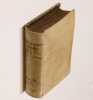
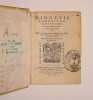
12mo. 596,(28 index),(2 epilogue 'Candido Lectori'),(1 woodcut illustration),(1 woodcut printer's mark of De Marnef) p. Later vellum 13 cm - The greatest known source of information about the philosophers of antiquity (Ref: Hoffmann 1,569; Graesse 2,397, erroneously dating 1561) (Details: 2 thongs laced through the joints. Woodcut printer's mark of De Marnef on the title (BaTyR no. 28133), depicting a pelican on his nest, feeding his young with his own blood; the motto is: 'In me mors, in me vita'. On the last page another version of De Marnef's printer's mark (BaTyR no. 2882), now depicting a griffon that holds in its claw a cubic weight to which is attached a winged globe. The cube stands for constancy and the globe for fortune; the motto is: 'Virtutis et gloriae, comes invidia'. Marnef used this version of his mark only at the end of the books he printed; This printer's mark very closely resembles that of the Lyonese printer Sébastien Gryphius, only the motto is different. Greek text and a Latin translation.) (Condition: Vellum somewhat age-toned. Short title in ink on the back. Front flyleaf removed. Stamp on front pastedown and on the title; tiny hole in outer margins of title; 4 tiny holes in last leaf; Binder's error: he bound leaf X7, p. 333/4, probably a cancel, before leaf X3) (Note: This is according to Graesse a repetition of the edition of 'De vita et moribus etc.' edited by Johannes Boulierius (Jean Boulier), Lyon 1556. We compared both works and conclude that Graesse is more or less right. The typesetter of the 1560 edition had most probably the 1556 edition before him. He repeats even the printed marginal remarks and annotations. But there are occasionally minute differences in the Greek text, and sometimes the 1560 edition adds an explanatory marginal remark. In book 7 p. 340, in the life of Zeno Criticus for instance, we found a printed 'varia lectio'. There 1556 has only therizonti, 1560 adds in the margin: '* Forte erizonti contentioso'. In 1556 the number 58 is quintaginta & octo, in 1560 Duodesexaginta. (p. 425 & 342) In the epilogue dated 1560, we read that we have here a text revised and ameliorated with the help of a manuscript 'cuius (quamvis mutili) veritate & fide non pauca restituenda, emendandaque curavit Hieronymus Marnefius Parisiensis Typographus'. (Leaf 2Q7). This activity is confirmed in the 'Extrait du Privilège du Roi', which grants Marnefius the exclusive right to publish this text 'Lequel auroit esté nouvelement reveu, visité, corrigé, additionné & augmenté', for the next six years. (Leaf A1 verso, which is the verso of the title) Immediately after this privilege, and preceding the Latin translation, we find a 3 page letter of Fr. Ambrosius addressed to Cosimo de' Medici. This letter is meant to assure the reader that this 1560 translation is a reliable old, and often printed one, based on the translation that was made by the Italian priest, theologian and Hellenist Ambrogio Traversari, O.S.B. Cam., also known as Ambrosius Traversari, or Ambrosius Camaldulensis, 1386-1439. He worked between 1424 and 1433 on this translation, which came to be widely circulated in manuscript form, and was only published in Rome in 1472. In this dedicatory letter Ambrosius Traversari tells us that he translated the 'Lives of the Philosophers' at the request of Cosimo de' Medici. ('Tibi (...) hoc opus dedicatum fuit, qui & autoritate tua in primis nos ad illud impulisti'. p. 5) The 'Lives of the Philosophers' of the Greek author Diogenes Laertius, who probably lived in the first half of the 3rd cent. A.D., is a compendium full of biographies of the ancient philosophers, from Thales to Epicurus, and their doctrines. Diogenes Laertius drew his material from earlier compilations. His reliability and value differ from passage to passage. Some give invaluable information, other passages offer mere caricature. (OCD 2nd ed. p. 348/49) It 'provides not a systematic analysis, but rather a eulogistic narrative of the course of ancient philosophy (...) of the four main classical schools, the Academy, Peripatetics, Stoics and Epicureans. Anecdotal and perhaps largely apocryphal in nature, still it gave to Renaissance humanists some conception of ancient philosophy, especially of Platonic and Epicurean thought'. (Ch.L. Stinger, 'Humanism and the Church Fathers: Ambrogio Traversari (1386-1439) and Christian antiquity in the Italian Renaissance', Albany 1977, p. 71)) (Provenance: On the front pastedown a green stamp of 'Univ. Doz. Dr. Mag. F.F. Schwarz, Professor. A 8810 Graz, Panoramagasse 2A' with a handwritten date of acquisition '1973'. Franz Ferdinand Schwarz was from 1982 till 1996 professor of classical philology at the University of Graz, where he was born in 1934. He died in his hometown in 2001 after a long illness. (See his wikipedia lemma 'Franz Ferdinand Schwarz') On the title an old almost illegible stamp of the University of Ferrara, showing a tree in its center, and part of the legend 'Università di Ferrara') (Collation: A - 2Q-8) (Photographs on request)
Filosofiske Historie, eller navnkundige Filosofers Levnet, Meninger og sindrige Udsagn, i ti Bøger. Af det Græske oversatte, og med Anmærkninger oplyste, ved Børge Riisbrigh. Efter Oversætterens Død til trykken befordret ved M. Børge Thorlacius. 2 vols.
Kjøbenhavn, Schubothe, 1812. 8vo. Ubeskåret, bind 2 uåbnet, i de originale marmorerede papomslag. Omslag med slitage. Foromslag på bind 1 løst, mangler dele af ryggen. Indvendig pæn og ren. XXXII,518 pp. 322 pp. + Kobberstukket portræt af Børge Riisbrigh.
Første danske udgave af Laertius' berømte filosofihistorie, den første af sin art. Bibliotheca Danica IV:94.

Uilen van Athene. Leven en leer van klassieke filosofen. Een bloemlezing vertaald en ingeleid door J.C.B. EYKMAN.
Amst., Meulenhoff, (1966).
271 p. Pb. 20 cm (OiN 164; slightly used)
Leven en leer van beroemde filosofen. Vertaald door R. FERWERDA & J. EYKMAN.
Baarn, Ambo, 1989.
435 p. Cloth 22 cm (OiN Suppl. 49; incl. worn and faded dustjacket)
De vitis, dogmatis et apophthegmatis clarorum philosophorum libri decem. Edidit H.G. HUEBNERUS.
Hildesheim, N.Y., Olms, 1981.
4 vols: XXII,379;VI,814;X,670;724 p. Cl. 19 cm (Repr. Lpz. 1828 - 1833) (Heavy book, may require extra shipping costs)
Diogenis Laertii De vitis, dogmatibus et apophthegmatibus clarorum philosophorum…
1692 Amstelaedami. Apud Henricum Wetstenium. 1692. 2 volumes in-4, plein maroquin rouge à longs grains, triple filet doré en encadrement sur les plats, dos à nerfs ornés, pièces de titre et de tomaison en maroquin brun, tranches dorées, roulettes intérieures dorées.(8) ff. ; 672 pp. ; (4) ff. ; 590 pp.; (28) ff.
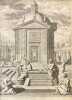
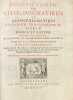
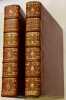
Selon Brunet, "édition la plus complète et la plus belle que l'on eût alors de cet écrivain." Elle est imprimés sur 2 colonnes et est illustrée d’un frontispice et de 25 planches.Le premier tome, en édition bilingue latin/grec, contient la vie des principaux philosophes grecs (Platon, Thalès, Euclides, Socrate, Pythagore…), orné de leur portraits à pleine page. Cet ouvrage est annoté par Isaac et Méric Casaubon ainsi qu’Aldobrandini. Le second tome contient les observations de Gilles Ménage et Joachim Kühni.Coiffes frottées au tome I avec petit accroc à la coiffe supérieure, petit trou de vers en bas du dos du tome II.Bel exemplaire relié en plein maroquin rouge. Brunet II n°720.

Leben und Meinungen berühmter Philosophen -
1990 Aus dem Griech. übers. von Otto Apelt. Unter Mitarb. von Hans Günter Zekl neu hrsg. sowie mit Vorw., Einl. und neuen Anm. zu Text und Ubers. vers von Klaus Reich - Hamburg : Felix Meiner, 1990 - in-8 broché, 411 pages - très bon état -
Tous nos livres sont visibles sur notre site : https://www.livrepoesie.com/
De vita et moribus philosophorum libri X. Cum indice locupletissimo
1551 Lyon, apud Seb. Gryphium, (Sébastien Gryphe), Lyon, 1551, in 12 de 468 pp., (19) pp. d'index des noms propres, rel. d'ép. plein velin ivoire à recouvrements, dos lisse avec titre et nom d'auteur manuscrits à l'encre brune, date en pied, tranches bleues, bel ex.
C'est dans cette traduction latine de Ambrogio Traversari (1386-1439), dit Ambroise le Camaldule, que parurent les premières éditions de Diogène Laerce au XV° siècle. Bel ex-libris armorié gravé sur bois de Gaëtan HECQ.
Diogenes LAERTIUS, Casaubon, Hesychius, Fr. Ambrosius, Benedictus Brognoli
Reference : HI415
Diogenis Laertii De Vitis, dogmatis & apophthegmatis eorum qui in philosophia claruerunt Liber VIII, IX, X, ....
567-584 pp., (avec) Isaaci Casauboni Notae as Diogenis Laertii libros de vitis120 pp., index 5 pp., 1 bl., (avec) Fr. Ambrosii in Diogenis Laertii opus, Benedicti Bragnoli Epistola 47 pp., index 24 pp., (avec) Hesychii Milesii illustii cognomento 88 pp., 1 bl. S.l., s.d. ( Geneve, Henri Estienne II). In-8o, texte en grec et a latin. Rel. XVIIIe plein basane verte, dos a nerfs, double roulette sur les plats, ex-libris manuscrit sur le page de garde. La traduction latine est due a Ambrogio Traversari (1386-1439) et a Junius Hadrianus celle de Hesychius. Hoffmann I, 564, Brunet II, 719 (Avec des nouvelles corrections et des augmentations. Tome II seul.
Lives and Opinions of Eminent Philosophers
NOVA SCIENCE PUBLISHERS INC
LIVRE A L’ETAT DE NEUF. EXPEDIE SOUS 3 JOURS OUVRES. NUMERO DE SUIVI COMMUNIQUE AVANT ENVOI, EMBALLAGE RENFORCE. EAN:9781536197259
Filosofiske Historie, eller: navnkundige Filosofers Levnet, Meninger og sindrige Udsagn, i ti Bøger. Af det Græske oversatte, og med Anmærkninger oplyste ved Børge Riisbrigh. Bd. 1 (af 2).
Kbhvn., Schubothes Forlag, 1812. Ubeskåret i orig. blå kartonnage. Ryg med udbedring af nyere papir. Kobberstukket portræt (Riisbrigh). XXXIV,518 pp. Indvendig frisk.

