 Write to the booksellers
DIOGENES LAERTIUS.
Diogenis Laertii De vitis, dogmatibus et apophthegmatibus clarorum philosophorum libri decem, graece et latine.
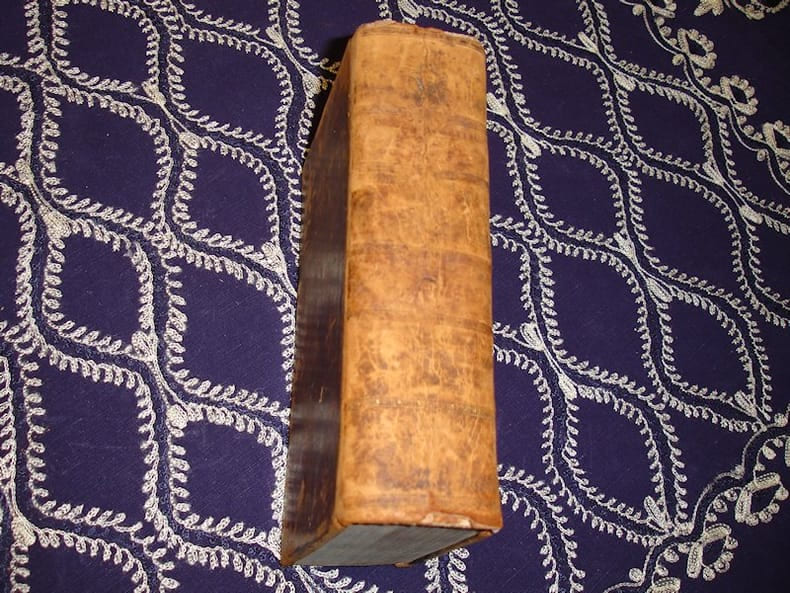
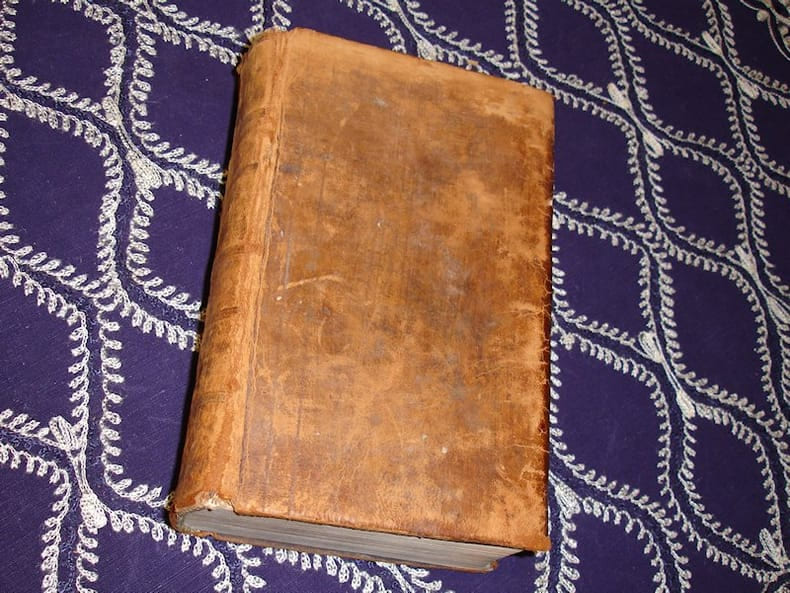
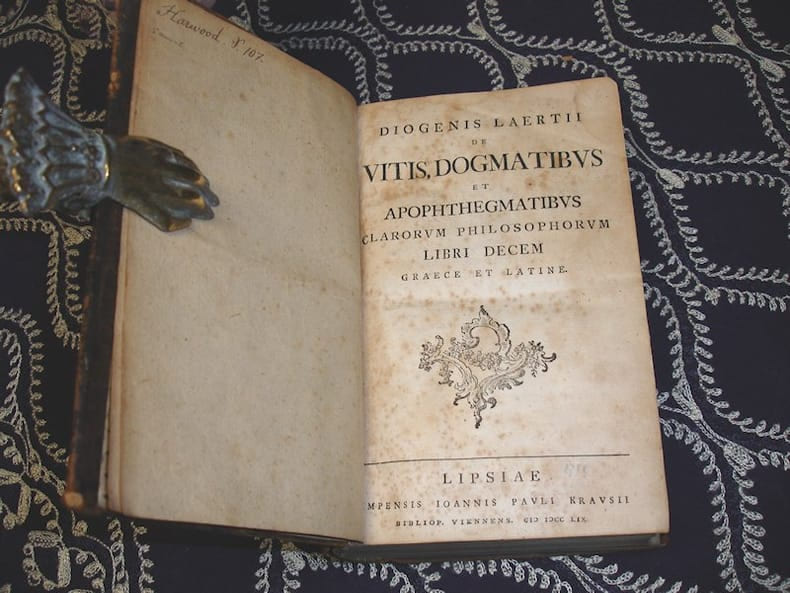
Leipzig (Lipsiae), Impensis Ioannis Pauli Krausii, Bibliop. Viennens., 1759. (Colophon at the end: 'Lipsiae, Ex officina I.G.I. Breitkopfii')
Reference : 130315
8vo. (XIV),756 (recte 736),(94 index) p. Contemporary calf. 19.5 cm The greatest known source of information about the philosophers of antiquity (Ref: VD18 10213392-008; Hoffmann 1,566; Dibdin 1,504; Moss 1,400/01; Brunet 2,720; Graesse 2,396; Ebert 6177) (Details: Printed in 2 colums, Greek text with facing Latin translation) (Condition: Binding scuffed & chafed, especially at the extremes. Back & boards rubbed. Paper foxing, yellowing and occasionally browning. Right upper corner of the last 80 p. is slightly waterstained. Some small and old ink annotations and underlinings) (Note: The 'Lives and Doctrines of the Philosophers' of the Greek author Diogenes Laertius, who lived probably in the first half of the third century A.D., is still 'our best indirect source of knowledge for classical philosophy'. The 'Lives' comprises both a biographical and a doxographical account, basically focused on Greek thinkers from the 6th to the 3rd century B.C. (from Thales to Epicurus), although references to schools and individuals extend to at least the 2nd century A.D.' (The Classical Tradition, Cambr. Mass. 2010, p. 271) Diogenes Laertius drew his material from earlier compilations, and his doxographic account offers long excerpts from primary texts not transmitted elsewhere, for example Epicurus' 'Principal Doctrines'. Diogenes' reliability and value differ from passage to passage. Some give invaluable information, other passages offer mere caricature. His approach is not a 'systematic analysis, but rather a eulogistic narrative of the course of ancient philosophy, and of the four main classical schools, the Academy, Peripatetics, Stoics and Epicureans. Anecdotal and perhaps largely apocryphal in nature, still it gave to Renaissance humanists, like Leonardo Bruni, Machiavelli, Erasmus et alii, some conception of ancient philosophy, especially of Platonic and Epicurean thought.' (Ch.L. Stinger, 'Humanism and the Church Fathers: Ambrogio Traversari (1386-1439) and Christian antiquity in the Italian Renaissance', Albany 1977, p. 71) The 'editio princeps' was published in Basel in 1533. The Latin translation was published much earlier in Rome in 1472. This translation was later revised several times and appears also in this book. It was made by the Italian Hellenist Ambrogio Traversari, also known as Ambrosius Traversari, 1386-1439. Our 1759 edition is a reissue of the edition of 1731 of Longolius, which in turn was a revision of the 1692 edition, which was produced by the Danish philologist Marcus Meibom, or Marcus Meibomius. The edition of 1731 was produced by the German philologist and historian Paulus Daniel Longolius, 1704-1779, from 1735 till his death Rector of the Gymnasium in Hof. He wrote on local history and was an editor of Zedler's Universallexikon. He also published three texts of classical authors: 'Plinii epistolae' (Amsterdam 1734), this Diogenes edition (Curiae, i.e. Hof, Saale, 1739), and a Gellius edition (Curiae, 1741). (ADB 19, 156/57) The 1731 edition contained, besides the Greek text and Latin translation, a preface, commentaries and engraved portraits. Because this edition was out of print, and there was much demand for it, the publisher Paulus Krausius decided to produce this Leipsic edition of 1759, which is in fact a reissue of the 1731 edition of Longolius, omitting however the portraits, the preface and the commentaries, and offering the Greek text , the Latin translation, and 94 pages of indexes. (Praefatio leaf *5 verso and *6 recto) (Provenance: on the front flyleaf in pencil 'RtK', this is Rijkel ten Kate 1918-2008. He taught classics at the Willem Lodewijk Gymnasium in Groningen. In 1955 he wrote his dissertation: Quomodo heroes in Statii Thebaide describantur quaeritur, on the Thebaid of the Roman poet Statius) (Collation: *8 (minus blank leaf *8), A-3F8 (minus blank leaf 3F8); the pagination jumps between the gatherings 2Y and 2Z from 721 to 741, the catchword on leaf 2Y4 verso is correct)) (Photographs on request)
Bookseller's contact details
Antiquariaat Fragmenta Selecta
+31 20 418 55 65
Payment mode

Sale conditions
Terms of Sale All items offered are subject to prior sale. Your order will be final after you have received our confirmation, with a specification of the availability of the items and the shipping costs. All books are complete and in good antiquarian condition, unless otherwise described. Prices are in EURO. Postage and insurance are not included. Postage will be calculated at cost (no extra charges). Returns Books may be returned within 14 days of receipt, if returned in the same condition as sent, and packed, shipped and insured as received (please always notify us). We will refund the shipping costs of a return shipment only if our descriptions were not correct. How to pay Pre-payment is necessary for new customers. Our order confirmation will provide detailed information and a specification of the shipping costs. Customers who are known to us and libraries will be invoiced as usual. We accept Visa and Mastercard. You can submit your card information through our SECURE PAYMENT FORM. PayPal: we will send you a personal link to the PayPal website. Banktransfers: payment can be made into our bank account in The Netherlands.
1 book(s) with the same title
Diogenis Laertii De Vitis, Dogmatibus et Apophthegmatibus Clarorum Philosophorum Libri Decem Graece et Latine.
Lipsiae - Leipzig, Ioannis Pauli Krausii 1759, 205x120mm, relié demi-veau de l’époque, cuir frotté, manque la pièce de titre, papier bruni par endroits.
8 ff. - 756 p. - 47 ff., Pour un paiement via PayPal, veuillez nous en faire la demande et nous vous enverrons une facture PayPal

