 Write to the booksellers
124 books for « demosthenes »Edit
-
Language
English (1)
French (122)
Greek (1)
-
Century
16th (1)
18th (1)
19th (9)
20th (12)
21st (2)
-
Countries
Belgium (3)
Denmark (4)
France (31)
Greece (1)
Netherlands (81)
Switzerland (4)
-
Syndicate
CLAM (1)
ILAB (21)
SLAM (14)
Topics
Demosthenis et Aeschinis Mutuae accusationes de ementita Legatione, et de Corona, ac contra Timarchum quinque numero, cum earum argumentis, ipsorum oratorum vita, et Aeschinis Epistola ad Athenienses, ac indice copioso. Nuper a bene docto viro traductae. Dictorum series versa pagina conintetur. Cum Privilegio Veneto.
Venice (Venetiis), Apud Hieronymum Scotum, 1545.
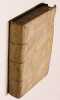
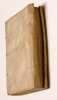
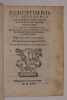
223,(1 blank) leaves. Limp overlapping vellum. 16 cm (Ref: Edit16 CNCE 16736; Hoffmann 1,528) (Details: Latin translation only. Woodcut printer's mark on the title page and at the end of the book, depicting a branch of olive and a palm tree, graft onto a trunk, with between them an anchor; anchor and trunk are held together bij the initials SOS (Signum Octaviani Scoti); a banner runs around with the motto: 'In tenebris fulget'. Printed in italics, except for the title. Some historiated and ornamental woodcut initials) (Condition: Vellum age-tanned and slightly soiled. 2 tiny holes in both boards, because of the 2 ties which have disappeared) (Note: In the preface of this book the learned anonymous translator explains his readers that it was his aim to collect for those who are not able to read Greek (qui graeca non legerant) in one volume (in unum eundemque codicem ac seorsum ab reliquis) five speeches, translated into Latin, of Demosthenes and Aeschines, because those speeches, full of mutual accusations and attacks, belonged together (inter se sint connexae (...) ut una ab altera divelli non possit). They shared the same actors and the same subject matter, and showed to the consent of all, the power of speech, and the art of oratory in her perfection (tota ars dicendi & vis orandi). Demosthenes and Aeschines were at daggers drawn, and therefore the collections begins with the 'Contra Timarchum oratio', because this speech was the beginning of their enmity (quod inde Demosthenis & Aeschinis inimicitiae exordium habuerint). In this preface he severely criticizes the clumsy Latin translation of Leonardus Aretinus (Leonardo Aretino, known to us also as Leonardo Bruni, ca. 1370-1444). He calls his translations 'mendosae' and unreliable. The anonymous translator not only translated speeches of Demosthenes and Aeschines, he added also relevant material from other sources, such as Libanius, Philostratus, and Apollonius, which he now translates into Latin for the first time (adiunctis tam Libanii quam aliorum argumentis ad eas ipsas orationes). (Interpres lectori S.P.D., leaf 2/3) Translated are beside Aeschines' 'Contra Timarchum Oratio', the 'Oratio de ementita legatione' of Demosthenes and Aeschines, now commonly known as 'De falsa legatione', and the 'Oratio contra Ctesiphontem de Corona', and the 'Oratio de Corona pro Ctesiphonte' of both men. Added are biographic sketches, argumenta and testimonia. The Athenian Demosthenes, 384-322 BC, was without doubt the greatest orator of his time. His surviving speeches are mostly connected with his politics. He was a fierce opponent of Philippus II, king of Macedon since 359, who gradually tried to subject the whole of Greece. In 351 he delivered his first Philippic, against him. His speeches against Philippus, known as Philippics, are one long warning against the growing Macedonian power. Demosthenes attacked also the pro-Macedonian elements in Athens, who sought peace with Philippus, and wanted to give in. One of their leaders was the orator Aeschines, 389-314 BC. In 345 Demosthenes and his Athenian ally Timarchus tried to impeach in a speech, called 'De falsa legatione' or 'On the false embassy', Aeschines 'for wilfully neglecting the interest of Athens as a member of the embassy which had negociated the peace' (H.J. Rose, A handbook of Greek literature, London 1965, p. 291). Demosthenes held Aeschines responsible for Philip's use of the peace negotiations to intervene in other Greek city-states. Demosthenes was unsuccessful and Aeschines was acquitted, having delivered a speech in which he defends himself against accusations of treason and collusion with the enemy. Instead of refuting the accusations directly, Aeschines used Athenian Civil Procedure to argue against Timarchus as a qualified prosecutor. The feud reached its peak in 330 with Demosthenes' most famous oratorical effort, the so-called speech 'On the Crown'. A member of his party, Ctesiphon, had proposed in 336 to honor Demosthenes for his services, as was customary, with a golden crown. Nothing came of it the next 6 years, mainly because Aeschines accused Ctesiphon of legal irregularities, but in effect he attacked Demosthenes' policy. In 330, after a charge of Aeschines, 'Demosthenes replied in the masterpiece, commonly known in modern times as the 'De Corona'. It is partly a formal rebuttal of the charge against Ktesiphon, but this is the weakest part of it, for technically Aischines had the law on his side. Substantially, it is a magnificent defence of the principles guiding the anti-Macedonian party, justifying them in face of failure. Less to modern taste is its bitter personal attack on Aischines, who however had not spared Demosthenes in his own speech'. (Rose, p. 292)) (Provenance: On the front flyleaf in pencil '7 januari 1961', written by the Flemish linguist Walter Couvreur, 1914-1996, who was an Orientalist, and professor of Indoeuropean linguistics at the University of Gent. It is the date of acquisition. The place of acquisition he wrote on the flyleaf at the end: 'Turijn, Bottega d'Erasmo') (Collation: A-2E8, last leaf blank, pagination sometimes irregular) (Photographs on request)
Ingeborg LüscherSkulpturen
Galerie Farideh Cadot, Paris/Galerie Heike Curtze, Düsseldorf, 1988. In-4, broché sous couverture illustrée en couleurs, 59 pp. Demosthenes Davvetas : Element und Herz, Eine Sprache/La langue de l'élément-cœur/The Langage of the Element-Heart - Planches - Biographie/Expositions/Catalogues.
Avec un portrait de l'artiste et 20 planches couleurs à pleine page.Catalogue trilingue allemand/français/anglais. --- Plus d'informations sur le site archivesdunord.com
D mosth nous peri stephanou logos. Demosthenis Oratio de corona. accuratè emendata, argumento locupletata, & partibus distincta.mosth nous peri stephanou logos. Demosthenis
Parisiis : apud Dionysium Joannem Aumont. M DCC LXIX.1769,156 p.en Ancien grec; in-12 plein veau epoque,relie avec edition latine 1770 Demosthenis Oratio de corona. accuratè emendata, argumento locupletata, & partibus distincta.83p.mosth
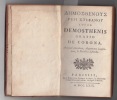
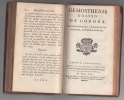
2 editions Ancien grec latin,texte bon,reliure un peu usee Remise de 20% pour toutes commandes supérieures à 200 €
Demosthenes, Thomas Leland, Epihanius Wilson, T.Dwight, J.McCarthy,R.H.Stoddard,P.Van Dyke,A.Ellerly Bergh
Reference : 015295
(1900)
Orations of Demosthenes
New York - London 1900 The Colonial Press Cloth
Langue: anglais. Orations de Démosthène, prononcées pour exciter les Athéniens contre Philippe, roi de Macédoine ; et lors des délibérations publiques. Les Grands Classiques du Monde, Collection Universitaire, limitée à mille exemplaires dont celui-ci est le numéro 230. Édition en toile vert clair, couverture rigide, tranche supérieure dorée, deux autres côtés non rognés, 24 x 16 cm, XII et 448 pages, illustrations de 3 pages de large, quelques usures sur les couvertures, très propre à l'intérieur en excellent état.

Oreste ou le Roman sans fin Davvetas, Demosthenes
Envoi de l'Auteur.
Merci de nous contacter à l'avance si vous souhaitez consulter une référence dans notre boutique à Authon-du-Perche.
Démosthène. Harangues : Texte établi et traduit par Maurice Croiset [Unknown Binding] Démosthènes
Tome II seul. Charnières légèrement érodés aux extrêmités du dos.
Merci de nous contacter à l'avance si vous souhaitez consulter une référence dans notre boutique à Authon-du-Perche.
Oreste ou le Roman sans fin Davvetas, Demosthenes
Attention édition est de 1986. mention au stylo sur la 1ère page.
Merci de nous contacter à l'avance si vous souhaitez consulter une référence dans notre boutique à Authon-du-Perche.
Attische redenaars. 3e deel, 1e helft: Demosthenes. (Met inleiding en aantekeningen) door H.Th. Hemstege.
Kerkrade & Heerlen, N. Alberts, n.d.
XII,209 p. Half cloth. 22 cm (Introduction, Greek text, Dutch notes)
Ausgewählte Reden des Demosthenes. Erklärt von J. Sörgel. II. Bändchen: Rede über den Frieden, Zweite Rede gegen Philippus, Rede über die Angelegenheiten im Chersones, dritte Rede gegen Philippos.
Gotha, Friedrich Andreas Perthes, 1909.
IV,152 p. Half cloth. 21.5 cm (Greek text & commentary in German)(Cover slightly worn at the extremes)
Demosthenes' orations. Intr. by J. WARRINGTON.
Ldn., N.Y., Dent & Dutton, (1954).
XIII,292 p. Cl. (Everymans's library)
Ausgewählte Reden des Demosthenes. Erklärt von Anton Westermann. 3. Bändchen: (XXIII) Rede gegen Aristokrates; (LIV) Rede gegen Konon; (LVII) Rede gegen Eubulides. 3. verbesserte Auflage besorgt von Emil Rosenberg.
Berlin, Weidmann, 1890.
197 p. Wrappers. 21 cm (WmS, Sammlung Griechischer und Lateinischer Schriftsteller mit deutschen Anmerkungen. Last edition) (Name on the title)
Demosthenes' rede tegen Zenothemis. (Oratie XXXII), met inleiding en commentaar door Arnold Carel Cosman.
(Leiden), Burgersdijk & Niermans, 1939.
(VI),197 p. Wrs. 24 cm (Diss., Leiden; text, introduction & commentary in Dutch) (Whitaker 05646)(Lower corner slightly dogeared)
Demosthenes, Speeches 50-59. Translated by V. BERS.
Austin, University of Texas Press, 2003.
XXXI,205 p. Paperback 22 cm (The oratory of classical Greece 6)
Die attische Beredsamkeit. 3. Aufl. 3. Abt., erster Abschnitt: Demosthenes.
Hildesheim, N.Y., Olms, 1979.
VIII,644 p. Cl. 23 cm (Repr. Lpz. 1893)
De demokratie bij Demosthenes.
Groningen, Batavia, Wolters,1939.
(VII),116 p. Wrs. 23 cm (Diss.)
De demokratie bij Demosthenes.
Groningen, Batavia, Wolters,1939.
(VII),116 p. Wrappers. (Dissertation)
De demokratie bij Demosthenes.
Groningen, Batavia, Wolters, 1939.
(VII),116p. Wrs. (Diss.)(Foxed)
Demosthenes' rede tegen Zenothemis. (Oratie XXXII), met inl. en comm. door -.
(Leiden), Burgersdijk & Niermans, 1939.
(VI),197 p. Wrs. (Diss.)(Whitaker 05646)
Demosthenes' rede tegen Zenothemis. (Oratie XXXII), met inl. en comm. door Arnold Carel Cosman.
(Leiden), Burgersdijk & Niermans, 1939.
(VI),197 p. Wrappers. 24 cm (Dissertation, Leiden)
Demosthenes. Der Staatsmann und sein Werden.
Berlin, Walter de Gruyter, 1963.
VIII,268 p. Cloth. 23 cm
Demosthenes. Der Staatsmann und sein Werden.
Berlin, Walter de Gruyter, 1963.
VIII,268 p. Cloth. 23 cm
Demosthenes. The origin and growth of his policy.
Berkeley, California, University of California Press, 1938.
273 p. Cloth. 23 cm (Sather Classical Lectures 13)
Demosthenes und seine Zeit. 2. revidierte Ausgabe.
Lpz., Tbn., 1885 - 1887.
3 vols: XVI,528;VII,566;X,496 p. H.cl. 23 cm (Cover worn at the extremes; head & tail of the back sl. chipped)

