 Write to the booksellers
DEMOSTHENES & AESCHINES.
Demosthenis et Aeschinis Mutuae accusationes de ementita Legatione, et de Corona, ac contra Timarchum quinque numero, cum earum argumentis, ipsorum oratorum vita, et Aeschinis Epistola ad Athenienses, ac indice copioso. Nuper a bene docto viro traductae. Dictorum series versa pagina conintetur. Cum Privilegio Veneto.
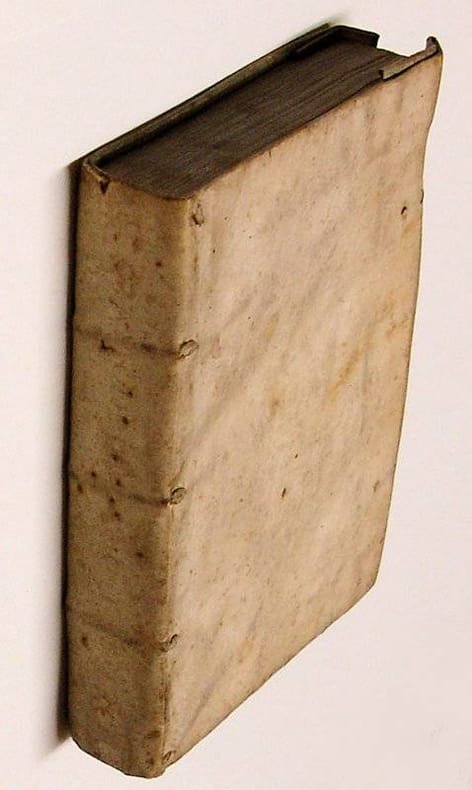
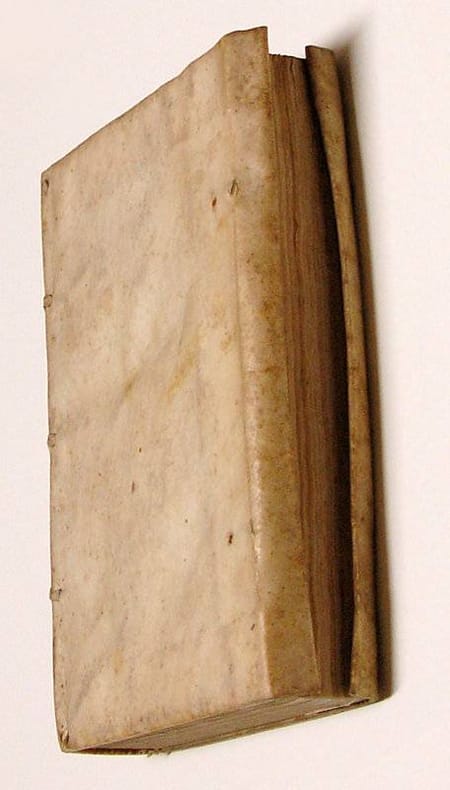
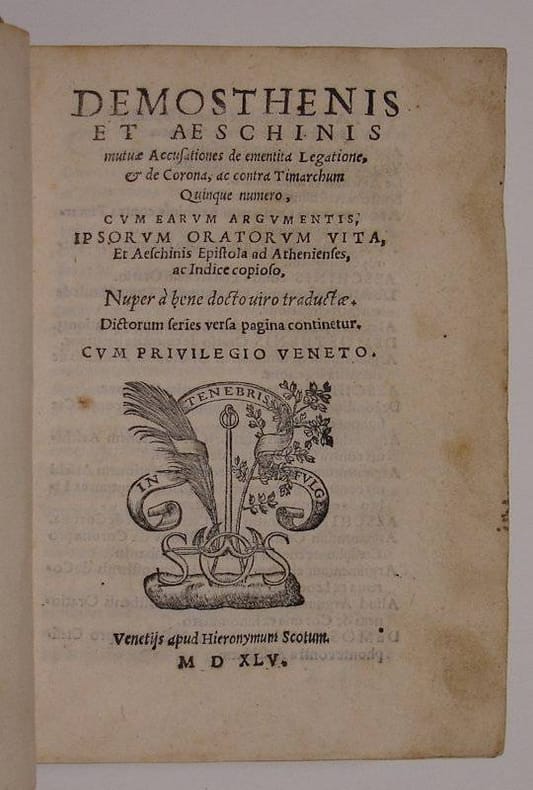
Venice (Venetiis), Apud Hieronymum Scotum, 1545.
Reference : 120062
223,(1 blank) leaves. Limp overlapping vellum. 16 cm (Ref: Edit16 CNCE 16736; Hoffmann 1,528) (Details: Latin translation only. Woodcut printer's mark on the title page and at the end of the book, depicting a branch of olive and a palm tree, graft onto a trunk, with between them an anchor; anchor and trunk are held together bij the initials SOS (Signum Octaviani Scoti); a banner runs around with the motto: 'In tenebris fulget'. Printed in italics, except for the title. Some historiated and ornamental woodcut initials) (Condition: Vellum age-tanned and slightly soiled. 2 tiny holes in both boards, because of the 2 ties which have disappeared) (Note: In the preface of this book the learned anonymous translator explains his readers that it was his aim to collect for those who are not able to read Greek (qui graeca non legerant) in one volume (in unum eundemque codicem ac seorsum ab reliquis) five speeches, translated into Latin, of Demosthenes and Aeschines, because those speeches, full of mutual accusations and attacks, belonged together (inter se sint connexae (...) ut una ab altera divelli non possit). They shared the same actors and the same subject matter, and showed to the consent of all, the power of speech, and the art of oratory in her perfection (tota ars dicendi & vis orandi). Demosthenes and Aeschines were at daggers drawn, and therefore the collections begins with the 'Contra Timarchum oratio', because this speech was the beginning of their enmity (quod inde Demosthenis & Aeschinis inimicitiae exordium habuerint). In this preface he severely criticizes the clumsy Latin translation of Leonardus Aretinus (Leonardo Aretino, known to us also as Leonardo Bruni, ca. 1370-1444). He calls his translations 'mendosae' and unreliable. The anonymous translator not only translated speeches of Demosthenes and Aeschines, he added also relevant material from other sources, such as Libanius, Philostratus, and Apollonius, which he now translates into Latin for the first time (adiunctis tam Libanii quam aliorum argumentis ad eas ipsas orationes). (Interpres lectori S.P.D., leaf 2/3) Translated are beside Aeschines' 'Contra Timarchum Oratio', the 'Oratio de ementita legatione' of Demosthenes and Aeschines, now commonly known as 'De falsa legatione', and the 'Oratio contra Ctesiphontem de Corona', and the 'Oratio de Corona pro Ctesiphonte' of both men. Added are biographic sketches, argumenta and testimonia. The Athenian Demosthenes, 384-322 BC, was without doubt the greatest orator of his time. His surviving speeches are mostly connected with his politics. He was a fierce opponent of Philippus II, king of Macedon since 359, who gradually tried to subject the whole of Greece. In 351 he delivered his first Philippic, against him. His speeches against Philippus, known as Philippics, are one long warning against the growing Macedonian power. Demosthenes attacked also the pro-Macedonian elements in Athens, who sought peace with Philippus, and wanted to give in. One of their leaders was the orator Aeschines, 389-314 BC. In 345 Demosthenes and his Athenian ally Timarchus tried to impeach in a speech, called 'De falsa legatione' or 'On the false embassy', Aeschines 'for wilfully neglecting the interest of Athens as a member of the embassy which had negociated the peace' (H.J. Rose, A handbook of Greek literature, London 1965, p. 291). Demosthenes held Aeschines responsible for Philip's use of the peace negotiations to intervene in other Greek city-states. Demosthenes was unsuccessful and Aeschines was acquitted, having delivered a speech in which he defends himself against accusations of treason and collusion with the enemy. Instead of refuting the accusations directly, Aeschines used Athenian Civil Procedure to argue against Timarchus as a qualified prosecutor. The feud reached its peak in 330 with Demosthenes' most famous oratorical effort, the so-called speech 'On the Crown'. A member of his party, Ctesiphon, had proposed in 336 to honor Demosthenes for his services, as was customary, with a golden crown. Nothing came of it the next 6 years, mainly because Aeschines accused Ctesiphon of legal irregularities, but in effect he attacked Demosthenes' policy. In 330, after a charge of Aeschines, 'Demosthenes replied in the masterpiece, commonly known in modern times as the 'De Corona'. It is partly a formal rebuttal of the charge against Ktesiphon, but this is the weakest part of it, for technically Aischines had the law on his side. Substantially, it is a magnificent defence of the principles guiding the anti-Macedonian party, justifying them in face of failure. Less to modern taste is its bitter personal attack on Aischines, who however had not spared Demosthenes in his own speech'. (Rose, p. 292)) (Provenance: On the front flyleaf in pencil '7 januari 1961', written by the Flemish linguist Walter Couvreur, 1914-1996, who was an Orientalist, and professor of Indoeuropean linguistics at the University of Gent. It is the date of acquisition. The place of acquisition he wrote on the flyleaf at the end: 'Turijn, Bottega d'Erasmo') (Collation: A-2E8, last leaf blank, pagination sometimes irregular) (Photographs on request)
Bookseller's contact details
Antiquariaat Fragmenta Selecta
+31 20 418 55 65
Payment mode

Sale conditions
Terms of Sale All items offered are subject to prior sale. Your order will be final after you have received our confirmation, with a specification of the availability of the items and the shipping costs. All books are complete and in good antiquarian condition, unless otherwise described. Prices are in EURO. Postage and insurance are not included. Postage will be calculated at cost (no extra charges). Returns Books may be returned within 14 days of receipt, if returned in the same condition as sent, and packed, shipped and insured as received (please always notify us). We will refund the shipping costs of a return shipment only if our descriptions were not correct. How to pay Pre-payment is necessary for new customers. Our order confirmation will provide detailed information and a specification of the shipping costs. Customers who are known to us and libraries will be invoiced as usual. We accept Visa and Mastercard. You can submit your card information through our SECURE PAYMENT FORM. PayPal: we will send you a personal link to the PayPal website. Banktransfers: payment can be made into our bank account in The Netherlands.

