 Write to the booksellers
121 books for « curtius l »Edit
-
Language
French (118)
Latin (2)
Russian (1)
-
Century
16th (1)
17th (5)
18th (3)
19th (19)
20th (33)
-
Countries
Belgium (10)
Denmark (11)
France (62)
Netherlands (26)
Switzerland (11)
United States of America (1)
-
Syndicate
ILAB (48)
NVVA (4)
SLACES (4)
SLAM (29)
Topics
- Age (1)
- Alexander the great (1)
- Antwerp (1)
- Archaeology (10)
- Benoist - méchin (2)
- Biography (1)
- Challamel (1)
- Classic literature (1)
- Curtius ernest robert (1)
- Daudet ernest (1)
- Elzevier (2)
- Engraving (books about) (1)
- Engravings (1)
- Essays (3)
- First edition (2)
- Geography (1)
- German history (1)
- German literature (1)
- Germanic languages (6)
- Germany (2)
- Germany pc (1)
- Grammar (1)
- Greece (3)
- Greek (17)
- Head edition (1)
- History (15)
- Italian (1)
- Italy (1)
- Japan (1)
- Latin (18)
- Latin greek (2)
- Linguistics (1)
- Literature (10)
- Macedonia (1)
- Medicine (1)
- Mosaic (5)
- Nettement alfred (2)
- Painting (1)
- Philology (3)
- Political sciences (1)
- Revoil bénédict henry (1)
- Rhetoric (1)
- Translation (1)
- Travel (1)
- Vellum (1)
Essais sur la Littérature Européenne. [Paperback] CURTIUS (Ernst Robert).
BROCHE ETAT CORRECT . COUVERTURE PIQUEE . LEGERS PLIS DOS . PAGES NON COUPEES . TEXTE PROPRE. Essais sur la Littérature Européenne .1954.
Merci de nous contacter à l'avance si vous souhaitez consulter une référence dans notre boutique à Authon-du-Perche.
Essai Sur La France - Traduction Par J. Benoit - Méchin chez grasset 1932
Broche. Couverture habilement recomposee, dos et plats d origine decoupes et colles sur nouveau brochage papier. Couverture d origine insolee, legerement jaunie. Contenu propre. Grasset, 1932. 334 pp. sur Photos sur demande.
Merci de nous contacter à l'avance si vous souhaitez consulter une référence dans notre boutique à Authon-du-Perche.
Q. Curtii Rufi Historia Alexandri Magni. Cum notis selectiss. Variorum, Raderi, Freinshemii, Loccenii, Blancardi, &c. Editio accuratissima. Accurante C.S.M.D.
Amsterdam (Amstelodami), Ex officina Elzeviriana, 1664.
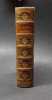
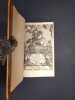
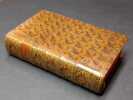
8vo. (IV),93,46,(1 blank);751,(1) p. folding map, and folding plate. Mottled 18th century calf 19.5 cm (Ref: STCN ppn 094956561; Schweiger 2,320; Willems 1325; Berghman 2054; Rahir 1369; Moss 548; Dibdin 375; Graesse 2,311; Ebert 5549) (Details: Beautiful binding. Back with 5 raised bands and panelled gilt with repeating floral motifs; in the center of the compartments gilt birds visit a bunch of flowers. Brown morocco letterpiece in the second compartment. All 3 edges of both boards gilt. Edges of the bookblock dyed red. Endpapers marbled. Engraved title, which depicts a world conquering Alexander on horseback, trampling his enemy Darius. He is accompanied by a flying Fama, who blows her horn. The plate depicts the 'fons solis', a fountain in the Egyptian oasis of the temple of Ammon, cool at midday and warm at the rising and setting of the sun. Alexander visited this famous oracle in order to obtain an answer concerning the divinity of his origin; the map shows the triumphal march of Alexander through Egypt and Asia) (Condition: Fine. Some rubbing on the upper board. Some light foxing) (Note: This is a typical Variorum edition. It offers a 'textus receptus' which is widely accepted, accompanied with the commentary and the annotations of various specialists, taken, or excerpted from earlier useful, normative or renewing editions. Editions like these, 'cum notis Variorum', were useful, but never broke new ground. The production of these sometimes overloaded 'dustbins' of knowledge was the specialty of Dutch scholars of the 17th and 18th century. The compilers seldom were great scholars, but often hard working schoolmasters. Their involvement in publishing a new edition was limited to the necessary, but ungrateful task of the beast of burden. In a 'Variorum' edition of Claudianus published by the same Elzevier a year later, we get a glimpse of such a division of labour. There the 'typographus', i.e. Louis and/or Daniel Elzevier, tells the reader that a 'vir diligentissimus' the schoolmaster Cornelius Schrevelius, excerpted from the best sources all that was necessary for a good understanding of the text. 'Quod ad praestantissimi poetae intellectum pertineret, ex optimis Doctissimorum Virorum', follows a number of names of Claudianus editors and commentators, 'aliorumque, qui antea in eo illustrando elaborarunt, notis & commentariis selectissima quaeque excerpsit'. Quintus Curtius Rufus, probably first cent. A.D., is the author of the only surviving monography on Alexander the Great in Latin. He was historian enough to use sources, which drew from different traditions, conscientiously. His aim was not to write great literature, but his 'Historia' certainly possesses great narrative qualities, acquired by a thorough knowledge of the epic and historiographic tradition, and a training in Roman rhetoric. (NP, s.v. Curtius) This work, consisting of 10 books, did not survive in its entirety, the first 2 books are lost. Now, the text of Curtius Rufus is preceded here by a rather strange philological accomplishment by the German scholar Johannes Casper Freinsheim, 1608-1660. He endeavoured to repair the loss of the 2 lost books by a composition of his own, a feat which was much admired by his contemporaries. He published this new text earlier in his edition of 1640. Moss declares that this supplemented text is 'scarcely descernible from that of Q. Curtius'. This 'Variorum' edition of Curtius Rufus was produced by the above mentioned Cornelis Schrevelius, 1608 - 1664, who took his doctoral degree in Paris as a Doctor of Medicine in 1627. Hence C.S.M.D. on the title, that is 'Cornelis Schrevelius Medicus Doctor'. He was Rector of the Schola Latina at Leiden) (Provenance: name in ballpoint on the front flyleaf of Lennart Håkanson, professor of Latin Literature at the Univ. of Uppsala, 1980-1987) (Collation: pi2, a-h8, i4, k2; A-3A8) (Photographs on request)
Q. Curtii Rufi Historia Alexandri Magni. Cum notis selectiss. Variorum, Raderi, Freinshemii, Loccenii, Blancardi, &c. Editio accuratissima, accurante C.S.M.D. (And:) J. Freinshemii Supplementorum in Q. Curtium liber I (& II).
Amsterdam, Ex Officina Elzeviriana, 1673.
8vo. 2 parts in 1: 751,(1); 93,(48),(1 blank) p., engraved title, 1 plate, 1 map. Overlapping vellum 19 cm (Ref: STCN ppn 095875646; Willems 1482; Berghman 2055; Rahir 1590; Schweiger 2,321; Moss 548; Dibdin 375: 'the edition of 1673 is the most correct and beautiful'; Graesse 2,311) (Details: 6 thongs laced through the joints. Engraved title, depicting a world conquering Alexander on horseback, trampling his enemy Darius; he is accompanied by a flying Fama, who blows her horn. A plate depicts the 'fons solis', a fountain in the Egyptian oasis of the temple of Ammon, cool at midday and warm at the rising and setting of the sun. Alexander visited this famous oracle in order to obtain an answer concerning the divinity of his origin. The map shows the triumphal march of Alexander through Egypt and Asia) (Condition: Good condition. Back soiled. A small unobjectionable wormhole in the gutter of the first half, not affecting text. Old & small paper label on the back) (Note: This is a typical Variorum edition. It offers a 'textus receptus' which is widely accepted, accompanied with the commentary and the annotations of various specialists, taken, or excerpted from earlier useful, normative or renewing editions. Editions like these, 'cum notis Variorum', were useful, but never broke new ground. The production of these sometimes overloaded 'dustbins' of knowledge was the specialty of Dutch scholars of the 17th and 18th century. The compilers seldom were great scholars, but often hard working schoolmasters. Their involvement in publishing a new edition was limited to the necessary. In a Variorum edition of Claudianus published by the same Elzevier in 1665, we get a glimpse of such labour. There the 'typographus', i.e. Louis and/or Daniel Elzevier, tells the reader that a 'vir diligentissimus' the schoolmaster Cornelius Schrevelius, excerpted from the best sources all that was necessary for a good understanding of the text. 'Quod ad praestantissimi poetae intellectum pertineret, ex optimis Doctissimorum Virorum', then follows a number of names of Claudianus editors and commentators, 'aliorumque, qui antea in eo illustrando elaborarunt, notis & commentariis selectissima quaeque excerpsit'. This 'Variorum' edition of Curtius Rufus of 1673 was, as it happens, produced by the above mentioned Cornelis Schrevelius, 1608 - 1664, who took his doctoral degree in Paris as a Doctor of Medicine in 1627. Hence C.S.M.D. on the title, that is 'Cornelis Schrevelius Medicus Doctor'. He was Rector of the Schola Latina at Leiden. The Roman historian Quintus Curtius Rufus, probably first century A.D., is the author of the only surviving monography on Alexander the Great in Latin. He was an historian enough to use sources, which drew from different traditions, conscientiously. His aim was not to write great literature, but his 'Historia' certainly possesses great narrative qualities, acquired by a thorough knowledge of the epic and historiographic tradition, and a training in Roman rhetoric. (NP, s.v. Curtius) This work, consisting of 10 books, did not survive in its entirety, the first 2 books are lost. The text of Curtius Rufus is followed in this edition by a rather strange philological accomplishment by the German scholar Johannes Casper Freinsheim, 1608-1660. He endeavoured to repair the loss of the 2 books that did not survive by a composition of his own, a feat which was much admired by his contemporaries. He published this new text earlier in his edition of 1640. Moss declares that this supplemented text is 'scarcely descernible from that of Q. Curtius') (Provenance: The label on the back reads: 'Litt Antiq. A.J. v. B.C.' This must be Aarnoud Jan van Beeck Calkoen, 1805-1874, born in Leiden. He went to Utrecht to study law. There he settled as a lawyer, and grew into politics. (NNBW 9,123) (Collation: pi2, A-3A8; (map after gathering A; folding plate after leaf M4); a-h8, i4, k2 (leaf k2 verso blank)) ( Photographs on request)
Hoogberoemde historie van 't leven ende de daden Alexandri de Groote. Inhoudende hoe hy Europa overheerd, Darius der Persen Coninck met gansch Asia ende India tot de Oceanische Zee t'ondergebraght heeft, ende eyntlijck tot Babilon gestorven is. Overgeset uyt Latijn door A. SNEL. Den vierden druck gecorrigeert.
Rotterdam, By Pieter van Waesbergen, 1648.
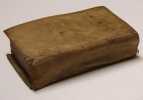
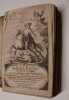
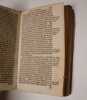
8vo. 513,(14) p. Vellum 16 cm (Ref: Geerebaert 105,c; OiN 154; Schweiger 2,328) (Details: Engraved title, depicting Alexander on horseback, at his feet a trampled Darius; printed in Gothic type, as is usual with translations into Dutch) (Condition: Shabby: vellum worn, back wrinkled; small tear at head of spine; book block loose in binding; front endpapers gone; rear endpapers loose; title soiled, loosening and with thumbed edges; small wormhole in the first 6 leaves near the left upper corner; first 2 gatherings dampstained at the lower margin; gatherings quite loose) (Note: This Dutch translation of Curtius Rufus was a great success. It was first published in 1613, and was reissued 15 times, for the last time ca. 1765. It was far more popular than the translation of Glazemaker that was reprinted only 2 times. Not much is known of the translator A. Snel. Van der Aa only records what we know already, that one A. Snel produced a translation of Curtius Rufus. The short preface of the second edition of 1627, signed by one Albrecht Snel, which is reprinted here in this 4th edition, learns us more. It is in fact a dedicatio to the 'Rulers' of the city of Delft and the 'Opper-Heeren', that is curators of the local Schola Latina. Albrecht Snel tells the reader that he is a teacher at the local Schola Latina, and that he wants to dedicate his translation as first-fruits to the excellent members of the City Council, just like the old Greeks did when they wanted to thank their benefactors. He calls his bosses 'Voedster-Heeren', i.e. sponsors, or patrons of Greek and Latin, and of those whom they charge to teach them at the local school. From the preface of the first edition of 1613 of this translation, and which was left out in later editions, we learn more about Snel. We learn something about his aim while translating Curtius Rufus. His aim is didactic. We must, Snel says, learn from the best examples available, what to do and what to avoid. We can do this best by reading the ancient historians, of whom Curtius Rufus is the best. Snel turns against those who proclaim that Dutch is inferior to Latin. We learn also which text Snel used for his translation, the 'Raphalyn'. This must be the edition of 'De rebus gestis Alexandri Magni' published 'ex officina Plantiniana Raphelengii' in Leiden in 1606. The translation is preceded by 'Byvoeghingh uit verschyden schrijvers tot vervullinghe van Quinti Curtii eerste' and 'tweede' boec.' This is a translation of a reconstruction of the lost first 2 books from other sources) (Collation: A-2K8) (Photographs on request)
De Nominum Graecorum formatione. Linguarum, Cognatarum ratione habita. + Festrede in Namen der Georg-Augusts-Universität zur Akademischen Preisvertheilung am IV. Juni 1864 gehalten von Dr. Ernst Curtius. + Herrn Professor Dr. Friedrich Haase wünschen ... - [CURTIUS' FIRST WORK]
Berlin, Dümmler, 1842 + Göttingen, (o.J.) + Breslau, 1863. 4to. Contemporary full cloth w. gilt spine. Some brownspotting, bue to the paper quality. VI, (2), 62 pp + 1 folded plate (""Tabula in quae praecipua suffixa comparantur, quibus sanscrita, graeca, latinaque, lingua in formandis ex radice nominibus utuntur""). + 23 pp. + 27 pp.
The very rare first edition of Curtius' first work, in which he is the first to deal properly and scientifically with the formation of the nominal stem in classical Greek.Georg Curtius (1820-1885) is one of the leading German classicists of all times. His writings were fundamental to the study of the Greek language and are among the most profound, influential and thorough ever written. He is primarily remembered for his magnum opus, ""Grundzüge der Griechischen Etymologie"", which counts as one of the most important and influential works on the theory of language.
Grundzüge der Griechischen Etymologie. 2 Theile. - [FUNDAMENTAL WORK ON THE THEORY OF LANGUAGE]
Leipzig, 1858-62. 8vo. Bound in one nice contemporary half calf with gilt spine. A bit of wear to capitals and hinges, and front hinge slightly cracked at bottom, otherwise fine. Minor occassional brownspotting. A small stamp to title-page. XIV, 371, (1) pp. + 1 folded plate" XVI, 398, (1 - errata) pp.
The scarce first edition of Curtius' magnum opus, a work of immense importance to the theory of the Greek language and one of the most important, influential, and useful works on the theory of language in general. ""Nach den Ansichten Aller, auch der Gegner, gehören diese ""Grundzüge"" zu den werthvollsten und nützlichsten Werken der Sprachwissenschaft überhaupt"" (Ernst Windisch in: Sebeok, Portraits of Linguists, I: p. 332).The work took Curtius about a decade to write, and the two volumes appeared with four years in between them. It is very rare to find any of the two volumes in the first edition, and both volumes in the first edition are almost never seen together. The work became immensely popular, and five editions appeared between this first and 1879. Georg Curtius (1820-1885) is one of the leading German classicists of all times. His writings were fundamental to the study of the Greek language and are among the most profound, influential and thorough ever written.Within the theory of language, one can hardly point to a work more generally influential than the present, which also excels in stringently and eloquently pointing out the connection between etymology and phonetics and proving that only through phonetics has etymology become a science.
Grundzüge der Griechischen Etymologie. 2 Theile. - [FUNDAMENTAL WORK ON THE THEORY OF LANGUAGE]
Leipzig, Teubner, 1858-1862. 8vo. Uniformly bound in two contemporary half calf binding with gilt lettering to spine. Spines with wear and scratches. Internally nice and clean. XIV, 371, (1) pp. + 1 folded plate" XVI, 398, (1 - errata) pp.
The scarce first edition of Curtius' magnum opus, a work of immense importance to the theory of the Greek language and one of the most important, influential, and useful works on the theory of language in general. ""Nach den Ansichten Aller, auch der Gegner, gehören diese ""Grundzüge"" zu den werthvollsten und nützlichsten Werken der Sprachwissenschaft überhaupt"" (Ernst Windisch in: Sebeok, Portraits of Linguists, I: p. 332).The work took Curtius about a decade to write, and the two volumes appeared with four years in between them. It is very rare to find any of the two volumes in the first edition, and both volumes in the first edition are almost never seen together. The work became immensely popular, and five editions appeared between this first and 1879. Georg Curtius (1820-1885) is one of the leading German classicists of all times. His writings were fundamental to the study of the Greek language and are among the most profound, influential and thorough ever written.Within the theory of language, one can hardly point to a work more generally influential than the present, which also excels in stringently and eloquently pointing out the connection between etymology and phonetics and proving that only through phonetics has etymology become a science.
Quinti Curtii Rufi De rebus gestis Alexandri Magni, regis Macedonum, libri superstites. Cum omnibus supplementis, variantibus lectionibus, commentariis ac notis perpetuis, Fr. Modii, V. Acidalii, T. Popmae, Joh. Freinshemii, Joh. Schefferi, Christoph. Cellarii, Nic. Heinsii. Selectis & excerptis Ph. Rubenii, J. Rutgersii, C. Barthii, Joh. Loccenii, M. Raderi, Cl. Salmasii, J.F. Gronovii, M. Tellierii, Christoph. Aug. Heumanni, itemque Jac. Perizonii vindiciis, & aliorum observationibus, auctioribusque indicibus curavit & digessit Henricus Snakenburg.
Delft, Leiden (Delphis & Lugd. Bat.), Apud Adrianum Beman, Samuelem Luchtmans, 1724.
4to. (XXXVII),824,222,1 p. Frontispiece, folding map & 17 engraved plates. Vellum 25 cm (Ref: STCN ppn 141302143; Schweiger 2,323; Brunet 2,450: 'édition très estimée'; Moss 2,549: 'This is undoubtedly a very excellent and copious edition'; Ernesti 2,352/3; Dibdin 2,376/7: 'a very valuable performance, and deservedly held in high respect'; Ebert 5554: 'Eine der schätzbarst. Ausgg. dieser Art'; Graesse 2,311/12; Spoelder p. 580, 's-Gravenhage 5) (Details: Prize copy, without the prize. Back with 6 raised bands. Boards with gilt borders, and the gilt coat of arms of The Hague. Title in red & black. Woodcut printer's mark of Luchtmans on the title. Folding map of the expedition of Alexander, plates with archaeological object, mythological scenes and portraits. The catchword on the last leaf of the first gathering (leaf 1cross4 verso), containing the 'Dedicatio', does not connect to the heading of the next gathering 2cross4, which contains the preface (Benevolo Lectori). This preface was inserted, as often occured, in a later stage of the production) (Condition: Prize removed. Vellum slightly soiled) (Note: 'This is one of the most valuable Editions of the Latin Classics I have ever read. Snakenburg has approved himself in this work to be a very able and judicious critic. Few editors have illustrated their authors so well'. With this quotation begins the review of Moss of this quarto Variorum edition. Like other Variorum editions it offers a 'textus receptus' which is widely accepted, in this case the text published by the German scholar Johannes Casper Freinsheim, 1608-1660, which appeared in 1640. The text on the upper half of the pages is accompanied with the commentary and the annotations of various specialists on the lower half, These are taken, or excerpted from earlier useful, normative or renewing editions. Editions like this one, 'cum notis Variorum', were useful, but never broke new ground. The production of these sometimes overloaded vehicles of knowledge was the specialty of Dutch scholars of the 17th and 18th century. The compilers seldom were great scholars, but often hard working schoolmasters. Yet Snakenburg did also some research. In a long and well-wrought introduction Snakenburg elaborates on the books he used, and the scholars who helped him. He seems to have digested anything worth knowing about Curtius Rufus. He also asked permission from the University Library of Leiden to consult a 'codex antiquissimus'. He further inspected 2 other manuscripts, one 'minime negligendus', and the third of a more recent date, both 'codices Vossiani'. He collected readings, emendations, and collations from all normative sources, but also e.g. annotations which he found in the margins of a book once owned by the Dutch scholar Nicolaas Heinsius, 1620-1681. Quintus Curtius Rufus, probably first cent. A.D., is the author of the only surviving monography on Alexander the Great in Latin. This work, consisting of 10 books, did not survive in its entirety, the first 2 books are lost. The text of Curtius Rufus is preceded in this edition by a rather peculiar philological accomplishment by Freinsheim. He endeavoured to repair the loss of the 2 lost books by a composition of his own, a feat which was much admired by his contemporaries. He had published this addition earlier in his edition of 1640. The only thing Hendrik Snakenburg, 1674-1750, ever did for scholarship is this Variorum edition. The praise and success which he earned with this one edition, makes it likely that he was a good critic with a sound judgement. Snakenburg spent his life teaching classics at the 'Schola Latina' of Leiden. In 1740 he was appointed Rector. In Leiden he was befriended with the classical scholar J. Gronovius and one of the publishers of this book, Samuel Luchtmans. His portrait, painted by J. Houbraken in 1715, is in the possession of the 'Lakenhal' in Leiden. (For Snakenburg see Van der Aa 17-2,801 and NNBW 2,1333/4) (Provenance: In pencil on the front pastedown: 'Dr. Brinkgreve'. This is Dr. Marius Roelof Johan Brinkgreve, 1888-1966, a Dutch teacher of classics at the gymnasium of Utrecht, (1912-1919), later till 1937 the director of 'Koninklijke Begeer' a silver-factory in the small town of Voorschoten. He was an active fascist, ca. 1933 party offical of the 'Nationale Unie', and in 1934 leader of the 'Algemeene Nederlandsche Fascisten Bond'. During WW II he sided with the German oppressor. (See for Brinkgreve, 'Repertorium kleine politieke partijen, 1918-1967'; also G. Brinkgreve, 'Schrijvend in 't Aalsmeerder veerhuis, opstellen van Geurt Brinkgreve', 1982, p. 93/105, with a portrait) (Collation: pi1 (frontispiece), 1-cross4, 3cross1, *-7*4, A-6P4, 6Q4 (minus leaf 6Q4) 6R2 (leaf 6R2 blank) (Photographs on request) (Heavy book, may require extra shipping costs)
Life of the Whore
Venice Piccini C1660 Une très belle gravure du milieu du XVIIe siècle, montrant une prostituée cherchant à obtenir la faveur d'un mousquetaire. Elle est collée sur une carte au dos. Nous n'avons pas été en mesure de localiser une image identique, mais une recherche d'image montre une gravure légèrement plus récente de composition identique, avec le même texte en italien au-dessous, mais une gravure beaucoup plus grossière. Cet exemple porte la mention Cur. Castagna en bas à gauche de l'image. Il s'agit de Curtius Castanga, ou Casangnia. Une note manuscrite en français indique que cette gravure a été réalisée par Jacques Piccini. Piccini (dont le prénom était Giacomo) (1617-1669) était un important graveur vénitien. Il est intéressant de noter que sa fille Isabella est également devenue un graveur important et que, bien qu'elle soit devenue religieuse, elle a continué à travailler comme graveur pour financer son couvent. Elle est morte à l'âge de 90 ans. La note manuscrite cite Brulliot p 305, #2257. L'image de moindre qualité datant de 1680 a été attribuée à Joseph Lunghi. Le texte italien est le suivant : "In stato lagrimabile e meschino, Con le brutte ferite in su la faccia, Va col' uaso da l'eglio e non il vino. Con infami esercty ogni hor procaccia, La vita sostenere perfida, et trista, Et vuol cie che ella fè ch'ogni altra faccia." Ce qui semble se traduire par "Dans un état larmoyant et misérable, Avec de vilaines blessures sur son visage, Elle va avec l'habitué et le vin. Avec des exercices infâmes chaque heure elle cherche, La vie à soutenir perfide, triste, Et elle veut ce qu'elle a fait que tous les autres font." La gravure est en bon état, avec quelques taches sur le bord inférieur seulement. 32 cm x 23,5 cm. La carte de support mesure 42 cm x 30 cm.
A very nice engraving from the mid seventeenth century, showing a prostitute looking for custom from a musketeer. Tipped onto backing card. We have been unable to locate an identical image, but image search shows a slightly later engraving of identical composition, with the same italian text below, but a much cruder engraving. This example state Cur. Castagna to the bottom left of the image. This is Curtius Castanga, or Casangnia. A hand written note in french, states that this was engraved by Jacques Piccini. Piccini (although his first name was Giacomo) (1617-1669) was a significant Venitian engraver. Interestingly, his daughter Isabella, also became an important engraver, and although she became a nun, continued to work as an engraver to fund her convent, She died at the age of ninety. The hand written note cites Brulliot p 305, #2257. The lower quality image from 1680 was attributed to Joseph Lunghi. The Italian text is "In stato lagrimabile e meschino, Con le brutte ferite in su la faccia, Va col' uaso da l'eglio e non il vino. Con infami esercty ogni hor procaccia, La vita sostenere perfida, et trista, Et vuol cie che ella fè ch'ogni altra faccia." Which seems to translate as "In a tearful and miserable state, With ugly wounds on her face, She goes with the accustomed one and the wine. With infamous exercises every hour she seeks, The life to sustain perfidious, sad, And she wants what she did that every other does." The engraving is in good condition, with a few stains to the bottom edge only. 32cm x 23.5cm. The backing card is 42cm x 30cm. .
LA SEMAINE DES FAMILLES 9EME ANNEE N°20 - VICTOR COUSIN DE RENE, CORRESPONDANCE DE CURTIUS, LES EXPOSITIONS DE ALFRED NETTEMENT FILS, LES MARAIS A SANGSUES DE BENEDICT-HENRY REVOIL, LA MANGEUSE DE ROSES XVIII DE H. AUDEVAL, LETTRES A UNE MERE
Au bureau du journal.. 16 FEV 1867. In-12. Broché. Bon état, Couv. convenable, Dos satisfaisant, Intérieur frais. Paginé de 305 à 320. Lecture en colonnes. Illustrée de quelques gravures en noir et blanc.. . . . Classification Dewey : 70.4413-Magasin pittoresque, universel et mosaïque
Revue universelle. Sous la direction d'Alfred Nettement. Sommaire : VICTOR COUSIN DE RENE, CORRESPONDANCE DE CURTIUS, LES EXPOSITIONS DE ALFRED NETTEMENT FILS, LES MARAIS A SANGSUES DE BENEDICT-HENRY REVOIL, LA MANGEUSE DE ROSES XVIII DE H. AUDEVAL, LETTRES A UNE MERE DE ALFRED NETTEMENT, UNE HISTOIRE INTIME DE CALIXTE VALAUGUY. Classification Dewey : 70.4413-Magasin pittoresque, universel et mosaïque

De herhalingsfiguren in de stijl van Quintus Curtius Rufus. Anaphora, paronomasia, alliteratio, homoioteleuton.
Assen, Van Gorcum, 1971.
(VII),144 p. Stiff wrappers. 24 cm (Dissertation, trade edition)
De herhalingsfiguren in de stijl van Quintus Curtius Rufus. Anaphora, paronomasia, alliteratio, homoioteleuton.
Assen, Van Gorcum, 1971.
(VII),144 p. Stiff wrappers. 24 cm (Dissertation, trade edition)
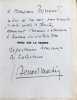
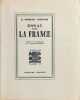
Essai sur la France. Traduit de l'allemand par J. Benoist-Méchin.
Paris Grasset, coll. "Pour mon plaisir" 1932 1 vol. Broché in-4, broché, couverture rempliée, 334 pp. Edition originale. Un des 10 exemplaires réimposés et numérotés sur Montval, tirage de tête après 5 Japon nacré, avec un envoi du traducteur, "ce livre où l'on voit, pour reprendre la belle parole de Dante, 'comment l'homme s'éternise à travers sa civilisation'". Quelques pâles rousseurs, sinon bon état.
Quintus Curtius Rufus, index verborum, relevés lexicaux et grammaticaux.
Hildesheim, N.Y., Olms, 1976.
629 p. Cloth 22x20 cm (Alpha-Omega, A29)
La antivité Dans l' Art - catalogue De l' Exposition - Liège 1959
Musée Curtius broché Couverture Illustrée Liège 1959 59 pages en format grand -8 - photographies en noir
Très Bon État
Essai sur la France. Traduit de l'allemand par J. Benoist-Méchin.
Paris, Bernard Grasset, 18 février 1932. In-12, 334 pp, avec une préface de l'auteur. Relié en demi-basane à la Bradel, dos lisse, pièce de titre, tête dorée, (couvertures conservées).
Bon exemplaire. Photos sur demande.
De rebus gestis Alexandri Magni Macedonum Regis Macedonum opus, ita demum emendatum atque... Accesserunt enim antehac nunquam uisa, duorum in principio liborum...
Basel, Froben, 1545. 4°. (3) Bl., 171 S., (6) Bl. (Register und Druckermarke). Mit ganzs. Frontispiz und Wappenholzschnitt. Pergamentband der Zeit mit handschrftlichem Rückentitel.
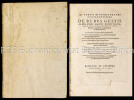
Adams C 3123. – VD16, C 6466. – Häufig aufgelegter Text der vollständigen Geschichte Alexander des Grossen, verfasst vom römischen Historiker Quintus Curtius Rufus. – Montierte Bibliotheksetikette auf dem festen Vorsatz. Trotz Gebrauchspuren gutes Exemplar. Vorder Vorsatz und das erste Blatt mit Eckausriss (ca. 8 cm). Pergamentbezug fleckig.

Phone number : 41 (0)44 261 57 50
ESSAI DE GRAMMAIRE JAPONAISE
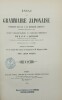
Essai de grammaire japonaise composé par M.J.H Donker Curtius, commissaire néerlandais au Japon Enrichi d’éclaircissements et d’additions nombreuses par M. le Dr J. Hoffmann, professeur de japonais et de chinois, interprète du gouvernement des Indes Néerlandaises ( publié en 1857, à Leyde), traduit du hollandais avec de nouvelles notes extraites des Grammaires des PP. Rodriguez et Collado par Léon Pagès. In 4°,Relié demi veau , manque dans le dos XV (1) 281 pp, 1 leaf errata. 4to Contemp. Half calf, spine gilt. Important early Western Japanese Grammar. The author J.H. Donker Curtius (1813-1879) was a Dutch salesman and director of Dejima trade point Japan. Cordier 499. Some foxing at the beginning, else a clean and fine copy.
LA SEMAINE DES FAMILLES 1ERE ANNEE N° 6. L'EVASION PAR ERNEST DAUDET, SCENES DE LA VIE PARISIENNE TOUT CE QUI RELUI N'EST PAS OR SCENE 3EME: L'HOTEL DE PHILIDOR PAR CURTIUS
Au bureau du journal.. 6 NOV 1858. In-12. Broché. Bon état, Livré sans Couverture, Dos satisfaisant, Intérieur acceptable. Paginé de 81 à 96.Lecture en colonnes.Illustrée de quelques gravures en noir et blanc.. . . . Classification Dewey : 70.4413-Magasin pittoresque, universel et mosaïque
Revue universelle. Sous la direction d'Alfred Nettement. Classification Dewey : 70.4413-Magasin pittoresque, universel et mosaïque
LA SEMAINE DES FAMILLES 2EME ANNEE N°39 - TANGER DE RENE, IL FAUT ATTENDRE LE SOIR DE CURTIUS, LE FIL DE LA VIERGE DE AMEDEE AUFAUVRE, LE REQUIEM DE MOZART DE AUGUSTIN CHALLAMEL, VISION DE FELIX-HENRI
Au bureau du journal.. 23 JUIN 1860. In-12. Broché. Bon état, Couv. convenable, Dos satisfaisant, Intérieur frais. Paginé de 609 à 624. Lecture en colonnes. Illustrée de quelques gravures en noir et blanc.. . . . Classification Dewey : 70.4413-Magasin pittoresque, universel et mosaïque
Revue universelle. Sous la direction d'Alfred Nettement. Classification Dewey : 70.4413-Magasin pittoresque, universel et mosaïque
LA SMEAINE DES FAMILLES 3EME ANNEE N°16 - LE VIEUX PARIS III DE GILBERT, UNE LETTRE DE MLLE DE TOURZEL DE ALFRED NETTEMENT, LES BATONS FLOTTANTS ACTE II DE CURTIUS, SCENES DE LA VIE NAPOLITAINE IV DE E. D'OLLY, LA VIE EN FAMILLE XVI DE ANNA EDIANEZ
Au bureau du journal.. 19 JAN 1861. In-12. Broché. Bon état, Couv. convenable, Dos satisfaisant, Intérieur frais. Paginé de 241 à 256. Lecture en colonnes. Illustrée de quelques gravures en noir et blanc.. . . . Classification Dewey : 70.4413-Magasin pittoresque, universel et mosaïque
Revue universelle. Sous la direction d'Alfred Nettement. Classification Dewey : 70.4413-Magasin pittoresque, universel et mosaïque
MEMOIRS OF PRINCE CHLODWIG OF HOHENLOHE SCHILLINGSGFUERST EDITED BY FRIEDRICH CURTIUS FOR PRINCE ALEXANDER OF HOHENLOHE SCHILLINGSFUERST / EN DEUX TOMES / TOMES 1 + 2 .
WILLIAM HEINEMANN. 1906. In-8. Relié. Etat d'usage, Couv. convenable, Dos satisfaisant, Quelques rousseurs. 406 pages + 502 pages - quelques rousseurs sans conséquence sur la lecture - pages non coupées - ouvrages essentiellement en anglais - illustration en monochrome sous serpente en frontispice - étiquette collée sur le 1er contre plat.. . . . Classification Dewey : 420-Langue anglaise. Anglo-saxon
Ouvrage essentiellement en anglais - Translated from the forst german edition and supervised by george W.Chrystal . Classification Dewey : 420-Langue anglaise. Anglo-saxon
[CLASSIQUE LATIN, QUINTE-CURCE] - RUFUS (Q. CURTIUS), LEMAIRE (N.E.) -
Reference : 200613058
Q. CURTIUS RUFUS ad CODICES PARISINOS RECENSITUS cum itinerario alexandri et Julio Valerio Aesopi graeci translatore quibus apus nos primun editis.
Paris, Colligeba nicolaus eligius lemaire, 1824 ; in-8, 724 pp., demi bassane à nerfs. Novos excursus, mappas, imagines, catalogos et indices omnium absolutissimos assidit N.E. lemaire professor latinae poeseos in academlia parissiensi. VOLUMEN TERTIUM ET ULTIMUN - (VITA ALEXANDRI).
Novos excursus, mappas, imagines, catalogos et indices omnium absolutissimos assidit N.E. lemaire professor latinae poeseos in academlia parissiensi. VOLUMEN TERTIUM ET ULTIMUN - (VITA ALEXANDRI).

