 Write to the booksellers
CURTIUS RUFUS.
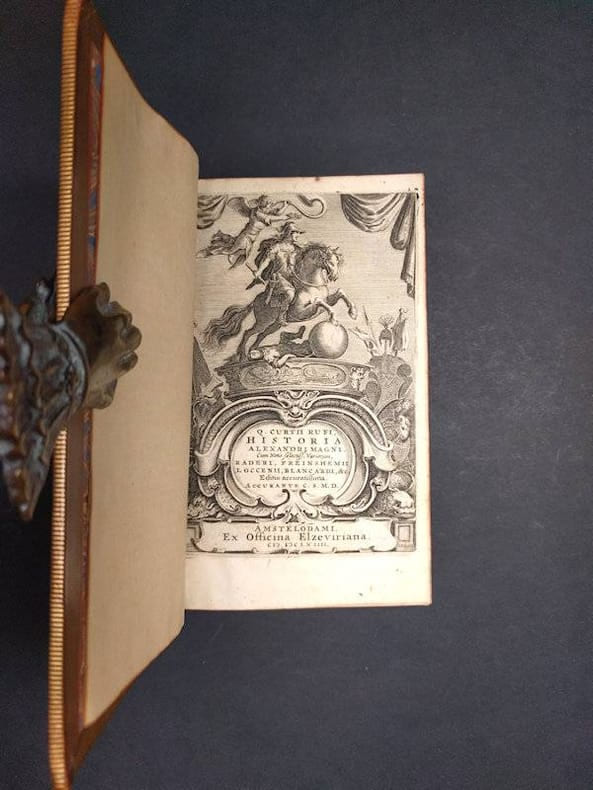
Q. Curtii Rufi Historia Alexandri Magni. Cum notis selectiss. Variorum, Raderi, Freinshemii, Loccenii, Blancardi, &c. Editio accuratissima. Accurante C.S.M.D.
Amsterdam (Amstelodami), Ex officina Elzeviriana, 1664.
Reference : 130180
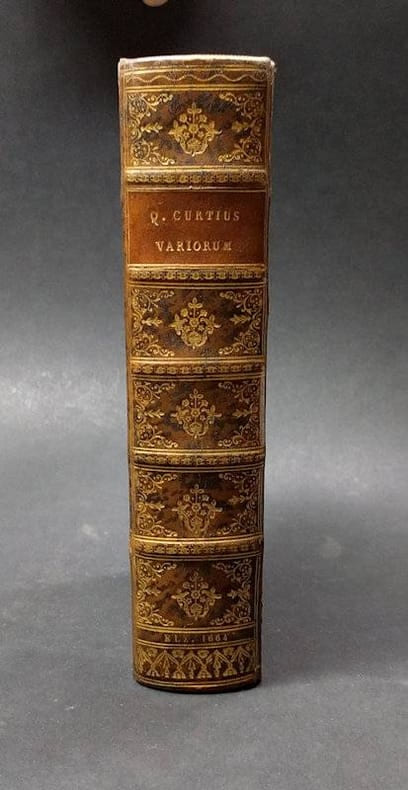
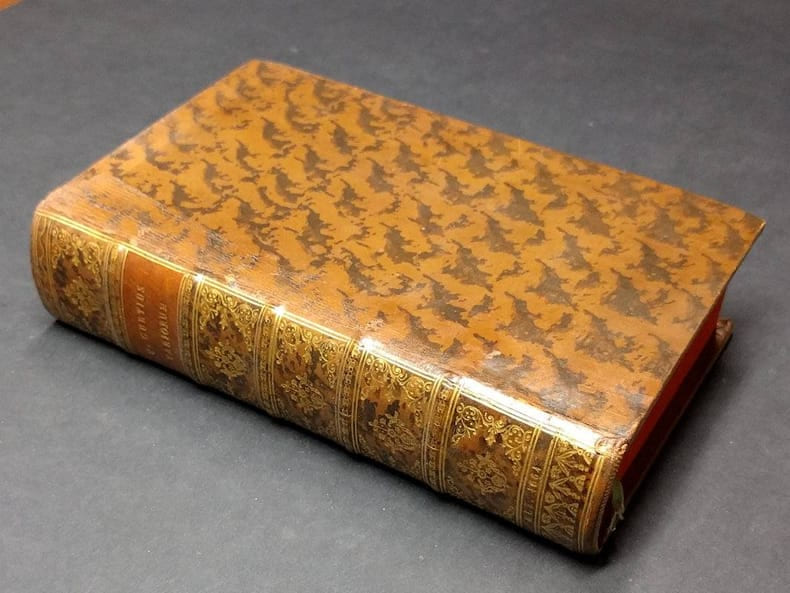
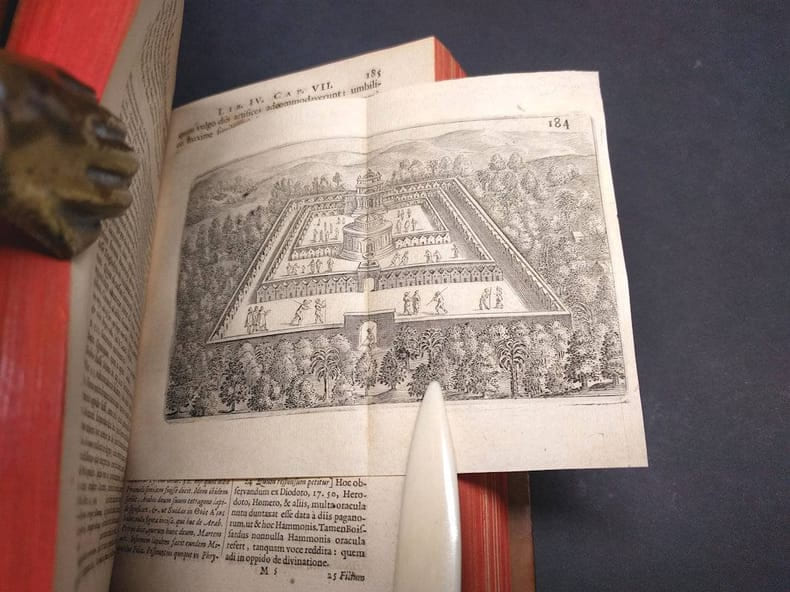
8vo. (IV),93,46,(1 blank);751,(1) p. folding map, and folding plate. Mottled 18th century calf 19.5 cm (Ref: STCN ppn 094956561; Schweiger 2,320; Willems 1325; Berghman 2054; Rahir 1369; Moss 548; Dibdin 375; Graesse 2,311; Ebert 5549) (Details: Beautiful binding. Back with 5 raised bands and panelled gilt with repeating floral motifs; in the center of the compartments gilt birds visit a bunch of flowers. Brown morocco letterpiece in the second compartment. All 3 edges of both boards gilt. Edges of the bookblock dyed red. Endpapers marbled. Engraved title, which depicts a world conquering Alexander on horseback, trampling his enemy Darius. He is accompanied by a flying Fama, who blows her horn. The plate depicts the 'fons solis', a fountain in the Egyptian oasis of the temple of Ammon, cool at midday and warm at the rising and setting of the sun. Alexander visited this famous oracle in order to obtain an answer concerning the divinity of his origin; the map shows the triumphal march of Alexander through Egypt and Asia) (Condition: Fine. Some rubbing on the upper board. Some light foxing) (Note: This is a typical Variorum edition. It offers a 'textus receptus' which is widely accepted, accompanied with the commentary and the annotations of various specialists, taken, or excerpted from earlier useful, normative or renewing editions. Editions like these, 'cum notis Variorum', were useful, but never broke new ground. The production of these sometimes overloaded 'dustbins' of knowledge was the specialty of Dutch scholars of the 17th and 18th century. The compilers seldom were great scholars, but often hard working schoolmasters. Their involvement in publishing a new edition was limited to the necessary, but ungrateful task of the beast of burden. In a 'Variorum' edition of Claudianus published by the same Elzevier a year later, we get a glimpse of such a division of labour. There the 'typographus', i.e. Louis and/or Daniel Elzevier, tells the reader that a 'vir diligentissimus' the schoolmaster Cornelius Schrevelius, excerpted from the best sources all that was necessary for a good understanding of the text. 'Quod ad praestantissimi poetae intellectum pertineret, ex optimis Doctissimorum Virorum', follows a number of names of Claudianus editors and commentators, 'aliorumque, qui antea in eo illustrando elaborarunt, notis & commentariis selectissima quaeque excerpsit'. Quintus Curtius Rufus, probably first cent. A.D., is the author of the only surviving monography on Alexander the Great in Latin. He was historian enough to use sources, which drew from different traditions, conscientiously. His aim was not to write great literature, but his 'Historia' certainly possesses great narrative qualities, acquired by a thorough knowledge of the epic and historiographic tradition, and a training in Roman rhetoric. (NP, s.v. Curtius) This work, consisting of 10 books, did not survive in its entirety, the first 2 books are lost. Now, the text of Curtius Rufus is preceded here by a rather strange philological accomplishment by the German scholar Johannes Casper Freinsheim, 1608-1660. He endeavoured to repair the loss of the 2 lost books by a composition of his own, a feat which was much admired by his contemporaries. He published this new text earlier in his edition of 1640. Moss declares that this supplemented text is 'scarcely descernible from that of Q. Curtius'. This 'Variorum' edition of Curtius Rufus was produced by the above mentioned Cornelis Schrevelius, 1608 - 1664, who took his doctoral degree in Paris as a Doctor of Medicine in 1627. Hence C.S.M.D. on the title, that is 'Cornelis Schrevelius Medicus Doctor'. He was Rector of the Schola Latina at Leiden) (Provenance: name in ballpoint on the front flyleaf of Lennart Håkanson, professor of Latin Literature at the Univ. of Uppsala, 1980-1987) (Collation: pi2, a-h8, i4, k2; A-3A8) (Photographs on request)
Bookseller's contact details
Antiquariaat Fragmenta Selecta
+31 20 418 55 65
Payment mode

Sale conditions
Terms of Sale All items offered are subject to prior sale. Your order will be final after you have received our confirmation, with a specification of the availability of the items and the shipping costs. All books are complete and in good antiquarian condition, unless otherwise described. Prices are in EURO. Postage and insurance are not included. Postage will be calculated at cost (no extra charges). Returns Books may be returned within 14 days of receipt, if returned in the same condition as sent, and packed, shipped and insured as received (please always notify us). We will refund the shipping costs of a return shipment only if our descriptions were not correct. How to pay Pre-payment is necessary for new customers. Our order confirmation will provide detailed information and a specification of the shipping costs. Customers who are known to us and libraries will be invoiced as usual. We accept Visa and Mastercard. You can submit your card information through our SECURE PAYMENT FORM. PayPal: we will send you a personal link to the PayPal website. Banktransfers: payment can be made into our bank account in The Netherlands.
1 book(s) with the same title
Q. Curtii Rufi Historia Alexandri Magni. Cum notis selectiss. Variorum, Raderi, Freinshemii, Loccenii, Blancardi, &c. Editio accuratissima, accurante C.S.M.D. (And:) J. Freinshemii Supplementorum in Q. Curtium liber I (& II).
Amsterdam, Ex Officina Elzeviriana, 1673.
8vo. 2 parts in 1: 751,(1); 93,(48),(1 blank) p., engraved title, 1 plate, 1 map. Overlapping vellum 19 cm (Ref: STCN ppn 095875646; Willems 1482; Berghman 2055; Rahir 1590; Schweiger 2,321; Moss 548; Dibdin 375: 'the edition of 1673 is the most correct and beautiful'; Graesse 2,311) (Details: 6 thongs laced through the joints. Engraved title, depicting a world conquering Alexander on horseback, trampling his enemy Darius; he is accompanied by a flying Fama, who blows her horn. A plate depicts the 'fons solis', a fountain in the Egyptian oasis of the temple of Ammon, cool at midday and warm at the rising and setting of the sun. Alexander visited this famous oracle in order to obtain an answer concerning the divinity of his origin. The map shows the triumphal march of Alexander through Egypt and Asia) (Condition: Good condition. Back soiled. A small unobjectionable wormhole in the gutter of the first half, not affecting text. Old & small paper label on the back) (Note: This is a typical Variorum edition. It offers a 'textus receptus' which is widely accepted, accompanied with the commentary and the annotations of various specialists, taken, or excerpted from earlier useful, normative or renewing editions. Editions like these, 'cum notis Variorum', were useful, but never broke new ground. The production of these sometimes overloaded 'dustbins' of knowledge was the specialty of Dutch scholars of the 17th and 18th century. The compilers seldom were great scholars, but often hard working schoolmasters. Their involvement in publishing a new edition was limited to the necessary. In a Variorum edition of Claudianus published by the same Elzevier in 1665, we get a glimpse of such labour. There the 'typographus', i.e. Louis and/or Daniel Elzevier, tells the reader that a 'vir diligentissimus' the schoolmaster Cornelius Schrevelius, excerpted from the best sources all that was necessary for a good understanding of the text. 'Quod ad praestantissimi poetae intellectum pertineret, ex optimis Doctissimorum Virorum', then follows a number of names of Claudianus editors and commentators, 'aliorumque, qui antea in eo illustrando elaborarunt, notis & commentariis selectissima quaeque excerpsit'. This 'Variorum' edition of Curtius Rufus of 1673 was, as it happens, produced by the above mentioned Cornelis Schrevelius, 1608 - 1664, who took his doctoral degree in Paris as a Doctor of Medicine in 1627. Hence C.S.M.D. on the title, that is 'Cornelis Schrevelius Medicus Doctor'. He was Rector of the Schola Latina at Leiden. The Roman historian Quintus Curtius Rufus, probably first century A.D., is the author of the only surviving monography on Alexander the Great in Latin. He was an historian enough to use sources, which drew from different traditions, conscientiously. His aim was not to write great literature, but his 'Historia' certainly possesses great narrative qualities, acquired by a thorough knowledge of the epic and historiographic tradition, and a training in Roman rhetoric. (NP, s.v. Curtius) This work, consisting of 10 books, did not survive in its entirety, the first 2 books are lost. The text of Curtius Rufus is followed in this edition by a rather strange philological accomplishment by the German scholar Johannes Casper Freinsheim, 1608-1660. He endeavoured to repair the loss of the 2 books that did not survive by a composition of his own, a feat which was much admired by his contemporaries. He published this new text earlier in his edition of 1640. Moss declares that this supplemented text is 'scarcely descernible from that of Q. Curtius') (Provenance: The label on the back reads: 'Litt Antiq. A.J. v. B.C.' This must be Aarnoud Jan van Beeck Calkoen, 1805-1874, born in Leiden. He went to Utrecht to study law. There he settled as a lawyer, and grew into politics. (NNBW 9,123) (Collation: pi2, A-3A8; (map after gathering A; folding plate after leaf M4); a-h8, i4, k2 (leaf k2 verso blank)) ( Photographs on request)

