Write to the booksellers
313 books for « bacon »Edit
-
Type
Book (309)
Music sheets (2)
New book (2)
-
Latest
Last 24h (1)
Last month (1)
-
Language
English (5)
French (292)
Russian (16)
-
Century
17th (10)
18th (11)
19th (29)
20th (107)
21st (26)
-
Countries
Belgium (24)
Canada (3)
China (1)
Denmark (8)
France (235)
Germany (1)
Greece (2)
Netherlands (1)
Switzerland (21)
United Kingdom (1)
United States of America (16)
-
Syndicate
ALAC (3)
CLAM (3)
CLAQ (1)
CNE (2)
ILAB (121)
NVVA (1)
SLACES (1)
SLAM (101)
Topics
- Army (5)
- Atlantis (3)
- Atlantis pc (1)
- Atlas (1)
- Bacon roger (4)
- Bacon edward (3)
- Bacon francis (259)
- Bacon jean (6)
- Bacon paul (3)
- Bacon roy (1)
- Books from the xviiith (2)
- Buchon jean alexandre charles (1)
- Cartography (1)
- Children’s books (3)
- Chivalry (3)
- Christianity (3)
- Christmas (1)
- Dedication (1)
- Descartes rené (1)
- Early printed books (3)
- Economics (1)
- Education (1)
- Ethic (9)
- Exhibition (2)
- Explorations (1)
- Expressionism (2)
- Fine arts (11)
- First edition (3)
- Guide books (1)
- Guitar (5)
- Guitar pc (1)
- Hermeticism (2)
- History (17)
- Humanism (2)
- Instruments (4)
- Instruments (4)
- Justice (1)
- Jutland (1)
- Language (2)
- Law (1)
- Literature (1)
- London (1)
- Methodology (2)
- Miro (1)
- Painters (2)
- Painting (6)
- Paris (1)
- Philosophy (4)
- Picasso (7)
- Policy (6)
- Religions (1)
- Review (3)
- Revue de l'art (1)
- Scores (1)
- Sculpture (1)
- Shapes & colours (1)
- Sociology (1)
- Songs (1)
- Surrealism (1)
- Symbolism (2)
- Theology (2)
- Trabucco j (1)
- Trucchi (2)
- War (10)
- War 14/18 (2)
- Western (3)
Opera. Tomus primus: Qui continet De Dignitate & Augmentis Scientiarum. Libros IX [i.e.: De Augmentis Scientiarum]. (All). - [A NEW FOUNDATION FOR SCIENCE]
London, Joannis Haviland, 1623 [later altered in manuscript to 1624]. Small folio. Bound in a lovely early 19th century full vellum binding with gilt borders to boards and gilt ornamentations and gilt title-label to spine.Lower front hinge cracked, but bindning still tight. A bit of edge wear, but overall very nice. Woodcut title-vignettes (burning heart) and woodcut initials in beginning. Text within single woodcut borders. (18), 493, (1 - errata) pp. Complete with both title-pages (no final blank). Old owner's name to title page (along with the dates 1624 and 1648), unlegible scribbles to second title-page, and ""collated e perfect"" in old hand to last leaf. A very nice and clean copy with good margins.
The extremely rare first edition of what is arguably Bacon's main work ""De Augmentis Scientiarum"", in which he sets out to lay the foundations of science entirely anew and reform the process of knowledge for the advancement of learning. Bacon believes that the advancement of learning will ultimately relieve mankind from its miseries and needs, and as such he not only reformed the foundations of science, he also laid the philosophical foundations for the dawning of the Industrial age. His proposed change of the collective thought of mankind completely reshaped the entire course of science in history. The aim of the present work - to investigate and re-classify philosophy and the sciences - marks a turning point in the rhetorical and theoretical framework for science, which is still essential for our conceptions of proper methodology today.The ""De Augmentis Scientarum"" constitutes a greatly expanded and completely re-written version of the ""Advancement of Learning"" (1605). The Latin is by William Rawley, in close collaboration with Bacon himself, who oversaw the entire process. When speaking of ""De Augmentis Scientiarum"" one never refers the incomparable English forerunner of the work (which was only in 2 books as opposed to the 9 of the ""De Augmentis Scientiarum""). The first English translation of the ""De Augmentis Scientiarum"" appeared in 1640 and is translated by Gilbert Wats as ""Of the Advancement and Proficiencie of Learning"".The ""De Augmentis Scientiarum"" was intended as Part 1 of Bacon's proposed, but never completed ""Instauratio magna"" (PMM 119). ""Bacon conceived a massive plan for the reorganization of scientific method and gave purposeful thought to the relation of science to public and social life. His pronouncement ""I have taken all knowledge to be my province"" is the motto of his work... [His] proposal was ""a total reconstruction of sciences, arts and all human knowledge... to extend the power and dominion of the human race... over the universe"". The plan for this was to be set out in six parts: (1) a complete survey of human knowledge and learning"" this was expounded in the ""De Augmentis Scientiarum"", 1623 (a greatly extended version of ""The Advancement of Learning"", 1605)... Of parts (3) to (5) only fragments were ever published"" part (6) remained unwritten."" (PMM 119 - the header being ""The Advancement of Learning""). Francis Bacon's Great Instauration for learning and the sciences was thus to be introduced by his most important work, the ""De Augmentis Scientiarum"", which he himself considered the most fundamental for the project that caused him to be considered one of the fathers of modern science. ""In ""De augmentis scientiarum"", which is concerned primarily with the classification of philosophy and the sciences, Bacon develops his influential view of the relation between science and theology. He distinguishes in traditional fashion between knowledge by divine revelation and knowledge by the senses, and divides the latter into natural theology, natural philosophy, and the sciences of man... Having placed his project within the complete framework of knowledge in true Aristotelian fashion, Bacon proceeds to demolish all previous pretentions to natural philosophy. His aim is to lay the foundations of science entirely anew, neither leaping to unproved general principles in the manner of the ancient philosophers nor heaping up unrelated facts in the manner of the ""empirics"" (among whom he counts contemporary alchemists and natural magicians). ""Histories,"" or collections of data, are to be drawn up systematically and used to raise an ordered system of axioms that will eventually embrace all the phenomena of nature.""... (D.S.B. I:374-75). For Bacon, this proposed reformation would lead to a great advancement in science and a progeny of new inventions that would relieve mankind of its miseries. His demand for a planned procedure of investigating all things natural marked a turning point in the rhetorical and theoretical framework for science, much of which still surrounds conceptions of proper methodology today.It is due to his ""De Augmentis Scientiarum"" that Bacon is referred to as the creator of empiricism. With this work and the work intended as the second of the Great Restauration project, the ""Novum Organum, Bacon established and popularized inductive methodologies for scientific inquiry, that which we now call the Baconian method, or quite simply ""the scientific method"". With his belief in the possibility of the advancement of learning of relieving mankind from its miseries and needs, Bacon is furthermore considered the philosophical influence behind the dawning of the Industrial age. He continually proposes that all scientific work should be done for charitable purposes, as matter of alleviating mankind's misery, and that therefore science should be practical and have the purpose of inventing useful things that will improve the conditions of mankind. This proposed change of our collective mind changed the entire course of science in history. The state was no longer merely contemplative"" it became a practical and inventive state - one that would have eventually led to the inventions that made possible the Industrial Revolutions of the following centuries.It is furthermore to be noted that it is in the present work that Bacon presents his cipher method for the first time. He had first mentioned the Biliteral Cypher in a brief paragraph of his ""Advancement of Learning"" in 1605, but it is in the present work that he details with illustrations how to write and use the Biliteral Cypher. As most will know, Bacon's Cypher has had the greatest of impact on modern Bacon-Shakespeare scholarship. Almost all theories of Bacon as the true author of the Shakespearian corpus can be traced back to the cipher that is presented in 1624 in the ""De Augmentis Scientiarum"".""The system has been recognized, and used, since the day that ""De Augmentis"" was published, and has had its place in every translation and publication of that work since, but the ages have waited to learn that it was embedded in the original books themselves from the date of his earliest writings (1579 as now known) and infolded his secret personal history."" (Elizabeth Wells Gallup, The Bi-Literal Cypher of Sir Francis Bacon Discovered in His Works and Deciphered, p. 48).As is known, since the 19th century, many people have suggested that the plays attributed to William Shakespeare were in fact written by Francis Bacon, and that the published plays contain enciphered messages to that effect. Both Ignatius L. Donnelly and Elizabeth Wells Gallup attempted to find such messages by looking for the use of Bacon's cipher in early printed editions of the plays.For roughly a century from 1850, Bacon's Cypher set the world of literature on fire. A passion for puzzles, codes, and conspiracies fuelled a widespread suspicion that Shakespeare was not the author of his plays. Professional and amateur scholars from all places all over the world have spent extraordinary amounts of time, energy, and money combing Renaissance texts in search of signatures and other messages that would reveal the true identity of their author. Also great authors and thinkers have been convinced that Shakespeare's works contained a secret message. These include Mark Twain, Walt Whitman, Sigmund Freud, Henry James, Henry Miller, etc. Francis Bacon, with his biliteral cipher -Renaissance England's first and clearest statement about how to hide texts within texts - became the leading candidate for the holder of the key to the puzzle.The cipher, which consists in an alphabet, was first printed in the present first edition, in 1623. It is to be found in Book 6, Chapter 1. It was reprinted in all the later editions of the work (2nd ed. Paris, 1624" London, 1638" English translation, Oxford, 1640) and the alphabet in all are substantially the same. Bacon devised this ingenious code in the late 1570s (when he spent three years in the entourage of the English ambassador in France), but he did not describe its workings until 1623. ""Bacon gives both mathematics and analogy which he considers a science and calls ""grammatical philosophy,"" a high place in his Great Instauration"" which, when used together help to unlock the doors to that which Bacon has deliberately concealed-- including certain mysteries hidden in the Shakespeare plays. For instance, the two great books published in 1623 were the Shakespeare's Folio ""Comedies, Histories & Tragedies"" and Bacon's ""De Augmentis Scientiarum"" {the philosophical background and purpose of the Shakespeare plays} two masterpieces published together, since they are as twins, each being a key to unlock hidden treasures in the other-- two relating to the twin faculties of the mind--imagination and reason--and both drawing upon the third faculty, memory."" (Peter Dawkins, ""Francis Bacon Herald of the New Age""). Bacon's Cypher, however, has not only been used as the key to the Shakespearian puzzle. It was in fact a highly important cryptographical invention, which constitutes on the the very first English works on the subject (predating Both Wilkins' ""Mercury"" And Falconer's ""Cryptomenysis""). This is one of the earliest illustrations of a cipher intended to hide a text within a text.Not only is this the first edition of ""de Augmentis Scientiarum"", it is also the most correct, and in addition the most beautiful. ""First edition, exceedingly scarce, and according to Archbishop Tenison, the ""fairest and most correct edition."" A copy is in the British Museum."" (Lowndes I:95). Gibson 129a. With the date on both title-pages altered in manuscript, adding a ""I"", as in some copies (as also noted in the description of e.g. the copy in the Huntington). This was presumably done by either the printer or publisher to those copies that remained unsold at the end of 1623. A second edition of the ""De Augmentis Scientiarum"" appeared in Paris in 1624. The first English translations of ""De Augmentis Scientiarum"" appeared in 1640.We have not been able to locate a single copy of this first edition in auctions within the last 40 years.

Operum moralium et civilium.... - [LARGE-PAPER COPY - FIRST ED. IN LATIN OF ""NOVA ATLANTIS"" AND THE ""ESSAYS""]
London, Edward Griffin [John Haviland, Bernard Norton, and John Bill], Richard Whitaker [& John Norton], 1638. Folio. (Binding: 32x22 cm, leaves: 31,1x20,8 cm.). Contemporary full speckled calf binding with six raised bands and gilt red leather title-label to spine. Boards with blindstamped ornamental border. Scuff marks to boards and hinges worn, so bands showing. Large woodcut head- and tail-pieces, initials, printer's devices, and typographical ornaments (that have been of great significance to the Baconians in their attempts to establish Bacon as the author of the works attributed to Shakespeare). Roman and Italic lettering, and some Greek. Several neat inscriptions to front free end-papers and verso of frontispiece, in Latin, Greek, English, and German, dated 1704, 1740, and 1926, the last being a presentation-inscription for the renowned German Bacon-scholar and noted Baconian George J. Pfeiffer. Neat early 18th century inscription to top of title-page. Old description of the copy (1946) neatly pasted on to inside of front board. Vague minor damp-staining to lower margin throughout, far from affecting text, and mostly barely visible. A vague minor dampstain to margins of a few leaves at the beginning, also far from affecting text. All in all a lovely, clean and crisp copy on large paper. Full page engraved frontispiece-portrait + (14), 386 (pp. 177-78 omitted in pagination)"" (16), 475, (1) pp. Fully complete, with separate half-titles for the different works.
![Operum moralium et civilium.... - [LARGE-PAPER COPY - FIRST ED. IN LATIN OF ""NOVA ATLANTIS"" AND THE ""ESSAYS""]. "BACON, FRANCIS.](https://static.livre-rare-book.com/pictures/LLX/46277_3_thumb.jpg)
![Operum moralium et civilium.... - [LARGE-PAPER COPY - FIRST ED. IN LATIN OF ""NOVA ATLANTIS"" AND THE ""ESSAYS""]. "BACON, FRANCIS.](https://static.livre-rare-book.com/pictures/LLX/46277_4_thumb.jpg)
![Operum moralium et civilium.... - [LARGE-PAPER COPY - FIRST ED. IN LATIN OF ""NOVA ATLANTIS"" AND THE ""ESSAYS""]. "BACON, FRANCIS.](https://static.livre-rare-book.com/pictures/LLX/46277_5_thumb.jpg)
Scarce first edition, first issue, on large paper - THE GREAT BOOK COLLECTOR VOLLBEHR'S COPY, GIVEN TO THE IMPORTANT BACONIAN G.J. PFEIFFER - of the monumental first collected edition of the works of Francis Bacon, containing the seminal first printing in Latin of not only his greatly influential ""Nova Atlantis"" (""The New Atlantis"" - often referred to as ""the blueprint for the founding of America""), but also his groundbreaking Essays (""Sermones Fideli"") as well as his history of Henry VII (""Historiam Regni Henrici Septimi"") and his Dialogue on the Holy War (""Dialogum de Bello Sacro""), published by Bacon's literary executor, his close friend William Ramsey, to whom Bacon bequeathed most of his manuscripts. This first edition of his works in Latin is of the utmost importance to Bacon-scholarship and has played a seminal role in the spreading of his works as well as the understanding of two of his greatest achievements, The Essays and The Nova Atlantis, which is usually referred to with its Latin title instead of the English.This magnificent copy with its wide margins contains several interesting inscriptions in different languages. One of them, 19th century, in German states that ""This book is to remind you of the ""15th Century Plot"". When, in 1926, you showed to scholars his collection of 2000 incunables. He is also known as ""Otto H.F. Vollbehr., [...]"" - "" Dated ""N. York City 29/11 26"" And in the same hand, the presentation inscription is continued: ""This ""little book"" is being handed over in friendship to Mr. George J. Pfeiffer the famous ""Bacon-scholar"" in order for him to continue his fruitful studies [...]."" -THE PRESENT COPY THUS EVIDENTLY BEING THE GREAT BOOK COLLECTOR VOLLBEHR'S COPY, GIVEN TO THE IMPORTANT BACONIAN PFEIFFER. ""Vollbehr was a German industrial chemist turned book collector who at the close of World War I found himself with more assets than most. Either in his own collection or through consignment Vollbehr had control of thousands of incunabula. In 1926 Vollbehr came to the United States, bringing with him a collection of 3,000 incunabula to be exhibited at the Eucharistic Congress in Chicago. After the exhibition in Chicago, Vollbehr traveled with the collection by train to several other cities. His last stop was in Washington, and over 100 of the books were exhibited in the Great Hall of the Library of Congress. Vollbehr proposed that if a benefactor would step forward to buy the collection for an American institution for half the asking price of $1.5 million, he would donate the other half. In addition, he would include a complete copy of the Gutenberg Bible printed on vellum as one of the 3,000 incunabula.The Gutenberg Bible which crowned Vollbehr's collection had had only three owners. The first owner was said to have been Johann Fust, who took it to Paris and sold it as a manuscript to a representative of the monks of Saint Blasius. It resided with the monks in the Black Forest until they had to move to St. Paul in Carinthia in the face of the Napoleonic army. Finally, in 1926, Otto Vollbehr purchased the three volumes from the monks for $250,000.In December 1929, a bill was presented to Congress proposing that public funds be used to acquire the Vollbehr collection for the Library of Congress. In June 1930 Congress passed the bill and President Hoover signed it into law. Between July 15 and September 3 the Vollbehr books arrived at the Library of Congress. The Bible, one of three known perfect copies printed on vellum, is one of only a few items that are permanently on display in the Library."" (from the Library of Congress web-site). George J. Pfeiffer, Ph. D., of New York, graduate of Harvard University, and Vice-president of the Bacon Society of America, is considered one of the most important Bacon-scholars of his time. His thorough scientific studies convinced himself and many others that Bacon was in fact the author of the works attributed to Shakespeare. With THE FIRST PRINTING IN LATIN OF ""NOVA ATLANTIS"", Bacon's famous theories of his masterly utopian work became widespread and hugely influential. It had originally been printed, posthumously, in English and appeared at the very end of his ""Sylva Sylvarum"" of 1626, where it was more or less hidden away and quite humbly presented by Rawley, who was responsible for his leftover papers. Rawley's introduction to the Latin edition of the work is quite different from that of the English edition and has had quite an impact upon the reception of the work, a work which came to inspire a totally new philosophical and political genre and which fundamentally changed the way that we view the world. The ""Nova Atlantis"" occupies a unique place within the works of Bacon"" among many other things, it is the only overtly fictional product of his career (if one does not, like Pheiffer, believe that he is actually the true author of the Shakespearean works). The printing of this major work in the history of man's thought is quite interesting and fairly complicated. As mentioned, it appeared at the back of the larger, and much more conform, work ""Sylva Sylvarum"", which was published by his secretary and friend William Rawley shortly after Bacon's death. It does not, however, seem to have much in common with the ""Sylva Sylvarum"", and the ""New Atlantis"" was not even mentioned when that work entered the Stationers' Register on July 4th, 1626.The ""Sylva Sylvarum"" was being compiled during the last couple of years of Bacon's life, and there is evidence to conclude that ""Nova Atlantis"" was being translated into Latin at the same time, whereas it seems that the English version of it was written about a year or two earlier. Although the Latin translation was thus left lying around for quite some years before it was finally printed, perhaps due to the fact that it was an unfinished text, Bacon himself seems to have concerned himself a great deal with the Latin translation of the work (as well as the other works). The appearance of them in the ""universal language"" were, in the words of Bacon himself to be carried out 'for the benefit of other nations', a phrase which is paralleled in the text of ""Nova Atlantis"", as the father of Salomon's House remarks of his relation of the institution's working that 'I giue thee leave to Publish it"" for the Good of other Nations'. And finally does this great work appear to the benefit of all men and all nations, in the universal Latin language, when in 1638 Rawley publishes the ""Operum moralium"", in which his ""Essays"" also appear in Latin for the first time, as does the History of Henry VII, and the Dialogue on the Holy War, two other greatly important works. The printed title of the ""Operum Moralium"" not only informs the reader which texts are included within the volume" Rawley also provides information on the texts themselves, dividing them into two distinct sections (with two separate title-pages). The first section consists of five translations which (apart from De sapientia) had never appeared in Latin translation before" the second section consists in the first part of the ""Instauratio"" (originally published in 1620). The second issue of the ""Operum Moralium"" furthermore has the reissued sheets of the last part of the ""Novum organum"".Rawley's prefatory letter tells us quite a bit about the way that he (and Bacon himself) would like the ""Nova Atlantis"" to be viewed, and for the first time the work is addressed in a direct and assertive manner, bringing it forth as an important philosophical work, now for the first time properly introduced. Rawley informs the reader that Bacon began the process of translating the Essays and the Nova Atlantis, because he wished his moral and political works not to perish. He goes on to explain the importance of the moral and political works being published in the ""universal"" Latin and groups the texts in a new way. He now makes a new category of text for the final two works, ""De bello sacro"" and ""Nova Atlantis"", calling them 'fragmentary', as opposed to the ""Worke Unfinished"" that he used for the English ""Now Atlantis"" of 1626/7, stating that this is at the request of Bacon himself: ""And finally he ordered that two fragments be added, the Dialogue of the Holy War, and the New Atlantis: but he said that these were the three kinds of fragments."", giving to them a certain status of their own and a deliberate character that they had not possessed before. For the first time, the ""Nova Atlantis"", the hitherto hidden-away work that was never properly introduced, is now included in the general preface, which it was not in 1626/27, and the ""Nova Atlantis"" is given the central position within Bacon's works that it deserved - and that it has possessed ever since. This also explains the great impact of the first Latin version of the ""Nova Atlantis"" as opposed to the English version, which was far less influential. Not only is ""Nova Atlantis"" no longer just an unfinished work worthy of no more than being hidden away at the back of a larger work, it is now the central part of a seminal collection of works appearing for the first time in Latin ""for the Good of other Nations"".""Francis Bacon (1561-1626) was one of the leading figures in natural philosophy and in the field of scientific methodology in the period of transition from the Renaissance to the early modern era. As a lawyer, member of Parliament, and Queen's Counsel, Bacon wrote on questions of law, state and religion, as well as on contemporary politics"" but he also published texts in which he speculated on possible conceptions of society, and he pondered questions of ethics (Essays) even in his works on natural philosophy (The Advancement of Learning).After his studies at Trinity College, Cambridge and Gray's Inn, London, Bacon did not take up a post at a university, but instead tried to start a political career. Although his efforts were not crowned with success during the era of Queen Elizabeth, under James I he rose to the highest political office, Lord Chancellor. Bacon's international fame and influence spread during his last years, when he was able to focus his energies exclusively on his philosophical work, and even more so after his death, when English scientists of the Boyle circle (Invisible College) took up his idea of a cooperative research institution in their plans and preparations for establishing the Royal Society.To the present day Bacon is well known for his treatises on empiricist natural philosophy (The Advancement of Learning, Novum Organum Scientiarum) and for his doctrine of the idols, which he put forward in his early writings, as well as for the idea of a modern research institute, which he described in Nova Atlantis."" (SEP). Gibson: 196" Lowndes I:96.
BACON (Francis). Histoire naturelle de Mre Francois Bacon. Sommaville 1631
BACON (Francis). Histoire naturelle de Mre Francois Bacon. Paris, Antoine de Sommaville & André Soubron (1631). 1 volume in-8, 8 ff., 26 pp., 3 ff., 567 pp., reliure en parchemin souple de l'époque, dos avec titre manuscrit à l'encre noire. Édition originale de la traduction française, due à Pierre Amboise, sieur de La Magdelaine, de l’ouvrage posthume de Francis Bacon publié en anglais sous le titre Sylva Sylvarum, or A Natural History. Cette version française, publiée à Paris par Antoine de Sommaville et André Soubron, constitue l’un des premiers moments importants de la réception française de la philosophie naturelle baconienne. WorldCat confirme l’édition parisienne de 1631 chez Sommaville et Soubron. L’ouvrage est d’un grand intérêt non seulement pour la diffusion en France de la méthode expérimentale de Bacon, mais aussi parce qu’il comprend, après le texte principal, un discours sur la vie de l’auteur, généralement présenté comme la première biographie imprimée de Bacon, ainsi que la première publication française de la New Atlantis, donnée ici sous le titre L’Atlas nouveau. Composée à partir de matériaux posthumes, l’Histoire naturelle rassemble de nombreuses observations et expériences relevant de la philosophie naturelle : métaux, or, feu, sons, musique, médecine, plantes, animaux, liquéfaction des corps, putréfaction, phénomènes occultes, esprit des corps, etc. Un chapitre est consacré au vin et à « l’yvrongnerie » pp. 241-253. La New Atlantis, utopie scientifique publiée pour la première fois en anglais avec Sylva Sylvarum en 1627, occupe ici les pages 419 à 567 sous le titre L’Atlas nouveau. Sous la forme d’un récit de voyage vers l’île de Bensalem, Bacon imagine une société organisée autour du progrès des sciences, de l’expérimentation et d’une institution savante, la Maison de Salomon. Le texte est souvent considéré comme l’une des grandes utopies scientifiques de l’âge moderne. Dos partiellement décollé, mouillure sans gravité sur les premiers feuillets qui disparaît progressivement, annotations anciennes sur une page de garde. Plaisant exemplaire en vélin souple de l’époque
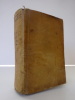
BACON, sa vie, son temps, sa philosophie et de son influence jusqu'à nos jours -- BEL EXEMPLAIRE
P., Didier, 1858; un volume in 8, relié en demi-chagrin noir, dos orné de filets dorés (reliure de l'époque), (2), 15pp., 464pp.
---- BEL EXEMPLAIRE - Seconde édition ---- Expédition en Espagne, expédition d'Essex en Irlande, avènement de Jacques Ier, sa conduite à la chambre des communes - Première édition du Traité de l'avancement des sciences ; conflit avec E. Coke - Composition des Cogitata et visa - Publication du De sapientia veterum - Bacon Procureur général - Bacon ministre - Bacon après sa chute - Ecrits divers - Sa maladie et sa mort - Analyse des ouvrages et de la philosophie de Bacon - Examen de la philosophie de Bacon - Histoire de la philosophie et de l'influence de Bacon - etc**5729/K3
Le christianisme de François Bacon , chancelier dAngleterre ou pensées et sentimens de ce grand homme sur la religion . Tome I
Nyon & Belin Paris An VII - 1799
Bon état Reliure pleine peau dépoque , dos lisse orné ( piéces de titre , de tomaison , caissons et fers ) ouvrage enrichi dun ex-libris ( ignace de billieux ) 108 pages ( discours préliminaire ) 104 pour la vie de françois bacon et 175 pages ( pensées de bacon sur la religion etc .....) reliure solide , pas de manque , légérement auréolé sur quelques pages ( ne nuisant nullement à la lecture du texte ) tome i seul . francis bacon (1561-1626), philosophe anglais . religion xviiie théologie théosophie philosophie biographie f bacon - largeur/hauteur : 10x17 cm - poids : 270 g - nombre de pages : 387 p. - langue : Français
[Bacon] - DUPIN Jacques - SYLVESTER David - BACON Francis
Reference : 014341
(1984)
Francis Bacon Peintures récentes
Paris Galerie Lelong 1984 In-4 Broché, couverture illustrée Edition originale
Collection "Repères, Cahiers d'art contemporain" n° 10. Préface de Jacques Dupin ( Fragments dans les marges d'un texte de Michel Leiris), et entretien de Francis Bacon avec David Sylvester, en anglais. Photos de l'artiste et 22 reprodustions en couleurs de ses oeuvres, l'une reprise en couverture. 36 pp. JOINT 3 photographies originale, reproduction en noir de 3 toiles de Bacon, avec étiquettes au dos pour la presse. Très bon exemplaire 0
Francis Bacon, logique de la sensation.
S.l., Editions de la Différence / Coll. ''La Vue le texte'', (1996). 2 vol. au format pt in-4 (273 x 198 mm) de 112 pp. et un vol. de planches, non paginé, brochés.
![Francis Bacon, logique de la sensation.. DELEUZE (Gilles) - [BACON (Francis)].](https://static.livre-rare-book.com/pictures/BLS/31979_1_thumb.jpg)
Ensemble complet des deux volumes le constituant. Le premier recèle l'étude magistrale de Deleuze. Le second renferme quant à lui la reproduction des toiles de Bacon. ''La tâche de la peinture est définie comme la tentative de rendre visibles des forces qui ne le sont pas.» A cet égard, Deleuze permet d'adopter ici un regard différent sur les peintures de Bacon, de les mieux comprendre et les analyser. Et "Le livre de Gilles Deleuze sur Francis Bacon est bien autre chose que l'étude d'un peintre par un philosophe. Est-il du reste "sur " Bacon, ce livre ? Et qui est le philosophe, qui est le peintre ? Qui pense, et qui regarde penser ? On peut certainement penser la peinture, on peut aussi peindre la pensée, y compris cette forme exaltante, violente, de la pensée qu'est la peinture...'' Léger jaunissement affectant le dos des exemplaires ainsi que les marges du premier plat du coffret. Du reste, très belle condition.

[F. Bacon] - BACON, Francis - David Sylvester, Michel Leiris.
Reference : 972
(1966)
DERRIÈRE LE MIROIR N° 162. FRANCIS BACON. Novembre 1966.
Paris, Maeght éditeur, 1966. In-folio (380 x 280 mm) en feuilles, 34 pages. 5 LITHOGRAPHIES EN COULEURS d'après les peintures de Francis Bacon. 8 reproductions en couleurs dont 1 triptyque en triple page, 5 reproductions en noir. Texte de Michel Leiris et interview de Francis Bacon par David Sylvester. Bien complet de "Chroniques" de 1966. Magnifique numéro avec un très beau travail de lithographie d'interprétation. Tirage original rare. Bien complet. Excellent état.

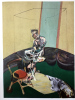
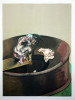
Tirage original en excellent état de conservation, intérieur impeccable, la couverture très belle. Complet des reproductions dont un triptyque et des lithographies en couleurs.
Bacon - Picasso - La Vie des images.
S.l., Flammarion / Réunion des Musées nationaux, (2005). Un vol. au format pt in-4 (283 x 223 mm) de 237 pp., broché, sous couverture à rabats rempliés.
![Bacon - Picasso - La Vie des images.. BALDASSARI (Anne) - [BACON 5francis) & PICASSO (Pablo)].](https://static.livre-rare-book.com/pictures/BLS/32351_1_thumb.jpg)
L'ouvrage s'agrémente d'une abondante iconographie. ''Paris, 1927 : Francis Bacon visite l'exposition " Cent dessins par Picasso " à la galerie Paul Rosenberg. Le choc est tel qu'il va déterminer son entrée en peinture. " Obsédé ", Bacon ne cessera dès lors d'entretenir des rapports multiformes avec l'art du grand maître moderne. Cet ouvrage et l'exposition présentée au musée Picasso confrontent les deux artistes et retracent l'histoire d'une " période Picasso " (1927-1944) de l'œuvre de Francis Bacon, jusqu'ici peu connue. A travers le prisme baconien des peintures à " clefs ", " cris " ou " ombres portées ", ce sont aussi les révolutions surréalistes de Picasso, menées par un essaim de petites baigneuses, qui se donnent à redécouvrir. Le mano a mano artistique de cette filiation majeure, oscillant entre fascination et déni, témoigne singulièrement d'une vie parallèle des images, de leur puissance génésique à convoquer la peinture des maîtres anciens comme à incarner, au présent, la " vibration du vivant "''. Très belle condition.
Oeuvres philosophiques, morales et politiques de François Bacon Baron de Verulam, Vicomte de Saint-Alban lord chancelier d'Angleterre.
Paris Société du Panthéon Littéraire 1842, In/4, 788 pages, avec une notice biographique par J. A. C. Buchon. Texte sur deux colonnes

Francis Bacon, né le 22 janvier 1561 à Londres et mort à Highgate près de la même ville en 1626, baron de Verulam, vicomte de St Albans, Chancelier d’Angleterre, est un scientifique et philosophe anglais.
Francis Bacon. Logique de la sensation. Tome 1.
Coll. "La vue le texte", Paris, éd. De la différence, 30 octobre 1981, EDITION ORIGINALE, in-8, cartonnage souple, couv. 3 photos en coul. d'œuvre de Bacon, 112 pp., index des tableaux cités, table des matières, anciennes écritures au bic surchargé au marqueur bleu sur la page de titre, Belle étude de l'œuvre picturale de Francis Bacon par le philosophe français Gilles Deleuze. Première édition. Bon état général mais couverture défraîchie et petits manques sur le dos
Librairie spécialisée en gastronomie , œnologie et tabagie
LITHOGRAPHIE ORIGINALE DE FRANCIS BACON POUR CHATEAU MOUTON ROTHSCHILD.
1990.En hommage à Bacon.BE.Infimes marques.
Analyse de la philosophie du chancelier François Bacon
A Amsterdam, et se trouve à Paris, 1755, 1755 Tome I : (1bl), (1), 411 p., (1) Tome II : (1bl), (1), 347 p., (1) 2 vol in-12, en plein veau marbré de l'époque, dos à 5 nerfs orné de fleurons, pièces de titre et de maroquin rouge, tranches rougies. deux volumes sur trois.
![Analyse de la philosophie du chancelier François Bacon. [BACON (François)] DELEYRE, Paul)](https://static.livre-rare-book.com/pictures/OMB/1748_1_thumb.jpg)
L'auteur de cette analyse, Paul Deleyre, était le bibliothécaire de l'infant du Duc de Parmes, dont le précepteur n'était autre que Condillac. On adjoint parfois à cette analyse de la philosophie de Bacon, une vie de Bacon par le même Deleyre. Bel exemplaire.
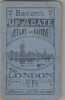
Bacon's Up to Date Atlas and Guide to London
1920 G. W. Bacon & Co., Ltd [1920], 28 sheets, 42 pp., Blue illustrated softcover binding. Minor wear to the edges and fading to the spine. Minor occasional spotting to the edges and bright internally. With 28 coloured maps of London and travel guide to the rear. Small 8vo.
Remise de 20% pour toutes commandes supérieures à 200 €
Opus International 68.
Ed. Georges Fall 1978 In-8, broché couv. illustrée par Bacon, illustrations et photographies en n. & b., 112 pp. Bon état d’occasion.
“Francis Bacon” par Jean-Luc Chalumeau, Max Clarac-Serou, Dominique le Buhan, Jean-Louis Pradel, Gerard-Georges Lemaire, Giovanni Joppolo, Michel Gerard, Eddy Batache et Jesse Fernandez. Bon état d’occasion
L'art de l'impossible
1976. Genève Éditions Albert Skira coll. Les sentiers de la création 1976 - 2 volumes brochés sous emboitage 16 5 cm x 21 5 cm 132+145 pages ills noir & blanc et couleur in et hors-texte - Entretiens de Francis Bacon avec David Sylvester préface de Michel Leiris- Très bon état
Oeuvres philosophiques de BACON publiées d'après les textes originaux avec notice, sommaires et éclaircissements par M.N. BOUILLET --- BEL EXEMPLAIRE --- PREMIERE EDITION FRANCAISE --- 3 VOLUMES --- COMPLETE SET
P., Hachette, 1834, 3 VOLUMES in 8 reliés en demi-basane verte, dos ornés de filets dorés (reliures de l'époque), T.1 : (2), 144pp., 554pp., (1), 2 tableaux dépliants, T.2 : (2), 96pp., (2), 516pp., T.3 : (2), 59pp., (1), 594pp., (1)
---- PREMIERE EDITION FRANCAISE ---- BEL EXEMPLAIRE ---- "Aucun des écrits de BACON n'avait encore été imprimés en France, à l'exception u De augmentis scientiarum qui fut publié en 1624". (Préface de l'éditeur) ---- Notice sur BACON (64pp.), notice sur les principales éditions et traductions de ses oeuvres, introduction de N. BOUILLET - De la dignité des sciences - De l'avancement des sciences, Sciences ou philosophie, Science de l'homme, Science de l'usage et des facultés de l'âme (logique et morale) - etc**5707(0).P4-CAV E2-CAV i5
Oeuvres philosophiques, morales et politiques de François Bacon, traduites en français
Notice biographique de J.-A.-C. Buchon, Paris, Auguste Desrez impr.-ed., 1838 – in-4, 790 pp – demi-rel. chagrin rouge d'ép., un grand tableau dépliant.
Bel ouvrage qui réunit les oeuvres complètes du célèbre philosophe anglais François Bacon. Dignite et accroissement des Sciences, Novum organum, etc...Très bon ex.
Bacon F. Essays in Volume 2, Volume 1. In Russian /Bekon F. Sochineniya v 2 t.
Bacon F. Essays in Volume 2, Volume 1. In Russian /Bekon F. Sochineniya v 2 t. Tom 1. Philosophical Legacy M Thought 1971. We have thousands of titles and often several copies of each title may be available. Please feel free to contact us for a detailed description of the copies available. The delivery of this book might be delayed beyond the usual timeframe due to extended processing and preparation before shipment, and faster shipping options are not offered. Please inform us if you need the order by a certain date or have a deadline. SKUalb51073e0efc1fd404
Bacon F. The history of King Henry VIIs reign. In Russian /Bekon F. Istoriya pr
Bacon F. The history of King Henry VIIs reign. In Russian /Bekon F. Istoriya pravleniya korolya Genrikha VII. Series: Monuments to Historical Thought. M. Science 1990. We have thousands of titles and often several copies of each title may be available. Please feel free to contact us for a detailed description of the copies available. The delivery of this book might be delayed beyond the usual timeframe due to extended processing and preparation before shipment, and faster shipping options are not offered. Please inform us if you need the order by a certain date or have a deadline. SKUalb3c72d0fa024dadd1
[Francis] Bacon.
S.l., Skira, (2008). Un fort vol. au format pt in-4 carré (308 x 288 mm) de 250 pp. Reliure d'édition de pleine percaline ébène, sous jaquette illustrée.
![[Francis] Bacon.. CHIAPPINI (Rudy, sous la direction de) - [BACON (Francis)].](https://static.livre-rare-book.com/pictures/BLS/32623_1_thumb.jpg)
L'ouvrage s'agrémente d'une abondante iconographie. ''Comme un éclair dans l'obscurité, les œuvres de Francis Bacon révèlent, l'espace d'un instant qui défie la persistance du temps, la brutalité, la violence et la beauté convulsive de la vie. Son regard cherche à bloquer le cours intarissable de l'existence et à le transformer en une image absolue. Il veut coaguler sur la toile le sens d'un quotidien qui s'éloigne et s'estompe dans le temps, mais qui est incontournable. Une image vécue qui ne peut pas revenir à l'obscurité et qui devient la révélation permanente de la condition humaine.'' Très belle condition.
Bacon-Freud. Expressions.
Saint Paul : catalogue de l'exposition de la Fondation maeght de juillet à octobre 1995. Un volume broché (25x21 pages), 208 pages. Avec 29 reproductions en couleurs de Francis Bacon et 43 de Lucien Freud. Texte de jean-Louis Prat. Biographies et principales expositions pour les deux artistes. Bon état.


Tous nos livres sont visibles sur notre site : https://www.livrepoesie.com/
Bacon F. Compositions in 2 tp. In Russian /Bekon F. Sochineniya v 2-kh tt.
Bacon F. Compositions in 2 tp. In Russian /Bekon F. Sochineniya v 2-kh tt. M Thought 1977-1978. We have thousands of titles and often several copies of each title may be available. Please feel free to contact us for a detailed description of the copies available. The delivery of this book might be delayed beyond the usual timeframe due to extended processing and preparation before shipment, and faster shipping options are not offered. Please inform us if you need the order by a certain date or have a deadline. SKUalba955a058a67b2dd3

Les passions de Francis Bacon
Paris Gallimard i pleine toile noire sous jaquette illustrée, 178 pp illustrées en couleurs, certaines planches couleurs sont dépliante, tres belle momographie, bon état
Bacon F. New organon. In Russian /Bekon F. Novyy organon.
Bacon F. New organon. In Russian /Bekon F. Novyy organon. Moscow: State Socio-Economic Publishing House. 1936.year 244 p. You are welcome to reach out to us for a detailed description of the copies currently available. Delivery of this book may take longer than usual including extended processing and pre-shipping time, no expedited shipping is available. Please advise us if you have a set date or a deadline to receive your order.SKUalb5c9c399952cf4b15