 Write to the booksellers
8409 books for « al des »Edit
-
Type
Any type (1)
Artists book (2)
Autograph (3)
Book (7963)
Disk (3)
Magazine (137)
Maps (2)
Music sheets (200)
New book (102)
-
Latest
Last 24h (386)
Last 3 days (4)
Last month (53)
Last week (7)
-
Language
Czech (1)
Dutch (8)
English (199)
French (7832)
German (21)
Greek (2)
Italian (38)
Japanese (2)
Latin (1)
Norwegian (1)
Russian (296)
Spanish (11)
Swedish (1)
-
Century
16th (3)
17th (15)
18th (47)
19th (280)
20th (4306)
21st (1587)
lrb.search.century.TWENTY_SECOND (1)
-
Countries
Belgium (171)
Brazil (5)
Canada (906)
Côte d'Ivoire (43)
Denmark (124)
France (5371)
Netherlands (1)
Switzerland (1270)
United Kingdom (227)
United States of America (295)
-
Syndicate
ALAC (886)
CLAM (11)
CLAQ (208)
ILAB (2172)
NVVA (54)
SLACES (54)
SLAM (793)
SNCAO (2)
Topics
- 1900 (142)
- Africa (19)
- Agriculture (23)
- Arabic (38)
- Archaeology (73)
- Architecture (143)
- Asia - orient (22)
- Autographs (24)
- Avant-garde (21)
- Belgium (26)
- Birds (58)
- Botany (178)
- Brussels (15)
- Chemistry (26)
- Children’s books (33)
- China (18)
- Christmas (22)
- Cinema (44)
- Comic strip (221)
- Decorative arts (15)
- Drawings (57)
- Egypt (31)
- English (28)
- Entomology (462)
- Ethic (53)
- Europe (21)
- Exhibition catalogue (65)
- Feminism (23)
- Fine arts (84)
- First edition (46)
- Fishes (18)
- Flanders (17)
- Geneva (66)
- Geography (33)
- Geology (38)
- Germany (15)
- Guittoneau ben (20)
- Hainaut (19)
- Helvética (272)
- History (355)
- Humour anecdotes (15)
- Hydrobiology (28)
- Industrial arts & crafts - fine arts (23)
- Invertebrates (45)
- Iran - persia (15)
- Islam muslim (111)
- Japan (15)
- Latin (35)
- Law (24)
- Linnean society of lyons (69)
- Literature (208)
- Liturgy (19)
- Lyons and area (67)
- Lyons college (67)
- Lyons college pc (69)
- Lyons revue (67)
- Malacology (57)
- Mammals (45)
- Manuscripts (16)
- Matisse (19)
- Mechanics (20)
- Medicine (35)
- Military arts (15)
- Museums (20)
- Music (39)
- Navy (75)
- Newspapers press (37)
- Pacific (34)
- Painting (197)
- Palaeontology (184)
- Paris (42)
- Philosophy (52)
- Photography (99)
- Poetry (70)
- Policy (30)
- Psychoanalysis (15)
- Quebec (157)
- Regionalism (69)
- Religions (42)
- Reptiles (47)
- Review (104)
- Reviews (45)
- Romanticism (27)
- School (19)
- Sciences (45)
- Scores (214)
- Sculpture (80)
- Shapes & colours (28)
- Songs (175)
- Surrealism (45)
- Switzerland (282)
- Symbolism (21)
- Tea (19)
- Theatre (53)
- Theology (66)
- Travel (63)
- Various (24)
- War (36)
- Women (the) (25)
Istoria Literaturii române
Grai Si Suflet - Cultura Nationala 1994 412 pages Bucuresti. in-8. 1994. broché. 412 pages.
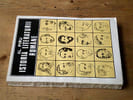
Etat correct. Couverture un peu fripée au dos. Papier jauni avec un coin corné
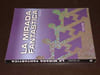
La mirada fantastica
H. Kliczkowski 2002 160 pages in-8. 2002. 160 pages. In-8 carré (253x228 mm) 160 pages. Nombreuses illustrations. Texte en espagnol. Très bon état général. Poids : 570 gr
Itinéraire illustré de la Haute Egypte
Librairies-Imprimeries réunies 290+9 pages in-8. Sans date. Plein cuir titré en lettres dorées. 290+9 pages. Les anciennes capitales des bords du Nil avec 2 cartes dépliantes de la Haute Egypte et de la Basse Egypte
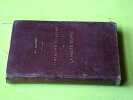
Etat correct. Reliure frottée. Papier un peu jauni avec peu de rousseurs et des passages annotés au crayon gris. Trois petites coupures aux cartes
Traduction nouvelle de l'oraison de Ciceron pour le poete Archias suivie de quelques imitations d'Odes d'Horace en vers français
F.-V. Guilleminet & E.-P.-J. Catineau 1804 43 pages Paris & Poitiers. in-8. 1804. Demi-Percaline à coins. 43 pages.
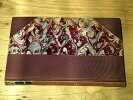
Bon état
Dāʼūd al-Ashkashī & Ḥusām al-Dīn al-Kātī (DA-UD AL-ASHKASI & HUSAM AL-DIN AL-KATI)
Reference : 60111
(1772)
Arabic manuscript on cream paper, containing: [Dāʼūd al-Ashkashī :] supercommentary Ḥāshiyah ʻalá Sharḥ al-Marāḥ on Aḥmad Dīkqūz’s (15th c.) commentary on Aḥmad ibn Masʻūd’s (13th c.) grammatical treatise Marāḥ al-arwāḥ, on Arabic morphology. + [Ḥu... - [HIGHLY INTERESTING ARABIC MANUSCRIPT ON LOGIC AND GRAMMAR]
(Presumably Yemen), 1772. 4to. Bound in a contemporary full leather binding with flap. Boards and flap with blindtooled ornamentation. Spine worn and worn through at hinges. Back board loose at top 2/3, but still attached. A bit of worming to boards and overall signs of wear to leather. Internally well preserved, with occasional light discolouration. 170 ff. with numerous additional smaller pages of notes inserted throughout, several in different colours (pink and blue). Text throughout is written in Naskh script, in a single column. Mostly written in black ink with occasional colorful highlights. Passages of core texts are overlined, generally in red but occasionally in black or green. The first text varies between approximately 18 and 33 lines per page and is occasionally written diagonally (for example, fol. 31rv) the second is consistent at 9 lines per page with considerable interlinear notes. Portions of the text are copied by the primary scribe on smaller pages, for example ff. 70r-79v, to be distinguished from the small pages of notes that were likely inserted later. The title and author of the first text are presented in attractive green and red calligraphy on f. 1r. The scribe’s name is also written in calligraphy on f. 1r and 126r, in addition to the colophon on f. 168v, but the name has been systematically erased in all three locations, for unknown reasons. According to the colophon on f. 168v, the manuscript was copied on the first Friday of Rabi? al-Thani 1186 AH, equivalent to 3 July 1772 CE. As noted above, the scribe’s name has been erased. The style of the script and decorations suggest that it was most likely copied in or near Yemen. Texts: Fol. 1r-126v: Da'ud al-Ashkashi’s supercommentary ?ashiyah ?alá Shar? al-Mara? on A?mad Dikquz’s (15th c.) commentary on A?mad ibn Mas?ud’s (13th c.) grammatical treatise Mara? al-arwa?, on Arabic morphology. Fol. 129v-168v: ?usam al-Din al-Kati’s (d. 1358/9) commentary Shar? al-Isaghuji on Athir al-Din al-Abhari’s (d. 1265) Isaghuji. Miscellaneous notes and poems appear on front and rear flyleaves, on pages between the two texts, in margins, between lines, and on small inserted pages. Many of these paratexts are in the hand of the primary scribe. The notes discuss numerous topics, but especially grammar and logic, the subjects of the two main texts. Marginal and interlinear notes generally comment on specific passages in the main text. A few notes, especially on fol. 128r, are in Turkish, attesting to Ottoman influence. The front pastedown has a short story or riddle about Muslims and nonbelievers on a ship.
![Arabic manuscript on cream paper, containing: [Dāʼūd al-Ashkashī :] supercommentary Ḥāshiyah ʻalá Sharḥ al-Marāḥ on Aḥmad Dīkqūz’s (15th c.) ...](https://static.livre-rare-book.com/pictures/LLX/60111_9_thumb.jpg)
Unrecorded Arabic manuscript containing two highly important treatises, the first of which is of the utmost scarcity (only three other manuscript copies of the work are known), and the other of which is of the utmost importance to the development of logic in the Arab world. Da'ud al-Ashkashi’s supercommentary “?ashiyah ?alá Shar? al-Mara?” on A?mad Dikquz’s (15th c.) commentary on A?mad ibn Mas?ud’s (13th c.) grammatical treatise “Mara? al-arwa?”, on Arabic morphology, is extremely rare, and the present manuscript is only the fourth known copy of the work known to exist. Being unrecorded, this manuscript contributes significantly to preserving an old Arabic work of logic and grammar that may otherwise have been lost and may very well shed new light on a text that is now extremely obscure. The core texts are relatively well known, but al-Ashkashi’s work is extremely obscure. The spelling of his name is uncertain and virtually nothing is known about his life. There is one copy of this text in the Municipal Library of Alexandria (Egypt) and two at Princeton University (Incipit:????? ??? ???? ?? ?????? ?????? ??????? ????? ?????? ????????), but so far, no scholars seem to have worked seriously with the work to determine what it may reveal. Husam al-Din al-Kati’s (d. 1358/9) commentary on Athir al-Din al-Abhari’s (d. 1265) “Isaghuji” (Isagoge) is a well-known, popular, and very influential commentary, of which several copies are known in institutions. Although al-Abhari’s Isaghuji is often described as a commentary on Porphyry’s text, it is really more of an imitation, or a text in the same genre. This extremely influential commentary constitutes an introduction to logic in the style of Porphyrios’ famous “Isagoge” of Porphyry. Being extremely popular and influential, numerous manuscripts and supercommentaries of it are known. (Incipit: ????? ??? ?????? ????? ??????? ????? ?????? ????). Not much is known about Husam-al-Din-Katia (who is sometimes referred to as al-Rumi) either, but we know he was a native Anatolian. Furthermore, it was his commentary (and glosses) on al-Abhari's Isagoge that became the most popular and the standard accompanying text throughout the Ottoman period. “This work is a super-commentary or gloss on Athir al-Din al-Abhari (d. 663/1264 or 1265)’s Isaghuji, a brief collection of definitions of logic terms named after its inspiration, the Neoplatonist Porphyry (Furfuriyus, d. 309 AD)’s Isagoge. Abhari’s work which only covers the Categories of Porphyry’s work, served as the standard introductory text for the study of logic in madrasas across the Islamic world until modern times, with an emphasis on elementary semantics through the syllogism. Of the many commentaries and glosses on al-Abhari’s Isaghuji, ?üsamüddin ?asan el-Kati’s was one of the most popular, and continued to be the accompanying text by which al-Abhari’s Isaghuji was studied throughout the Ottoman period. In his autobiographical entry, Tasköprüzade mentions having studied the Isagoge via ?üsamüddin el-Kati (Hüsam-i Kati)’s commentary. Well known super glosses (?ashiya) on ?üsamüddin el-Kati’s commentary were produced by Mevlana ?araca A?mad (d. 854/1450) ???? ???? ??????, Mu?yi al-Din Mu?ammad al-Barda?i (d. 927/1521) ???? ?? ???? ??????? and Mu?yi al-Din al-Taliji (al-Talishi) ??? ????? ??????? ??????? (?ashiya ?ala´ shar? ?usam al-Din al-Kati, ????? ??? ???? ????? ?????? , composed in the year 1085). These works tend to be bound together in manuscript codices.” (Uiversity of St. Andrews: The Islamisation of Anatolia). The two works bound here on logic and grammar have clearly been thoroughly studied, both by the scribe, whose name has sadly been erased, and by later readers. The comments almost constitute a work in its own, and there may be much new material to be found here, for the serious scholar. This kind of supercommentary is extremely interesting and will reveal a lot about the development of logic in the Arab world over the numerous centuries that this supercommentary has come to cover - documenting an entire tradition of one of the most important disciplines from the middle ages. As of now, the present manuscript remains univestigated, as do several of this type whose contents are not just straightforward.

Sadr al-Din al-Qunawi e Nasir al-Din al-Tusi, Patrizia Spallino (ed), Ivana Panzeca (ed)
Reference : 66044
Il calamo dell'esistenza. La corrispondenza epistolare tra Sadr al-Din al-Qunawi e Nasir al-Din al-Tusi
, Brepols - Fidem, 2019 Paperback, 424 pages, Size:165 x 240 mm, Language: Italian. ISBN 9782503584119.
Summary Uno degli esempi pi significativi dei frutti prodotti dal confronto aperto tra un sufi ed un filosofo la corrispondenza tenutasi nel XIII secolo tra ?adr al-D?n al-Q?naw? (m. 1274) e Nas?r al-D?n al-??s? (m. 1274), il primo discepolo diretto e figlio adottivo dello ?ay? al-akbar Ibn al-'Arab?, il secondo seguace e commentatore di Avicenna. Soggetto centrale del dibattito l'analisi dell'essere in tutte le sue molteplici determinazioni e manifestazioni: la realt di Dio, l'essere generale e comune, la sostanza e la materia, l'unit e la molteplicit , la natura dell'anima, del corpo, delle forze celesti, il dolore e la gioia spirituale, l'emanazione, il finito e l'infinito. Tutti i quesiti si sviluppano su uno scenario in cui si prendono in considerazione gli estremi limiti del pensiero teoretico che guarda e si interroga sulla sfera contemplativa della luce rivelativa; una dialettica serrata nel tentativo di armonizzare due dimensioni all'apparenza inconciliabili ma in realt complementari. TABLE OF CONTENTS Nota sulla traslitterazione Introduzione 1. Il primo interlocutore: ?adr al-D?n Mu?ammad b. Is??q al-Q?naw? Opere di Q?naw? 2. La controparte: Ab? ?a'far Mu?ammad ibn Mu?ammad ibn al-?asan Na??r al-D?n al-??s? 2.1. Opere di ??s? 2.2. La parabola di ??s? tra sciismo duodecimano e ismailismo 2.3. La parentesi sufi e le epistole in persiano 3. 3. Studio e analisi del testo al-Mur?sal?t bayna ?adr al-D?n al-Q?naw? wa Na??r al-D?n al-??s? 4. L'edizione del testo 5. Nota sui manoscritti 6. Traduzione Bibliografia Indice dei termini tecnici Indice dei nomi
Divers authors (Majlis al-a la li-ri'ayat al-funun wa-al-adab wa-al-ulum al-ijtima iyah. Lajnat al-qanun)
Reference : C59785
(1977)
Bibliyujrafiya al-qanun wa-al ulum al-siyasiyah (min sanat 1875 ila sanat 1970) Muallad 2, al-Buhuth
Al-Qahirah [Cairo], al-Hayah al-Misriyah al-Ammah lil-Kitab 1977 519pp., includes indexes, hardback (red cloth, spine in red leather with engilded title), 24cm., VG, [text fully in arabic], ISBN 9772014211, [Volume 2 of the Bibliography on law and political sciences in Egypt 1875-1970]
Akhbar ad-daulat as-seldzhu kiyya (Zubdat at-tavarikh fi akhbar al-umara va-lÖ
In Russian. Al-Husayni, Sadr al-Din Ali. Akhbar ad-daulat al-selju qiyah (Zubdat at-tawarih fi ahbar al-umara wa-l-muluk al-seljuqiyah). Akhbar ad-daulat as-seldzhu kiyya (Zubdat at-tavarikh fi akhbar al-umara va-l- muluk as-seldzhukiyya). (Soobshcheniya o Sel'dzhukskom gosudarstve. Slivki letopisey, Soobshchayushchikh o sel'd zhukskikh emirakh i gosudaryakh). In Russian /Akhbar al-Daulat al-selju qiyah (Zubdat al-Tawarih fi ahbar al-umara wa-l-muluk al-seljuqiyah). (Reports of the Seljuk State. Cream of Chronicles of Herd Juq Emirs and Sovereigns) . All images are for identification of editions only. Several books of the same edition may be available. Please feel free to request photos of available books. SKU998431
REINAUD (Joseph Toussaint, traducteur), Abu Zayd AL-HASAN al-SIRAFI, Sulayman al-Tajir
Reference : PHO-2067
(1845)
Relation des voyages faits par les Arabes et les Persans dans l'Inde et à la Chine dans le IXe siècle de l'ère chrétienne, texte arabe imprimé en 1811 par les soins de feu Langlès, avec des corrections et des additions et accompagné d’une traduction française et d’éclaircissements par M. Reinaud, membre de l’institut.
Paris, Imprimerie Royale, 1845, 2 volumes in-12 (15x9,5cm), CLXX, 154 pp. 105, (1), 202 pp., demi toile et coins moderne, pièce de titre et tomaison, couverture conservée, coupé en tête, mouillure, cachet répétés.
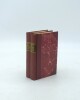
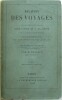
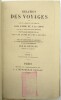
Première édition française de deux récits de voyage arabes en Chine et en Inde. Le texte a été traduit de l’arabe par l’orientaliste et professeur français Joseph Toussaint Reinaud (1795-1867). Le texte arabe avait été imprimé pour la première fois en 1811, sous la supervision du linguiste et orientaliste français Louis-Mathieu Langlès. Le premier volume s’ouvre par une introduction, suivie de la traduction. Le texte principal se divise en deux parties. Le premier récit repose sur le témoignage d’un marchand nommé Sulayman Al-Tajir (Sulayman le Marchand), qui aurait voyagé en Inde et en Chine vers les années 851-852 (237 de l’Hégire) ; cependant, l’auteur véritable du texte reste inconnu. Le récit suivant est rédigé par Abu Zayd al-Hasan al-Sirafi. Al-Sirafi rapporte avoir reçu la mission de vérifier et d’enrichir le premier témoignage. La date de ce second récit demeure incertaine, mais il fut probablement rédigé dans la première moitié du Xe siècle. Le récit de Sulaymān al-Tājir (vers 851-852), complété par Abū Zayd al-Ḥasan al-Sīrāfī au Xe siècle, relate un voyage partant du port de Siraf (golfe Persique) vers l’Inde, avec des escales sur la côte occidentale (Sind, Malabar), puis à Ceylan (Sri Lanka), avant d’atteindre la Chine à Khanfu (Canton/Guangzhou). Sulaymān décrit le commerce intense de soie, porcelaine, épices et métaux précieux, les douanes, la monnaie et les marchés, tandis qu’al-Sīrāfī enrichit le récit par des observations sur les royaumes indiens, les castes et coutumes religieuses, ainsi que sur la Chine : la cour impériale et le « Fils du Ciel », la capitale (Chang’an ou Hangzhou), l’organisation des marchés, la justice, l’administration et l’infrastructure urbaine, incluant routes pavées, papier hygiénique et urinoirs en bambou. Le texte offre également les premières mentions arabes du thé et de la porcelaine, des détails sur les coutumes alimentaires et religieuses, la sécurité des routes et la puissance maritime chinoise, offrant ainsi un panorama vivant et inédit de la vie quotidienne et du commerce en Inde et en Chine médiévales. Le second volume contient des notes accompagnant la traduction, suivies du texte arabe. À ce dernier ont été ajoutés deux extraits d’ouvrages d’Al-Masʿudi, dont ses Muruj al-dhahab. M2-Et3
Al-Jawanib al-qanuniyah li-nashat al-Bank al-Dawli lil-inma wa al-ta'mir [texte en arabe, text in arabic]
Al-Qahirah [Cairo], al-Hayah al-Misriyah al-Ammah lil-Kitab 1976 402pp., hardback (blue cloth, spine in blue leather with engilded title), 24cm., VG, [text fully in arabic], OCLC 12068426, ISBN 9772010415, [Study on the World Bank, the juridical aspects of its activities concerning investment and development], E59789
MAÇOUDI [Abu'l-Hasan Ibn al-Husain Ibn-'Ali al-Mas'ǔdi]. Texte arabe et traduction par C. Barbier de Meynard
Reference : PHO-1755
(1871)
Les Prairies d'or (Murug al-dahab), Collections d'ouvrages orientaux publiés par la Société Asiatique
Paris, Imprimerie Impériale & Nationale, 1871-1930, 7 vol. (sur 9, manque tome 2 & 3) In-8°, brochage éditeur. Édition bilingue : Texte arabe avec traduction française en regard, Tome I, (1871), 2ff.-XII-408pp.,Tome IV, (1914), 2ff,VII_XI ,480pp., Tome V(1928); 3ffnch.-VI-515 pp; Tome VI (1928) ;3ffnch.-IX-518 ;Tome VII (1929); 3ffnch.-X-438 pp; Tome VIII (1930); 3ffnch-X-446 pp.; Tome IX (1930) ,3ffnch.-VI-299 pp. , en fin d’ouvrage , notes et variantes, correction ainsi que la table des matières .Manque les tomes 2/3 , petits défauts de reliure.
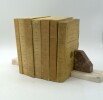
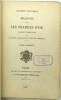
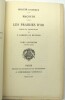
Le tome 1 débute par le « Commencement des choses et la création … des êtres » et finit par l’Histoire de Chine, Tome 2 et 3 sont manquants, le tome 4, chapitre LXII, décrit la naissance du prophète et finit au chapitre LXXXIV, « Paroles mémorables d’Ali… », le tome 5 s’ouvre sur le chapitre LXXXV, (le khalifat d’el-Haçan , fils d’Ali,…) , se finissant au chapitre C ( le règne d’Hicham , fils d’Abd-el-Melik ,..), le 9eme et dernier tome se finit au chapitre CXXXII (nomenclature des chefs du pèlerinage depuis le commencement de l’islam…) , suivi de l’index général (p93-p299). En rapprochant la préface des Prairies d'or et certains passages du Livre de l'avertissement, on peut retrouver les titres de vingt-trois ouvrages qu'il composa. Le principal était une Histoire universelle (Akhbār az-zamān), qu'il entreprit en 943, sorte de vaste encyclopédie historico-géographique en trente livres. Ensuite il écrivit un Livre moyen (Kitāb al-awsat), complément du précédent, qui est un récit chronologique des événements de l'histoire humaine depuis la création du monde. Les Prairies d'or sont un abrégé en cent trente-deux chapitres de la matière contenue dans les deux compositions précédentes. Le Livre de l'avertissement et de la révision, son dernier ouvrage, en est un autre résumé bien plus mince (un cinquième environ), mais avec des compléments et perfectionnements sur certains points. Ces abrègements étaient destinés à faciliter la diffusion du contenu des deux premiers ouvrages. Al-Mas'ûdî ou Al-Masudi ou Maçoudi (en arabe : علی بن حسین مسعودی Abū al-Ḥasan 'Alī ibn al-Ḥusayn ibn 'Alī al-Mas'ūdī), né à Bagdad à la fin du IXe siècle, mort à Fostat en septembre 956, est un encyclopédiste et polygraphe arabe, à l'apogée de l'islam classique. Ses Murūj adh-dhahab wa-ma'ādin al-jawhar, ou Prairies d'or et mines de pierres précieuses, resteront jusqu'au milieu du XVe siècle le manuel de référence des géographes et des historiens de langue arabe ou persane. Paris, Imprimerie Impériale & Nationale , 7 vol. (out of 9) In-8°, editor cover. Bilingual edition: Arabic text with French translation opposite. Tome I, (1871), 2ff.-XII-408pp.,Tome IV, (1914), 2ff,VII_XI ,480pp Tome V(1928); VI & 515 pp; Tome VI (1928) ;IX & 518 ;Tome VII (1929); X & 438 pp; Tome VIII (1930); X & 446 pp.;Tome IX (1930) ,3ffnch. & VI & 299 pp.. Missing volumes 2/3, very scarce, important and interesting encyclopedia of the history and geography of the known world. The first three volumes in collaboration with M. Pavet de Courteille.
COLLECTIF - Ecrit par Cheikh' Abd Al Muhsin Al'Abbâd selon les ouvrages de : Ibn Hajar Al'Asqalani, Ibn Rajab, IBN Daqiq Al'id, Al'Uthaymin
Reference : 114612
(2011)
Commentaire du livre 40 Habiths An-Nawawi
2011 Editions Dar Al Muslim, Collection "Le Tawhid" - 2011 - In-8, broché, couverture illustrée - 159 p. - Ouvrage en français et en arabe
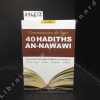
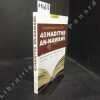
Bon état - Coins légèrement émoussés - Menus frottements sur la couverture Bon
Al-Sihyuniyah wa-siyasat al-unf ; Za'if Jabuntinski wa-talamidhuhu fi al-siyasah al-Isra'iliyah [texte en arabe, text in arabic]
Al-Qahirah [Cairo], al-Hayah al-Misriyah al-Ammah lil-Kitab 1979 346pp.with some illustrations (portrait, some maps & facsimiles), contains bibliography (pp.337-346), hardback (blue cloth, spine in blue leather with engilded title), 24cm., VG, [text entirely in arabic], OCLC 19459626
Nazariyat al-shi'ir 'indra al-falasifah al-Muslimin ; min al-Kindi hatta Ibn Rushd [texte en arabe, text in arabic]
Al-Qahirah [Cairo], al-Hayah al-Misriyah al-Ammah lil-Kitab 1984 315pp., contains bibliography (pp.297-313), hardback (blue cloth, spine in blue leather with engilded title), 24cm., VG, [text entirely in arabic], OCLC 15270188, [ISBN 977013527 (invalid)]
AL-GARIB AL-MUSANNAF. La somme des vocables inusités. Tome I et II uniquement.
Carthage, Fondation nationale,1989-90. 2 vol. in-8 br., 641 pp. en continu. Envoi autographe de l'auteur.
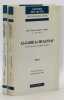
Les premiers manuscrits réunissant les vocables inusités en langue arabe dus, au début du IIIe siècle de l’hégire, à Al-Asmaï et à ses contemporains ne nous sont pas parvenus. C’est dans la Bibliothèque de Tunis qu’a été découverte l’une des plus anciennes copies d’ «Al Gharib al-Musannaf», voire même des plus intégrales. Son auteur, Abu Ubayd Ibn Sallam, esprit curieux et amateur de compilations, est mort en 224 H / 838 ap. J.C. Cet ouvrage se compose de plusieurs «livres» (kitab), qui sont d’anciennes monographies thématiques, comme le «livre des chevaux», le «livre des armures», etc... Il sera mis à contribution à partir du IVe siècle (H) et servira de base aux grands lexiques, tels « As – Sihah » d’Al-Jawhari ou « Al Mukhassas » d’Ibn Sidah. On ne peut donc pas le considérer comme un lexique, mais comme une « somme » à mi-parcours entre les monographies thématiques et les dictionnaires proprement dits. Il représente, en fait, une étape dans la « lexicalisation » de la langue arabe. On pourrait penser que les vocables inusités sont tombés en désuétude car bannis par l’usage et devenus donc inutiles. En fait, ils servent de « vivier historique » dans lequel les lexicographes puisent pour répondre au besoin grandissant de termes nouveaux. Un peu poussiéreux mais bon ensemble. - Frais de port : -France 7,15 € -U.E. 9 € -Monde (z B : 14 €) (z C : 24 €)

Bilder aus Mekka
Leiden, Brill, 1889 ; in-folio, en ff. sous chemise., 2 ff. texte, 18 ff. portant 20 photographies en noir.Suite rarissime de 20 tirages photographiques sur papier albuminé montées à pleine ou demi-page sur 18 feuillets de papier fort précédés de 2 ff. de texte (faux-titre et liste des planches).Témoignage unique sur une Mecque disparue que le visiteur moderne peinerait à reconnaître, ces photographies prises en 1885, sont, après celles de Muhammed Sadiq Bey prises en 1881, les premiers clichés de la ville. Cet album fait suite à une première publication de photographies destinées à illustrer son ouvrage Bilder Atlas zu Mekka La Haye 1888, cette première suite, quoique moins rare, est également fort recherchée.Les Bilder aus Mekka parues anonymement étaient entièrement attribuées à Snouck Hurgronje jusqu’en 1981 lorsque F. Allen et C. Gavin sont parvenus à reconstituer la signature calligraphique en arabe d’un certain Al Sayid abd Al Ghaffar sur quelques uns des tirages, signature qui avait été effacée par l’éditeur. On ne sait dès lors plus à quel photographe attribuer ces clichés. Dans notre exemplaire, cette signature fantomatique est visible sur les planches III, V, VIII, X, XIII. Une étude attentive pourrait la révéler sur quelques autres. Al Ghaffar est sans doute le photographe amateur que Snouck Hurgronje dit avoir initié à cet art, sans le nommer, dans ses mémoires. Il ressort de travaux récents que le docteur Al Ghaffar, médecin et savant mécquois, probablement le premier photographe de la ville, était un photographe accompli lorsqu’il a fait la connaissance du Hollandais en 1885. Il aurait collaboré avec Snouck Hurgronje en mettant à sa disposition son matériel et son laboratoire. Les photographies signées Al Ghaffar sont parmi les plus vivantes et les plus techniques de la suite ; paysages animés, grandes vues des lieux saints avec la foule de pèlerins. Les photographies de figurants prenant la pose ou les vues de monuments ne sont pas signées. Ces photographies, avec l’enregistrement sur rouleau de cire d’une récitation du Coran que Snouck Hurgronje avait rapportée du même voyage, ont fait l’objet d’une importante exposition à Dubai en 2011.Christiaan Snouck Hurgronje (1857-1936) est un savant orientaliste, aventurier et espion hollandais. Spécialiste du monde musulman, il fut envoyé en mission par le gouvernement en Indonésie afin de comprendre la nature des soulèvements anticoloniaux. Sa mission en Arabie semble en rapport avec ce travail : surveiller les pèlerins indonésiens qui font le Hadj pour prévenir tout rapprochement panislamique. Il enseignait les civilisations islamiques à l’université de Leiden et fut chargé de mission pour le compte des gouvernements anglais et français afin de juguler les velléités indépendantistes en Inde et au Maroc. Sa récente mise en lumière suite à l’exposition de Dubai et aux prix extravagants que ses suites atteignent en ventes publiques a donné lieu à des controverses sur le personnage. Accusations de duplicité concernant sa fausse conversion pour se mêler aux pèlerins de la Mecque. Ses vues sur l’islam sont considérées par certains auteurs comme une cause des relations souvent conflictuelles entre l’Occident et le monde musulman.Beaux tirages frais, exemplaire sans le feuillet de titre ni la préface qui semble manquer à la plupart des exemplaires. Feuillets de texte roussis et endommagés, rousseurs éparses sur les papiers portant les photos, chemise un peu défraîchie.
Al-Wifaq al-Amriki al-Suvyitti 1963-1976 [texte en arabe, text in arabic]
Al-Qahirah [Cairo], al-Hayah al-Misriyah al-Ammah lil-Kitab 1981 380pp., hardback (blue cloth, spine in blue leather with engilded title), 24cm., VG, [text fully in arabic], OCLC 9202057, ISBN 977735672, [Study on the American-Soviet relations 1963-1976]
[Harris Ben ] - - Hoffman Al,Goodhart Al - Hoffman Al,Goodhart Al
Reference : 109543
(1933)
Partition de la chanson : Two Buck Tim from Timbuctoo Edition originale de cette partition piano , chant. . Sur la couverture illustrée , photo de de Guy Lombardo
Famous Music Corporation 1933
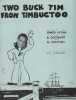
Très bon état Format Américain Piano
- Hoffman Al,Goodhart Al,Sigler Maurice - Hoffman Al,Sigler Maurice,Goodhart Al
Reference : 108884
(1936)
Partition de la chanson : I'm in a dancing mood Edition originale de cette partition pour piano et chant. "<span class="acf-rel-item acf-rel-item-add disabled" tabindex="0" data-id="108886">This’ll Make You Whistle" est une comédie Britannique avec en vedette</span> Jack Buchanan This'll Make You Whistle
Crawford Music corporation 1936
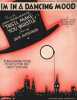
Très bon état Petit format Guitare,Piano
- Silver Abner,Sherman Al.,Lewis Al. - Lewis Al,Silver Abner,Sherman AL
Reference : 108039
(1935)
Partition de la chanson : The Santa Claus express Chanson de Noël
Partitions sur les Fêtes religieuses Crawford Music corporation 1935
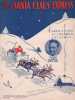
Bon état Format Américain Guitare,Piano
A Glossary of Sufi Technical Terms Compiled by Abd al-Razzaq al-Qashani. Translated from the Arabic by Nabil Safwat. Revised and edited by David Pendlebury.
London: The Octogon Press, 1991 in-8, 139 pages (texte anglais) + 165 pages (texte arabe). Cartonné, jaquette, très bon état, qq annotations.
A Glossary of Sufi Technical Terms Compiled by Abd al-Razzaq al-Qashani. Translated from the Arabic by Nabil Safwat. Revised and edited by David Pendlebury. (London: The Octogon Press, 1991). [M.C.: religion, Islam, soufisme]
Abū Ubayd AL-BAKRI (ou BEKRI) , QUATREMÈRE (Étienne , Traducteur)
Reference : PHO-1372
(1831)
Notice d'un manuscrit arabe de la bibliothèque du roi contenant la description de l'Afrique
Paris , Imprimerie Royale , 1831 , in-4 , 230pp. , relié demi veau époque , tranches cailloutées ,ex-libris T.E. Mionnet (numismate ) , cachet ,dos manquant , frottements aux plats , rousseurs éparses.
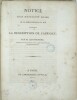
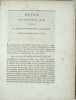
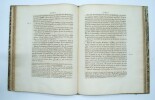
Première traduction partielle de l’oeuvre de Al-Bekri « La description de l’Afrique » , comme l’indique le traducteur en début d’ouvrage , c’est la traduction d’un manuscrit unique de la bibliothèque du roi , n’ayant ni commencement , ni fin , néanmoins la recherche de Quatremère lui permit de l’attribuer à Abū Ubayd AL-BAKRI , une traduction définitive fut établi par le baron de Slane quelques années plus tard sur plusieurs manuscrits . Le livre est écrit en 1067-1068 à Cordoue, en al-Andalus (actuelle Espagne). Al-Bakri y fait une compilation historique et géographique de différentes régions d'Afrique ,il se base sur les récits de commerçants et de voyageurs, notamment Muhammad ibn Yūsuf al-Warrāq (Sur la topographie de l'Afrique du Nord), et d'Abraham ben Jacob dont les mémoires ont été perdus. Malgré le fait qu' Al-Bakri n'a jamais quitté al-Andalus, ses écrits sont considérés comme un rapport impartial des récits d'autres voyageurs par les historiens contemporains, une grande partie de ce qu'il a écrit étant corroborée par d'autres sources. p2-8C
La croyance de Muhammad ibn abd al-wahhäb - commentée par Cheikh Sâlih Al-Fawzän membre du comité des grands savants d'Arabie Saoudite
Ibn Al-Qayyim. Non daté. In-4. Relié. Bon état, Couv. convenable, Dos satisfaisant, Intérieur frais. 224 pages.. . . . Classification Dewey : 297-Islam et religions dérivées
Traduction : Réda Atman, Abû Hârûn Salim Ibn Abd Al-Qâdir. Classification Dewey : 297-Islam et religions dérivées
Ihyâ' 'Ulûm al-Dîn [Revitalisation des sciences de la religion] - uvres complètes 1 - 4
Dar Al Kotob Beyrouth (Liban), Dar Al-Kotob Al-Ilmiyah, 2008. Fort In-8 Pleine reliure d'éditeur en simili-cuir r plats richement ornés de motifs géométriques et d'encadrements estampés à froid et dorés dans le goût oriental. Titre en belle calligraphie dorée sur le premier plat et au dos. 1536 pages (le texte complet des 40 livres de l'Ihyâ' est réuni ici sans coupure).L'intérêt majeur de cette édition de 2008 est de proposer l'intégralité de la somme théologique et mystique d'Al-Ghazâlî sans le fractionnement habituel en 4 ou 5 volumes. Bon état
![Ihyâ' 'Ulûm al-Dîn [Revitalisation des sciences de la religion] - uvres complètes 1 - 4. AL-GHAZÂLÎ Abû Hâmed](https://static.livre-rare-book.com/pictures/MAS/193640_1_thumb.jpg)
Toutes les expéditions sont faites en suivi au-dessus de 25 euros. Expédition quotidienne pour les envois simples, suivis, recommandés ou Colissimo.
[Starmer ] - Tucker AL. - Spencer Otis - Dubin Al,Tucker AL.
Reference : 109662
(1924)
Partition de la chanson : Words Edition originale américaine , partition piano et chant avec en couverture l’interprète AL Tucker and his Society Orchestra
Jack Mills 1924
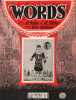
Bon état Format Américain Piano,Ukulélé

