 Write to the booksellers
DEVOGHEL Monseigneur Edouard
Le Vatican
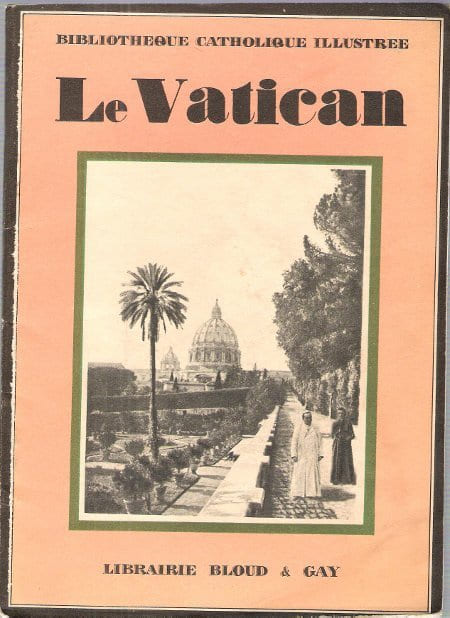
Paris Librairie Bloud & Gay 1932 In Quarto Collection " Bibliothèque Catholique illustrée " . Légers défauts . Exemplaire agraphé .- 56 p. , 250 gr.
Reference : 012932
Couverture souple Très bon
Bookseller's contact details
Au vert paradis du livre
Claire ( Anne Marie ) Dréau
9 place de la Mairie
34530 Aumes
France
04 67 98 96 91
Payment mode

Sale conditions
CONDITIONS DE VENTE : Vente par correspondance dans le monde entier ( régie par la loi de la VPC ) 7 jours sur 7 . Pour recevoir le devis des frais de port vous devez veiller à bien rédiger votre email . Emballage sous carton et enveloppe kraft ou bulles si livre très léger , départ par Poste ou Mondial Relay . Expédition dès réception du règlement par Paypal ou par virement bancaire ou par chèque de banque française , libellé à l'ordre de Mme DREAU , adressé à la Librairie : Au vert paradis du livre , 9 place de la Mairie 34530 AUMES . France . Achat-Vente sur le site et par email ou téléphonique au 04 67 98 96 91 .
5 book(s) with the same title
Vatican I, Infallible or Neglectable? Historical and Theological Approaches to the Event and Reception of the First Vatican Council
, Brepols, 2023 Paperback, 348 pages, Size:156 x 234 mm, Language(s):English, French. ISBN 9782503601717.
Summary On 20 October 1870 pope Pius IX adjourned the First Vatican Council, because of the Italian Rissorgimento troops approaching the city of Rome. Given that the Council had only opened less than a year prior, on 8 December 1869, the act was emblematic. The council, as the Catholic Church's protective response against all things new - rationalism, liberalism, naturalism, materialism, and pantheism - was overtaken by history. Given its premature end not all documents prepared were completed and those that were promulgated, became among the most controversial documents in the nineteenth and twentieth-century Catholic Church, strongly defining its relations to other Christian confessions and modernity. Similarly, around one hundred years after the suspension of the First Vatican Council its historical and theological study was overtaken by the event of the Second Vatican Council, known for its rapprochement to the modern world. The history and results of the First Vatican Council were either forgotten or reinterpreted in light of this subsequent council's decisions. In light of the 150th anniversary of this council, the editors and authors of this volume set themselves the goal of re-examining this tradition of historical and theological reception (and forgetting) of the First Vatican Council. TABLE OF CONTENTS Vatican I, Infallible or Neglectable? Historical Perspectives on the Event and Reception of the First Vatican Council Edited by Dries Bosschaert, Peter De Mey, and Simon Beentjes Introduction Dries Bosschaert, Peter De Mey, and Simon Beentjes Part I: The History of Vatican I and its Main Actors The Holy See, Church and Politics The Climax of Vatican I (1864-1876) Andrea Ciampani (LUMSA di Roma) Victor Dechamps, Archbishop of Mechelen (Belgium), on the Eve of the First Vatican Council Dries Vanysacker (KU Leuven) Des v ques de juste milieu. Le cardinal Mathieu et la minorit inopportuniste Vincent Petit 'Ein Mann mit eiserner Natur': Archbishop Peter Kenrick, Vatican I, and his Submission to Pastor ternus Kenneth L. Parker (Duquesne University) Ignaz von D llinger and the First Vatican Council Franz Xaver Bischof (Ludwig Maximilians Universit t M nchen) The First Vatican Council and the Faculty of Theology at Louvain Leo Kenis (KU Leuven) Russian Diplomats on Vatican I Papal Infallibility, the Emergence of 'Parties' and Concerns on Catholic Clergy in the Empire Katsiaryna Kimlenka (Lomonosov Moscow State University) Part II: Reconsidering the Doctrine of Vatican I Catholic Socio-Economic Thought in the 1860s and its Impact on Vatican I Alina Potempa (Humboldt-Universit t zu Berlin) 'Ecclesiam esse corpus Christi mysticum' Supremi Pastoris, Clemens Schrader and the Ecclesiology of the Mystical Body Valfredo Maria Rossi (Pontifical Gregorian University) Joseph Kleutgen and the Second Schema De Ecclesia Infallibility and the Minor Theological Censures John P. Joy (Albert the Great Center for Scholastic Studies) John Henry Newman, Vatican I and the doctrine of Papal Infallibility Cautions and Contributions Mary McCaughey (St. Mary's College Oscott) The Blessing that comes from ?Anathemas? The Traces of Hope that emerged in Vatican I Susana Vilas Boas (Universidade Cat lica Portuguesa) Part III: Receptions of Vatican I The First Vatican Council and Anglicanism Mark D. Chapman (University of Oxford) The Reception of the First Vatican Council in Old Catholic (Ecumenical) Theology Peter-Ben Smit (Vrije Universiteit Amsterdam) Infallibility in Perspective The Different Receptions of Pastor Aeternus among Catholic Ecumenists before the Second Vatican Council Simon Beentjes (KU Leuven) La primaut dans les conciles du Vatican R ception ou rupture ? Fermina Alvarez Alonso (Pontificia Universitas Lateranensis) The Trinitarian Theology of Bernard Lonergan An Example of the Reception of Vatican I in 20th-Century Theology Andrew Downie (Durham University) Can the Clock be Turned Back? Understandings of Tradition and Change in Vatican I's and Vatican II's Responses to the Modern World Kristin Colberg (College of Saint Benedict)
Vatican II After Sixty Years. Developments and Expectations Prior to the Council
, Brepols, 2023 Paperback, 348 pages, Size:156 x 234 mm, Illustrations:2 b/w, 2 tables b/w., Language(s):English, French. ISBN 9782503607726.
Summary This volume is the result of a workshop organized in Leuven within the context of the Australian Catholic University-KU Leuven-Tilburg University project on Vatican II (1962-1965). This volume focuses on the preparatory period of the Council and its broader context, for many renewal movements were underway decades before the Council's opening. The preparation of the Council was also a period of intense consultation of bishops and male superiors of religious orders and congregations. Indeed, John XXIII aimed at introducing an aggiornamento in the Roman Catholic Church, taking into account the wishes and the needs of bishops and superiors. The volume presented here offers new insights about this period on the basis of archives and other materials insufficiently consulted to date. The papers presented are the result of research by both senior scholars and junior researchers. They focus on the following issues: revelation, ecclesiology, ecumenism, and education. TABLE OF CONTENTS List of Contributors Introduction Part One: Historiography of Vatican II Chapter One: Historia, quae vitae magistra est (John XXIII): The History of Vatican II between Past and Future of Christian Faith Michael Quisinsky Part Two: Revelation Chapter Two: Some Pre-Conciliar Background to Dei Verbum: The Neo-Scholastic Manuals and Their Implied Models Ormond Rush Chapter Three: 'Throwing the Faith to Relativism?' On Understanding Scripture, Tradition, and Authority in the Long Run to Vatican II Karim Schelkens Chapter Four: Beyond the Scripture Sufficiency Debate: The Contribution of Yves Congar Andrew Meszaros Part Three: Church Chapter Five: The Vota of the Prelates of the Southern Cone Region on Ecclesiology and Laity Sandra Arenas Chapter Six: The Vota of the Episcopate of the Andean Region on Ecclesiology and Laity Rolando Iberico Ruiz Chapter Seven: The Australian Pre-Conciliar Ecclesiological Imagination: Exploring Metaphors of the Church from Vatican I to Vatican II in the Australian Landscape Antonia Pizzey Part Four: Eastern Catholic Churches and Ecumenism Chapter Eight: Le Cardinal Li nart et le Tout Action Catholique Catherine Masson Chapter Nine: The Vota of the Eastern Catholic Churches and the Reform of Eastern Canon Law Jose Maripurath Devassy, Astrid Kaptijn, Peter De Mey Chapter Ten: Universality in Time and Space: The Salvation Historical Turn in Catholic Ecclesiology against the Background of Pre-Conciliar Ecumenism Simon Beentjes Chapter Eleven: The Catholic Conference for Ecumenical Questions: A Representative Summa of Pre-conciliar European Catholic Ecumenism? Saretta Marotta Part Five: Education Chapter Twelve: Religious Education and the Re-Christianization of Western Europe in the Long 1950s: A Missed Opportunity? Stephen G. Parker Chapter Thirteen: Catechesis, Seminary Formation, and Schools on the Threshold of Vatican II: Expectations within the Vota Antepraeparatoria Isaak Deman Chapter Fourteen: De Scholis Catholicis: The Preparation of the Decree on Catholic Schools in the Preparatory Period Mathijs Lamberigts Index of Names
Le Vatican capitale de l'Église (L'Histoire le moment)
Lavauzelle 1984 550 pages in8. 1984. Relié jacquette. 550 pages. L'ouvrage 'Vingt siècles d'histoire du Vatican' de Jacques Mercier retrace l'histoire du Vatican depuis ses origines antiques jusqu'à Jean-Paul II avec un souci du détail qui donne au récit la chaleur d'un document vécu. Il évoque notamment l'ambiance de la Rome antique sous Néron et la construction du cirque au pied du mont Vatican
Bon état
Tout savoir sur le Vatican & les papes - Collection Enigmes du sacré, Hors-série n°2 : Rome et le Vatican, 2000 ans d'histoire - Un état microscopique mais une puissance diplomatique - Les secrets et scandales du Vatican - Dans les coulisses de la Bibliot
Diverti. 2016. In-4. Broché. Bon état, Couv. convenable, Dos satisfaisant, Intérieur frais. 162 pages - nombreuses photos et illustrations en couleurs dans et hors texte. Texte sur plusieurs colonnes.. . . . Classification Dewey : 70.49-Presse illustrée, magazines, revues
Sommaire : Rome et le Vatican, 2000 ans d'histoire - Un état microscopique mais une puissance diplomatique - Les secrets et scandales du Vatican - Dans les coulisses de la Bibliothèque vaticane - Interview : les 12 papes qui ont marqué l'histoire - L'énigme de la tombe de saint Pierre - Les Borgia, des intrignants au Vatican.. Classification Dewey : 70.49-Presse illustrée, magazines, revues


Architecture, peinture, sculpture du Vatican.
Amsterdam, VNU Books International, 1974, in-4°, 400 pp, 410 illustrations en couleurs, reliure toile éditeur, jaquette illustrée, bon état
Au Vatican, lieu d'exception, il fallait un livre exceptionnel auquel s'employa l'équipe de spécialistes réunie sous la direction de Deoclecio Redig de Campos, conservateur en chef des musées du Vatican. La clarté des textes et la précision des notices permettent d'aller à la rencontre des chefs-d'oeuvre du Vatican dont 410 illustrations en couleurs dressent le plus exhaustif inventaire jamais réalisé. — Table : La Basilique Saint-Pierre ; Les Palais du Vatican ; Les Appartements Borgia ; Les Chambres et les Loges de Raphael ; La Logetta et la stufetta du cardinal Bibbiena ; La Bibliothèque vaticane ; Les Archives vaticanes ; La Chapelle Sixtine ; Grandes salles et chapelles des palais ; Les Collections de Sculpture antique ; Le Musée étrusque ; La Pinacothèque ; Le Musée égyptien ; Le Musée chrétien ; Commentaires des planches. Désormais les frais d'envoi sont de 6 € seulement pour les livres jusqu'à 1 kg (colissimo suivi), pour la France métropolitaine.

