 Write to the booksellers
PAUL OROSE
Adversus Paganos historiarum libri septem. ut et Apologeticus contra Pelagium de arbitrii libertate. Ad fidem Mss. et praesertim Cod. Longob. antiquiss. Bibliothecae Florentinae Mediceae S. Laurentii, adjectis integris notis Franc. Fabricii Marcodurani et Lud. Lautii, recensuit suisque animadversionibus nummisque antiquis plurimis illustravit Sigebertus Havercampus
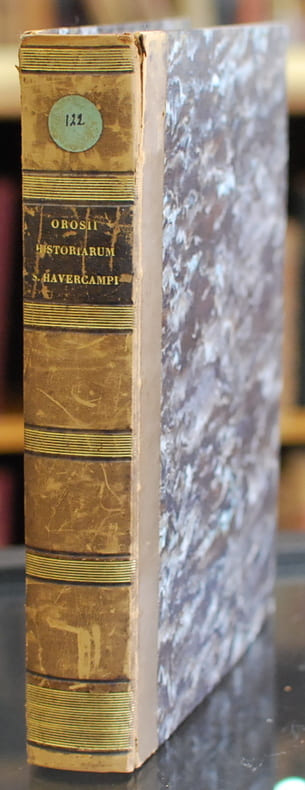
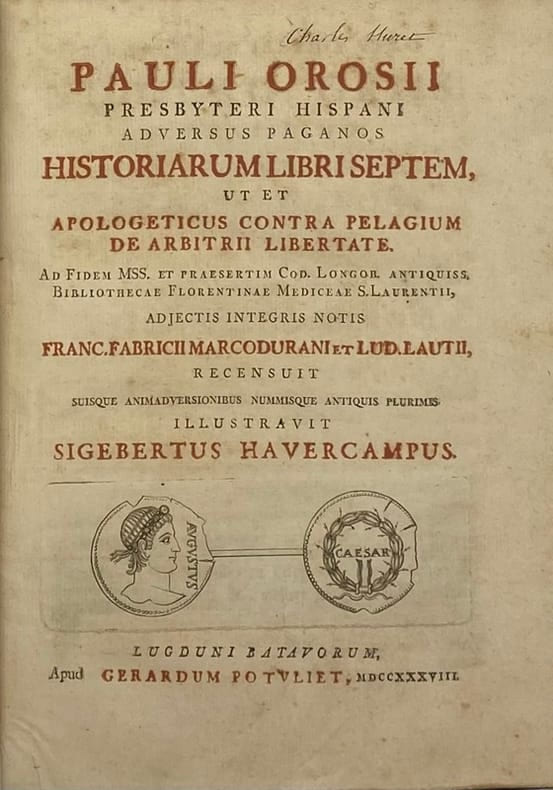
Leyde, Gerhard Potuliet, 1738 in-4, [19] ff. n. ch. (titre, dédicaces et préfaces, table orthographique), 634 pp., [15] ff. n. ch. d'index, avec des reproductions de monnaies dans le texte, demi-veau havane, dos lisse orné de filets dorés, pièce de titre prune, tranches mouchetées (rel. du XIXe siècle). Dos très frotté, épidermures.
Reference : 182967
Édition originale de cette version de Sigebert Haverkamp (1684-1742), longtemps estimée comme la meilleure, et dont les exemplaires ne sont pas courants, en dépit d'une remise en vente à la date de 1767.Le plus célèbre et le plus lu des disciples d'Augustin fut en même temps le plus infidèle à son intuition théologique, par le durcissement et la systématisation qu'il donnait à toutes les grandes intuitions du docteur africain : prêtre né à Brague, il avait quitté en 414 l'Espagne envahie par les Suèves pour rejoindre son mentor à Hippone. Ce dernier l'envoya en Palestine prêter main forte à Jérôme dans son combat contre les Pélagiens (415). Cela amena Orose à participer au synode de Jérusalem de juillet 415, et c'est comme documentation à charge qu'il rédigea pour les pères conciliaires son Apologeticus de arbitrii libertate, dans lequel toutes les maximes augustiniennes sont forcées. Mais les évêques orientaux ne voyaient aucune raison de condamner Pélage, tout comme leurs actuels successeurs considèrent les débats sur la grâce comme un faux problème de la théologie latine. Orose revint donc en Afrique, et c'est alors qu'il reçut commande d'Augustin d'un dossier historique pour compléter la démonstration effectuée dans les livres I-V du De Civitate Dei. C'est ainsi que naquit le livre des Historiae contra Paganos, tableau de l'histoire universelle depuis Adam jusqu'en 418, où est lié de manière eschatologique le destin de l'Empire, comme cité terrestre, à celui de l'Église, comme cité céleste. Augustin dut se résoudre à désavouer ces confusions dans le livre XVIII du De Civitate Dei, rédigé en 425. Le mal était fait : au Moyen Âge, on lut davantage Orose que son maître, et ses vues millénaristes allaient devenir une des sources majeures de ce que Mgr Arquillière a dénommé "augustinisme politique".Brunet, IV, 237. - - VENTE PAR CORRESPONDANCE UNIQUEMENT - LIEN DE PAIEMENT, NOUS CONSULTER.
Bookseller's contact details
Librairie Historique Fabrice Teissèdre
M. Fabrice Teissèdre
lecurieux@teissedre-librairie.fr
06 46 54 64 48
Payment mode
Sale conditions
Conditions de vente conformes au règlement du SLAM et aux usages de la LILA (ILAB). Les frais de port et d'assurance sont à la charge du client. Les envois sont effectués en colissimo ou DHL. Règlement par chèque, virement bancaire. Pour un règlement par carte bancaire (Visa, Mastercard), un lien de paiement sécurisé (via Lyf), vous sera envoyé par mail.
1 book(s) with the same title
Pauli Orosii presbyteri Hispani Adversus paganos historiarum libri septem, ut et Apologeticus contra Pelagium de arbitrii libertate. Ad fidem MSS. et praesertim cod. Longob. antiquiss., Bibliothecae Florentinae Mediceae S. Laurentii, adjectis integris notis Franc. Fabricii Marcodurani et Lud. Lautii, recensuit suisque animadversionibus nummisque antiquis plurimis illustravit Sigebertus Havercampus.
Leiden (Lugdini Batavorum), Apud Gerardum Potvliet, 1738.
4to. (XXXVIII),634,(30 index) p. Calf 25.5 cm (Ref: STCN ppn 238889998; Schweiger 2,622: 'Neue Recens. der Geschichtsbücher nach 11 Hdschr. u. älteren Ausgg.'; Schoenemann p. 502/3: 'quae ad Historiae illustrationem spectant docte ubique apposita sunt, ut nihil ex hac parte desiderari possit'; Brunet 4,237: 'Édition la meilleure que l'on ait de cet auteur, elle est peu commune et très recherchée'; Ebert 12256; Graesse 5,52) (Details: Back ruled gilt, and with 5 raised bands, & with a red morocco letterpiece in the second compartment. Title printed in red & black, and with an engraved numismatic vignet: both sides of a coin of Caesar Augustus. Numismatic text engravings on about 100 p.) (Condition: Head & tail of the spine gone. Front joint cracked and hanging on 3 bands. Rear joint cracking. Boards scratched, corners bumped. Paper partly somewhat browning. Endpapers foxed) (Note: Paulus Orosius, 5th century A.D., was a priest from Portugal. Fled before the Vandals he became a pupil of Augustine. It is on his instigation that Orosius wrote his 'Historia adversus Paganos', the first Christian universal history, from the creation of the world to the founding and history of Rome until A.D. 417. His pagan sources for Roman history were Livy, Tacitus, Suetonius, Justinus and Eutropius. We see here the course of history through the eyes of his master Augustine, who asked Orosius to write a historiographic 'supplement' to his 'City of God'. The work was apologetic, and attacked the pagan complaint that Rome's troubles were caused by her abandonment of the pagan Gods. He proved that there were also sufferings before the rise of Christianity. 'Ego initium miseriae hominum ab initio peccati hominis docere (ducere) institui', he tells the reader in the first chapter, and wanted to demonstrate that the sufferings of humanity diminished since Christ. The History was widely read in the Middle Ages. (Neue Pauly 9,53/4) An edition of this work was produced by the Dutch scholar Siegbert Havercamp, 1684/174, since 1721 professor of Greek at Leiden University. Schoenemann praises Havercamp because he offered also the 'praefationes' of worthy predecessors. Havercamp included the complete commentary on the 'Historiae' of Franz Fabricius of Düren, (also called Marcoduranus) 1527-1572. Fabricius studied in Paris under Ramus and Turnebus, and published much on Cicero. His Orosius edition dates from 1561. (Sandys 2,268, and ADB 6,507) Havercamp also incorporated the commentary of Ludovicus Lautius, a Flemish priest, who's commentary was published in 1615 in Mainz. (Van der Aa 11,214)) (Provenance: In the right margin of the title a small oval embossed ownership stamp of the 'Free Church College Library Glasgow'. The 'Free Church College Library', Glasgow, was established in 1856, and renamed 'United Free Church College Library' after the reunion of the 'Free Church of Scotland and United Presbyterian Church' in 1900; then it was renamed 'Trinity College Library' after reunion of the 'United Free Church' and the 'Church of Scotland' in 1929. Now it is incorporated in the University of Glasgow Divinity Hall Library) (Collation: +-2+4, *-3*4 (minus blank leaf 3*4), A-4O4) (Photographs on request)

