 Write to the booksellers
OROSIUS.
Pauli Orosii presbyteri Hispani Adversus paganos historiarum libri septem, ut et Apologeticus contra Pelagium de arbitrii libertate. Ad fidem MSS. et praesertim cod. Longob. antiquiss., Bibliothecae Florentinae Mediceae S. Laurentii, adjectis integris notis Franc. Fabricii Marcodurani et Lud. Lautii, recensuit suisque animadversionibus nummisque antiquis plurimis illustravit Sigebertus Havercampus.
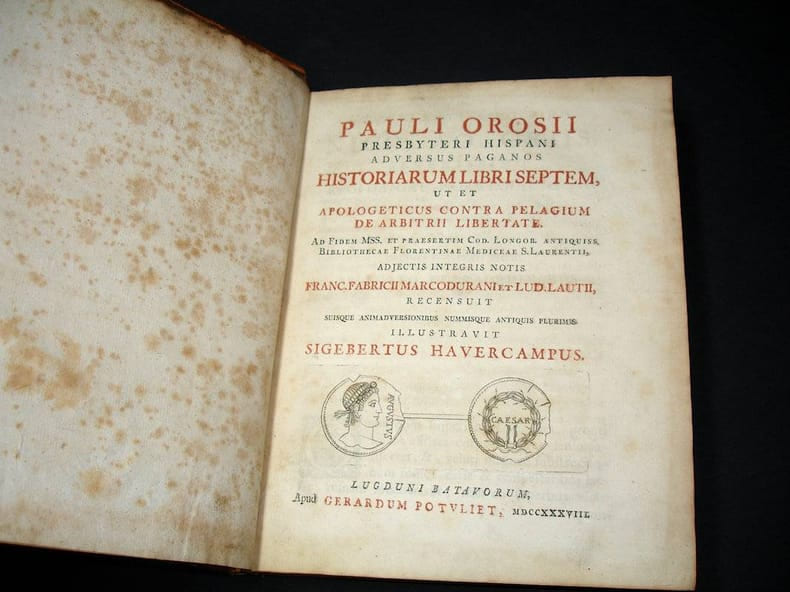
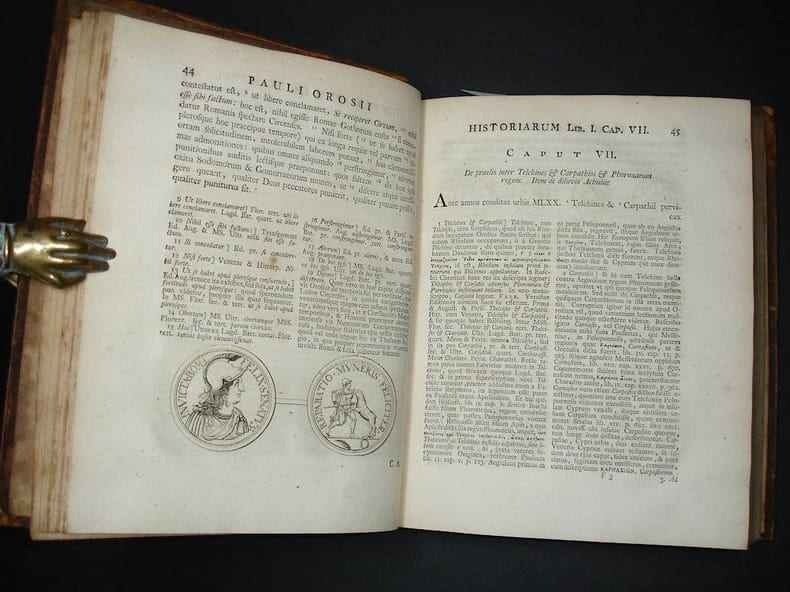
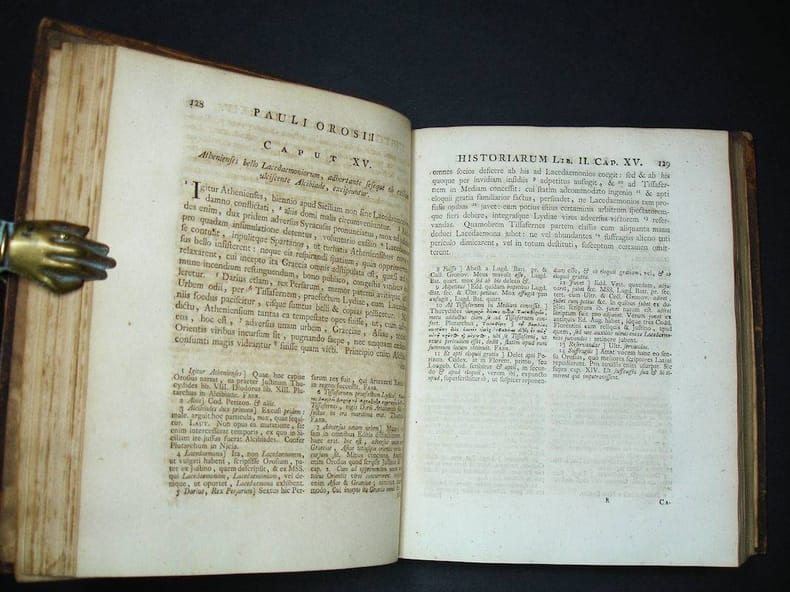
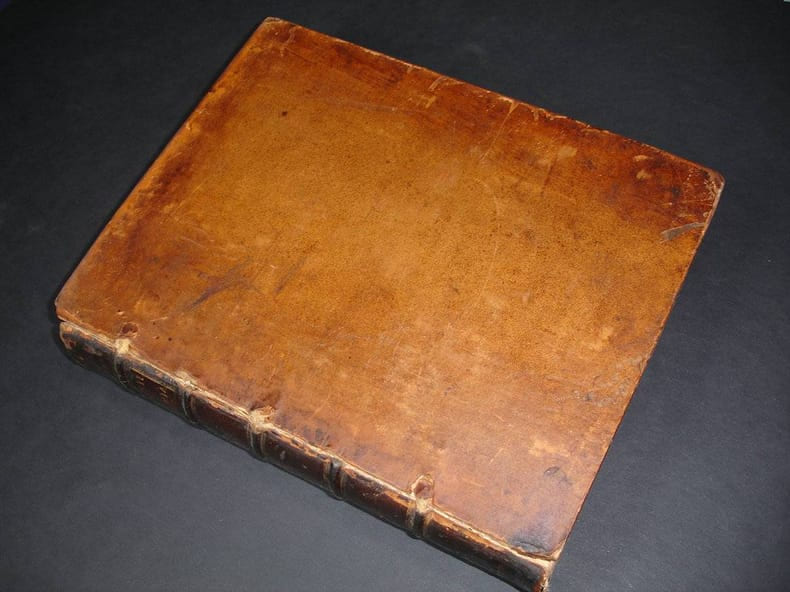
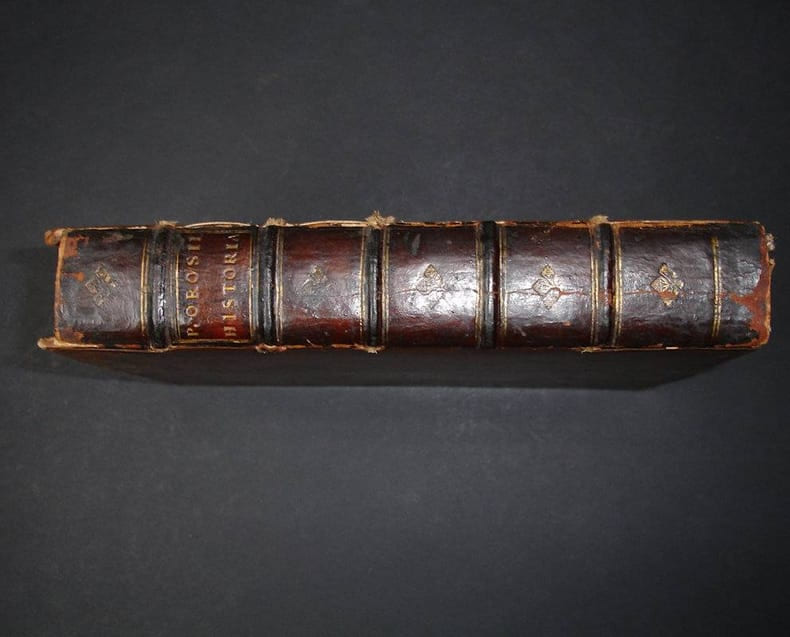
Leiden (Lugdini Batavorum), Apud Gerardum Potvliet, 1738.
Reference : 140107
4to. (XXXVIII),634,(30 index) p. Calf 25.5 cm (Ref: STCN ppn 238889998; Schweiger 2,622: 'Neue Recens. der Geschichtsbücher nach 11 Hdschr. u. älteren Ausgg.'; Schoenemann p. 502/3: 'quae ad Historiae illustrationem spectant docte ubique apposita sunt, ut nihil ex hac parte desiderari possit'; Brunet 4,237: 'Édition la meilleure que l'on ait de cet auteur, elle est peu commune et très recherchée'; Ebert 12256; Graesse 5,52) (Details: Back ruled gilt, and with 5 raised bands, & with a red morocco letterpiece in the second compartment. Title printed in red & black, and with an engraved numismatic vignet: both sides of a coin of Caesar Augustus. Numismatic text engravings on about 100 p.) (Condition: Head & tail of the spine gone. Front joint cracked and hanging on 3 bands. Rear joint cracking. Boards scratched, corners bumped. Paper partly somewhat browning. Endpapers foxed) (Note: Paulus Orosius, 5th century A.D., was a priest from Portugal. Fled before the Vandals he became a pupil of Augustine. It is on his instigation that Orosius wrote his 'Historia adversus Paganos', the first Christian universal history, from the creation of the world to the founding and history of Rome until A.D. 417. His pagan sources for Roman history were Livy, Tacitus, Suetonius, Justinus and Eutropius. We see here the course of history through the eyes of his master Augustine, who asked Orosius to write a historiographic 'supplement' to his 'City of God'. The work was apologetic, and attacked the pagan complaint that Rome's troubles were caused by her abandonment of the pagan Gods. He proved that there were also sufferings before the rise of Christianity. 'Ego initium miseriae hominum ab initio peccati hominis docere (ducere) institui', he tells the reader in the first chapter, and wanted to demonstrate that the sufferings of humanity diminished since Christ. The History was widely read in the Middle Ages. (Neue Pauly 9,53/4) An edition of this work was produced by the Dutch scholar Siegbert Havercamp, 1684/174, since 1721 professor of Greek at Leiden University. Schoenemann praises Havercamp because he offered also the 'praefationes' of worthy predecessors. Havercamp included the complete commentary on the 'Historiae' of Franz Fabricius of Düren, (also called Marcoduranus) 1527-1572. Fabricius studied in Paris under Ramus and Turnebus, and published much on Cicero. His Orosius edition dates from 1561. (Sandys 2,268, and ADB 6,507) Havercamp also incorporated the commentary of Ludovicus Lautius, a Flemish priest, who's commentary was published in 1615 in Mainz. (Van der Aa 11,214)) (Provenance: In the right margin of the title a small oval embossed ownership stamp of the 'Free Church College Library Glasgow'. The 'Free Church College Library', Glasgow, was established in 1856, and renamed 'United Free Church College Library' after the reunion of the 'Free Church of Scotland and United Presbyterian Church' in 1900; then it was renamed 'Trinity College Library' after reunion of the 'United Free Church' and the 'Church of Scotland' in 1929. Now it is incorporated in the University of Glasgow Divinity Hall Library) (Collation: +-2+4, *-3*4 (minus blank leaf 3*4), A-4O4) (Photographs on request)
Bookseller's contact details
Antiquariaat Fragmenta Selecta
+31 20 418 55 65
Payment mode

Sale conditions
Terms of Sale All items offered are subject to prior sale. Your order will be final after you have received our confirmation, with a specification of the availability of the items and the shipping costs. All books are complete and in good antiquarian condition, unless otherwise described. Prices are in EURO. Postage and insurance are not included. Postage will be calculated at cost (no extra charges). Returns Books may be returned within 14 days of receipt, if returned in the same condition as sent, and packed, shipped and insured as received (please always notify us). We will refund the shipping costs of a return shipment only if our descriptions were not correct. How to pay Pre-payment is necessary for new customers. Our order confirmation will provide detailed information and a specification of the shipping costs. Customers who are known to us and libraries will be invoiced as usual. We accept Visa and Mastercard. You can submit your card information through our SECURE PAYMENT FORM. PayPal: we will send you a personal link to the PayPal website. Banktransfers: payment can be made into our bank account in The Netherlands.

