 Write to the booksellers
PERSE [AULUS PERSIUS FLACCUS] - JUVENAL; TARTERON.
Traduction des satyres de Perse, et de Juvenal, Par le Révérend Pere Tarteron, de la Compagnie de Jésus. Nouvelle édition
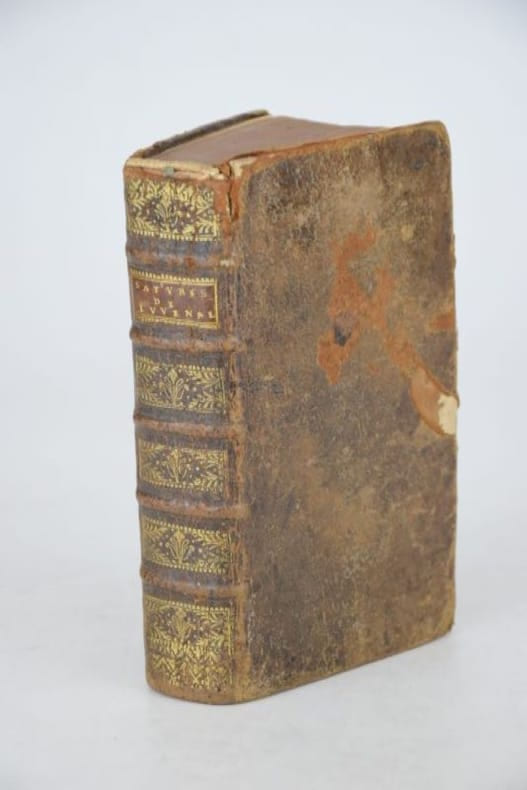
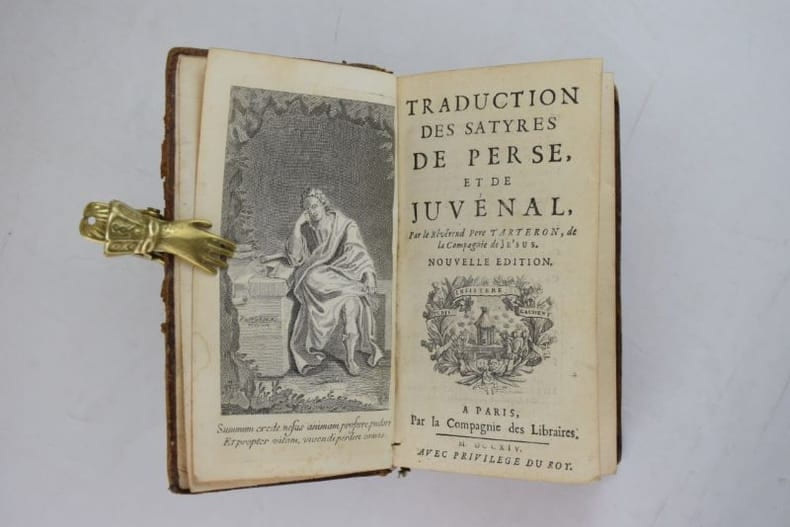
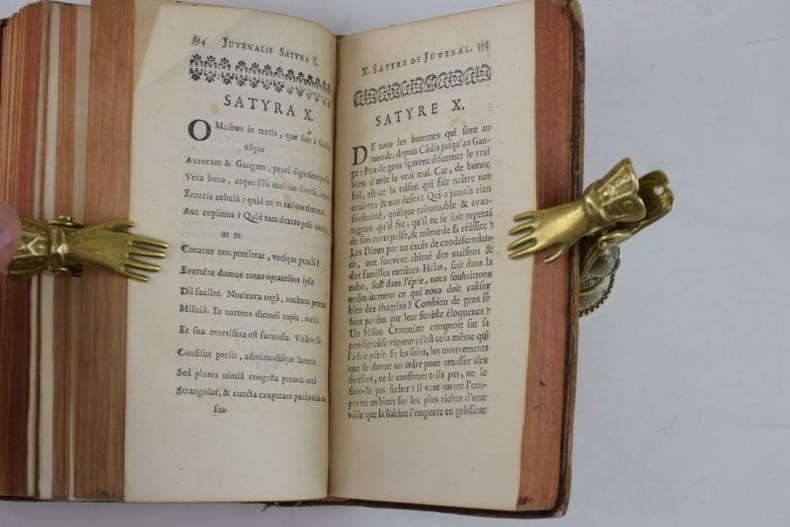
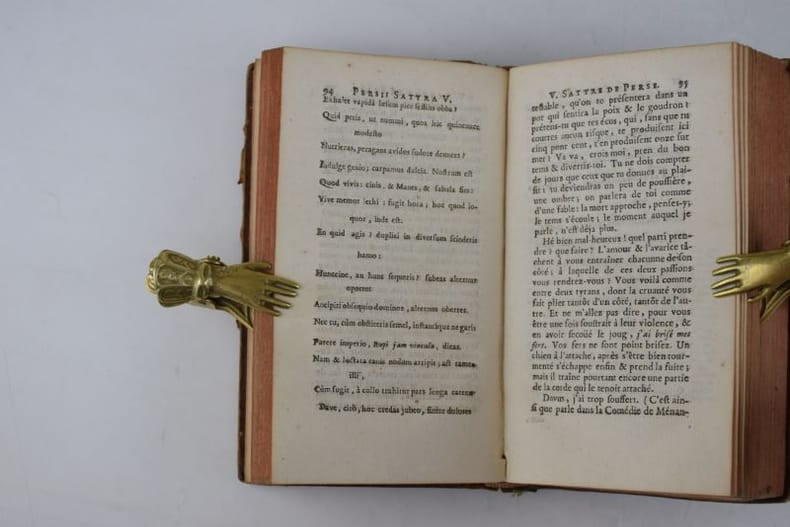
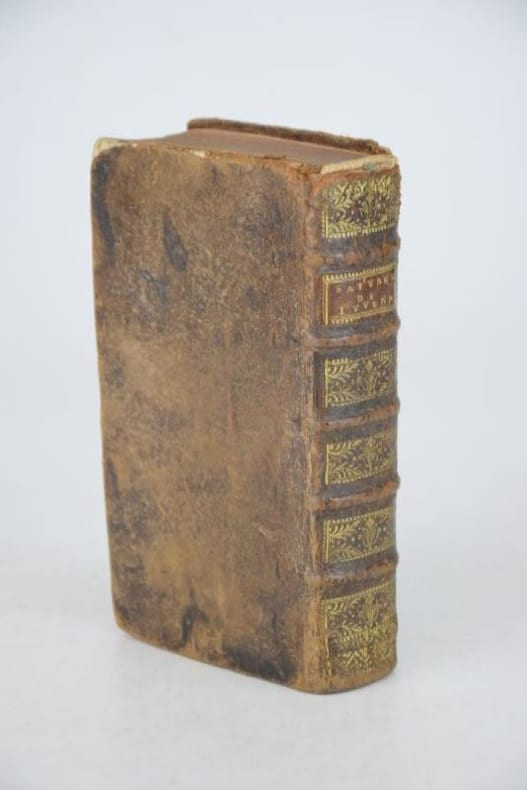
Paris, Par la Compagnie des Libraires, 1714. In-8 (166 x 93 mm), frontispice gravé, titre illustré d'une vignette, (19) ff. : Epistre d'un Traducteur à un Ami, (3) ff. : Avertissement, annonces de librairie, 591-(1) pp., (2) ff. dont Permission, Approbation, Privilège du Roi. Reliure basane, dos à nerfs orné de caissons dorés et d'une étiquette de titre rouge, tranches rouges, coiffe sup. absente, mors fendu sur 2 cm, manque de cuir au premier plat, aux coins et aux coupes.
Reference : 9351
Perse (en latin Aulus Persius Flaccus), né en 34 apr. J.-C. à Volterra en Étrurie et mort en 62, est un auteur latin du Ier siècle apr. J.-C.
Bookseller's contact details
Librairie Ancienne Richard
Christian Richard
6 rue de l'Hôtel de Ville
44000 Nantes
France
+33 (0)9 53 98 36 93
Payment mode


Sale conditions
Conformes aux usages de la librairie ancienne. L'emballage est gratuit, les frais de port sont en sus et vous serons indiqués en confirmation de votre commande. Nous acceptons les paiements par catre bancaire, chèque, virement postal et par Paypal. Envoi dès réception du règlement. <br />
2 book(s) with the same title
Traduction des Satyres de Perse, et de Juvénal, Par le Révérend Père Tarteron, de la Compagnie de Jésus. Nouvelle édition.
Paris, Par la Compagnie des Libraires 1714, 173x100mm, cartonnage papier marbré, étiquette de titre manuscrite au dos, bon état. Texte français - latin.
frontispice, 23 ff., 591 p., Pour un paiement via PayPal, veuillez nous en faire la demande et nous vous enverrons une facture PayPal
Traduction des Satyres de Perse, et de Juvénal, par le Révérend Pere Tarteron, de la Compagnie de Jésus. Nouvelle édition.
Paris, Par la Compagnie des Libraires, 1714.
12mo in eights & fours. (XLVIII),591,(1 blank) p. Calf 17 cm Two poets exploring the limits of satiric free speech (Ref: Schweiger 2,517; cf. Graesse 3,522; Ebert 11273) (Details: Back gilt and with 5 raised bands, shield in the second compartment. The frontispiece depicts a poet/thinker in a robe, and seated on a stone bench; on the bench the inscription Facit indignation versum. Printer's mark, a beehive, on the title. The Latin text & French translation are printed side by side in different typefaces) (Condition: Wear to extremities of the binding: head & tail of the back slightly chafed. Back rubbed. Shield on the back vanishing. Wormhole near the gutter of the left lower corner of the first 64 p.) (Note: The stoic poet Aulus Persius Flaccus, 34-62 A.D., is a representative of the imperial Latin satire. His stoic satires form one 'libellus' of 6 satires, together 650 hexameters. 'They are well described as Horatian diatribes transformed by Stoic rhetoric'. 'He wrote in a bizarre mixture of cryptic allusions, brash colloquialisms, and forced imagery'. (OCD, 2nd ed. p. 805) The Stoic philosopher is in the work of Persius not a figure of fun, but a wise man. The Roman poet Juvenalis, ca. 55-140 AD, was the last and most influential of the Roman satirists. He 'uses names and examples from the past as protective covers for his exposés of contemporary vice and folly'. (The Classical Tradition, Cambr. Mass., 2010, p. 501) His main theme is the dissolution of the social fabric. He had a lasting influence on neolatin and vernacular writers of the Renaissance and later centuries. A striking feature of this book is, when one runs it through for the first time, is the discrepancy between the space occupied by the Latin text and the French translation. Take for instance the pages 2 and 3: on p. 2 we count 56 Latin words, on the opposing page 152 French words. Concise verses are transformed into long phrases in prose. The translator of these verses, the French Jesuit Jérôme, or Hieronymus Tarteron, 1644-1720, was professor of rhetoric. He translated also the Satires, Letters and the Ars Poetica of Horace. As usual with Jesuit editions, here also 'le pere Tarteron a eu soin de retrancher ce qui dans ces poëts pourroit nuire aux bonnes moers', so we read in the second volume of the Nouveau Supplement au Grand Dictionnaire Historique, de L. Moreri, Paris 1749. The edition was first published in 1689 and met with some success: it was reissued in 1695, 1706, 1714, 1729, 1737 and 1752) (Collation: pi1 (frontispiece), â8, ê4, î8, ô4; A8-3B4 (:gatherings A - 3B alternating), 3C8)) (Photographs on request)

