 Write to the booksellers
Lamart
Love
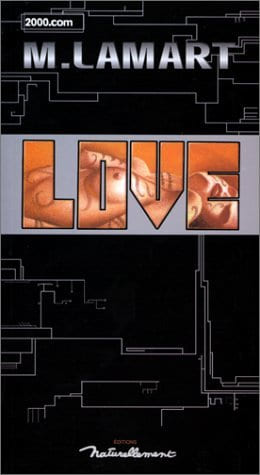
Naturellement 2000 222 pages 12x21x2cm. 2000. Broché. 222 pages.
Reference : 145252
ISBN : 291037002X
proche du neuf
Bookseller's contact details
Un Autre Monde
M. Emmanuel Arnaiz
07.69.73.87.31
Payment mode
Sale conditions
Conformes aux usages de la librairie ancienne.
5 book(s) with the same title
Werner Mannaers Love letters.
Antwerpen, MER Paper Kunsthalle, 2012 Gebonden, Hardcover, 296 pagina's met illustraties in kleur, 30x21 cm, *new ISBN 9789490693893.
Een liefdesbrief geeft vorm aan de liefde. Mannaers schrijft er geen, hij schildert ze in zijn smeuige bad painting-stijl. Gedurende een periode heeft hij elke dag een Love Letter gemaakt en bestemd. De bestemmeling is een vrouw. Mannaers is tevens verliefd op de liefde, dat maakt zijn reeks algemeen menselijk. Kunstenaars kunnen niet zwijgen over (hun) kunst, ook als ze de liefde bedrijven. Zo is het boek Love Letters een visueel commentarierend beeldverhaal over de geschiedenis van de moderne kunst geworden. Het werk van Mannaers is steeds 'intertekstueel', d.w.z. dat in of onder een tekst er een andere schuilt. In zijn Love Letters vinden we een dubbel niveau van twee soorten gelaagdheden. Zijn schilderijen zitten vol referenties aan andere kunstenaars. Voor zijn dagelijkse Love Letters, gouache op papier, plukt hij hier en daar uit zijn eigen schilderijen die in de maak zijn. Lieftalliger met minder weerhaken. // Love letters shape love. Werner Mannaers doesn?t write love letters, he paints them in his characteristic ?bad painting? style. During a certain time span, the painter created a Love Letter each day; the recipient of which was always a woman. Mannaers is in love with love; which makes his current series especially human: artists never shut up about (their) art, even when making love. The book Love Letters groups these paintings Mannaers made over time. Each Love Letter is effectuated using gouache on paper. They refer to some of Mannaers? paintings that are currently in the making. Each Love Letter equally makes reference to other artists. This makes this publication more than a collection of recent Love Letters: the publication discreetly evolves towards a visual commentary on the history of modern art.
Strategies of Passion Love and Marriage in Medieval Iceland and Norway,
Turnhout, Brepols, 2005 Hardback, XIV+345 p., 160 x 240 mm. ISBN 9782503521633.
This book is concerned with the social and gendered meanings of love in medieval Norway and Iceland. In the Viking Age, to love would most often imply a submissive social position, while being loved by a woman could elevate a man above the status of her family. Women were supposed to love upwards in the social hierarchy, but could also use their desire to negotiate the social position of men. A close reading of the skaldic poetry shows the dilemma men faced when longing for women's love and approval. These ideas of love relations shaped Norse interpretations of courtly love and marriage formation by consent in the twelfth and thirteenth centuries. However, new ideas of sexuality, gender and aristocratic culture changed several aspects of love and marital affection in the later middle ages. Men became the loving subject, but in a way that did not challenge the social order. For women, ideal love was attached to humility and submission to parents and husband. But even though the new ideology of love and marriage to some extent neutralized the tensions between consent and parental control, the sources show that both men and women could use the new conceptions of love to serve their own marital and social strategies. Languages : English.
Reference : bd-21d00d63fcf92202
M.O.Menshikov On Love: On Love Passion. Superstition and Truth of Love. Matrimo
M.O.Menshikov On Love: On Love Passion. Superstition and Truth of Love. Matrimonial Love. Holy Love. 1899./M.O.Menshikov O lyubvi: O lyubovnoy strasti. Sueveriya i pravda lyubvi. Lyubov supruzheskaya. Lyubov svyataya. 1899 god. The subject of this little book is love, the movement of the heart that turns life from boring prose into a captivating novel, a poem, and sometimes tragedy. Love in the alchemy of happiness is the philosophical stone whose touch of the most despicable things gives them the price of gold. We have thousands of titles and often several copies of each title may be available. Please feel free to contact us for a detailed description of the copies available. The delivery of this book might be delayed beyond the usual timeframe due to extended processing and preparation before shipment, and faster shipping options are not offered. Please inform us if you need the order by a certain date or have a deadline.SKUbd-21d00d63fcf92202
Reference : bd-c96ba3d26b7e4c35
M.O.Menshikov On Love: On Love Passion. Superstition and Truth of Love. Matrimo
M.O.Menshikov On Love: On Love Passion. Superstition and Truth of Love. Matrimonial Love. Holy Love. 1899./M.O.Menshikov O lyubvi: O lyubovnoy strasti. Sueveriya i pravda lyubvi. Lyubov suprueskaya. Lyubov svyataya. 1899 god. Love in the alchemy of happiness is that philosophical stone whose touch on the most despicable things gives them the price of gold. Like an elecsir in life, love brings back the fire of youth to our mortified attitude to things. And in the days of upheaval of 1917-1918, after one of the leaders of the revolution mispronounced the label faithful dog of the tsarist black hundred, the logical and tragic continuation was the lead multiplier that pierced the heart of a journalist at his summary execution on September 20, 1918, on the shore of Lake Valdai, in broad daylight, in front of the frightened Valdasha and the six young children of M.O. Menshikov. We have thousands of titles and often several copies of each title may be available. Please feel free to contact us for a detailed description of the copies available. The delivery of this book might be delayed beyond the usual timeframe due to extended processing and preparation before shipment, and faster shipping options are not offered. Please inform us if you need the order by a certain date or have a deadline. SKUbd-c96ba3d26b7e4c35
Reference : albaa9e2329ba05a769
Belshe V. Pimenova. Love in Nature. A History of Loves Development. In 3 Parts (
Belshe V. Pimenova. Love in Nature. A History of Loves Development. In 3 Parts (in one cover) In Russian (ask us if in doubt)/Belshe V. Per. E.K. Pimenovoy. Lyubov v prirode. Istoriya razvitiya lyubvi. V 3-kh chastyakh (v odnom pereplete) Short description: In Russian (ask us if in doubt).The author deals with the history of marriage free love the struggle for the liberation of women and other piquant topics related to the relationship between sex and marriage. The facts are taken from the field of physiological and zoological research in the late nineteenth and early twentieth centuries. The author in a philosophical fiction examines sensual and spiritual love sexual attraction the miracle of creation the origin of man from the ape the social ideal of love love and creativity love in the zoological and insect worlds analyzes the conflict between love and violence understands the role of social in the creation of feelings the division of labor in love gives the historical resolution of the act of fertilization reflects on the future of love discusses the basic biogenetic law and much more. We have thousands of titles and often several copies of each title may be available. Please feel free to contact us for a detailed description of the copies available. SKUalbaa9e2329ba05a769

