 Write to the booksellers
Théo Varlet
Paralipomena
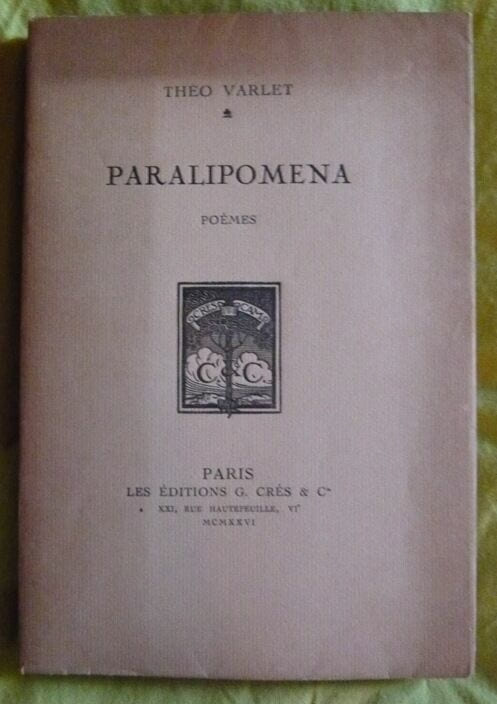
1926. Paris Les éditions G. Crès & Cie 1926 - Broché couverture rempliée 14 5 cm x 21 5 cm 118 pages - Texte de Théo Varlet - Edition originale. Un des 550 ex. num.sur vergé pur fil (N° 281) - Non coupé - Bon état
Reference : 4380
Bookseller's contact details
Librairie Sedon
M. Didier Sedon
59 avenue Charles de Gaulle
17300 Rochefort
France
06 19 22 96 97
Payment mode

Sale conditions
Réglement par paypal, virement bancaire, chèque ou espèces.
5 book(s) with the same title
Parerga und Paralipomena. 2 vols. - [SCHOPENHAUER'S MOST INFLUENTIAL WORK, HIS FINAL MASTERPIECE THAT CATAPULTED HIM INTO FAME]
Berlin, Hayn, 1851. 8vo. Uniformly bound in two uniform, contemporary - possibly original! - embossed full cloth bindings. Embossed lettering and ornamentation to spine. Spines and borders of boards slightly faded. Spines with repairs. Front free end-paper in vol. 2 with repair. Previous owner's label (Julius Kotrtsch) pasted on to lower margin of title-pages. Previous owner's name in contemporary hand to upper margin of title-pages. Verso of last leaf in vol. 2 annotated in pencil. Vol. 1 with light occasinal marginal browspotting. (6), 465, (1) pp." IV, 531 pp.
The scarce first edition of Schopenhauer's most influential work, his final masterpiece, which consists in his seminal philosophical reflections. The Parerga and Paralipomena was the first of his works to gain recognition and the work that propelled the then obscure figure into lasting philosophical prominence. Seeing that all of Schopenhauer's previous publications had been complete failures, it was only with great difficulty and reluctance that Hayn of Berlin was pesuaded to print the work, which they then only did in a small printrun of merely 750 copies, which now makes the first edition very difficult to find. The work is is two parts with the first ""parerga""-part consisting in six extended essays intended as supplementary to the author's thought whereas the second ""paralipomena""-part consists in shorter elaborations divided by topic into thirty-one subheadings that cover material hitherto unaddressed by Schopenhauer, but complementary to the ""parerga"". In spite of the poor reception of his earlier works, somehow, the “Parerga and Paralipomena attracted the attention of John Oxenford, a noted observer and translator of German literary culture, who contributed a favourable review of the work in 1852 and in 1853 wrote an article on Schopenhauer's philosophy entitled ""Iconoclasm in German Philosophy"", which, through its German translation in Vossische Zeitung sparked in immediate interest of Schopenhauer's work in Germany and propelled him into philosophical fame. “The effect was dramatic and almost overnight Schopenhauer in his own country passed from obscurity to fame and from then till his death in 1860he basked in the sunshine of belated recognition and eminence.” (Payne, in the Preface to his translation of Parerga and Paralipomena into English, Oxford, 2000p. xii) The work greatly influenced later philosophers, most notably Nietzsche, whose fondness of aphorism is directly inspired by “Parerga and Paralipomena”. “One of the most significant and fascinating works of the great philosopher Arthur Schopenhauer (1788-1860). The Parerga (Volume 1) are six long essays" the Paralipomena (Volume 2) are shorter writings arranged under thirty-one different subject-headings. These works won widespread attention with their publication in 1851, helping to secure lasting international fame for Schopenhauer. Indeed, their intellectual vigor, literary power, and rich diversity are still extraordinary even today.” (Payne).

Le sens du destin (extrait des Parerga et Paralipomena)
Librairie Philosophique Vrin - Bibliothèque des textes philosophiques - 1988. In-8, broché, couverture uni de la collection, 124 pages, très bel exemplaire.
Dans la Spéculation transcendante sur lintentionnalité apparente dans le destin de lindividu, essai des Parerga et Paralipomena (1851), Schopenhauer risque lhypothèse dun sens métaphysique de la vie de lindividu dont le destin singulier serait conduit par la volonté, une, jusquau renoncement libérateur. Lidée que lindividu ne serait pas né dune rencontre fortuite, quil aurait été voulu comme tel, y prend un relief remarquable. De léthique, chapitre des Parerga et Paralipomena, donne une interprétation morale du sens de lexistence. A lheure de la mort, labnégation de soi-même en faveur dun autre atteste, dans lexpérience, lunité transcendante et indestructible de la volonté.Si, dans le premier essai, Schopenhauer cherche un destin qui convienne à chacun, dans le second, en revanche, il tend à nous enfermer dans le mal de tous. Mise à jour du Samedi 27 Juin 2026. Paiement PayPal immédiat, Mondial Relay pour : France, Allemagne, Autriche, Belgique, Espagne, Italie, Portugal, Luxembourg, Pays-Bas, Pologne (Communiquer votre point ou locker si connu). Une participation supplémentaire peut être demandée pour les colis lourds hors France où les envois compris entre 5 et 25 kg sont dégressifs : 2 à 4 kilogrammes - 7.99 / 5 à 10 kg - 15.99 / 15 -25 kg - 25.99. Certaines de nos collections ( Vian, Céline, Camus (...) peuvent être expédiées en Franco de port. Pour linternational hors Europe (Suisse, Canada, Japon, Etats-Unis, les frais dexpéditions peuvent varier selon le poids (mise à jour : 1 juin 2026).
Ioannis Meursii Reliqua Attica; sive ad librum De populis Atticae Paralipomena. Liber singularis. Cui accedit Auctarium ex Itinerario (de Pagis Atticis) Jacobi Sponii. (Bound with:) Ioannis Meursii Theseus, sive de ejus vita rebusque gestis liber postumus. Accedunt ejusdem Paralipomena de Pagis Atticis, et Excerpta ex v.cl. Jacobi Sponii Itinerario de iisdem pagis. (And with:) Ioannis Meursii Themis Attica, sive De legibus Atticis libri II.
Ad 1 & 2: Utrecht (Ultrajecti), Apud Franciscum Halma, 1684. 3: Utrecht (Trajecti ad Rhenum), Apud Joannem vande Water, Joannem Ribbium, Franciscum Halma, 1685.
4to. 3 volumes in 1: 52,(8 index),40; (VIII),136,(12 index); (IV),152,(20 index) p. Vellum 20 cm (Ref: STCN ppn 066811074; STCN ppn 066811007; STCN ppn 840519370; Haitsma Mulier/Van der Lem 334u & 334t) (Details: 6 thongs laced through the joints. Short title calligraphed with black ink on the back. Title of 'Theseus' printed in red & black. Emblematic woodcut printer's device on the third title, depicting Ceres and Athena, labour and science, the motto is: 'vivitur in genio', 'only through his genius man survives') (Condition: Vellum slightly soiled) (Note: The Dutch classicist and historian Johannes Meursius (Johannes van Meurs), 1579-1639, was professor of History and Greek in the university of Leiden from 1610 till 1620. He studied under the genius J.J. Scaliger, and is best known for the 'editiones principes' of a number of Byzantine authors he produced, and the 'editio princeps' of the 'Elementa Harmonica' of Aristoxenus (1616). He edited also the 'Timaeus' of Plato with the commentary and translation of Chalcidius (1617). Meursius' indefatigable labours concerned also the history of ancient Greece, and especially Eleusis, and the antiquities of Athens and Attica. His work was widely used as a source by later ancient historians. Nothing that related to the history of Athens he left untouched, law, government, festivals, institutions, manners, literature, religion etc. The dazzling variety of titles of part of his pioneering work seems almost to exhaust the subject 'ancient Athens': De populis Atticae (1616), Atticarum lectionum libri VI (1617), Aeschylus, Sophocles, Euripides. Sive de tragoediis eorum (1619), Panathenaea. Sive de Minervae illo gemino festo (1619), Eleusinia. Sive, de Cereris Eleusinae sacro, ac festo (1619), Fortuna Attica. Sive, de Athenarum origine (1622), Archontes Athenienses. Sive, de ijs, qui Athenis summum istum magistratum obierunt (1622), Cecropia. Sive de Athenarum arce, & ejusdem antiquitatibus (1622), De ludis Graecorum (1622), Pisistratus. Sive, de ejus vita, & tyrannide (1623), Athenae Atticae. Sive, de praecipuis Athenarum antiquitatibus (1624), Areopagus. Sive, de senatu areopagitico (1624), Regnum Atticum. Sive, de regibus Atheniensium (1633), Reliqua Attica; sive, ad librum De populis Atticae, paralipomena (1684), Theseus, sive de ejus vita rebusque gestis (1684), Themis Attica sive De legibus Atticis (1685) It is manifest that Meursius with these works laid the foundations of much later learning. The works in this convolute have been edited by J.G. Graevius, who has added at the beginning of the 'Theseus' a dedicatio to Carolus Sanctamauraeus, tutor of the Dauphin of France) (Collation: A-G4, H2; 2A-E4; *4, A-R4, chiS4, S2; (after the last textpage of the Theseus (leaf R4) a gathering (chiS) with an 'Index rerum' has been inserted, before the 'Index auctorum' to which the catchword of R4-verso is referring. STCN errs in indicating S2 as chiS2); *2, A-X4, Y2) (Photographs on request)
Paralipomena Additions To Attic Black-Figure Vase-Painters And To Attic Red-Figure Vase-Painters
Beazley, J. D.: Paralipomena Additions To Attic Black-Figure Vase-Painters And To Attic Red-Figure Vase-Painters. London: at the Clarendon Press, 1971. xix, 679pp. Cloth. 24x16cms.
Text in English
Beazley Addenda: Additional References to Abv, Arv2 and Paralipomena
Carpenter, Thomas H.: Beazley Addenda: Additional References to Abv, Arv2 and Paralipomena. Oxford: Oxford University Press, 1989. Second edition, 481 pages. Hardback.
Text in English

