 Write to the booksellers
Jean Roc (Henri-Pierre Roché)
Don Juan
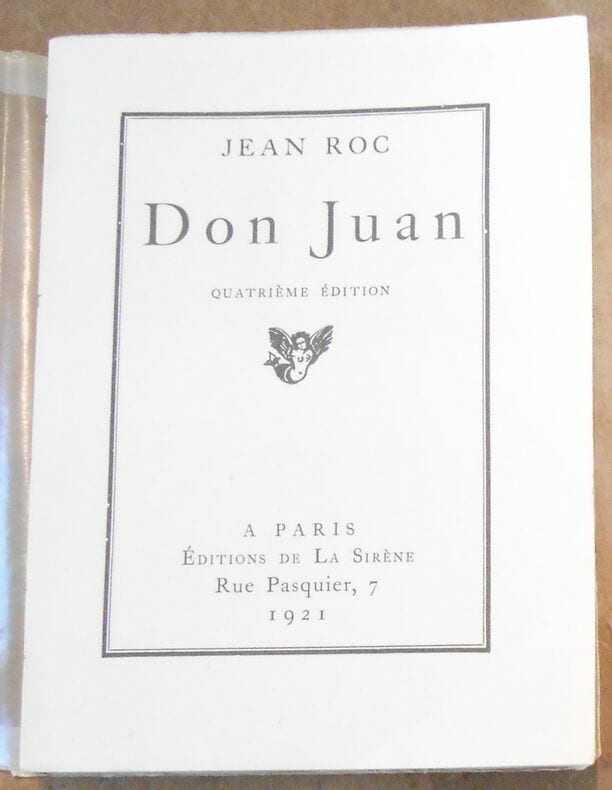
1921. Paris Éditions de La Sirène 1921 e.o. ( mention fictive de 4ème ed.) - Broché 14 5 cm x 19 cm 202 pages - Texte de Jean Roc (Henri-Pierre Roché) - Très bon état ; premier roman de Henri-Pierre Roché
Reference : 19358
Bookseller's contact details
Librairie Sedon
M. Didier Sedon
59 avenue Charles de Gaulle
17300 Rochefort
France
06 19 22 96 97
Payment mode

Sale conditions
Réglement par paypal, virement bancaire, chèque ou espèces.
5 book(s) with the same title
Marie Walewska. Douze ans auprès d'Hitler. Le Don Juan de Venise, Casanova
État : Bon état - Année : 1951, 1952 et 1955 - Format : in 12° - Pages : 154, 158 et 121pp - Editeur : Librairie Arthème Fayard - Lieu d'édition : Paris - Type : Reliure percaline éditeur - Divers : Cartonnage très légèrement frotté. Pages un peu jaunies. Qqes pâles rousseurs sur la tranche de tête. Intérieur bien propre. - Collection : L'Histoire illustrée - Commander rapidement : https://www.bons-livres.fr/livre/collectif/7994-marie-walewska-douze-ans-aupres-d-hitler-le-don-juan-de-venise-casanova?lrb
Trois livres de la collection ˮL'Histoire illustréeˮ de chez Fayard regroupés dans un cartonnage éditeur en skivertex: Marie Walewska de Octave Aubry. Douze ans auprès d'Hitler de Albert Zoller. Le Don Juan de Venise, Casanova de J. Lucas-Dubreton.
LA TABLE RONDE N° 119 - DON JUAN. THÈME DE L’ART UNIVERSEL. HENRY DE MONTHERLANT : Don Juan (Acte I).ORTEGA Y GASSET : La figure de Don Juan.ESTHER VAN LOO : La conversion et la mon du Don Juan historique.JEAN DORESSE : Don Juan
LIBRAIRIE PLON. NOVEMBRE 1957. In-12. Broché. Bon état, Couv. convenable, Dos satisfaisant, Intérieur frais. 199 pages.. . . . Classification Dewey : 70.49-Presse illustrée, magazines, revues
Sommaire : DON JUAN. THÈME DE L’ART UNIVERSEL. HENRY DE MONTHERLANT : Don Juan (Acte I).ORTEGA Y GASSET : La figure de Don Juan.ESTHER VAN LOO : La conversion et la mon du Don Juan historique.JEAN DORESSE : Don Juan, figure d’un siècle ou de toujours ? RENÉ DUPUIS : De la naissance espagnole de Don Juan à sa maturité française (1630-1665).HENRI GOUHIER : L’inhumain Don Juan.RENÉ POMEAU : Beaumarchais, ou le mariage de Don Juan. HENRI GUILLEMIN : Clartés sur le mystère Byron. ANDRÉ MEYNIEUX : Pouchkine et Don Juan. MICHELINE SAUVAGE : L’ombre du séducteur, Kierkegaard et Don Juan.MAURICE PRADINES : Les méprises de l’affectivité. JOSEPH PALAU : Idées pour un Don Juan.SUZANNE LILAR : Deux mythes de l’amour : Tristan et Don Juan.ANDRÉ LE GALL : Don Juan n’est pas l’homme.MARIA LE HARDOUIN : Passage de Don Juan.HENRI D’AMFREVILLE : Don Juan et la démocratisation de l’amour.ROBERT POULET : Un Don Juan en prose.MICHEL DÉON : La postérité de Don Juan.CHRONIQUES parCLAUDE ELSEN — CHRISTIAN CAPRIER ARMAND LUNEL — ALAIN BOSQUET ROGER GRENIER — JEAN ANGLADE JACQUES DE RICAUMONTVérités littéraires, par ANDRÉ THÉRIVE Journal d’un écrivain, par EMMANUEL BERL Classification Dewey : 70.49-Presse illustrée, magazines, revues
DIAPASON N° 244 - Le dossier Don Juan, Mozart et le cinéma, Pour le Don Giovanni de Losey, un personnage de plus : le clavecin, Quelques Don Juan a l'écran, Losey s'explique, Sept personnages en quête d'identité, Don Juan dans le Don Giovanni de Mozart
DIAPASON. NOVEMBRE 1979. In-12. Broché. Bon état, Couv. convenable, Dos satisfaisant, Intérieur frais. 180 pages. Nombreuses illustrations en noir et blanc dans et hors texte.. . . . Classification Dewey : 780-Musique
Sommaire :Le dossier Don Juan, Mozart et le cinéma, Pour le Don Giovanni de Losey, un personnage de plus : le clavecin, Quelques Don Juan a l'écran, Losey s'explique, Sept personnages en quête d'identité, Don Juan dans le Don Giovanni de Mozart, Don Juan et les Dons Juans, Don Giovanni, au disque Classification Dewey : 780-Musique
Revue OBLIQUE, numéro spécial consacré à DON JUAN.
1er et 2e volumes 1981, brochés en un volulme in 4°, 150 et 136 pages ; couverture illustrée.
Introduction - Mythologique - Le Don Juan de Molière - Le Don Giovanni de Mozart - Les autres Don Juan - Un tombeau pour Don Juan - Masson - Quiroga - etc... Orné de nombreuses illustrations. PHOTOS sur DEMANDE. ...................... Photos sur demande ...................


Phone number : 04 77 32 63 69
Obliques N° 4 et N° 5 : Don Juan - Analyse d'un mythe - Bibliographie - Filmographie - Mythologique - Le Dom Juan de Molière - Le Don Giovanni de Mozart - Bérard - Cassandre - Les autres Don Juan - Un tombeau pour Don Juan - Masson - Quiroga - ... (2 volumes)
1974 N° 4 et N° 5 - 1974 - 2 volumes in-8, brochés couvertures illustrées - 138 + 147 pages - Illustrations et reproductions photographiques en N&B in et hors texte
Bon état - Menus frottements sur les couvertures

