 Write to the booksellers
Charles Dobzynski
table des éléments
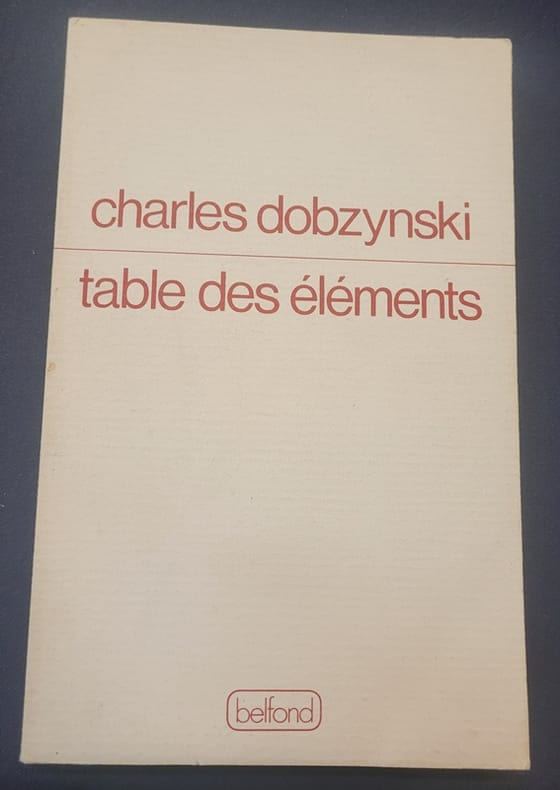
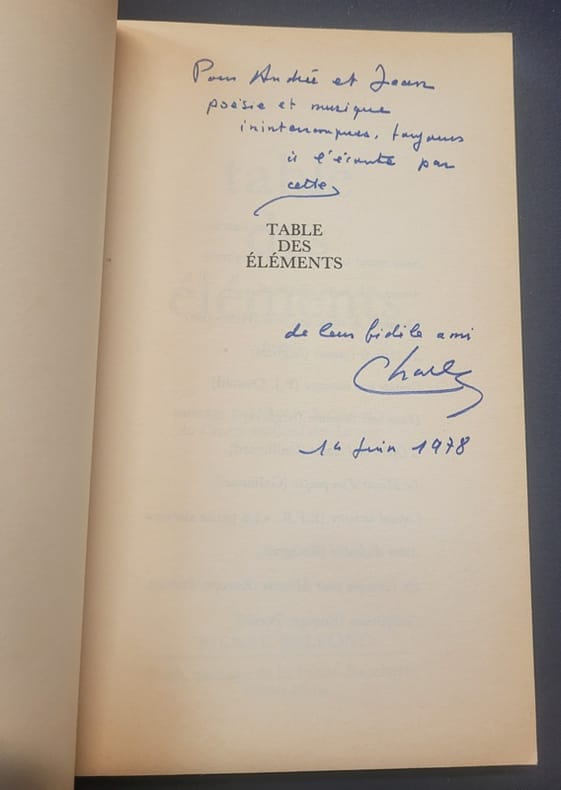
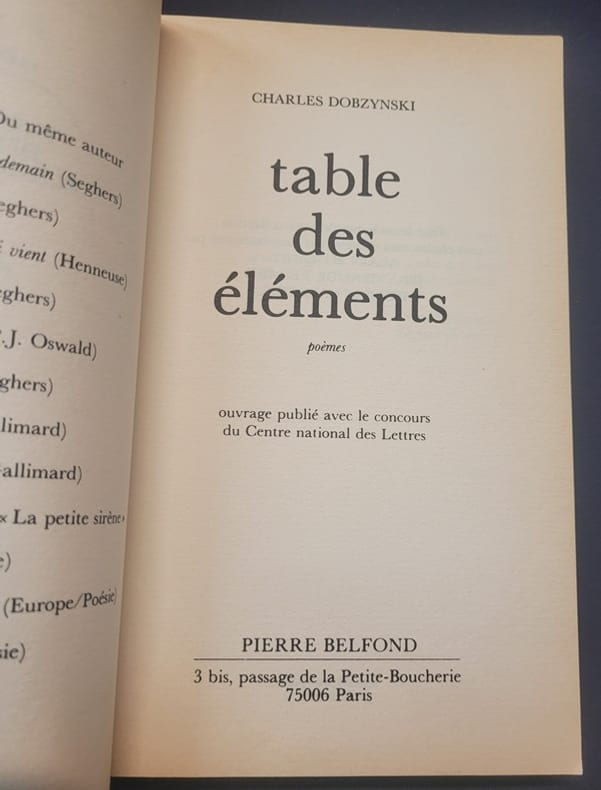
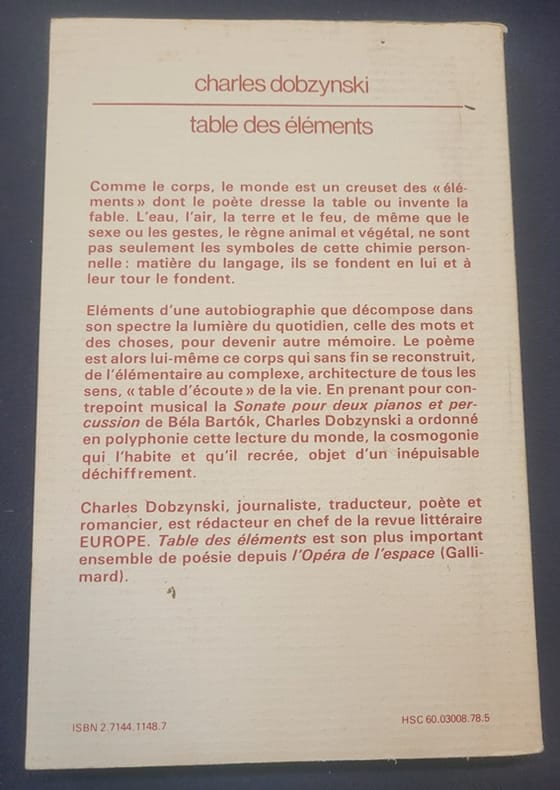
Paris Belfond 1978 In8 - broché - 187 pages - Envoi autographe de l'auteur a Jean Marcenac
Reference : 88Eh
Bon Dédicacé par l'auteur
Bookseller's contact details
L'Encrivore
Dominique Delecroix - Isabelle Vasseur
7 rue Marie de Luxembourg
41100 Vendôme
France
0033 (0)6 859 610 48
Payment mode
Sale conditions
Envoi dès réception et encaissement du paiement par chèque bancaire. Port en sus - Emballage gratuit. <br />Recommandé si demandé et au dessus de 40 euros d'achat. <br />L'ouvrage est disponible "dans la mesure du possible".
5 book(s) with the same title
The High-Frequency Spectra of the Elements, I-II. - [ESTABLISHING ORDER IN THE PERIODICAL TABLE OF ELEMENTS - PMM 407]
London, 1913 & 1914. 8vo. 2 volumes, uniformly bound with the original wrappers in recent full blue cloth. In ""The London, Edinburgh and Dublin Philosophical Magazine"", Sixth Series, Vol. 26, no. 156, December 1913 & vol. 27, no. 160, April 1914. Lower part of index (pp. 1059-1064) in vol 26 with horisontal repair to lower part, affecting last three line (but legible). A fine and clean set. Moseley's papers: pp. 703-13" pp. 1024-1034. [Entire issues: pp. 937-1064" pp. 541-756].
First edition of these groundbreaking papers, in which the arrangement of the elements in the periodic table was based on the atomic number and which thus placed the atomic table on a firm scientific foundation. ""Moseley, working under Rutherford at Manchester, used the method of X-ray spectroscopy devised by the Braggs to calculate variations in the wave-lenght of the rays emitted by each element. These he was able to arrange in a series according to the nuclear charge of the element. Thus if the nuclear charge of hydrogen is 1, in helium it is 2, in lithium 3, and so on by regular progression to uranium as 92. These figures Moseley called atomic numbers.he pointed out that they also represented a corresponding increase in extra-nuclear electrons and that it is the number and arrangement of these electrons rather than the atomic weight that determines the properties of an element. It was now possible to base the periodical table on a firm foundation, and to state with confidence that the number of elements up to uranium is limited to 92. When Moseley'stable was completed, six atomic numbers had no corresponding elements"" but Moseley himself was able to predict the nature of four of the missing elements.""(PMM 407). “In a very short time, Moseley produced the first of his two famous papers in which he showed the spectra of K radiation of ten different substances … Moseley arranged the spectra, one below the other in a step-like fashion, in such a way that a given wavelength was in the same position for all spectra. It then became clear by simple inspection of this ‘step ladder’ that the spectrum of K radiation of each element contains two strong lines (which Moseley called Ka (for the longer wavelength) and Kß (for the shorter) and that this pair of lines moves to shorter and shorter wavelengths in a monotonic fashion if one moves step by step from calcium to zinc Moseley's work made it clear once and for all that indeed the position number in the Periodic Table is equal to the number Z of positive elementary charges in the nucleus of an atom. It also showed that Z is more important for the spectroscopic and chemical properties of an atom than the atomic mass number A. This is evident in the case of the elements cobalt (Z = 27, A = 58.9) and nickel (Z = 28, A = 58.7), where even the order in A differs from that in Z.” (Brandt, The Harvest of a Century: Discoveries in Modern Physics in 100 Episodes) PMM 407Evans 62Norman 1599

Table des éléments. Poèmes
Paris Belfond 1978 1 vol. broché in-8, broché, 186 pp., musique notée. Edition originale sans grand papier. Envoi autographe signé de l'auteur à un poète et critique. Bon exemplaire.

Table des éléments
Paris, Pierre Belfond, 1978, in-8, 187 pp, Broché, couverture blanche imprimée en rouge, Édition originale de ce recueil de sonates comprenant partitions et paroles. Cet exemplaire est enrichi d'un envoi autographe signé de l'auteur à Mathieu Bénézet. Couverture légèrement roussie. Couverture rigide
Bon 187 pp.
TABLE DES ELEMENTS - POEMES.
BELFOND. 1978. In-8. Broché. Bon état, Couv. convenable, Dos satisfaisant, Intérieur frais. 187 pages - nombreuses phrases musicales hors texte.. . . . Classification Dewey : 841-Poésie
Classification Dewey : 841-Poésie
[Chez La Veuve Damonneville, & Musier fils, P. F. Didot jeune, De Hansy] - BAUME, Antoine
Reference : 70590
(1762)
Éléments de Pharmacie théorique et pratique, Contenant toutes les Opérations fondamentales de cet Art [ Edition originale ] Avec leur définition, & une Explication de ces Opérations, par les Principes de la Chymie ; La manière de bien choisir, de préparer, & de mêler les Médicaments ; Les Moyens de reconnoître les Médicaments falsifiés ou altérés ; Les Recettes des Médicaments nouvellement mis en usage ; Les Principes fondamentaux de plusieurs Arts dépendans de la Pharmacie ; Avec une Table des Vertus & Doses des Médicaments
Par M. Baumé, Maître Apothicaire de Paris & démonstrateur en Chymie, 1 vol. fort in -8 reliure de l'époque pleine basane marbrée, dos à 5 nerfs orné, Chez La Veuve Damonneville, & Musier fils, P. F. Didot jeune, De Hansy, Paris, 1762, XVI-853 pp., 1 f. n. ch., 4 pp. (Catalogue Didot) avec 2 planches hors texte. Rappel du titre complet : Éléments de Pharmacie théorique et pratique, Contenant toutes les Opérations fondamentales de cet Art avec leur définition, & une Explication de ces Opérations, par les Principes de la Chymie ; La manière de bien choisir, de préparer, & de mêler les Médicaments ; Les Moyens de reconnoître les Médicaments falsifiés ou altérés ; Les Recettes des Médicaments nouvellement mis en usage ; Les Principes fondamentaux de plusieurs Arts dépendans de la Pharmacie ; Avec une Table des Vertus & Doses des Médicaments
Rare exemplaire de l'édition originale des "Éléments de Pharmacie théorique et pratique" du savant pharmacien et chimiste Antoine Baumé (1728-1804). L'exemplaire est parfaitement conforme à la description fournie par Pierre Julien et René Weitz dans leur belle étude des différentes éditions des "Eléments de Pharmacie", et conforme à "l'exemplaire de la Faculté de Pharmacie de Paris" qui "comporte en outre, in fine, un cahier de 4 pages : le catalogue des livres de médecine de P.-Fr. Didot, l'un des co-éditeurs du volume". Etat satisfaisant (reliure frottée avec coiffe sup. arasée, manque le coin supérieur au premier plat, coupes frottées, ex-libris ms. d'un étudiant en médecine de l'époque en page de titre) pour ce rare exemplaire qu'une petite restauration saura valoriser. (Julien & Weitz, Revue d'Histoire de la Pharmacie, 1979, pp. 33-56)

