 Write to the booksellers
MOULINS Maurice de
L'ISOLÉ
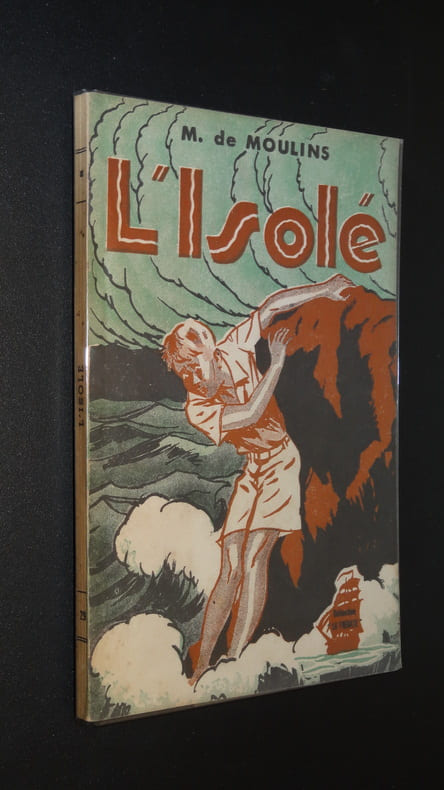
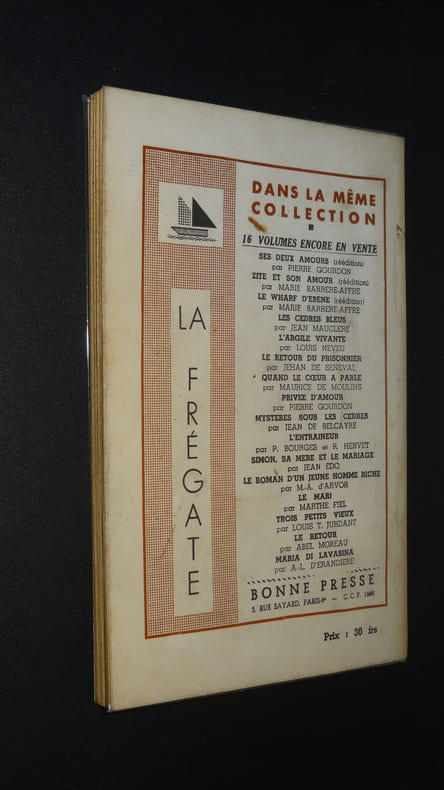
Maison de la Bonne Presse, collection "La Frégate" n°29, 1 volume agrafé de format 18 x 11,5 cm, 125 pages, bon état. Frais de port en supplément.
Reference : JC948
Envoi en lettre verte : + 4,30 euros
Bookseller's contact details
Librairie Nebulor
M. Jean-Eric Junger
13 rue Noë
56000 Vannes
France
02 97 40 49 76
Payment mode

Sale conditions
Les prix indiqués sont en euros, les frais de port sont en supplément et recalculés dans le cas d'envois groupés. Les paiements peuvent être réalisés par carte bancaire, chèque, virement bancaire, Paypal. Les envois se font par la Poste ou par Mondial Relay, au choix du client.
5 book(s) with the same title
Le tireur isolé.
Paris : Guy Lévis Mano (GLM), mars 1971 - un volume broché (19,5x14,5 cm), 34 pages. Edition originale tirée à 535 exemplaires numérotés : 1/505 sur offset. Bon état.
De 1923 à 1974 Guy Lévis Mano (1904-1980), ouvrier typographe et poète a imprimé et édité plus de 500 livres de poésie d'auteurs français et étrangers allant du surréalisme à Garcia Lorca, ou de Louise Labé à Andrée Chedid. "Le style typographique de G.L.M., qui fera rechercher ses livres dans l'avenir comme les plus représentatifs de notre époque, est parvenu à ce même équilibre heureux entre les audaces modernes et la plus sûre tradition."(Albert Béguin, 1949). Tous nos livres sont visibles sur notre site : https://www.livrepoesie.com/
L'isole piu famose del Mondo. Arettino e intagliate da Girolamo Porro Padovano. Con l'aggiunta di molte isole all' ill.re s. conte Georgio Trivltio. - [THE CULMINATION OF THE ""BOOK OF ISLANDS""]
Venetia [Venice], apresso gli heredi di S. Gagliani, 1590. [Colophon: In Vintia, appresso Giorgio Angelieri, a instantia de gli heredi di Simon Gagliani de Karera, 1590]. Small folio. 18th century (ab. 1780-90) half vellum with gilt leather title label to spine. Corners a bit bumped and title label a bit worn, otherwise nice and tight. A very nice copy, on thick, crisp paper. A few quires browned and brownspotted, and some occasional lighter browning. Four leaves with a marginal worm-tract, far from affecting text. Beautiful engraved title-page, consisting of a wide architectural border illustrated with large figures, putti, globes, and various symbols. Beautiful large woodcut initials and head- and tail-pieces. 47 half-page engraved maps in the text (by Porro, of islands and continents), excellent, crisp impressions. Large woodcut device to colophon. (12) ff., 201, (1) pp.
Third, much enlarged edition (with 47 maps as opposed to the mere 30 of the first edition) of Porcacchi's great book of islands, arguably the most famous of all ""isolario""s, with the 47 finely engraved maps by the famous map-maker Girolamo Porro, which also include maps of non-insular places, e.g North America and Mexico City, the famous city plan of Venice and that of Constantinople. Porcachhi's great ""isolario"" represents the culmination of the ""book of islands""-genre, both in regards to artistic quality and the information provided. It furthermore constitutes a main work in the history of the published knowledge of farther parts of the world and an important link in the development from what we call the ""book of islands"" to the modern atlas. As such it is of great value in several respects, both historically, culturally, and cartographically. ""The ""book of islands,"" or isolario, a novel form of cartographic book combining maps and narrative-historical chorography, was invented and initially developed in Italy during the fifteenth and sixteenth centuries. According to R.A. Skelton, ""like the portolano, or pilot-book, to which it was related, it had its origins in the Mediterranean, as an illustrated guide for travelers in the Aegean Archipelago and the Levant."". The first ""book of islands"" was authored by a Florentine ecclesiastic [around 1420] named Cristoforo Buondelmonti [...].The ""book of islands"" was eventually superseded as a cartographic genre, as was the ""Geographia"" of Ptolemy, by the modern atlas"" it persists even after Abraham Ortelius's 1570 ""Theatrum orbis terrarium"", but at the margins rather than at the center of the history of cartography. While the ""isolario"", Ptolemy's ""Geographia"", and the ""modern"" atlas coexist for some time, the gradual eclipse of the ""book of islands"" at one level reflected a progressive decentering of the Mediterranean that occurred within the broader context of early modern history, following the Atlantic discoveries. But well before that happened, in conjunction with the culminating moment of the discoveries and exploration period and at the height of the high Renaissance, the second printed ""book of islands"" appeared in 1528 in Venice published by Zoppino: the ""Libro di Benedetto Bordone nel qual si ragiona de tutte l'isole del mondo"" [Book of Benedetto Bordone in which are discussed all the islands of the world]. As the title suggests, this ""isolario"" provided even broader coverage than the Martellus recensions of Buondelmonti and gave special prominence to the islands of the New World [...].Da li Sonetti's translation of Buondelmonti's ""book of islands"" into a cycle of sonnets in Venice represented in its way an expression of the same desire to reconcile contemporary geographical knowledge to Italian vernacular traditions of geographical poetry that Berlinghieri's poetic Ptolemy expressed. But while the tradition of Tuscan geographical poetry would not survive the Quattrocento, the prose book of islands did, thanks especially to the Venetian print culture that was responsible for da li Sonetti and that produced Bordone's High Renaissance print ""isolario"". As mentioned, the print genre ""book of islands"" would endure in fact, albeit at the margins of modern cartography and literature, in multiple editions of Bordone, which were followed by the no less successful Tommaso Porcacchi's ""L'isole più famose del mondo"" (1572"" with copper-plate engravings), a line that continued through the seventeenth century [...] But just as with other major literary fields of endeavor including the political (Machiavelli), the pastoral (Sannazzaro), the courtly-bureaucratic (Castiglione), and the epic-novellistic (Ariosto), the ""isolario"" produced its masterpieces in the discoveries and travel writing field(alongside Columbus, Vespucci, and Verrazzano) during the High Renaissance."" (Cachey, ""From the Mediterranean to the World: A Note on the Italian ""Book of Islands"" (""isolario"")"", pp. 1-10). Shirley T.POR-1d" Phillips: 50.

Libro D'Antoine Isole War Una Volte edizione Originale gallimard
Editions Gallimard 1989 1989. Libro D'Antoine Isole War Una Volte (Edizione Originale 1989 - Gallimard) La descrizione di questo articolo è stata tradotta automaticamente. Se hai dubbi o domande ti invitiamo a contattarci. tascabile di grande formato 256 pagine abbondantemente illustrato alcune centinaia di isole una trentina di arcipelaghi che Antoine ebbe il piacere di scoprire; ce li offre in questo libro con le loro coste accoglienti o austere le loro foreste paradisiache la loro toccante nudità e la loro incredibile ricchezza in buone condizioni completo e solido senza lacrime o annotazioni; interni impeccabili puliti e ancora freschi; piccolo attrito alle estremità dei cardini del bordo; è ancora un buon album per la sua età. vedi anche molti libri nel mio negozio. per la Francia e il Belgio i costi di spedizione aumentano molto poco o per niente in caso di acquisti multipli. Azienda perlenbook Siret n ° 49982801100010. Esca RCS Tgi 499828 911 N ° GESTION 2007 A 111. Creato da eBay
Bon état
[cavalerie militaire] THOMAS (Capitaine G. Max); HAPPICH (H.); L'HOTTE (Général); DERIGNY (M.); BIENSAN (R. de)
Reference : 13982328
[Réunion de 5 textes sur la cavalerie militaire] THOMAS (Capitaine G. Max), La cavalerie combinée avec les autres armes sous l'influence du nouvel armement. (Paris, Librairie militaire J. Dumaine, 1870) - HAPPICH (H.), Instructions du Général-Major Carl von Schmidt pour le dressage, l'emploi et la conduite de la cavalerie depuis le cavalier isolé jusqu'à la division de cavalerie. (Paris, Imprimerie et librairie militaire J. Dumaine, 1877) - L'HOTTE (Général), Observations faites par le Gal L'Hotte au cours des manœuvres de cavalerie de Chalons de 1886 publiées par ordre du Ministre de la guerre en vue des manœuvres de cavalerie de 1887. (Paris, Berger-Levrault, 1887) - DERIGNY (M.), Projet de règlement sur le service stratégique de la cavalerie avant le combat. (Paris, Imprimerie et librairie militaire J. Dumaine, 1876) - BIENSAN (R. de), Conduite d'un escadron de contact avec 3 grande cartes. (Paris, Imprimerie et librairie militaire J. Dumaine, 1881)
Paris: , 1870-1887 réunion de 5 textes reliés en un voi. in-8: 51 pages et 6 planches; 14 pages; 40 pages; 30 pages; 206 pages et 3 cartes se dépliant. Demi chagrin, dos à 4 nerfs, caissons dorés, petites usures, qq rousseurs, autrement bel exemplaire.
[Réunion de 5 textes sur la cavalerie militaire] THOMAS (Capitaine G. Max), La cavalerie combinée avec les autres armes sous l'influence du nouvel armement. (Paris, Librairie militaire J. Dumaine, 1870 - HAPPICH (H.), Instructions du Général-Major Carl von Schmidt pour le dressage, l'emploi et la conduite de la cavalerie depuis le cavalier isolé jusqu'à la division de cavalerie. (Paris, Imprimerie et librairie militaire J. Dumaine, 1877) - L'HOTTE (Général), Observations faites par le Gal L'Hotte au cours des manœuvres de cavalerie de Chalons de 1886 publiées par ordre du Ministre de la guerre en vue des manœuvres de cavalerie de 1887. (Paris, Berger-Levrault, 1887) - DERIGNY (M.), Projet de règlement sur le service stratégique de la cavalerie avant le combat. (Paris, Imprimerie et librairie militaire J. Dumaine, 1876) - BIENSAN (R. de), Conduite d'un escadron de contact avec 3 grande cartes. (Paris, Imprimerie et librairie militaire J. Dumaine, 1881) (Paris: , 1870-1887) [M.C.: cavalerie militaire]
Pour le renouveau / expiation-conversion - rédemption/ meditations d'un isolé 1915-1916
Librairie académique PERRIN et C° 1916 237 pages in8. 1916. broché. 237 pages. Il s'agit d'un livre de méditations spirituelles écrites par un isolé pendant la période 1915-1916 traitant des thèmes du renouveau de l'expiation de la conversion et de la rédemption
Bon état

