 Write to the booksellers
AUTRAND (Charles) -
Magazine -
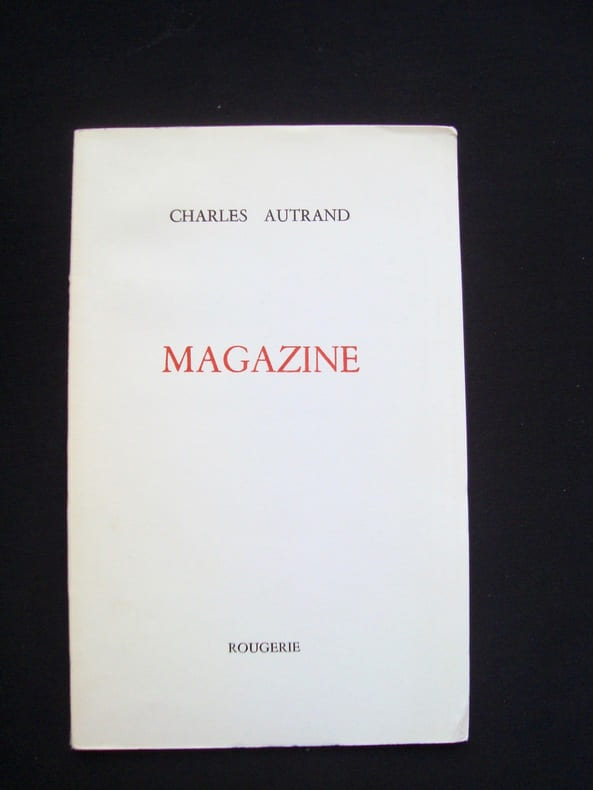
Editions Rougerie, 1969 - In-8 broché, sans pagination - Edition originale : un des 250 exemplaires numérotés sur alfa mousse enrichi d'un envoi de l'auteur - bon état -
Reference : 10047
Tous nos livres sont visibles sur notre site : https://www.livrepoesie.com/
Bookseller's contact details
Le Livre à Venir
Mme et Mr. Florine et Richard Jaillet
41 Place de l'Oscambre
03140 Chantelle
France
06 44 78 76 58
Payment mode
Sale conditions
Règlement accepté : chèque, paypal, virement bancaire ou mandat. Nous garantissons l'état de nos livres conformes à la description donnée sur nos notices. Envoi de photographies sur demande. Les prix indiqués sont nets, port en sus à la charge de l'acquéreur. A réception de votre commande, vous recevrez une demande de règlement détaillée. Nous envoyons les ouvrages dans un délai de trois jours maximum, à réception de votre règlement par chèque,paypal, espèces ou virement bancaire. <br />
5 book(s) with the same title
The Freemason's Magazine or General and Complete Library. Vol. 1 - 11. - [“THE ARCHTYPE OF LATER MASONIC PERIODICALS”]
London, Scatcherd & Whitaker Parsons Cawthorn, 1793 - 1798. 8vo. Bound in 11 volumes. Volume 2 - 11 uniformly bound in contemporary half calfs. Volume 1 in half calf with later marbled paper covered boards. Bindings with wear and stains. Leather on spines cracked. Volume 1 with reinforced hinges a dampstain to first leaves. A few volumes with dampstain to first leaves but, internally, generally a nice and clean set. 616, (4) pp. + 2 frontispiece and 7 engraved plates (4), 480 pp. + 7 plates (Wolstieg only calling for 5) (4), 450, (4) pp. + 7 engraved plates (4), 426, (6), 8 pp. + 7 engraved plates (Wolstieg only calling for 3) (2), 436 pp. + 6 engraved plates (Wolstieg only calling for 2) (2), 452, (4) pp. + 6 engraved plates (Wolstieg only calling for 4) (6), 438, (4) pp. + 8 engraved plates (Wolstieg only calling for 6) (4), 464, (4) pp. + 8 engraved plates (Wolstieg only calling for 4) (6), 506 pp. + 9 engraved plates (Wolstieg only calling for 4) (2), 430 pp. + 6 engraved plates (Wolstieg only calling for 1) (2), IV, 338, (8) pp. + 9 engraved plates (Wolstieg only calling for 2). This set has a total of 79 engraved plates, Wolfstieg only calls for 47 plates.
Rare complete run of the first English periodical dedicated to freemasonry, “the archetype of later Masonic periodicals” (Önnerfors, The Freemasons’ Magazine 1793–1798) published at a crucial time in the history of European Freemasonry in the immediate aftermath of the French Revolution. It represents one of the first efforts by the fraternity to define, consolidate and disseminate its intellectual and moral identity in public. Its contents - lodge proceedings, philosophical essays, antiquarian inquiries, biographical notices, poetry and finely executed symbolic engravings - reflect the full breadth of late Enlightenment Masonry. The importance of the work lies in its function as a precursor since it anticipates the Masonic journals in the 19th century and marks the transition of Freemasonry into a self-conscious, print-based intellectual culture. ”The Freemasons’ Magazine represent a forceful statement of British Freemasonry concerning its vigour, loyalty, and societal engagement. During 1794 the journal for the first time served as a platform to refute anti-Masonic writings that circulated in the public. Important apologies such as Defence of masonry (1730) or Cousto’s spiced account of his treatment by the Portuguese inquisition were republished. Parts of Ramsay’s ‘Oration’ were republished not just once but twice. We can also witness how the Knights Templar (called the ‘sublime degree of masonry’) entered the world of British Masonic imagination, long after the continental development. Nevertheless at the very same time Freemasonry in Britain was also celebrating technological progress in industry, agriculture, and science, which makes its relationship to modernity complex. The Freemasons’ Magazine managed to attract correspondents in different parts of the empire and even the USA. A particularly strong link throughout the first seven volumes was Edinburgh. In the last four volumes we find more material inserted from Ireland, at exactly the time when political tensions there erupted into a full-scale rebellion. The political tense years of 1797 and 1798 offer an intriguing insight into the British psyche at the time. Under constant (real and imagined) threat of French invasion, internally shaken by the Irish rebellion, uprisings, and repeated mutinies, public opinion was fuelled with anti-Masonic ideas, not at least by Robison’s book Proofs of a conspiracy. The Freemasons’ Magazine unfortunately did not survive 1798. Most importantly perhaps it can be regarded as the archetype of later Masonic periodicals, developing into a archtype Masonic press by the middle of the nineteenth century with titles such as he Freemasons’ Quarterly Magazine and Review (1834–53), The Masonic observer (1856–9), he Freemason’s Magazine and Masonic mirror (1856–71), the Freemason (1869–1951), some of them surviving well into the twentieth century. Whereas Masonic periodicals during the first century of their existence tied into the ongoing debates and controversies surrounding Freemasonry in culture and society, they developed more and more into purely internal membership magazines with little connection to the outside world.” (Önnerfors, The Freemasons’ Magazine 1793–1798). Wolfsteig 516

Reference : bd-770ae91843b7ff82
Two issues of The Burlington Magazine. Volume XL. # CCXXVIII and 228 for March
"Two issues of The Burlington Magazine. Volume XL. # CCXXVIII and 228 for March 1922 and # CCXXIX and 229 for April 1922 The Burlington Magazine for connoisseurs. Vol. XL. # CCXXVIII. March 1922. # CCXXIX. April 1922. London: The Burlington Magazine, Ltd., 1922.- # 228.-XXXII p. (Advertising), III, I, 2, 107-154 p.: or - # 229.-XXXVIII p. (Advertising), IV, 2, 157-204 p.;/Dva vypuska zhurnala The Burlington Magazine. Tom XL. #CCXXVIII i 228 za mart 1922 i #CCXXIX i 229 za aprel 1922 The Burlington Magazine for connoisseurs. Vol. XL. #CCXXVIII. March 1922. #CCXXIX. April 1922. London: The Burlington Magazine, Ltd, 1922.-#228.-XXXII s. (reklama), III, I, 2, 107-154 s.: il.-#229.-XXXVIII s. (reklama), IV, 2, 157-204 s.: il.; Two issues of The Burlington Magazine. Volume XL. # CCXXVIII and 228 for March 1922 and # CCXXIX and 229 for April 1922 The Burlington Magazine for connoisseurs. Vol. XL. # CCXXVIII. March 1922. # CCXXIX. April 1922. London: The Burlington Magazine, Ltd., 1922.- # 228.-XXXII p. (Advertising), III, I, 2, 107-154 p.: or - # 229.-XXXVIII p. (Advertising), IV, 2, 157-204 p.;. We have thousands of titles and often several copies of each title may be available. Please feel free to contact us for a detailed description of the copies available. The delivery of this book might be delayed beyond the usual timeframe due to extended processing and preparation before shipment, and faster shipping options are not offered. Please inform us if you need the order by a certain date or have a deadline.SKUbd-770ae91843b7ff82"
Reference : bd-17ff5f46ffe12abb
Two issues of The Burlington Magazine. # 527 for February 1947 and # 528 for Ma
"Two issues of The Burlington Magazine. # 527 for February 1947 and # 528 for March 1947. The Burlington Magazine for connoisseurs. Vol. LXXXIX. # 527. February 1947 # 528. March 1947. London: The Burlington Magazine, Ltd., 1947.- # 527.-XXII p. (advertising), 29-52 p. (advertising); - # 528.-XXII p. (advertising), 53-82 p. (advertising);/Dva vypuska zhurnala The Burlington Magazine. #527 za fevral 1947 i #528 za mart 1947. The Burlington Magazine for connoisseurs. Vol. LXXXIX. #527. February 1947 #528. March 1947. London: The Burlington Magazine, Ltd, 1947.-#527.-XXII s. (reklama), 29-52 s.: il.;-#528.-XXII s. (reklama), 53-82 s.: il.; Two issues of The Burlington Magazine. # 527 for February 1947 and # 528 for March 1947. The Burlington Magazine for connoisseurs. Vol. LXXXIX. # 527. February 1947 # 528. March 1947. London: The Burlington Magazine, Ltd, 1947.- # 527.-XXII. We have thousands of titles and often several copies of each title may be available. Please feel free to contact us for a detailed description of the copies available. The delivery of this book might be delayed beyond the usual timeframe due to extended processing and preparation before shipment, and faster shipping options are not offered. Please inform us if you need the order by a certain date or have a deadline.SKUbd-17ff5f46ffe12abb"
PARIS MAGAZINE. N° 43. Mars 1935.
Tous nos exemplaires de PARIS-MAGAZINE sont en bon état (avec parfois des agrafes rouillées, sans atteinte aux pages).
/// PARIS MAGAZINE. Paris IIe (227, rue Saint-Denis, puis 6, rue du Ponceau). Gérante : Simone Bouchez. Grand in-8° agrafé. Cette revue « de charme » se distingue de ses nombreuses concurrentes par la qualité de ses photographies, auxquelles PARIS MAGAZINE accorde une large place, avec de nombreux hors-textes (parfois en couleurs). Le principal fournisseur de photographies est le fameux Studio Manassé, de Vienne, dirigé par Olga et Adorján von Wlassics. Collaborent aussi régulièrement à Paris Magazine les photographes : Kertesz, Brassaï, Schall, Sougez, Bill Brandt, Man Ray, Germaine Krull, Bucovich, Braig, Jean Moral, Perkhammer, Ergy Landau, Ph. Halsmann, Dr Wolff, Pierre Verger, Jablonowsky, Schostal, Nora Dumas, Caillaud, S. Aoyama, André Steiner, Jean Roubier, Zuber, etc. Les textes sont également dignes dintérêt (surtout pour ce genre de publication) ; ils sont de Robert Dieudonné, Marcel Aymé, Maurice Dekobra, George Stuart, Pierre Descaves, Henri Duvernois, Serge, Léon Treich, Fernand Pouey, Maurice Garçon, Jean-Pierre Dorian, Paul Reboux, Prosper Montagné (rubrique gastronomique), Jean de Letraz (rubrique cinéma), Max Favalelli, Jean Feuga, Bernard Nabonne, Gaston Paris, etc. Les illustrations dessinées sont, pour la plupart, de Touchagues. À noter, quelques contributions de lénigmatique mystagogue Georges Saint-Bonnet. /// PARIS MAGAZINE a paru sans interruption de septembre 1931 à août 1939. En 1949, une nouvelle série a paru, qui cessa après une dizaine de numéros.
PARIS MAGAZINE. N° 44. Avril 1935.
Tous nos exemplaires de PARIS-MAGAZINE sont en bon état (avec parfois des agrafes rouillées, sans atteinte aux pages).
/// PARIS MAGAZINE. Paris IIe (227, rue Saint-Denis, puis 6, rue du Ponceau). Gérante : Simone Bouchez. Grand in-8° agrafé. Cette revue « de charme » se distingue de ses nombreuses concurrentes par la qualité de ses photographies, auxquelles PARIS MAGAZINE accorde une large place, avec de nombreux hors-textes (parfois en couleurs). Le principal fournisseur de photographies est le fameux Studio Manassé, de Vienne, dirigé par Olga et Adorján von Wlassics. Collaborent aussi régulièrement à Paris Magazine les photographes : Kertesz, Brassaï, Schall, Sougez, Bill Brandt, Man Ray, Germaine Krull, Bucovich, Braig, Jean Moral, Perkhammer, Ergy Landau, Ph. Halsmann, Dr Wolff, Pierre Verger, Jablonowsky, Schostal, Nora Dumas, Caillaud, S. Aoyama, André Steiner, Jean Roubier, Zuber, etc. Les textes sont également dignes dintérêt (surtout pour ce genre de publication) ; ils sont de Robert Dieudonné, Marcel Aymé, Maurice Dekobra, George Stuart, Pierre Descaves, Henri Duvernois, Serge, Léon Treich, Fernand Pouey, Maurice Garçon, Jean-Pierre Dorian, Paul Reboux, Prosper Montagné (rubrique gastronomique), Jean de Letraz (rubrique cinéma), Max Favalelli, Jean Feuga, Bernard Nabonne, Gaston Paris, etc. Les illustrations dessinées sont, pour la plupart, de Touchagues. À noter, quelques contributions de lénigmatique mystagogue Georges Saint-Bonnet. /// PARIS MAGAZINE a paru sans interruption de septembre 1931 à août 1939. En 1949, une nouvelle série a paru, qui cessa après une dizaine de numéros.

