 Write to the booksellers
GASCARD, Nicolas.
Atmosphère.
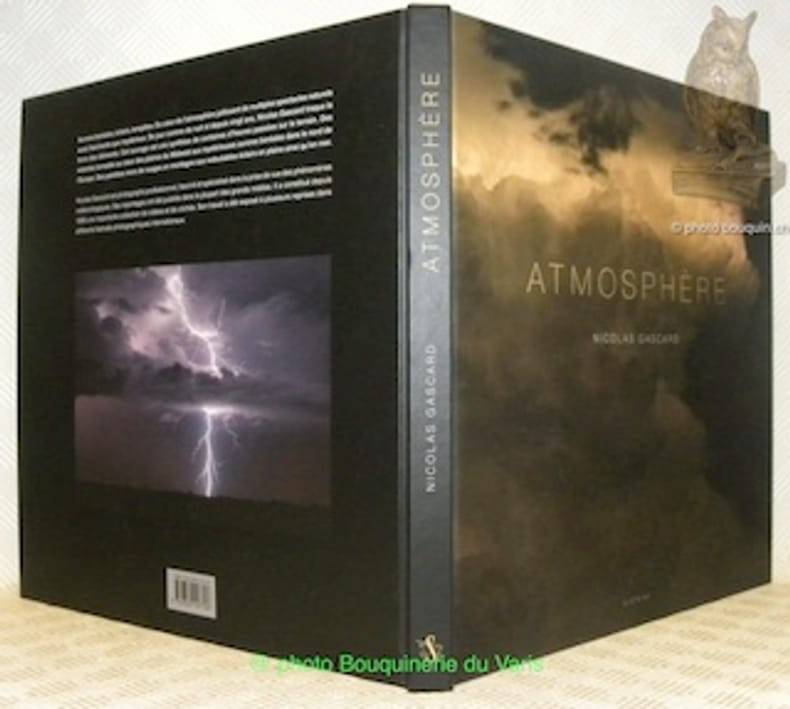
Genève, Editions Slatkine 2016, 310x295mm, 159pages, Cartonage illustré de l’éditeur. Inscriptions manuscrites sur la page de garde supérieure, autrement très bel exempaire.
Reference : 112065
photos couleurs, Pour un paiement via PayPal, veuillez nous en faire la demande et nous vous enverrons une facture PayPal
Bookseller's contact details
Bouquinerie du Varis
M. Jacquier Julien
Route de Léchelles 36
1773 Russy
Canton de Fribourg Switzerland
41 26 323 23 43
Payment mode


Sale conditions
Nous expédions les livres dès réception de votre paiement. Paiement sous facture PayPal. Virement bancaire ou Cartes de Crédits. Les chèques ne sont pas acceptés. Vous avez la possibilité de nous retourner les livres commandés. Aux conditions suivantes: • Si le titre ne correspond pas à votre commande. • Si l’état du livre ne correspond pas à la description que nous en avons faite. • Si le retour est fait dans les 15 jours. • Si le retour est fait dans le même emballage, comme vous l’avez reçu. • Si le retour est accompagné d’un écrit mentionnant les motifs. Ces conditions étant remplies, nous nous engageons à rembourser au client le prix des livres, sans les frais de port. Uniquement pour la Suisse, possibilité de payer sur facture sous 30 jours dès réception de la commande.
5 book(s) with the same title
The general circulation of the atmosphere: a numerical experiment. [Extracted from: Quarterly Journal of the Royal Meteorological Society Vol. 82 No. 352, April 1956]. - [THE FIRST SUCCESFUL CLIMATE MODEL]
(London, Royal Meteorological Society, 1956). 8vo. Extracted and with a nice marbled paper-backstrip (kind of representing the elements). Damp-staining to lower part of leaves. Pp. 123-164. Illustrated.
First printing of Phillips' seminal paper, in which he presents for the first time his mathematical model that could realistically depict monthly and seasonal patterns in the troposphere. This became became the first successful general circulation model of climate (GCM). ""Numerical models (General Circulation Models or GCMs), representing physical processes in the atmosphere, ocean, cryosphere and land surface, are the most advanced tools currently available for simulating the response of the global climate system to increasing greenhouse gas concentrations. While simpler models have also been used to provide globally - or regionally-averaged estimates of the climate response, only GCMs, possibly in conjunction with nested regional models, have the potential to provide geographically and physically consistent estimates of regional climate change which are required in impact analysis...GCMs depict the climate using a three dimensional grid over the globe, typically having a horizontal resolution of between 250 and 600 km, 10 to 20 vertical layers in the atmosphere and sometimes as many as 30 layers in the oceans."" (IPCC - International Panel on Climate Change). In 1956, Norman Phillips developed a mathematical model that could realistically depict monthly and seasonal patterns in the troposphere, thus revolutionizing weather and climate change predition. It became the first successful climate model. Following Phillips' work, several groups began working to create GCMs that are now essential to predict climate change. ""Steady improvements to short-range NWP accrued during the early 1950s, in large part due to more realistic models that accounted for energy conversion in extratropical cyclones. Encouraged by the success of these forecasts, IAS team member Norman Phillips began to contemplate longer-range prediction using the IAS computer. His work took the form of a numerical simulation of the atmosphere's general circu lation for a period of 1 month. The work was completed in 1955 and Phillips communicated the results to von Neumann, who immediately recognized their significance. Von Neumann hastily arranged a conference in October 1955, Application of Numerical Integration Techniques to the Problem of the General Circulation, held at Princeton University. In his opening statement at the conference, von Neumann said I should like to make a few general remarks concerning the problem of forecasting climate fluctuations and the various aspects of the general circulation that cause such fluctuations. Specifically, I wish to point out that the hydro-dynamical and computational efforts which have been made in connection with the problem of short-range forecasting serve as a natural introduction to an effort in this direction . . . With this philosophy in mind, we held our first meeting nine years ago at the Institute for Advanced Study to discuss the problem of short-range weather prediction. Since that time, a great deal of progress has been made in the subject, and we feel that we are now prepared to enter into the problem of forecasting the longer period fluctuations of the general circulation. (von Neumann 1955, 9-10) Following this conference, which highlighted his numerical experiment, Phillips entered the research into competition for the first Napier Shaw Memorial Prize, a prize honoring England's venerated leader of meteorology, Sir Napier Shaw (1854-1945), on the occasion of the centenary of his birth (the competition was announced in April 1954). The subject for the first competition was ""the energetics of the atmosphere."" On 20 June 1956, ""the adjudicators recommended that the prize be given to Norman A. Phillips of the Institute of Advanced Study, Princeton, U.S.A. for his essay 'The general circulation of the atmosphere: a numerical experiment,' which had been published in the Quarterly Journal [of the Royal Meteorological Society] (82, p. 1230) [April 1956] ..."" (Quarterly Journal of the Royal Meteorological Society 1956b)"" (Lewis: Clarifying the Dynamics of the General Circulation: Phillips's 1956 Experiment).

LOCO REVUE N° 445 - Atmosphère, atmosphère, Comment jouait-on au train miniature il y a 100 ans ?, Décor a la française (suite), Propos d'atmosphère : conseils pour le prochain concours photo, Bale : l'exposition Chemin de fer 82, Les bizarreries
LOCO-REVUE. JANVIER 1983. In-4. Broché. Bon état, Couv. convenable, Dos satisfaisant, Intérieur frais. Paginé de 1 à 84. Nombreuses illustrations en noir et blanc dans et hors texte.. . . . Classification Dewey : 625-Chemins de fer, routes, autoroutes
La revue des modélistes et amateurs de chemins de fer. Sommaire :Atmosphère, atmosphère, Comment jouait-on au train miniature il y a 100 ans ?, Décor a la française (suite), Propos d'atmosphère : conseils pour le prochain concours photo, Bale : l'exposition Chemin de fer 82, Les bizarreries de la maison Purrey au 1/87 Classification Dewey : 625-Chemins de fer, routes, autoroutes

Cet air qui nous entoure l'atmosphère
Hachette 1958 254 pages in8. 1958. Broché. 254 pages. Nombreuses illustration en noir et blanc et en couleur Chapitres : vicissitudes - étages de l'atmosphère terrestre - nuages arc-en-ciel coloration du ciel - mirages - aurore polaire - végétaux et animaux à; la conquête de l'atmosphère - autres planètes - destin de l'atmosphère terrestre - prévisions du temps - pluie et beau temps - royaume des vents - tornades - ouragans - jet-streams - orages et éclairs - oxygène et cycle de l'azote - homme et atmosphère (respiration - pollution - conquête de l'air - étoile faite par l'homme - baromètre et maladies - poussière radioactive
Etat Correct couverture défraîchie intérieur propre texte frais
Sequel to an Essay on the Constitution of the Atmosphere in the Philosophical Transactions for 1826" with some Account of the Sulphurets of Lime. Received June 9, - Read June 15, 1837.
(London, Richard and John E. Taylor, 1837). 4to. No wrappers as extracted from ""Philosophical Transactions"" 1837 - Part II. Pp. 347-363. Clean and fine.
First printing of Dalton's last paper submitted to the ""Transactions"". This paper, one of his last, deals with the constitution of the atmosphere, just as his first love was meteorology.""In an essay of mine on the constitution of the atmosphere, which was printed in the Transactions for 1826, I signified my intention of following it with a sequel of experiments to ascertain if possible which of the two views therein developed was most counntenanced by facts. I now proceed to give an account of such investigations relating to this subject as havee engaged my attention during a long period of years.""(John Dalton). - (Smith: John Dalton. A Bibliography. No. 78).
Recherches sur les couches supérieures de l'atmosphère solaire
Paris, Gauthier-Villars, 1910-1911, in-4, Réunion de 11 plaquettes : 8, 7, 5, 4, 7, 4, 7, 4, 7, 6 et 10 pp, Brochées, couvertures bleues; réunies sous couverture rose imprimée de l'éditeur, Notes d'Henri-Alexandre Deslandres (1853-1948), extraites des Comptes rendus des séances de l'Académie des sciences, tomes 150, 151, 152 et 153 : - Séance du 10 janvier 1910, "Orage magnétique du 25 septembre 1909 et phénomènes solaires connexes. Vérification des théories proposées". - Séance du 25 avril 1910, "Distribution des filaments dans la couche supérieure de l'atmosphère solaire". - Séance, séance du 20 juin 1910, "Sur un filament extraordinaire" (Note de MM. Deslandres, d'Azambuja et V. Burson). - Séance du 8 août 1910, "Sur les propriétés polaires du Soleil". - Séance du 30 janvier 1911, "Recherches sur les mouvements des couches atmosphériques solaires par le déplacement des raies spectrales. Dissymétrie et particularités du phénomène". - Séance du 29 mai 1911, "Explication simple des protubérances solaires et d'autres phénomènes pars des champs magnétiques très faibles". - Séance du 6 juin 1911, "Remarques complémentaires sur les champs magnétiques faibles de l'atmosphère solaire". - Séance du 3 juillet 1911, "Ionisation des gaz solaires. Relations entre le rayonnement et la rotation des corps célestes". - Séance du 24 juillet 1911, "Remarques sur les mouvements des protubérances solaires". - Séance du 21 août 1911, "Vitesses de rotation des filaments noirs dans la couche supérieure de l'atmosphère solaire" (Note de Deslandres et d'Azumbuja). Deslandres travailla au laboratoire de physique de l'Ecole polytechnique puis à celui de la Sorbonne où il s'occupait principalement de l'étude des spectres. Il devint directeur de l'Observatoire de Meudon en 1907 à la mort de Janssen, puis de l'Observatoire de Paris, où il fut chargé d'organiser le service de spectroscopie. Dans ce domaine il fit d'importantes découvertes. Fervent défenseur d'une étude physico-chimique du ciel et du soleil, il étudia les différents spectrographes enregistreurs alors connus. Couverture générale défraîchie, dos usé. Couverture rigide
Bon Réunion de 11 plaquettes :

