 Write to the booksellers
Gabriele Fahr-Becker
L'Art Nouveau
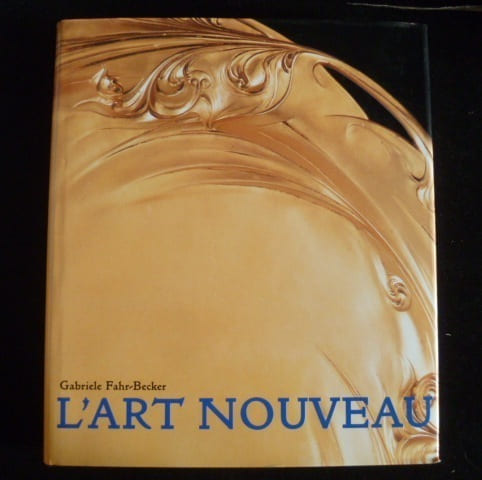
Paris, Könemann, 1997, in-4, relié-jaquette éditeur,, 424 pages. Bon état. Index.
Reference : 24528
NB. Les questions et commandes sont traitées dans les 48h, les expéditions reprendront lundi 12 octobre. Merci !
Bookseller's contact details
Librairie Christian Chaboud
M. Christian Chaboud
Avenue du Mont Kemmel 32
1060 Bruxelles
Belgium
librairie.christianchaboud@gmail.com
(+32) 470 87 87 88
Payment mode

Sale conditions
La Librairie Christian Chaboud vous propose un vaste choix de livres anciens et modernes. Les ouvrages peuvent être consultés et retirés sur rendez-vous à Bruxelles ou à Paris (5e arr.); prévoir quelques jours de délai. Merci de nous contacter. Le prix indiqué ne comprend pas les frais de port qui vous seront communiqués par mail ou téléphone. Les envois vers la France se font au tarif de la poste française. L'envoi des ouvrages se fait à réception de paiement. Tout renseignement peut être demandé par messagerie et téléphone. Le paiement est possible par carte, virement bancaire, Paypal et espèces. Le livre est réservé pendant 8 jours après confirmation de sa disponibilité.
5 book(s) with the same title
Two plates from: Modèles de lettres d'Art Nouveau
Paris Firmin Didot & Cie C1885 Two plates from a French decorative lettering manual, produced for sign painters, decorators, and designers working in the Art Nouveau style. It belongs to a wider group of late-19th and early-20th-century model books that supplied ornamental alphabets and practical lettering forms for commercial and artistic use. These appear as part of the scarce: Modèles de Lettres D'Art Nouveau, showing that Ducompex's drawings were intended both as artistic models and as working templates for building painters and sign writers. These plates would look lovely framed, as wonderful examples of typography, graphic design, calligraphy, and Art Nouveau ephemera. With gilt highlights to letter edges. One measures: 280 x 375 mm, and the other slightly bigger at: 290 x 410 mm. Both blank to verso. Ducompex's alphabet designs also influenced later digital font recreations and design references.
Two plates from a French decorative lettering manual, produced for sign painters, decorators, and designers working in the Art Nouveau style. It belongs to a wider group of late-19th and early-20th-century model books that supplied ornamental alphabets and practical lettering forms for commercial and artistic use. These appear as part of the scarce: Modèles de Lettres D'Art Nouveau, showing that Ducompex's drawings were intended both as artistic models and as working templates for building painters and sign writers. These plates would look lovely framed, as wonderful examples of typography, graphic design, calligraphy, and Art Nouveau ephemera. With gilt highlights to letter edges. One measures: 280 x 375 mm, and the other slightly bigger at: 290 x 410 mm. Both blank to verso. Ducompex's alphabet designs also influenced later digital font recreations and design references. .

November 1909 - a leaf from a art nouveau calendar
Amsterdam: Tresling & Co. 1909 Une jolie lithographie originale datant de novembre 1909, imprimée par Tresling & Co. à Amsterdam. Elle était à l'origine reliée à un calendrier annuel et présente un bord dentelé en haut, là où elle a été détachée. La moitié supérieure comporte une illustration saisonnière, tandis que la moitié inférieure est ornée d'un joli mois de style Art nouveau. Les coordonnées de l'imprimeur figurent en bas. Sur carton rigide. Verso vierge. La plaque mesure 43 cm x 21 cm (format folio étroit). Elle a été réalisée à l'aide d'une technique de lithographie en couleur, signée ou monogrammée sur la pierre. Bien qu'il s'agisse d'un exemplaire propre et soigné, il présente un pli au milieu de la feuille, à l'endroit où elle a été pliée. Theo van Hoytema (1863-1917) était un illustrateur et concepteur de livres néerlandais. Il était particulièrement connu pour ses images de la nature (plus précisément les oiseaux). Il a grandi à La Haye, puis à Voorschoten. Il a suivi des cours de dessin à l'Académie des Beaux-Arts de La Haye et, grâce aux contacts de son oncle, il a étudié au Musée zoologique de Leyde. Ses premières illustrations ont été publiées en 1891, « How the birds came to a King » (Comment les oiseaux sont venus chez le roi). Il a ensuite publié « The Ugly Duckling » (Le vilain petit canard) en 1893 et « The Happy Owls » (Les chouettes heureuses) en 1895. Il s'est marié en 1891, mais ce n'était pas un mariage heureux et il n'a pas duré. Après l'échec de son mariage, il entra dans une période d'agitation, déménageant plusieurs fois et séjournant quelque temps chez son frère à Londres. Entre 1904 et 1906, il passa du temps à l'hôpital et dans un sanatorium pour névrosés. À sa sortie, il vécut avec sa sur à La Haye jusqu'à la fin de sa vie. C'est au cours de cette dernière période qu'il réalisa les calendriers qui le rendirent célèbre. Theo van Hoytema a réalisé 17 calendriers. Le dernier, celui de l'année 1918, était quelque peu sommaire, car il était en cours de préparation l'année de sa mort et n'a pas été achevé sous forme de lithographie en couleurs. Ses uvres sont exposées au musée Bijmans Van Beuningen, à Rotterdam, ainsi qu'au Rijksmuseum et au Stedelijk Museum, à Amsterdam. Une rue et une place/un parc portent son nom à La Haye, où se trouve également un mémorial.
A lovely original lithograph leaf of November 1909, printed by Tresling & Co. of Amsterdam. This was originally connected to an annual calendar, and has a serrated edge to the top where removed. This has a seasonal illustration to the top half, then an attractive art nouveau style month drawn to the bottom half. To the bottom are the printer details. On stiff card. Blank to back. The plate is 43cm x 21cm (narrow folio format). It has been produced by a colour lithographic technique, signed or monogrammed to the stone. Although a clean and neat copy, there is a crease halfway down the sheet where it has been folded. Theo van Hoytema (1863-1917) was Dutch illustrator and book designer. He was particularly known for his nature images (more specifically birds). He grew up in The Hague, and afterwards in Voorschoten. He took drawing lessons at the Academy of Art in The Hague, and through his Uncle's contacts, he studied at the Zoological Museum in Leiden. His first illustrations were published in 1891, "How the birds came to a King" He followed this up with "The Ugly Duckling" in 1893, and "The Happy Owls" in 1895. He married in 1891, but it was not a happy marriage, and did not last. He entered a restless period after the breakdown of his marriage, moving around, and staying for a while with his brother in London. Between 1904 and 1906 he spent time in a hospital, and a sanatorium for neurotics. On release, he lived with his sister in The Hague for the rest of his life. It was during this later period that he made the calendars which made him famous. Theo van Hoytema made 17 calendars. The final one for the year 1918, was somewhat sketchy, as it was in preparation in the year of his death, and was not completed as a full colour lithograph. There are collections of his work in the Museum Bijmans Van Beuningen, Rotterdam, and the Rijksmuseum & Stedelijk Museums in Amsterdam. There is a road and square / park named after him in The Hague, with a memorial there. .
Piasa - Tableaux anciens, militaria, instruments scientifiques, verreries, miniatures des XVIIIe et XIXe siècles, objets d'art et de bel ameublement, tapis, tapisseries, art nouveau, art déco (Drouot Richelieu, 23 mars 2005)
Piasa Dos carré collé 2005 In-4 (21 x 27 cm), dos carré collé, 87 pages, iconographie en couleurs, vente du 23 mars 2005 ; très bon état. Livraison a domicile (La Poste) ou en Mondial Relay sur simple demande.

Piasa - Art nouveau, art déco (Drouot Richelieu, 30 juin 1999)
Piasa Dos carré collé 1999 In-4 (21 x 27 cm), dos carré collé, 65 pages, iconographie en couleurs et noir et blanc ; très bon état. Livraison a domicile (La Poste) ou en Mondial Relay sur simple demande.
Piasa - Art nouveau, art déco (Drouot Richelieu, 11 décembre 2002)
Piasa Dos carré collé 2002 In-4 (21 x 27 cm), dos carré collé, 33 pages, iconographie en couleurs ; très bon état. Livraison a domicile (La Poste) ou en Mondial Relay sur simple demande.

