 Write to the booksellers
ROYER (Alphonse).
Un divan.
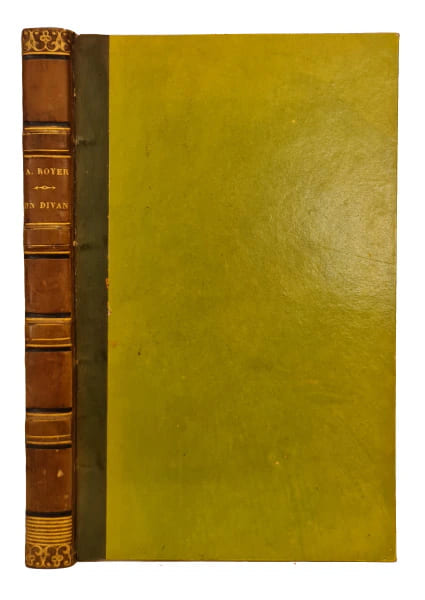
Paris Abel Ledoux 1834 1 vol. Relié in-8, demi-basane glacée olive, dos à nerfs orné de filets dorés et à froid, tranches mouchetées, III + 352 pp. Edition originale. Alphonse Royer (1803-1875) a d'abord séjourné plusieurs années à l'étranger avant de se fixer à Paris et de faire de l'exotisme son thème de prédilection, comme dans ce "divan", présentant sept nouvelles orientales d'élégante facture. Un seul volume a paru sur les deux annoncés en introduction. Charmante reliure de l'époque.
Reference : 48984
Bookseller's contact details
Vignes Online
M. Henri Vignes
La Font Macaire
87120 Eymoutiers
France
05 55 14 44 53
Payment mode


Sale conditions
conformes aux usages de la Librairie ancienne et moderne et, pour l'étranger, aux règlements en matière de paiement. Les prix indiqués sont nets, en euros. Frais de port en sus à la charge du destinataire.
5 book(s) with the same title
N Tours. 1880-1959. crivain et traducteur franais. M.A.S. de Francis de Miomandre . S.l.n.d. 11 pages in-8, L Evolution du Divan . S.l.n.d. 11 pages in-8, L Evolution du Divan .
Francis de Miomandre retrace, avec humour, une brve histoire du divan :Si les vieux dictionnaires dfinissent le divan comme une ... sorte de chaise-longue avec ou sans dossier, qui sert de sige dans certains salons dattente et dans quelques cafs dits cafs-divans ... il y a eu une poque o il sagissait dun meuble essentiellement utilis dans les salles dattente. ...Mais, alors, par quoi tait- il remplac dans le salon ? Eh bien ! justement, par rien. On ignorait le divan. Seuls quelques voyageurs en parlaient comme dune chose quils avaient vue l-bas, en Orient, et qui servait la sieste et aux longues paresses dun peuple dshabitu de toute action, ignorant de nos progrs modernes. Ils navaient pas la moindre ide de lacclimater chez nous. [...] Chez nous, rgnait le canap, ce meuble correct, bien lev, raisonnable, ce meuble fait pour des messieurs et des dames sagement assis, les mains aux genoux, et causant dides gnrales, ou de potins mondains [...]. Il rgna longtemps, il semblait ne devoir jamais tre dtrn. [...] Cependant cette rvolution a eu lieu et plus heureuse que bien dautres sans trouver personne pour regretter le pass. [...] Que de choses, en littrature, en art, en politique, en morale sexpliquent par lavnement du divan, et ne sexpliquent que par elle ! [...] Ce nest point par lOrient mme que nous arrive le divan. Mais par lintermdiaire de la Russie, qui dailleurs est un peu lOrient, bien entendu, mais un Orient moins agressif et comme qui dirait europanis. On se mfie moins. Ce quon refuserait dun tartare on laccepte dun Moscovite. La quantit de divans que lon consomme dans les romans russes est incroyable... Preuve que cest la mme chose dans la vie. Un hros de Pouchkine, de Tourgueniev, de Dostoevski passe une grande partie de son existence rver et bavarder sur un divan. Cest l quil mdite sur la complication de lamour et sur la malfaon de cet univers incomprhensible. Cest l quil reconstruit la socit et Dieu sait ce dont il est capable quand il se lve, pour appliquer ces ides. Cest, somme tout, l quil mne sa vritable vie, qui est la vie intrieure. [...] Il y eut une lutte, assez longue, entre le canap et le divan. Le canap, pour maintenir sa domination dfaillante, se dfendait par maint artifice de mimtisme. Il sapprofondit, stala, devint chaise-longue, pouf, que sais-je ? Ses drisoires efforts ne pouvaient le sauver. Vous enregistrerez ses derniers triomphes dans les romans de Marcel Proust (ou du moins dans cette partie prliminaire qui se passe au temps, jamais perdu, de Charles Swann)... Mais ...le divan sinstalla, dsormais invincible. Il ne se contenta point dtre l. Il lui fallait encore tre seul... et ...il se mit se rpandre. [...] Du salon et du boudoir, il gagna la chambre coucher [...] le cabinet de travail, [...], et jusqu la salle manger, et lantichambre. [...] A force dtre ainsi partout attirant par sa commodit, et en quelque sorte magntique, le divan perdit trs vite sa figure de meuble. Il devint le point central, autour duquel sordonna la dcoration, lamnagement du home entier... Francis de Miomandre obtient le Goncourt en 1908 pour son cinquime livre, Ecrit sur de l'eau. "Comme cette attribution du prix tait inattendue et que personne n'avait lu le livre qui avait t tir cinq cents exemplaires aux ditions de la revue Le Feu de Marseille, les articles que la critique lui consacra furent d'une fantaisie dsarmante. Le Temps, entre autres, affirma gravement qu'il s'agissait d'une tude de mSurs sur les grands paquebots !". Il participe un temps au Club des longues moustaches [1908-1911] groupe littraire informel qui se runit au Caff Florian Venise.


Spécimen du divan (recueil de poésies) de Menoutchehri, poète persan du Ve siècle de l'Hégire (XIe de J.-C.). Texte, traduction et notes par A. de Biberstein Kazimirski
Versailles Imprimerie F. Dax 1876 in-8 demi-basane marine à coins, dos à nerfs muet, couverture imprimée conservée [Rel. moderne], premières gardes refaites
55 pp., [texte français], un f. vierge, 29 pp. disposées à l'orientale [texte farsi], la couverture sert de titre.Édition originale de cette version qui sera réimprimée en 1878 et en 1886. Wojciech Kazimirski de Biberstein (1808-1887) était un orientaliste arabisant d'origine polonaise, auteur d'un dictionnaire bilingue arabe-français et de plusieurs traductions arabe-français, notamment du Coran ; il fut aussi attaché en tant que drogman à la légation de Perse
Trans revue de psychanalyse n°1 automne 1992 - Le divan - Psyché étendue - la couche analogique - à perte de vue - à la recherche de l'enfant perdu - disparêtre - les fakirs du divan - Divan le terrible - interpréter ? - coucher pour soigner la condition
Les impressions au point. 1992. In-8. Broché. Bon état, Couv. convenable, Dos satisfaisant, Intérieur frais. 181 pages.. . . . Classification Dewey : 150-Psychologie
Sommaire : Psyché étendue - la couche analogique - à perte de vue - à la recherche de l'enfant perdu - disparêtre - les fakirs du divan - Divan le terrible - interpréter ? - coucher pour soigner la condition de ma sollicitude - l'envie du divan - le mouvement psychanalytique 1ère partie - le mouvement vers l'autre ou le cheminement de l'incertitude. Classification Dewey : 150-Psychologie
Le Divan N° 92 : Les poètes du Divan. Anthologie des poètes du Divan, précédée d'une étude par Pierre Lièvre.
Couverture souple. Broché. 140 pages. Couverture factice.
Périodique. Le Divan, Septembre-Octobre 1923.
Le Divan (Revue). Mars 1926
Revue n°117, 1926, in-12, br...
Remise de 20% pour toutes commandes supérieures à 200 €

